Section 8.4 Power Models
Power models are swoopy lines and take the form of the equation:
\(y=bx^m\)
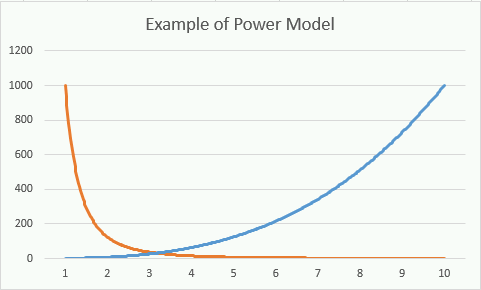
There are a few interesting things to note about power models:
-
When \(m\) is positive, the power model has a value of 0 at \(x=0\)
-
When \(m\) is negative, the power model has a value of \(\infty\) at \(x=0\)
Example of a Power Model- Volume of a Sphere
There are many examples of power models in engineering but perhaps the one that you are the most familiar with might be geometric functions. For example, consider the volume of a sphere.
\(V=\frac{4}{3} \pi r^3\)
in this particular example, \(V\) and \(r\) are the variables and correspond to the volume and radius of the sphere respectively, \(\frac{4}{3} \pi\) is the constant, and \(3\) (the three in the exponent) is the slope. We can see that if we double the radius, we do not double the volume of the sphere, we increase it by 8 times!
If \(r=1\text{,}\) \(V= \frac{4}{3} \pi\)
If \(r=2\text{,}\) \(V= \frac{4}{3} \pi (2^3) = \frac{32}{3} \pi\)
Fun Fact
This is the reason why insects are small and you don’t see human-sized ants running around. Since insects “breathe” by diffusing oxygen through their shell they do not scale up nicely. Technically, it is a little more complicated than just straight diffusion but the fact is, geometry limits their size. If an ant was two times bigger, it would have about 8 times more volume which is much more difficult to diffuse oxygen!

Identifying the units in this equation is a lot easier. We know that \(\pi\) is a dimensionless number, so the only dimensions are on \(V\) (\(L^3\)) and on the other \(r^3\) (\(L*L*L=L^3\)) which checks out.
Other examples of power models in engineering include but are not limited to:
-
Kinetic Energy: \(KE= \frac{1}{2}*m*v^2\)
-
Ideal gas law: \(V= \frac{nRT}{P}\)

