Section 4.6 Derived Units
Just like the dimensions, we can then combine different combinations of units to help us quantify more complex physical dimensions.
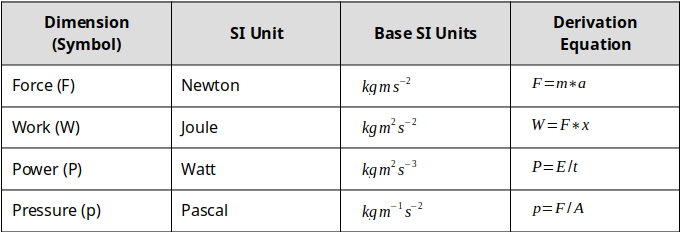
For example, we discussed the concept of force above. We already determined that the dimensions of force are \(MLT^{-2}\text{.}\) Similarly, force has a derived SI unit of Newtons. Remember, unlike dimensions, units are quantities that describe dimensions, and the values attributed to them are arbitrary.
What I mean by arbitrary is let’s consider a different derived unit, the Joule. 1 Joule is defined as the amount of work done moving 1 Newton by 1 meter. That is arbitrary. Why isn’t 1 Joule defined as moving 10 Newtons over 12 meters? Although it seems easier to use the number 1 (it is easier) it doesn’t HAVE to be that way. It just is because that’s what a bunch of french dudes decided. That being said, they did make some great decisions that make calculations and understanding units much easier as we will see.
Remember: Dimensions are universal concepts but units are not. What I mean by that is if we ever meet aliens, they will know what the dimension of length is and what it refers to, but they will have no idea what a meter is.

Some of the derived units are pretty easy. Consider area. Since the base SI unit for length is the meter, and we know that \(area=length*length\), it follows that the SI unit for area is simply \(meter*meter=meters^2\).
There are currently 22 derived units with special names. Click here to see the list. You will notice that almost all of the names are the names of famous scientists and engineers who were involved in the discovery of the scientific concept covered by the unit. A table of the most common derived SI units is shown below.