Section 4.3 Deep Dive Into the Dimensions of Something a Bit More Complex
Now that we have covered some of the simple quantities and your brain muscles are loose, let’s take one more look at dimensions and consider the physical concept of work. Take a minute to watch the following YouTube clip to familiarize yourself with the concept of Work.
So what are the dimensions of work? Let’s logically follow the steps below:
-
From the video we saw that \(Work=Force*Distance\). We already know that distance has dimension of length, but we don’t have any idea about the dimensions of force. That leaves us here: \("Dimension\;of\,Force?"*L\)
-
Well, luckily for us, the video also states that \(Force = Mass * Acceleration\) and we know that mass is a fundamental dimension. So we can then expand our analysis: \(M*"Dimension\,of\,Acceleration?"*L\text{.}\)
-
We are making progress but now we have another unknown dimension, the dimensions of acceleration. But wait! You should have found above in Checkpoint 4.2.3 that has dimensions of \(LT^{-2}\text{.}\) Now we just need to put it all together: \(M*L*T^{-2}*L = M*L^2*T^{-2}\)
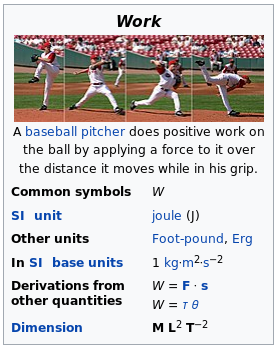
That means our final answer is: \(M*L^2*T^{-2}\text{.}\)
Work can be defined as the transfer of energy, so it turns out the Work and Energy share the same dimensions. That means you also now know the dimensions for Energy as well. Now try and do this on your own by filling in the blanks to Checkpoint 4.3.2 where electric charge has dimensions of electric intensity * time and electric potential is defined as the work done to move a unit of charge.
I tricked you into learning something, surprise! You have just done dimensional analysis! Dimensional analysis is a powerful tool in engineering. It allows us to understand a physical quantity by understanding the underlying fundamental dimensions of the quantity. In fact, if you go to the Wikipedia page for work you will see they list the dimensions of work as part of the summary.