Section 4.10 Converting Units and Conversion Factors
Up until this point, you should have a good grasp of what a dimension is, and what a unit is. We have also discussed a few reasons for unit conversions such as changing magnitude or unit, obtaining the units needed for a derived unit, and another reason may be because we need to switch between the unit systems. Now the question becomes, how can we use all of this knowledge to convert between different units and prefixes? The last piece of the puzzle is going to be conversion factors. If you can’t find the conversion factor you need, google it! We will use conversion factors as a kind of “decoder ring” to help us arrive at the unit of interest. To start, let’s begin with some of the conversion factors for the dimension of Length.
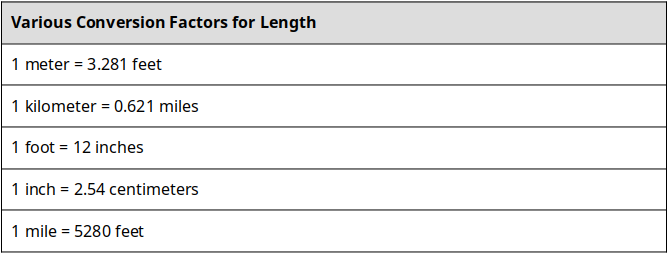
| Quantity | Conversion Factor |
| Mass | 1 slug = 14.59 kg |
| Force | 1 lb = 4.45 N |
There are a couple of things to notice from the table above. First, the conversion factors can be between USCS and metric (e.g. 1 meter = 3.281 feet) or from USCS to USCS (e.g. 1 foot = 12 inches). The reason you don’t see any conversion factors from metric to metric is because we use prefixes instead of different units to describe quantities of different magnitudes.
The way to read the conversion factors is “There are 0.621 miles for every 1 kilometer” or mathematically that can be represented as:
\(1=\frac{0.621\,mi}{1\.km}\)
It is important to note that since \(0.621\,mi=1\,km\) that the ratio \(\frac{0.621\,mi}{1\,km}\) is actually a dimensionless 1. Now, time for a quick math problem…
OK, well that was an easy question but the idea is to get you to consider that the ratio of \(\frac{0.621\,mi}{1\,km}\) is the same as \(\frac{1\,km}{0.621,\mi}\) which is the same as the number 1. We also know that we can multiply any number by 1 without changing the number. OK, so why is this useful? Let’s look at an example to illustrate.
Marathon Example (Converting Length)
Let’s say that we wanted to convert the number of miles in a marathon to kilometers. We know that a marathon is 26.219 miles. We know that our conversion factor tells us that \(0621\,mi =1\,km\text{.}\) Now all we have to do is multiply our original quantity, 26.219 miles by one of the two ratios: \(\frac{0.621\,mi}{1\,km}\) or \(\frac{1\,km}{0.621,\mi}\text{.}\) But which one should we use? The trick is to select the ratio such that the unit that is being converted is eliminated, and the unit we are trying to convert to remains.

If we try the first ratio we get: \(26.219\,mi*\frac{0.621\,mi}{1\,km}=16.282 \frac{mi^2}{km}\) which is clearly a completely meaningless answer. What are the units \(\frac{mi^2}{km}\) and what does that have to do with distance? We acknowledge that technically that answer is correct because the quantity \(\frac{0.621\,mi}{1\,km}\) is just the number 1, but it does not answer our original question.
However, if we try the second ratio we get: \(26.219\,mi*\frac{1\,km}{0.621\,mi}=42.221\,km\) we can see that the unit mi cancels out algebraically and we are left with km for our answer. So therefore we can say that a marathon is 26,219 mi or 42.221 km.
Putting this all together we can come up with…
Steps for converting units:
-
Determine the appropriate conversion factor(s) to be used.
-
Set up a ratio based on the conversion factor that will result in the current unit being eliminated, and the unit of interest being preserved.
-
Perform multiplication and algebra.

