Section 4.2 Dimensions
To summarize what you read in the previous section, a dimension describes the measurement of interest, which in the case above was length. There are no other dimensions necessary nor does it even make sense to think about another “dimension to height”. On the other hand, the unit meter is used to quantify the dimension and there are multiple different units we can use. Some units are more practical than others as we will see later in this chapter. For now, let’s concentrate our mental effort on understanding dimensions.
The Fundamental Dimensions of the Universe
Now that we have an idea of what a dimension is, we can easily list out all of the dimensions needed to describe anything in the universe. Yes, that is a bold statement but it is true. It turns out there are only a few fundamental dimensions of the universe and we can measure every single physical phenomenon you can think of using combinations of these dimensions.
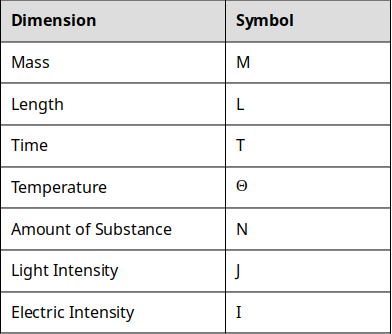
Figure 4.2.1 shows the seven fundamental dimensions and the symbol used to define them. That is it. That is all the dimensions you need to describe everything in the universe.
Hold on a second, you might say. What about something like volume? Isn’t volumea dimension? Well yes, but it is a derived dimension. The dimensions listed above are the fundamental dimensions that we can then combine in different ways to arrive at derived dimensions.
Derived Dimensions
You are already familiar with some of the derived dimensions. For example, it is likely that you already understand that volume is really just \(length*length*length=length^3\). Similarly, you probably already knew that the dimension area is simply \(length*length=length^2\). As we explore more complex concepts in engineering, you can expect the dimensions to get more complex.
A Quick Note on Notation
Now is a good time to put this concept into practice. Before we do, just a quick note on notation. Consider the dimension of velocity. You may have learned in physics class (or will learn) that \(velocity = \frac{distance}{time}\). Now, we remember that distance is really the same thing as the dimension length which is represented by the symbol L. Similarly, Figure 4.2.1 shows that time is represented by the symbol T. Therefore, the dimensions of velocity is \(\frac{L}{T}=LT^{-1}\)
As you can see, all of the ways of writing out the notation are equally as valid. However, the \(LT{-1}\) is the most space efficient and the form that we will be using for the rest of the chapter. If you need a refresher on the math behind this, click here.
Other derived dimensions would include Force, Pressure, density, and acceleration. Use the examples of each physical properties and units to help you answer Checkpoint 4.2.3.
Checkpoint 4.2.3 Dimensions of Physical Quantities.
The dimensions are written in the "negative exponent" notation to indicate division for the sake of saving space.

