Section 4.7 Metric Prefixes
Up until this point, it may seem there is little to no difference between the metric system and USCU (United States Customary Units) and you are right! USCU also has a unit for length (e.g. the inch) and you can also create derived units for area (e.g. the \(inch^2\)). If you live in the United States or are familiar with the USCU you should know that there are actually multiple different units used for length. In the US they are most commonly, the inch, the foot, the yard, and the mile. You should also know that the mile is used for long distances, the yard for intermediate distances, etc. The different units are designed to allow us to talk about different quantities easily. But converting between inches and yards is NOT straightforward.
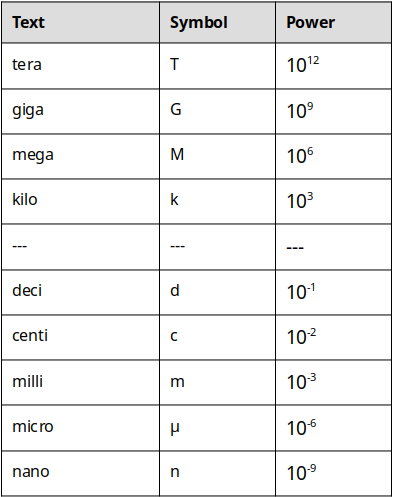
The beauty of the metric system is that it does not have an equivalent confusing structure. There is ONLY the meter for the dimension of length. So what happens when we want to talk about different magnitudes of different quantities? That is where the metric prefixes come into play. The prefixes work by changing the magnitude of the dimension. For example, if we are talking about the height of a person, it is likely that it will be described in numbers of meters. However, if we are talking about the circumference of the earth, we would likely talk about kilometers. In this example, the metric prefix is “kilo” which stands for 1000. So instead of saying the circumference of the earth is 40,000,000 meters we would say that it is 40,000 kilometers. Figure 4.7.1 shows the most common metric prefixes:
Keep in mind that there are more metric prefixes than this. For a complete list, check out this page.
Now we can combine any of the metric prefixes with any of the units to change dimension. For example, let’s consider a blink of an eye.

It takes about 0.3 to 0.4 seconds to blink your eye. We could say that it takes 3 to 4 deciseconds because the prefix “deci” corresponds to \(10^{-1}\text{.}\)
\(0.3\,seconds=3\,deciseconds=3*10^{-1}\,seconds\)
However, no one really talks about deciseconds, so instead, you might say that an eye blink takes 300 to 400 milliseconds. In this case the prefix “milli” corresponds to \(10^{-3}\) so it is still equivalent (see Figure 4.7.1).
Make sure to work out your brain until this concept makes sense to you! You can make up your own problems easily here depending on what you are into. Do you like swimming? How many centimeters are there in a 100 meter swim? You get the idea.
Metric Prefixes and Derived Units
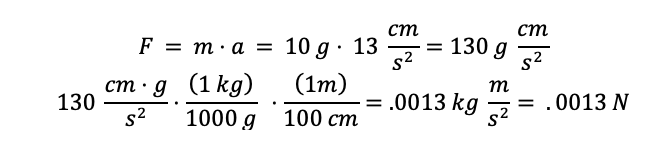
One thing to keep in mind when using derived units is that the metric prefix used to define the unit in Table 3.3 matters. You will note that for example Newton is defined as \(1\, \frac{kg*m}{s^2}\text{.}\) Therefore, if you were solving for the Force and were given units of mass as 10 g and acceleration as \(13\, \frac{cm}{s^2}\) then you would need to convert g to kg and cm to m in order to get a Newton. This is shown in the example below: