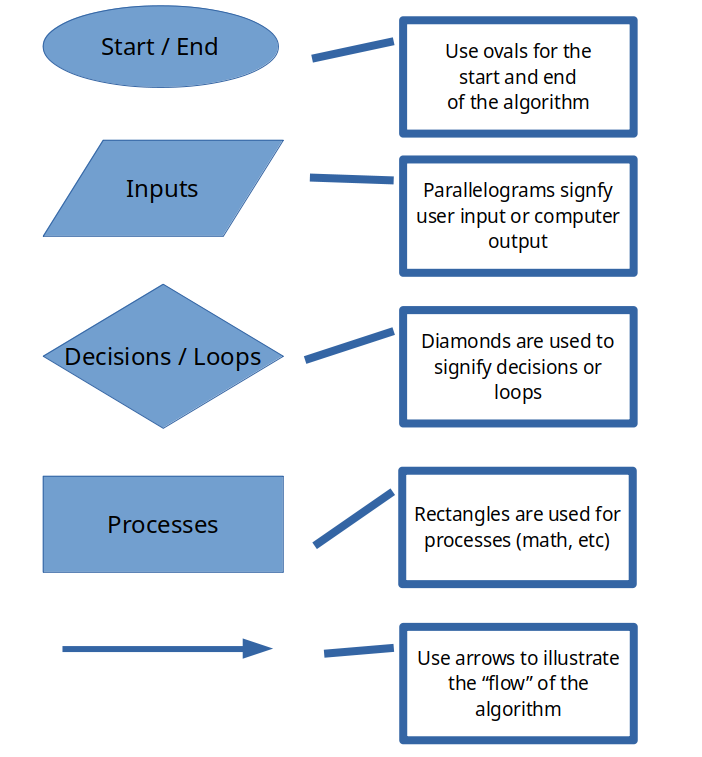
There are probably other ways to communicate algorithms, but for this class, we will only consider two: pseudocode and flowcharts. I highly recommend getting used to both ways of communicating algorithms as they are often most useful when used in conjunction. I have worked at several engineering companies and I can safely affirm that engineers often use both pseudocode and flowcharts in conjunction.
The last thing to note is that there are no rules when it comes to pseudocode or flowcharting there are just guidelines. I once had a student that used to draw elaborate pictures for her “flowcharts”. Elephants meant something I can’t remember, but it was crazy. Her technique worked for her, but it was impossible for anyone else to follow. The guidelines that I will present below are standardized and should be understandable by your professors, tutors, or TAs.
Lucky for us we have already seen examples of pseudocode. Pseudocode is just an implementation of an algorithm in plain English. Writing pseudocode can be helpful because you think about how your algorithm will work before you start to worry about programming it. The only real rule for pseudocode is that it needs to describe the logic of the algorithm so that when you go to translate the algorithm into a computer programming language, it is simply a task of changing English to MATLAB.
Another common way to write down algorithms is using a flowchart. Before we talk about some general rules for flowcharting, look at the flowchart for the 8 am problem shown below in figure 7.5.1. I think the best way to learn about how to flowchart, is to look at a flowchart and discover its logic on your own.
As you can see, flowcharts are nice because they are pictures with arrows which makes it easy to follow along. Just like your pseudocode, in order for flowcharts to be effective, they need to fully describe the logic of the algorithm. Again, that makes copying the algorithm into MATLAB (or whatever programming language) much easier.
The only real rule with flowcharts is that they are useful to you. Honestly, I prefer flowcharting to pseudocode but in my professional life, I use both to help organize my thoughts and force me to think algorithmically. Whichever you decide to use is a matter of personal taste, but all good engineers will use at least one of these techniques.
Think about an algorithm that only you would know (or very few of your classmates), and explain it “algorithmically” as either a flowchart OR pseudo-code. The only requirement is that it should have some decisions to make and should contain no bugs. My suggestion is to avoid recipes, they are kind of boring and aren’t really unique TO YOU. Perhaps you are a gifted gardener and know exactly how to prune apple trees? Are you into repairing cars and know the best procedure to follow to diagnose and replace an alternator? I am willing to bet that there is something that you know how to do that a lot of your classmates would not understand (it doesn’t matter how nerdy or weird it is).
Examples might include choosing what to eat for breakfast, deciding what to wear, planning your day, selecting a parking spot, or organizing your homework.