Section3.5Investigation 1.5: Buttered Side Down Again?
So far, we have looked for evidence in favor of a "greater than" or "less than" alternative hypothesis. But what if our research question is interested in either type of outcome?
The folks at MythBusters, a popular television program on the Discovery Channel, wanted to investigate whether a piece of toast that has been buttered on one side is more likely to land buttered/messy side down or buttered side up. First, they wanted to design a toast-dropping rig that would have no built-in bias for unbuttered toast to land on either side when dropped. For this pilot study, they labeled the sides "top" and "bottom" for ten unbuttered pieces of toast and counted how many landed "top-down."
With 10 pieces of toast, what outcomes for the number of successes would convince you that there was a problem with the rig? Suggest a way of stating the alternative hypothesis that reflects this interest/prior suspicion.
You have now stated a two-sided alternative hypothesis (rather than a "one-sided" alternative of strictly less than or strictly greater than). So now we need to decide which values we will consider "or more extreme" in calculating the p-value.
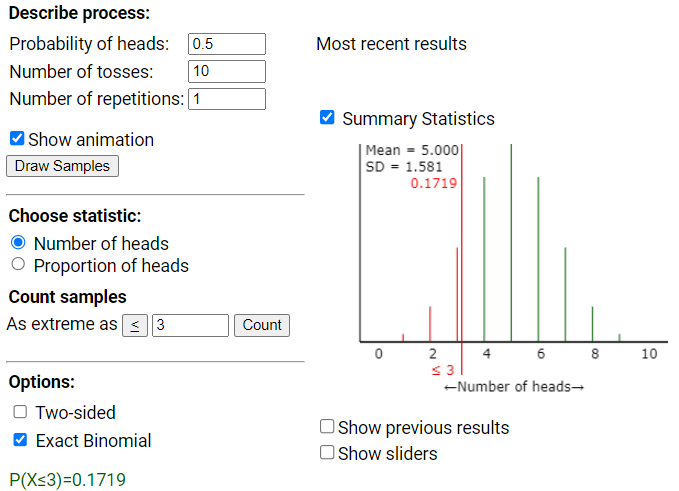
In this pilot study, the toast landed top-down 3 times and top-up 7 times. Use the One Proportion Inference applet to calculate the binomial probability of 3 or fewer successes in 10 attempts, assuming the null hypothesis is true (i.e., P(X ≤ 3) where X is the number landing top-down).
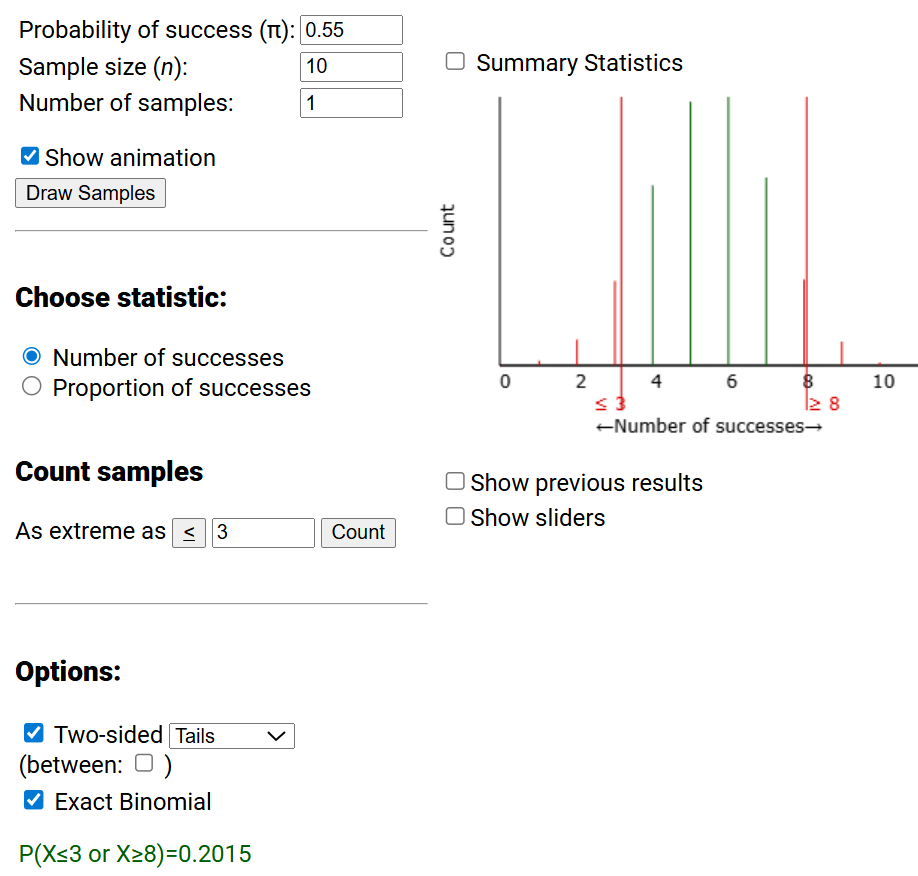
If we calculate the two-sided p-value as P(X ≤ 3) + P(X ≥ 7), what would you report for the p-value? Would you find this p-value to be convincing evidence in favor of the two-sided alternative hypothesis?
In this text, we will consider outcomes "more extreme" than the observed outcome if the "tail probability" is less than or equal to the tail probability of the observed outcome. So for this null hypothesis (\(\pi\) = 0.55), because P(X ≥ 7) > P(X ≤ 3), we would not consider x = 7 to be "more extreme" than x = 3. Therefore, we would not include x = 7 in the p-value calculation. Notice, this distinction arose once our binomial distribution was not symmetric (\(\pi\) ≠ 0.50).
There are other ways to define "more extreme" as well, and results will vary across different software packages (see Practice Problem 1.5). But the results will be more similar the more symmetric the null distribution is, and when the null distribution is skewed, adjusting for the asymmetry is generally preferred to going "the same distance" on each side or doubling the one-sided p-value.
Two-sided p-values are used with two-sided alternative hypotheses (≠, not equal to). A two-sided p-value considers outcomes in both tails that are at least as rare as the observed result, where at least as rare could be defined as having a smaller tail probability of occurring as the observed statistic. If the null distribution is symmetric, the approaches are equivalent and the two-sided p-value will be double the one-sided p-value.
The MythBusters decided a 3/7 split was "way outside a random sample" and so they needed to build a different toast-dropping rig. Do you agree with their conclusion from the pilot study? Write a short paragraph to the MythBusters justifying your answer. Include appropriate numerical evidence to support your argument.
Based on the two-sided p-values, both 0.50 and 0.55 are plausible values for the probability of a piece of toast landing top side down. Because 0.50 is plausible (p-value = 0.3438), these data do not provide convincing evidence that there is a built-in bias with the mechanism and they could have continued to use it.
After building a new rig (that they were more confident had no bias), they used the rig to drop buttered toast from the roof of a building. The Mythbusters weren’t sure whether the toast would land buttered side down (as in the myth) or whether, like a curved leaf falling from a tree, the toast might try to "right itself" and land with the indented side (from being buttered) down. So again, they wanted to use a two-sided alternative hypothesis, allowing for either possibility to be of interest.
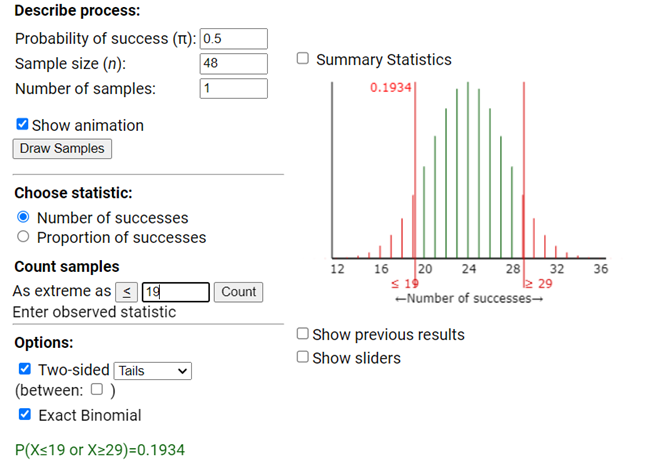
Use the applet to find the two-sided p-value for testing \(H_0\!:\pi = 0.5\) vs. \(H_a\!:\pi \neq 0.50\text{.}\) Do you have strong enough evidence to reject the null hypothesis and conclude \(\pi\) differs from 0.5? Why are you making this decision?
Two-sided binomial test for \(n\) = 48, \(\pi\) = 0.5, observed = 19
The p-value is not small (p-value = 0.1934, which is larger than 0.05), so we fail to reject the null hypothesis that \(\pi\) = 0.50. We conclude it is plausible that buttered toast is equally likely to land up or down when dropped from the top of a building.
These data (19 out of 48) do not provide convincing evidence against the null hypothesis that toast buttered on one side is equally likely to land buttered side up or down (two-sided p-value = 0.1934). In other words, it is plausible that this is a 50/50 process. However, this analysis cannot be used as proof that \(\pi\) = 0.50, as other values could be plausible as well. The sample data allow for many (technically, infinitely many) plausible values of this probability, as you will explore in the next investigation.
Recall that the process we are using to test our hypotheses is to first assume the null hypothesis is true. For this reason, we can never use this process as evidence for the null hypothesis, only lack of evidence against it. Keep in mind the saying "Absence of evidence is not evidence of absence." Also, note that our evidence depends on the form of the alternative hypothesis. A more complete statement is that we do not have evidence in favor of the alternative that we specified, and that our strength of evidence could differ if we started with a different alternative hypothesis.
For the "smallest tail probability" approach, set the pull-down menu to "Tails" (finds tail value on other side that is first below the one-sided p-value)
There are other approaches for calculating the two-sided p-value. For example, we could consider an outcome \(k\) more extreme than the observed, if \(P(X = k) < P(X = observed)\text{.}\)
Return to the pilot study with 3 successes out of \(n\) = 10 drops. Based on this new approach, which values above 5 would you consider more extreme than 3 when \(\pi\) = 0.55? Document your justification. What is the resulting two-sided p-value?
Checkpoint3.5.6Strange Behavior with Extreme Observations.
Suppose \(n\) = 20 and you observed 0 successes. Find the two-sided p-values using the approach suggested in the previous question for \(\pi\) = 0.13, \(\pi\) = 0.145, and \(\pi\) = 0.15. According to the two-sided p-values, which of these values are plausible for \(\pi\) at the 10% level of significance? What strange behavior do you observe?
Or we could choose to use x values that are the same number (or more) of standard deviations above the mean or double the one-sided p-value. Why do you think these methods are not recommended in general?
It’s interesting that the one-sided p-value for the pilot study is also not statistically significant. If it had been, would it be reasonable for the Mythbusters to use the one-sided p-value instead to support their conclusion? Explain.