Section8.2Swarm Intelligence: Emergent Behavior and Simple Rules
Swarm Robotics is a subfield of decentralized multi-robot systems inspired by biological collective behaviors seen in nature—such as ant colonies, bird flocks, and fish schools.
A defining feature of swarm robotics is Emergent Behavior: complex, highly organized group patterns that arise from many individual agents following a small set of simple, local interaction rules without any top-down coordination.
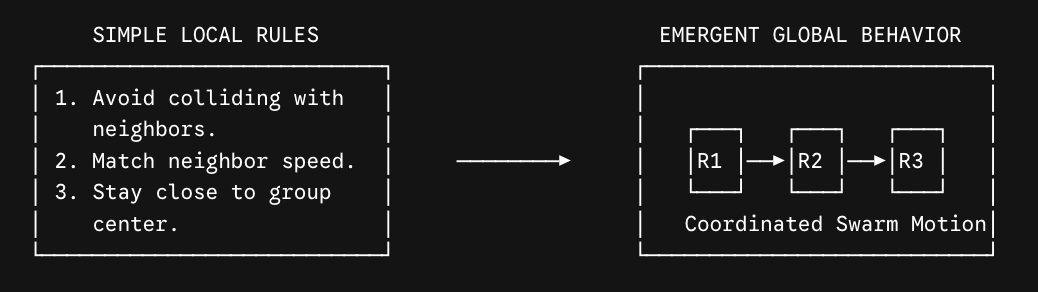
Picture a short list of simple local rules—avoid colliding with neighbors, match neighbor speed, stay close to the group center—handed to every individual robot. No single rule mentions the group’s overall shape or path, yet when every robot follows those same three rules simultaneously, the whole fleet self-organizes into coordinated swarm motion, flowing together like R1, R2, and R3 moving as one connected chain.
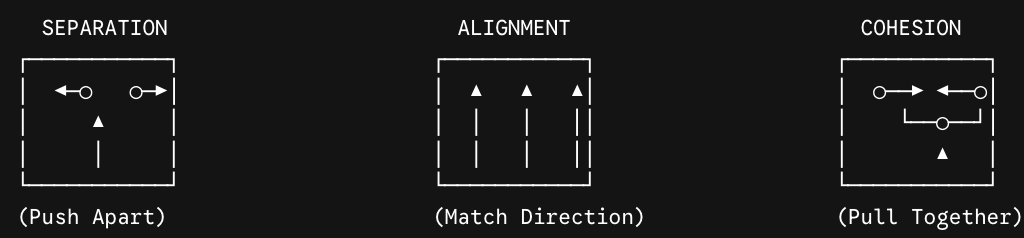
Picture three neighboring robots and how each rule nudges them: under Separation, two robots that drift too close push directly apart from each other; under Alignment, three robots pointed in different directions all rotate to match a shared heading; under Cohesion, robots scattered around empty space steer inward toward their shared center point.
Swarm members often do not talk to each other directly through wireless radios. Instead, they communicate through Stigmergy—modifying the environment to influence the future behavior of other agents.
Biological Example: Ants lay chemical pheromone trails on the ground while foraging. Other ants smell these trails and follow them toward food sources.
Robotic Example: A fleet of vacuum robots drops virtual "cleaned zone" markers on a shared map, signaling to other units that an area requires no further attention.
Real-World Example (Intel & Disney Drone Light Shows): Hundreds of light-emitting quadcopters execute synchronized light shows. While high-level paths are planned beforehand, each drone executes local separation and position-holding behaviors to absorb wind gusts safely without hitting adjacent drones.
VEX Robotics Example (Swarm Foraging Lab): In a multi-robot VEX field lab, multiple VEX robots use distance sensors to roam an arena searching for scattered game objects. When Robot A detects a large cluster of objects, it turns on an onboard LED indicator. Neighboring VEX robots equipped with color/vision sensors detect this light signal and pivot toward Robot A, achieving collective harvesting through visual stigmergy.
Subsubsection8.2.4.1Exercise 8.2.2: Parsons Problem — Flocking Separation Force Calculation
Reorder the Python code blocks below to implement the Separation Rule for a swarm robot, calculating a repulsive vector away from a nearby neighbor if it gets too close.
Arrange the blocks to form a complete function calculate_separation_vector that returns a repulsive push vector away from a neighbor within the safe distance, or a zero vector otherwise.