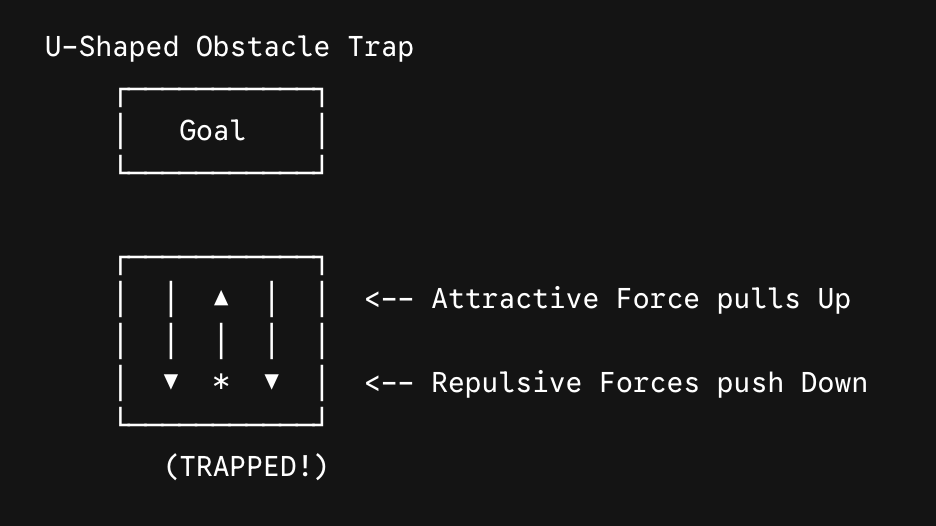
Section4.5Limitations of Reactive Navigation: Local Minima Traps
While reactive navigation methods—such as Finite State Machines and Artificial Potential Fields—are computationally fast and excellent for immediate collision avoidance, they suffer from a major structural limitation: Local Minima (Dead Ends).
A reactive system only looks at immediate sensor readings around its immediate location. Because it lacks a global map or long-term memory of where it has already been, it can easily get tricked by complex spatial geometry, such as concave walls, cul-de-sacs, or U-shaped barriers.
Picture a goal sitting just behind a U-shaped wall. As the robot drives into the pocket of the U, the attractive force keeps pulling it toward the goal on the far side of the wall, while the repulsive forces from the two inner walls of the pocket push back against it from both sides. Once those forces balance, the robot is trapped in the center of the pocket, unable to sense any way out.
Mathematically, a Local Minimum occurs when the vector pulling the robot toward its goal (\(F_{\text{att}}\)) is equal in magnitude and opposite in direction to the repulsive vectors pushing away from surrounding walls (\(F_{\text{rep}}\)):
When the net force drops to zero, the robot enters an equilibrium state where its control logic believes it has nowhere valid to go. The robot will either freeze in place or oscillate endlessly back and forth inside the trap.
Real-World Example (Robotic Vacuums & Lawn Mowers): Early-generation robotic vacuum cleaners used purely reactive sensors. When encountering a U-shaped arrangement of chair legs or a dead-end hallway under a dining table, the vacuum would repeatedly bounce off the legs or spin in circles indefinitely until its battery drained. Modern vacuums solve this by combining reactive cliff/bump sensors with simultaneous mapping systems.
Real-World Example (Planetary Rovers): Mars rovers like Perseverance use reactive hazard avoidance (Hazcam sensors) to steer around large boulders on the fly. However, if a rover encounters a steep, bowl-shaped crater blocking its path toward a scientific waypoint, purely reactive navigation would pull it directly into the center of the crater. NASA’s autonomy software detects this local minimum and hands control over to global pathfinding software to plot a route around the rim of the crater.
VEX Robotics Example (Wall Traps in VEX Arenas): In VEX game fields, scoring zones or mobile goal ladders often create physical corners or concave pocket spaces. If your VEX robot relies solely on distance sensors for reactive navigation while moving toward an autonomous target, driving into a U-shaped pocket will trap the robot: the front sensor pushes backward away from the interior wall while the goal attraction pulls forward. The robot stalls inside the pocket, wasting valuable autonomous match time.
Global Planner (A*): Computes a high-level, obstacle-free topological or grid path across a known map (Chapter 3). This ensures the robot never chooses a path into a closed U-shaped trap in the first place.
Local Controller (FSM / Vector Avoidance): Executes small steering adjustments along that global path in real time, reacting dynamically to dynamic obstacles (like other moving VEX robots) that were not part of the static global map.
A robot using purely reactive obstacle avoidance enters a U-shaped dead-end alley and stops moving because the attraction to the goal behind the wall cancels out the repulsion from the wall ahead. What is the standard hybrid solution to escape this local minimum?