
Section 8.3 Multi-Robot Task Allocation (MRTA) and Fleet Coordination

When multiple robots work together, a fundamental management challenge arises: Which robot should perform which task?
This is known as the Multi-Robot Task Allocation (MRTA) problem.
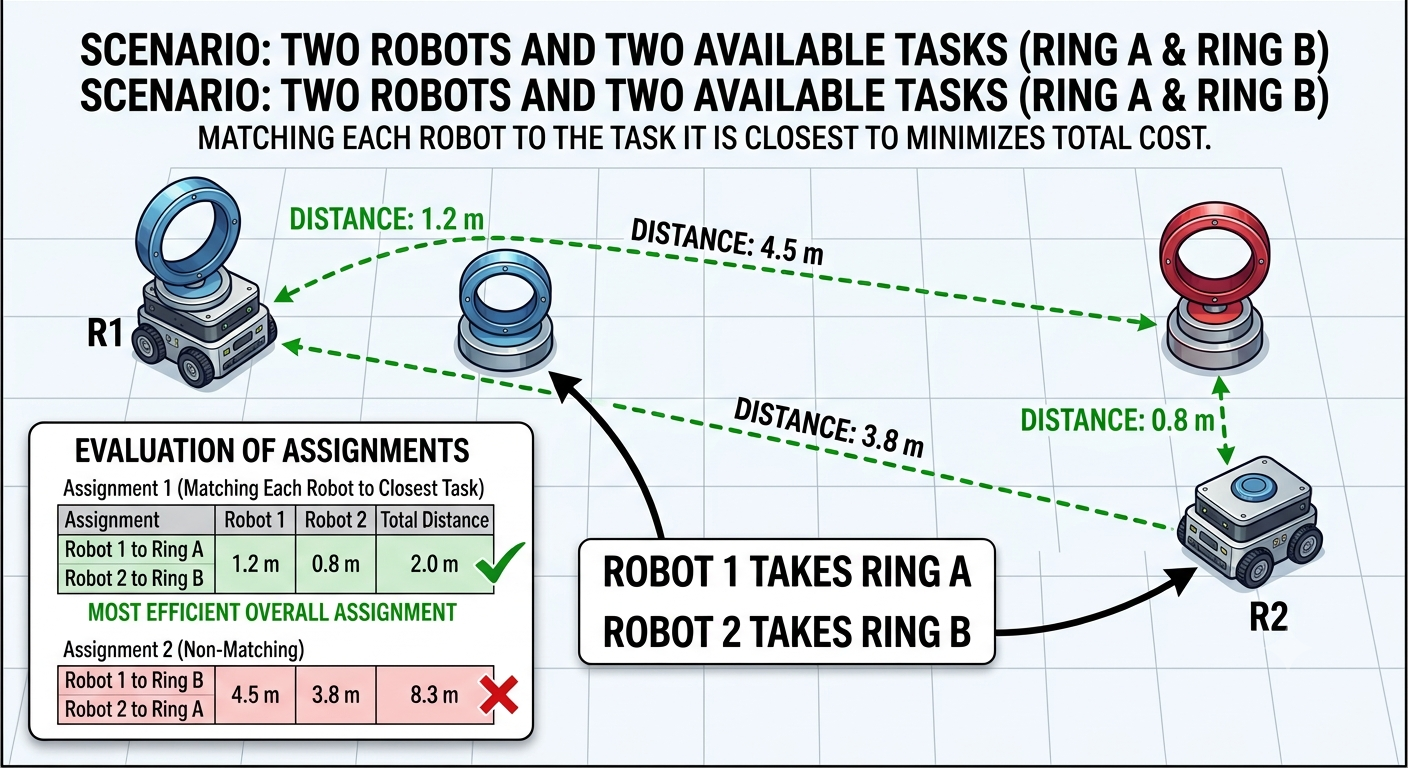
Picture two robots and two available tasks, Pick Ring A and Pick Ring B. Robot 1 sits close to Ring A (1.2 m) but far from Ring B (4.5 m), while Robot 2 sits far from Ring A (3.8 m) but close to Ring B (0.8 m). Matching each robot to the task it is closest to, rather than assigning both robots to the same ring, produces the most efficient overall assignment: Robot 1 takes Ring A, and Robot 2 takes Ring B.
Figure 8.3.1. Assigning each robot to its closest task minimizes the fleet’s total travel cost.

Subsection 8.3.1 Market-Based Auction Protocols

One of the most popular methods for decentralized task allocation is the Market-Based (Auction) Protocol:
  1. Task Announcement: A task (e.g., "Collect game piece at \((x = 2, y = 5)\)") is broadcast to the fleet.
  2. Bidding: Each available robot calculates its Cost/Bid to complete the task based on its current distance, battery level, or tool capability. Lower distance/cost = better bid.
  3. Awarding: The robot with the lowest cost bid wins the contract and claims ownership of the task.
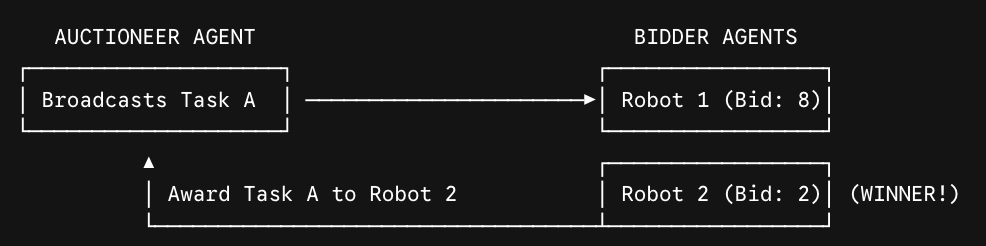
In this scheme, an Auctioneer Agent broadcasts Task A to every Bidder Agent in the fleet. Each bidder replies with its own cost bidβ€”for example, Robot 1 bids 8 and Robot 2 bids 2. Because Robot 2’s bid is lower, the auctioneer awards Task A to Robot 2, the winner.
Figure 8.3.2. An auctioneer awards a task to the bidder offering the lowest execution cost.

Subsection 8.3.2 Traffic Control: Priority-Based Intersection Management

When multiple robots share the same physical floor space, two robots will eventually want to occupy the exact same coordinate at the same time.
To prevent gridlock, multi-robot coordinators use Priority Rules:
  • Fixed Priority: Robots with critical or time-sensitive tasks (e.g., carrying a heavy load or running low on battery) are granted right-of-way.
  • First-Come, First-Served: The first robot to reserve an intersection block claims the space; other robots pause at wait-lines outside the block until it clears.

Subsection 8.3.3 Real-World & VEX Robotics Examples

  • Real-World Example (Autonomous Container Terminals): Port terminals like those in Rotterdam use market auctions to coordinate dozens of Automated Guided Vehicles (AGVs) carrying shipping containers. When a crane unloads a ship, AGVs submit bids based on their current proximity and battery status. The optimal AGV receives the job instantly.
  • VEX Robotics Example (2v2 VEX Alliance Coordination): During two-robot alliance strategy in VEX competitions, one robot might be configured with a mobile goal clamp while its alliance partner has an elevated ring intake. The team allocates tasks dynamically: Robot A handles goal transport (low cost for heavy pushing), while Robot B focuses on scoring rings (low cost for high reach).
Reading Questions 8.3.4 Reading Questions

Check your understanding

1. Exercise 8.3.1: Task Allocation Auction Logic.

Three robots bid on a task located at coordinate \((x = 3.0, y = 0.0)\text{:}\)
  • Robot A is at \((0.0, 0.0)\) β†’ Distance Cost = 3.0
  • Robot B is at \((2.0, 0.0)\) β†’ Distance Cost = 1.0
  • Robot C is at \((8.0, 0.0)\) β†’ Distance Cost = 5.0
Under a standard lowest-cost market auction protocol, which robot is awarded the task?
  • Robot A wins because it submitted its bid first.
  • Incorrect. Auctions evaluate cost bids, not submission timing order.
  • Robot C wins because it has the highest score number.
  • Incorrect. Higher distance costs represent lower efficiency.
  • Robot B wins because it has the lowest execution cost (closest distance).
  • Correct! Robot B has the lowest cost bid (distance of 1.0), making it the most efficient choice to handle the task.
  • Robot A and Robot B split the task in half.
  • Incorrect. Individual tasks are assigned to a single winning bidder.
You have attempted of activities on this page.