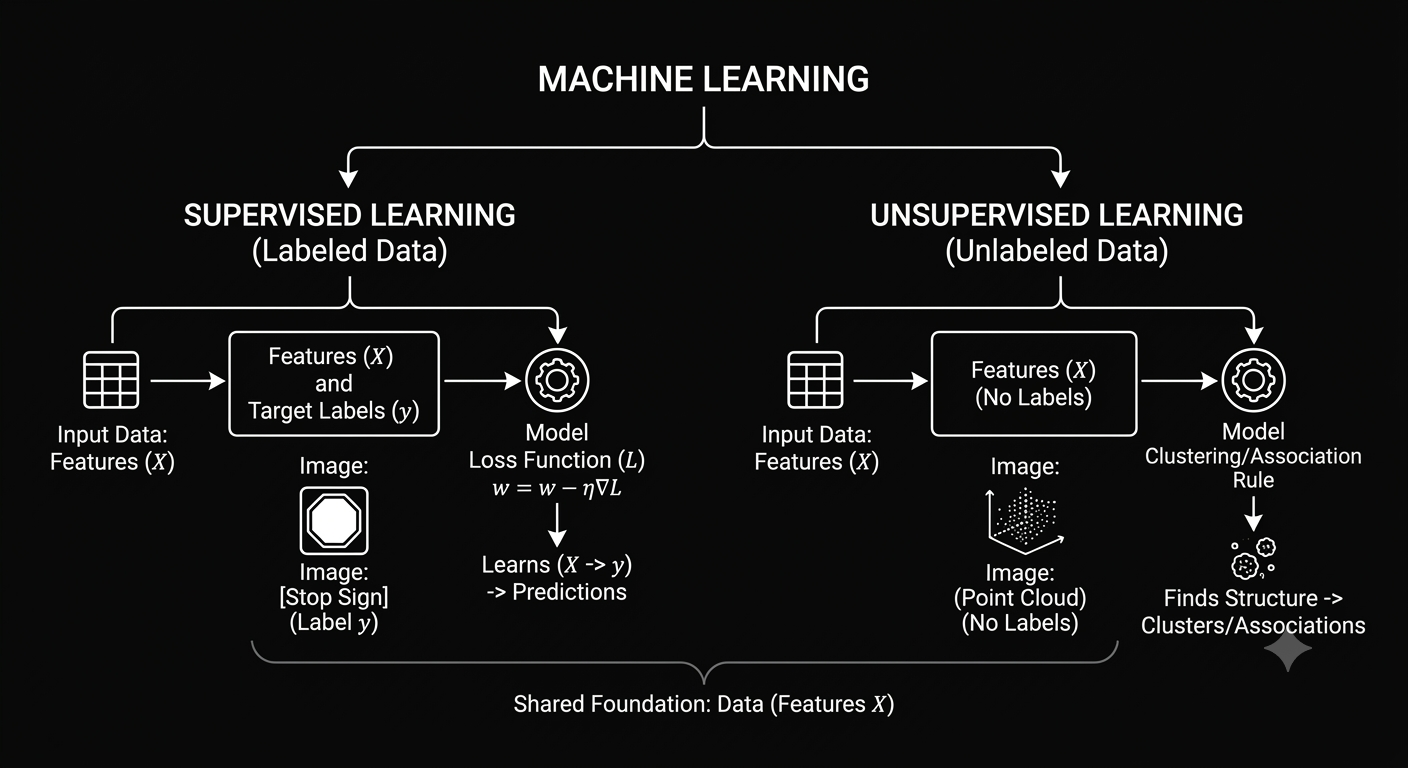
In machine learning, algorithms learn patterns from data, but they differ fundamentally in how they are taught. The two primary paradigms are Supervised Learning and Unsupervised Learning.
Both paradigms start from the same root, Machine Learning, and both begin with a set of Features \((X)\text{.}\) Supervised Learning pairs those features with Target Labels \((y)\)—for example, an image paired with the label "Stop Sign"—and learns from that labeled data. Unsupervised Learning instead works from Features \((X)\) alone, with no labels at all—for example, a point cloud with no ground truth—and must find its own natural clusters within the raw data.
Subsection6.1.1Supervised Learning: Learning with a Teacher
Imagine teaching a child to recognize fruits. You show them an apple and explicitly say, "This is an apple." You show them a banana and say, "This is a banana."
Labels (\(y\)): The ground-truth target category or correct output provided by a human expert or simulation (e.g., "obstacle", "free space", "stop sign").
Now imagine handing a child a box containing mixed LEGO bricks, wooden blocks, and metal screws without telling them what any of the items are. The child might naturally group the items by color, shape, or texture.
In Unsupervised Learning, the dataset contains only Features (\(X\)) with no ground-truth labels (\(y\)). The algorithm analyzes the raw data to discover hidden patterns, groupings, or clusters on its own based on statistical similarity (e.g., \(k\)-Means Clustering).
Subsection6.1.3Why We Rely Heavily on Supervised Learning in Autonomous Robotics
While unsupervised learning is valuable for exploratory data analysis or segmenting unknown environments, supervised learning is the backbone of most practical AI robotics perception systems. Here is why:
Safety & Predictability: Robots interact directly with the real physical world. A self-driving car cannot simply cluster visual blobs together and "guess" what they mean—it needs to know with high confidence whether a shape in front of it is a pedestrian, a plastic bag, or a solid wall. Supervised learning enforces explicit semantic ground truth.
Actionable Decision-Making: Robotic decision pipelines require specific, deterministic categories to trigger state machine actions. A warehouse mobile robot needs a discrete classification output (e.g., "Charging Dock Identified") to initiate a docking maneuver, which unsupervised clustering alone cannot provide without human labeling.
Benchmarking & Validation: In safety-critical robotics engineering, we must quantitatively measure performance before deploying code to physical hardware. Supervised datasets allow developers to calculate exact accuracy metrics (e.g., precision, recall, mean average precision) against verified ground truth.
Supervised Regression is used to predict the continuous 3D coordinate \((x, y, z)\) relative to the robotic end-effector so the mechanical gripper can move to the precise location to pick the fruit.
Subsubsection6.1.5.1Exercise 6.1.3: ActiveCode Exercise — Building a Lightweight Decision Tree Classifier
Note: Because Runestone CodeLens runs pure Python without external libraries like scikit-learn, we implement a lightweight pure-Python Decision Tree structure below to demonstrate supervised decision boundary execution.
Run the code below to see how a trained decision tree uses feature thresholds \((x, y)\) to classify coordinates as either 0 ("Free Space") or 1 ("Obstacle").
1.Exercise 6.1.1: Supervised vs. Unsupervised Learning Conceptual Check.
Why do safety-critical robotic systems (such as autonomous vehicles) rely primarily on supervised learning rather than unsupervised learning for object recognition?
Supervised learning algorithms do not require any computing power to run on embedded hardware.
Incorrect. Supervised learning models still require computation to run inference on embedded hardware.
Supervised learning maps sensory inputs to explicit, human-verified labels (like "pedestrian"), ensuring predictable and safe action triggers.
Correct! Supervised learning enforces explicit semantic ground truth, so the robot knows with high confidence what it is looking at before triggering a safety-critical action.
Unsupervised learning requires camera sensors to be calibrated manually every time the robot boots up.
Incorrect. Sensor calibration is unrelated to whether a learning algorithm is supervised or unsupervised.
Supervised learning automatically generates physical motor torque commands without needing control scripts.
Incorrect. Supervised learning produces predictions (like labels or values); a separate control script still turns those predictions into motor commands.
A mobile robot uses a camera to predict the recommended driving speed (a continuous value between 0.0 m/s and 2.0 m/s) based on lighting and terrain roughness. Which type of supervised machine learning task is this?