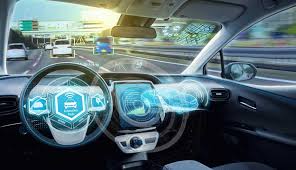
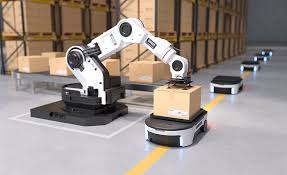
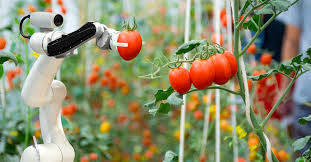
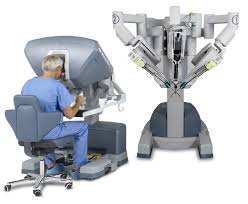
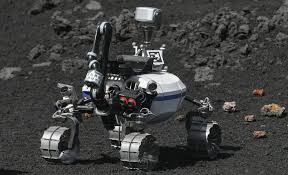
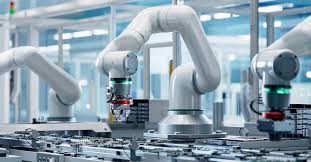
At its core, any autonomous robotic system can be described as a repeating operational cycle called the Sense-Plan-Act paradigm. In many engineering contexts this is also called the Perception-Planning-Control loop. The robot continuously observes the environment, decides what to do next, and executes actions through actuators.
The cycle repeats while the robot operates, and each new action changes the environment that the robot must sense again. This feedback loop is what makes adaptive, autonomous behavior possible in real-world settings.
Across domains, the specific sensors and actuators differ, but the same paradigm appears: sense the environment, plan the next step, and act through control. This common structure helps engineers transfer methods between applications such as driving, warehousing, medicine, and exploration.
Robotics engineering offers several exciting career paths. One option is becoming a robotics engineer, where you design, build, and test robotic systems. These engineers work with mechanical components, sensors, and control systems to create robots that can perform specific tasks in industries such as manufacturing, healthcare, and defense.
Another career is robotics software engineering. In this role, you focus on the programming side of robotics by developing the software that controls how robots move, interact with their environment, and make decisions. Robotics software engineers often work with technologies like artificial intelligence, computer vision, and machine learning to make robots smarter and more capable.
A third option is becoming an automation engineer. Automation engineers use robots and other advanced technologies to improve efficiency in manufacturing and industrial settings. They design and maintain automated systems that help businesses increase productivity, improve quality, and reduce the need for repetitive manual tasks.
All three careers combine problem-solving, technology, and innovation, making robotics engineering a fast-growing and rewarding field for people interested in engineering and computer science.
Wheels and drive motors are actuators used during the Act phase, not sensors.
Cameras and infrared sensors
Correct. The Sense phase relies on sensors to gather environmental data. Cameras and infrared sensors detect physical obstacles and boundaries, whereas wheels, motors, and brushes are actuators (Act phase).
Vacuum brush and suction motor
The vacuum brush and suction motor are actuators that execute cleaning, which belongs to the Act phase.
Charging dock and battery terminals
The charging dock and battery terminals support power management, not environmental sensing.
Shutting down all motors is an extreme Act-phase response, not a planning decision.
Calculate an alternative navigation path that routes around the chair.
Correct. The Plan phase involves decision-making and path generation based on sensor inputs. Upon detecting an obstacle, the system processes the state and determines the safest path around it before sending signals to the motors.
Engage maximum brush rotation speed to clear space.
Increasing brush speed is an actuator command (Act phase) and would not resolve an obstacle in the path.
Send a signal to the infrared sensor to measure distance again.
Re-measuring distance is a Sense-phase action, not a planning decision.
Detecting furniture via ultrasonic pulses is a Sense-phase action.
Building a topological map of the floorplan
Building a map is part of the Plan phase, where the robot organizes sensor data into a usable representation.
Computing the shortest route to the charging station
Computing a route is a planning decision made before any motor commands are issued.
Physically turning wheel motors to steer around obstacles
Correct. The Act phase executes decisions in the physical world through actuators. Steering motor outputs represent mechanical execution, whereas detecting is Sense, and mapping/computing route are Plan.
Fixed plans consume significantly more computing memory than real-time sensing loops.
Memory consumption is not the reason continuous sensing loops are needed.
Sensor readings are only valid for one loop cycle before they are permanently erased.
Sensor readings are not erased between cycles; they are simply updated with new measurements.
Environments are dynamic and unpredictable, so real-time feedback is required to correct errors and avoid dynamic obstacles.
Correct. Real-world environments change continuously (e.g., moving people, pets, altered terrain). Closed-loop feedback ensures the robot adjusts its actions to real-time changes rather than relying on stale assumptions.
Continuous updates prevent the motor drive boards from overheating.
Continuous sensing loops are unrelated to thermal management of motor drive boards.
A robotic vacuum is moving down a hallway when a pet suddenly steps into its path. Which sequence correctly represents the Sense \(\rightarrow\) Plan \(\rightarrow\) Act response for safe navigation around the pet?
Plan: Distance sensor measures a drop in clear path distance.
Act: Logic computes a dynamic path to maintain a 1-meter safety buffer.
This option mislabels each stage: the listed "Sense" action is actually an Act-phase behavior, and the phases are out of order.
Sense: Camera detects a living object moving into the path.
Plan: Software determines a safe bypass route around the pet.
Act: Motor controllers signal left/right drive wheels to turn and execute the bypass.
Correct. The correct sequence flows strictly from gathering sensor data (Sense) to algorithm processing/decision making (Plan) to mechanical execution via actuators (Act).
Sense: Pathfinding algorithm updates coordinates.
Plan: Infrared sensor transmits voltage changes.
Act: Robot saves updated hallway map to storage.
This option scrambles the phases: the listed "Sense" step is actually a Plan-phase computation, and the listed "Act" step is not a physical action at all.