Section8.1Introduction to Multi-Agent Systems and Communication Paradigms
Up to this point, we have treated our robot as a solitary agent working alone in its environment. However, many real-world challenges—such as searching a vast disaster area, managing an automated warehouse, or harvesting an entire agricultural field—are far too large or complex for a single robot to complete efficiently.
A Multi-Agent System (MAS) consists of multiple autonomous robots (agents) that interact, coordinate, and share tasks to achieve individual or collective goals.
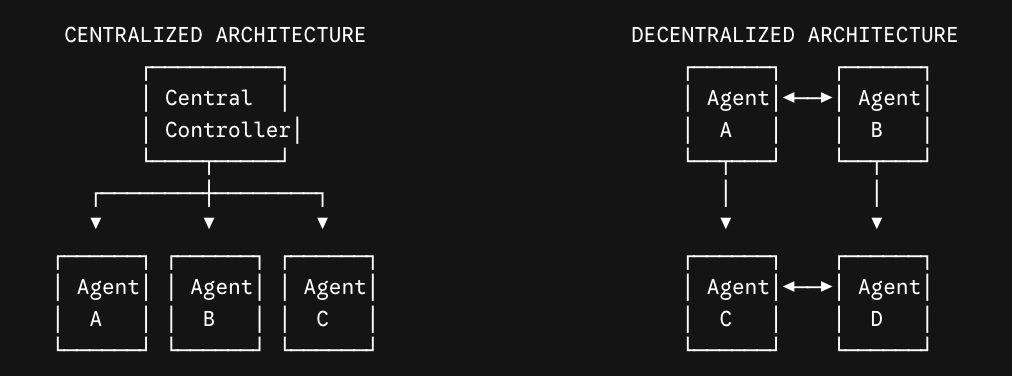
Picture two different ways to organize a fleet of robots. In a Centralized Architecture, a single Central Controller sits above every agent, sending commands down to Agent A, Agent B, and Agent C individually. In a Decentralized Architecture, there is no central controller at all: Agent A talks directly to Agent B, and Agent C talks directly to Agent D, each pair coordinating peer-to-peer.
Figure8.1.1.Centralized coordination routes commands through one controller, while decentralized coordination relies on direct communication among peer agents.
Decentralized (Distributed) Systems: Each robot runs its own decision-making logic locally based on local sensor data and short-range messages from neighboring peers.
Real-World Example (Amazon Fulfillment Warehouses): Hundreds of Kiva drive units move packages across factory floors. A central cloud server assigns tasks and calculates collision-free intersection schedules (Centralized Control). However, if an unexpected obstacle appears, individual drive units use local proximity sensors to stop instantly without waiting for server confirmation (Decentralized Safety Override).
VEX Robotics Example (VEX V5 VEXnet Communication): In VEX AI competitions or multi-robot cooperative labs, VEX V5 Robot Brains communicate wirelessly using VEXnet or custom peer-to-peer radio protocols. Robots share field telemetry—such as target positions or current locations—so one robot can collect game elements while its teammate blocks opponent pathways.
1.Exercise 8.1.1: Control Architectures Conceptual Check.
Why might an engineering team choose a decentralized control architecture over a centralized server when deploying a fleet of 500 search-and-rescue drones?