Section 3.4 Interactive A* Pathfinding ActiveCode
Now let’s bring all these concepts together: grid representation, Manhattan distance heuristics, and tracking path costs \(g(n)\) and \(f(n)\text{.}\)
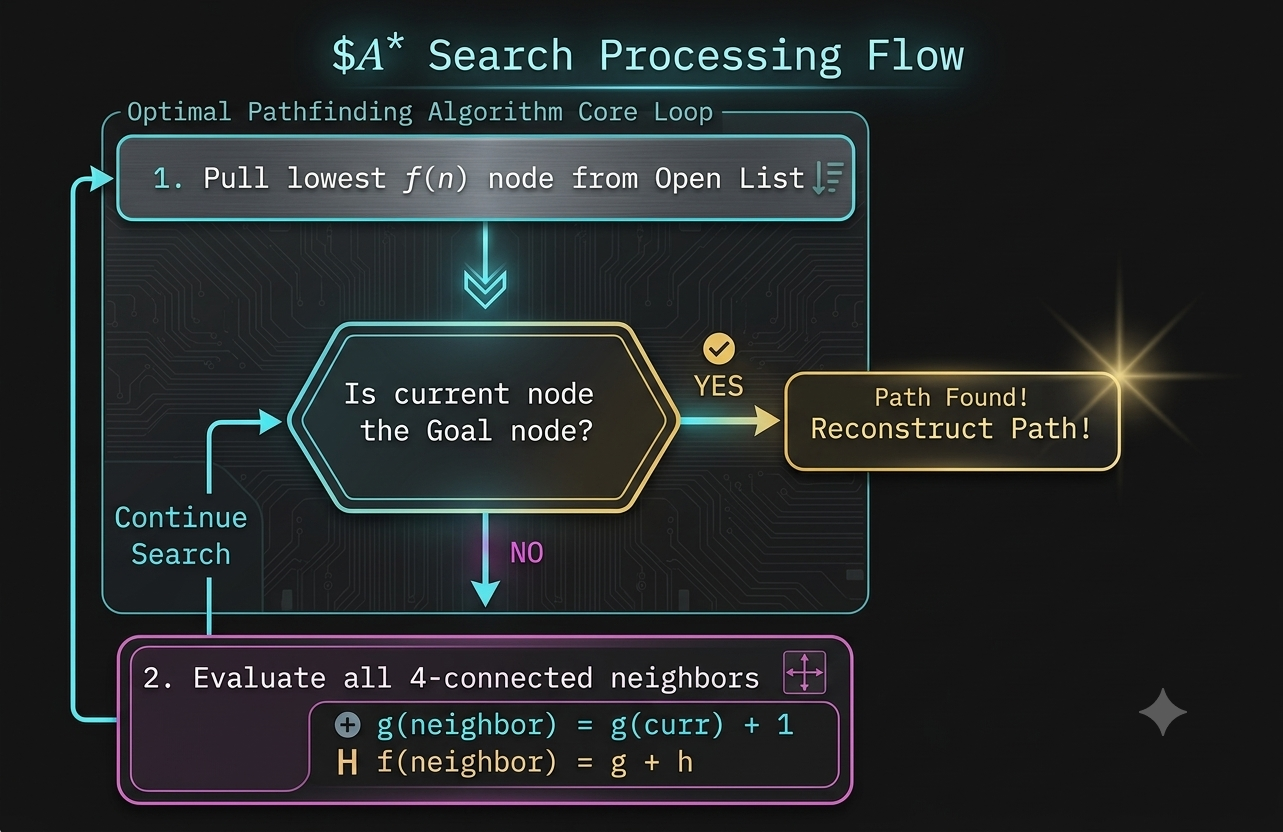
The A* Search Processing Flow repeats a two-step cycle: first, pull the node with the lowest \(f(n)\) score from the open list. If that node is the goal, the path is reconstructed and the search stops. Otherwise, the search evaluates all of that node’s 4-connected neighbors, computing \(g(\text{neighbor}) = g(\text{current}) + 1\) and \(f(\text{neighbor}) = g + h\) for each one, and the cycle repeats by pulling the next lowest-\(f(n)\) node.
Subsection 3.4.1 Section 3.4 Interactive Exercises
Subsubsection 3.4.1.1 Exercise 3.4.1: A* Pathfinding Completion Challenge
Below is a lightweight Python implementation of A* pathfinding on a 2D matrix grid.
Task:
-
Complete the
heuristicfunction to return the Manhattan distance betweencellandgoal. -
Complete the \(f(n)\) cost score update line:
f_score = tentative_g + h_score. -
Run the code to trace the shortest path found around the obstacle wall!
You have attempted of activities on this page.

