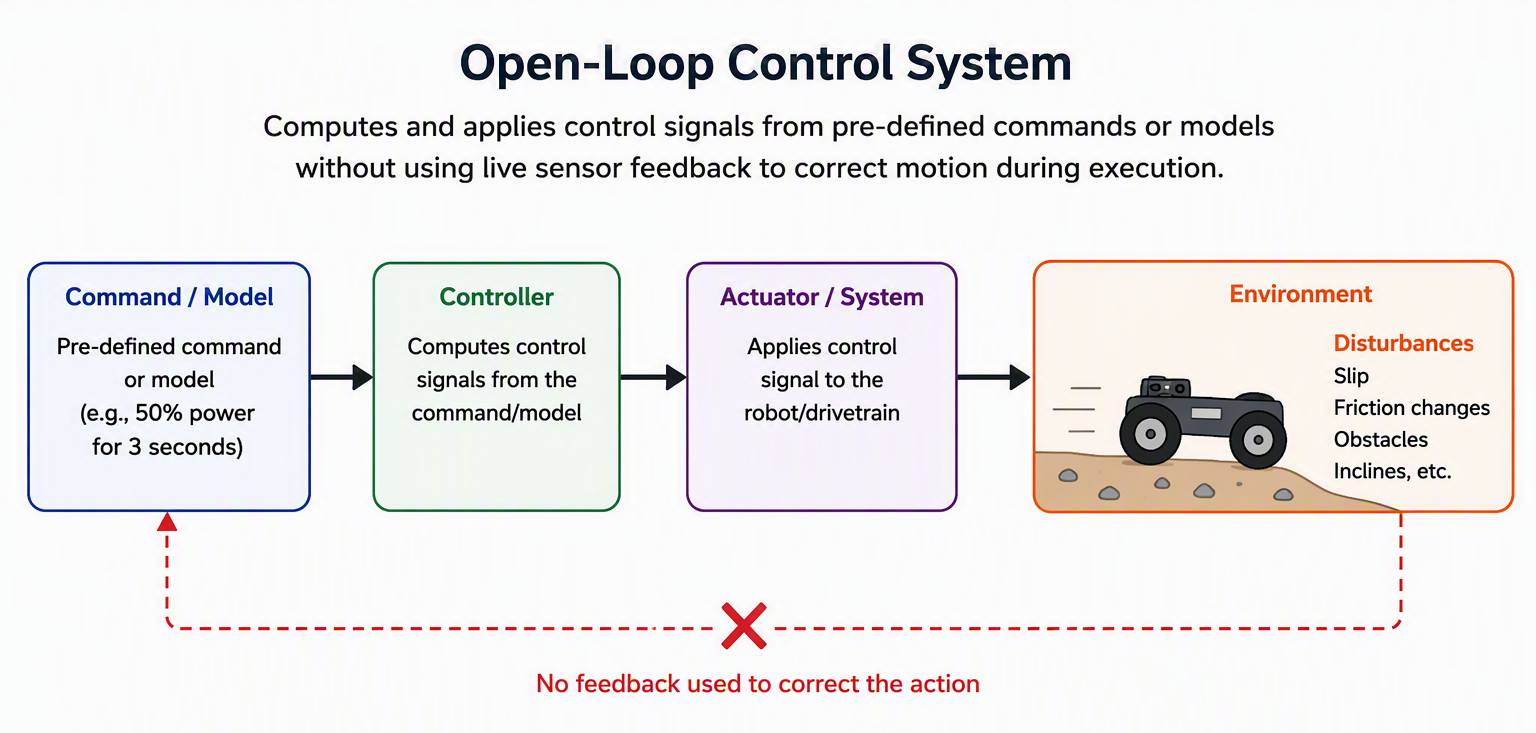
To make robots move reliably, engineers use mathematical control frameworks that connect commands to physical behavior. Two foundational categories are open-loop and closed-loop control. This section introduces open-loop systems and explains where they are useful, where they fail, and why they are still widely used in practice.
An open-loop control system computes and applies control signals from pre-defined commands or models without using live sensor feedback to correct motion during execution. For example, if a drivetrain is commanded to run at 50% power for exactly 3 seconds, it will follow that command regardless of slip, friction changes, or obstacles.
Despite limitations, open-loop control remains common because it is simple, inexpensive, and computationally light. It is often effective when conditions are predictable and tolerance requirements are loose.
A mobile robot is programmed to drive forward at a fixed 80% motor power for exactly 5 seconds. During the run, the drive wheels slip on a slick patch of floor, causing the robot to fall short of its intended target. Which statement best explains why this system failed to reach its target destination?
It is a closed-loop system that failed because the optical encoders calculated an incorrect distance feedback value.
Incorrect. This system is open-loop, not closed-loop — it never reads back an actual distance or position value at all, so there are no encoders to calculate anything, correct or not.
It is an open-loop system that executed a predetermined command without any feedback mechanism to detect or correct for the wheel slip.
Correct. Open-loop systems execute commands based solely on time or fixed inputs without measuring the actual state of the system or environment. Because there was no sensor feedback (such as wheel encoders or GPS) to detect that the robot was moving slower than intended due to wheel slip, the system could not adjust motor output to correct the error.
It is a closed-loop system where the proportional controller gain (\(K_p\)) was set too low to compensate for floor friction.
Incorrect. This system is open-loop, so there is no proportional controller or gain value being applied at all — the motor command never adjusts based on measured error.
It is an open-loop system that automatically adjusted motor voltage to counter the loss of traction, but ran out of execution time.
Incorrect. Open-loop systems do not monitor or adjust motor voltage in response to real-world conditions; they simply execute the pre-set command for the fixed duration regardless of traction loss.