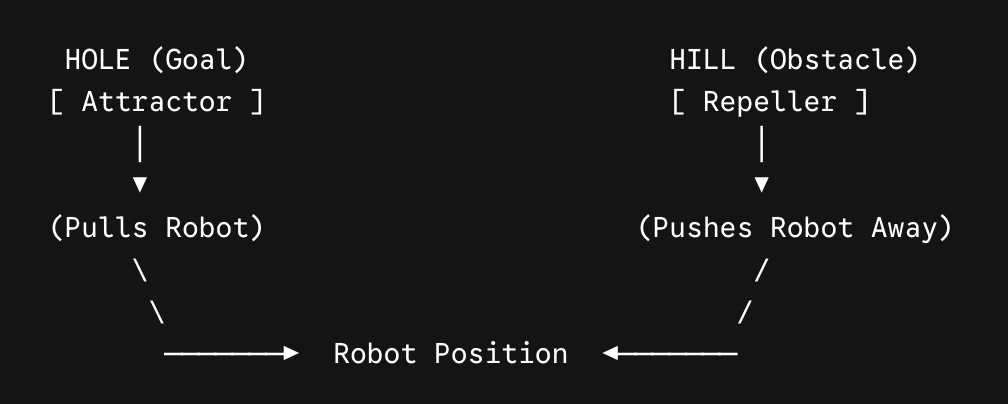
Instead of writing long lists of if/else statements for every possible sensor combination, imagine placing the robot in an imaginary physical landscape:
Picture the goal as a hole in the landscape that pulls the robot downhill toward it, and each obstacle as a hill that pushes the robot away as it climbs closer—the robot’s position sits between them, pulled toward the goal and pushed away from every nearby obstacle at once.
Real-World Example (Autonomous Drones & Marine Ships): Aerial inspection drones and autonomous cargo ships frequently use potential field concepts for local collision avoidance. A drone flying toward a GPS waypoint (attractor) will dynamically calculate repulsive force vectors around high-voltage power lines or crane towers (repellers). The drone smoothly curves around the hazard without ever stopping or losing momentum toward its destination.
Real-World Example (MagLev Train Safety Buffers): High-speed magnetic levitation trains utilize magnetic repulsion principles analogous to potential fields—as the train drifts closer to a track barrier, the opposing physical field strength increases exponentially, naturally pushing the vehicle back toward the center of the lane.
VEX Robotics Example (AI Vision Target Tracking with Obstacle Safety): In VEX games involving game elements (like collecting rings or balls), you can set the game element detected by a VEX AI Vision Sensor as an attractive target. Concurrently, signals from ultrasonic or distance sensors measuring nearby field barriers or opponent chassis generate repulsive forces. The VEX drivetrain continuously computes the vector sum to glide directly toward scoring objects while smoothly veering away from collisions.
The robot calculates the overall net force vector \(F_{\text{total}}\) by superimposing (adding together) the attractive force vector and all surrounding repulsive force vectors:
The robot’s onboard controller then translates \(F_{\text{total}}\) into wheel speed adjustments: steering the chassis toward the direction of the combined vector while scaling drive speed proportionally to the vector’s magnitude.
Incorrect. The forces will not cancel out perfectly because of the Northward component.
The robot will drive directly into the obstacle.
Incorrect. The repulsive force pushes the robot away from the obstacle.
The robot will veer sideways to bypass the obstacle while continuing toward the goal.
Correct! Combining the Eastward goal pull with the Northward repulsive push produces a diagonal northeast vector, causing the robot to gently steer around the obstacle.
The robot will teleport to the goal position.
Incorrect. Physical motion updates are vector-driven, not instantaneous teleportation.