Now that you understand the high-level ROS 2 architecture and graph concepts from Chapter 9, it is time to write code that makes robots move and react.
In this chapter, we will focus on the most fundamental communication dynamic in robotics: the Publisher/Subscriber (Pub/Sub) pattern. We will explore how nodes communicate asynchronously, how to construct publishers and subscribers in Python using rclpy, how callback functions process data streams, and how to control simulations like TurtleSim.
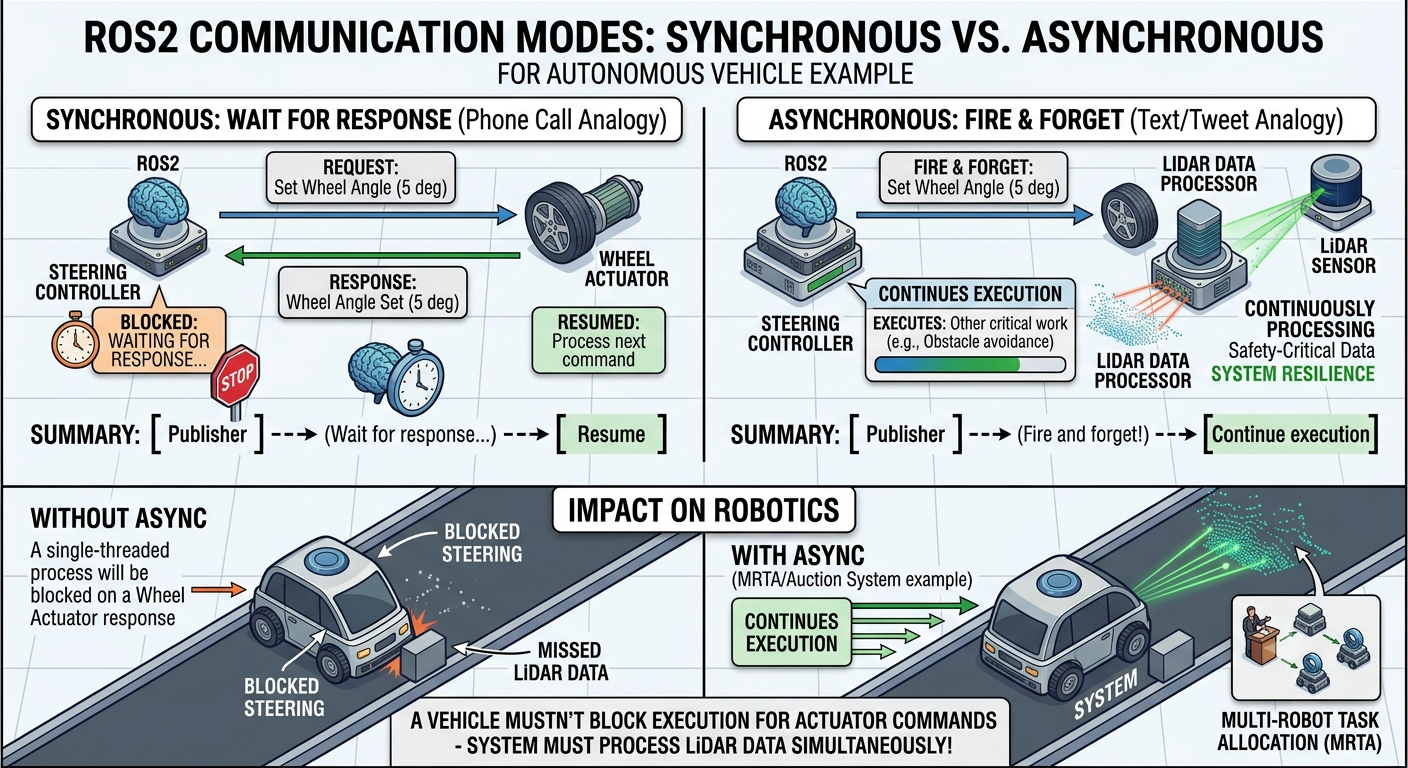
Synchronous: A process sends a request and blocks (stops and waits) until it gets a response before moving on. Think of a phone call—you ask a question and wait on the line until the other person answers.
Asynchronous: A process broadcasts data or sets up a listener, then immediately continues executing its own work without waiting. Think of sending a text message or posting a tweet—you post the information and go about your day. When someone replies, your phone alerts you.
In a synchronous exchange, a Publisher sends data and then waits for a response before resuming. In an asynchronous exchange, the Publisher instead fires the data off and immediately continues its own execution, with no waiting involved at all.
Robotics systems rely heavily on asynchronous communication. If an autonomous vehicle’s steering controller had to pause and block execution every time it sent a wheel command, the robot couldn’t process safety-critical LiDAR data simultaneously!
Figure10.1.1.Asynchronous communication lets a robot continue processing safety-critical sensor data instead of blocking while it waits for an actuator response.
Asynchronous communication guarantees that no messages will ever be lost over Wi-Fi.
Incorrect. Asynchronous communication does not guarantee delivery over an unreliable network; it simply avoids blocking execution while waiting.
Asynchronous communication allows nodes to publish and process sensor data concurrently without stalling execution.
Correct! Because a publisher does not wait for a response, it can keep publishing new sensor readings while subscribers process earlier messages at their own pace.
Asynchronous communication eliminates the need to specify topic message types.
Incorrect. Every ROS 2 topic still requires a defined message type, whether communication is synchronous or asynchronous.
Synchronous communication consumes less memory than asynchronous communication.
Incorrect. Memory usage is not the deciding factor; the key difference is whether execution blocks while waiting for a response.