
Section 5.2 Landmarks, Range Sensors, and Feature-Based Mapping

To combat encoder drift, robots must continuously look out at external landmarks in their environment using range sensors (e.g., LiDAR, Ultrasonic, or Vision sensors).
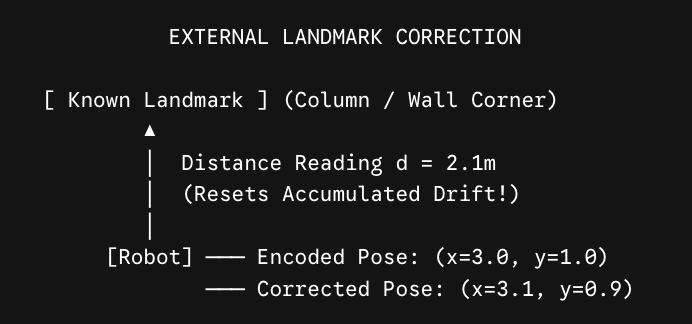
Picture a robot whose wheel encoders currently report a pose of \((x=3.0, y=1.0)\text{.}\) It detects a known landmark, a column or wall corner, at a distance reading of \(d = 2.1\) meters. Because the landmark’s true position is already known, this single reading resets the accumulated drift and corrects the robot’s pose to \((x=3.1, y=0.9)\)β€”independent of however much error had built up in the encoders beforehand.
Figure 5.2.1. A range measurement to a known landmark corrects the robot’s encoder-based pose estimate and reduces accumulated drift.

Subsection 5.2.1 What is a Landmark?

A Landmark is a distinct, easily recognizable feature in the physical environment. Landmarks can be:
  • Artificial Landmarks: Specially designed markers placed in the environment, such as AprilTags, QR codes, or reflective VEX vision targets.
  • Natural Landmarks: Permanent structural features already present in the room, such as wall corners, pillars, doorframes, or distinct furniture edges.

Subsection 5.2.2 Feature-Based Mapping vs. Occupancy Grids

In Chapter 3, we studied Occupancy Grid Maps, which divide space into a fixed grid of cells. In contrast, Feature-Based Mapping represents the world as a geometric list of discrete landmark coordinates:
\begin{equation*} \text{Map } M = \{L_1(x_1, y_1), L_2(x_2, y_2), \ldots, L_n(x_n, y_n)\} \end{equation*}
Instead of storing thousands of empty or full grid cells, the robot only maintains the positions of high-confidence landmark features, significantly reducing computational memory usage.

Subsection 5.2.3 Real-World & VEX Robotics Examples

  • Real-World Example (Self-Driving Cars & LiDAR Mapping): Self-driving vehicles match live LiDAR point clouds against pre-mapped 3D features (such as retroreflective highway signs and traffic light poles). When the car’s wheel odometry drifts slightly, detecting a known landmark immediately recalibrates the car’s position back to millimeter precision.
  • Real-World Example (Vacuum Robots & Optical Ceiling Tracking): High-end robotic vacuums feature upward-pointing optical cameras that track distinct feature points on household ceilings (light fixtures, structural beams) to correct floor wheel drift.
  • VEX Robotics Example (VEX AI Vision & AprilTag Tracking): A VEX robot equipped with a VEX AI Vision Sensor can identify known colored game elements or AprilTags posted on field walls. When the robot detects an AprilTag at a known position \((x_{\text{tag}}, y_{\text{tag}})\text{,}\) it calculates its distance and angle to that tag, instantly resetting any accumulated wheel encoder drift before making a turn.

Subsection 5.2.4 Section 5.2 Interactive Exercises

Subsubsection 5.2.4.1 Exercise 5.2.2: Parsons Problem β€” Feature Map Lookup Function

Reorder the Python code blocks below to construct a function that searches a feature map and finds the nearest landmark to a robot’s estimated position.
Checkpoint 5.2.2.

Arrange the blocks to form a complete function find_nearest_landmark that returns the closest landmark ID and distance from a robot’s position.

Reading Questions 5.2.5 Reading Questions

Check your understanding

1. Exercise 5.2.1: Landmark Selection Conceptual Check.

Which of the following objects serves as the most effective natural landmark for a mobile robot’s feature map?
  • A moving human walking through a hallway.
  • Incorrect. Moving humans shift position constantly and cannot serve as fixed spatial references.
  • A stationary, distinct vertical support column in a warehouse.
  • Correct! Stationary, permanent structural features provide reliable, repeatable reference coordinates for map creation and drift correction.
  • A pile of small cardboard boxes that are periodically re-stacked.
  • Incorrect. Frequently moved objects lead to inconsistent map representations.
  • A rolling office chair on wheels.
  • Incorrect. Mobile items on wheels shift position and corrupt map accuracy.
You have attempted of activities on this page.