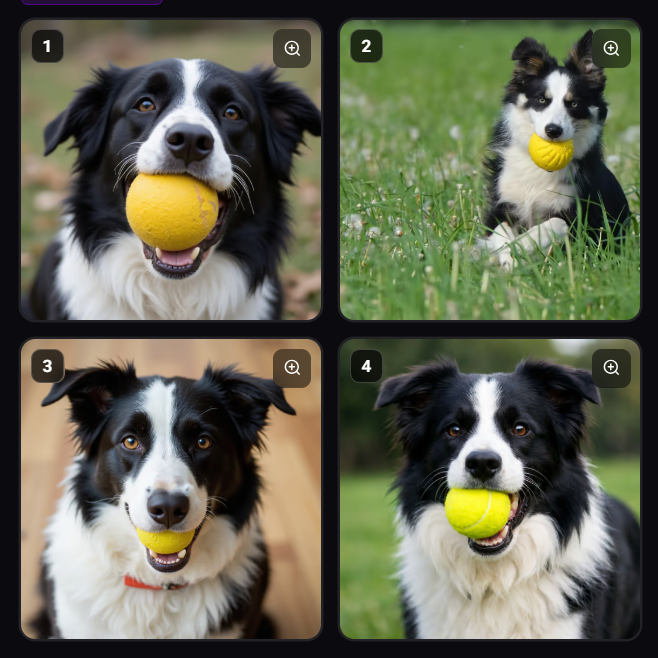
Artificial Intelligence (AI) is becoming a big part of our lives and changing the way we work and learn. AI is a branch of computer science with the goal of building smarter machines to do tasks that typically require human intelligence. Watch the following video to learn more about the impacts of AI on society. In this lesson, we will learn about the importance of responsible AI use and human decision-making.
Artificial intelligence (AI) systems are trained on large amounts of data to learn patterns and make predictions. Try Google Quick Draw. The Quick Draw AI is trained on millions of drawings from people around the world to recognize and predict what you are drawing. Take a look at the data it uses. The following video introduces Quick Draw.
The AI may recognize armadillos more accurately than cats.
No. With far fewer examples of armadillos, the AI is less likely to recognize them accurately.
The AI may recognize cats more accurately than armadillos.
Correct! AI systems generally perform better on categories that have more representative training data because they have learned more patterns from those examples.
The AI may recognize both equally well.
No. The amount and quality of training data can affect how accurately an AI recognizes different categories.
The AI may not recognize either animal.
No. The AI will still make a prediction, although it may be less accurate for objects with fewer training examples.
A streaming service that recommends movies or TV shows based on what you have watched before.
Correct! Recommendation systems often use AI to predict what users are likely to enjoy.
An online store that suggests products you might want to buy based on your browsing or purchase history.
Correct! AI is commonly used to make personalized shopping recommendations.
A calculator that does mathematical calculations.
Not quite. A basic calculator follows predefined mathematical rules and does not use AI to make predictions or recommendations.
A simple photo-sharing app that allows you to post photos to share with friends.
Not quite. A simple photo-sharing app doesn’t use AI to make predictions or recommendations, but more complex ones may use AI for features like facial recognition or content suggestions.
A social-media app that shows you posts based on your interests.
Correct! Social media platforms use AI to personalize content feeds learning from your preferences and behavior.
Google Quick Draw is trained on drawings submitted by people from around the world. Which objects are most likely to be drawn differently depending on a person’s culture or where they live? These human factors affect the training data and can influence how well the AI recognizes different objects.
Correct! Houses can have different shapes, roofs, building materials, and styles in different parts of the world.
squares
No, most people draw a square as a simple geometric shape, regardless of their culture or location.
school buses
Correct! School buses look very different across countries. For example, the familiar yellow school bus is common in the United States but not in many other places.
apples
Not quite. Although apples come in different varieties, people around the world generally draw them in similar ways.
hats
Correct! Hats can vary significantly in style, color, and design across different cultures and regions.
Machine Learning (ML) is a type of AI that learns patterns from data. Machine learning has become so successful that AI has become another term for machine learning, even though AI is a broader field. Watch the following video to learn more about machine learning.
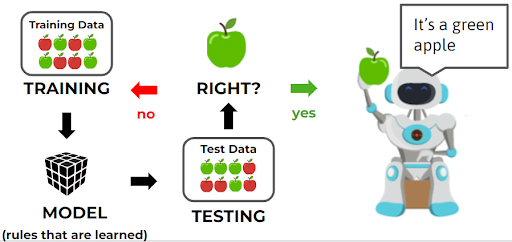
Take a look at the following diagram showing how an AI learns to recognize green apples by looking at many examples of apples that are labeled as green or not green. The set of patterns or rules that an AI learns is called the model. The model becomes more accurate as it is trained on more examples. Machine learning involves training and testing with data until the model is accurate enough for the task. Once we have a good model, we can use it to make predictions about new, unseen apples. The new apple is an input to the model, and the model produces an output that predicts whether the apple is green or not.

For example, self-driving cars use AI models to recognize objects on the road and make decisions about how to drive. What objects do you see below that a self-driving car would need to recognize?
In this project, you will use Google’s Teachable Machine which makes it easy to train AI models without writing code. Watch the following video introducing Teachable Machine. You can train a model to recognize images, sounds, or poses. The model learns patterns from the examples you provide and can then make predictions about new inputs.
If you have a webcam on your computer, try Image Project or Pose Project. You can also try the Image Project if you can download images on your computer, for example you could download this folder of cat and dog images. If you do not have a webcam or cannot download images, try the Audio Project which can use your computer’s microphone to record sounds.
Categories: Teachable machine will learn to recognize two different categories of input. Decide which two categories you want to use. For example, you could train a model to recognize cats and dogs, or happy and sad faces, or pointing up and down or clapping and snapping sounds. Click on the pencil icon next to Class 1 and type in your first category and do the same for Class 2.
Data: Watch this short gather video on how to input your data. You will use your webcam or microphone or upload images to record at least 20 examples of your two categories.
Train: Once you have collected at least 20 examples for each category, click on the "Train" button to train your model. Watch this train video for more information.
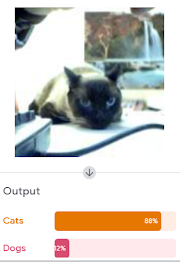
Test: After training, you can test your model in the Preview area. Upload or record a new sample and see what your model predicts! You should use examples that are not in your training data and are difficult to guess. Under the uploaded sample, the model will tell you the percentage of confidence it has in its prediction of the category. For example, the model below thinks this image is a cat with 88% confidence. Did your model get it right? If not upload more training data and train again.
Reflection: Answer the following questions below. What categories did you choose? After training, how accurate was your model in the preview area and what kind of examples did it have difficulty with? How did your decisions about the categories and training data affect the model’s accuracy and fairness?
The teachable machine does not require very many examples to learn your categories because it uses a technique called transfer learning, where it starts with a pre-trained model that is trained on the Imagenet dataset of millions of images with labels for 1000+ different classes which it then just tweaks to customize for your categories. However, the quality of data is crucial for a model’s accuracy. There is a saying of "Garbage in, garbage out", where you cannot expect good results if you feed the model incomplete or biased data. There is also the danger of machine learning algorithms learning the wrong or unexpected things from the data, because that is not something we can control.
ChatGPT was publicly released by OpenAI in late 2022 and quickly went viral, attracting 1 million users within five days. Most people were not aware of AI before ChatGPT (GPT stands for Generative Pre-trained Transformer). This was a major turning point for AI technology and adoption. The Generative AI breakthrough was possible due to the massive growth of data available on the Internet for training, new machine learning algorithms, and the increase in processing power to run the algorithms and store the resulting model. ChatGPT, and others that followed like CoPilot, Claude, and Gemini, are examples of Generative AI (Gen AI) which is a type of AI trained on large amounts of data (most of the Internet) to create a large language model (LLM) that can generate content such as text or code in many languages. The same technology can be used to generate images, audio, and recently even some video content.
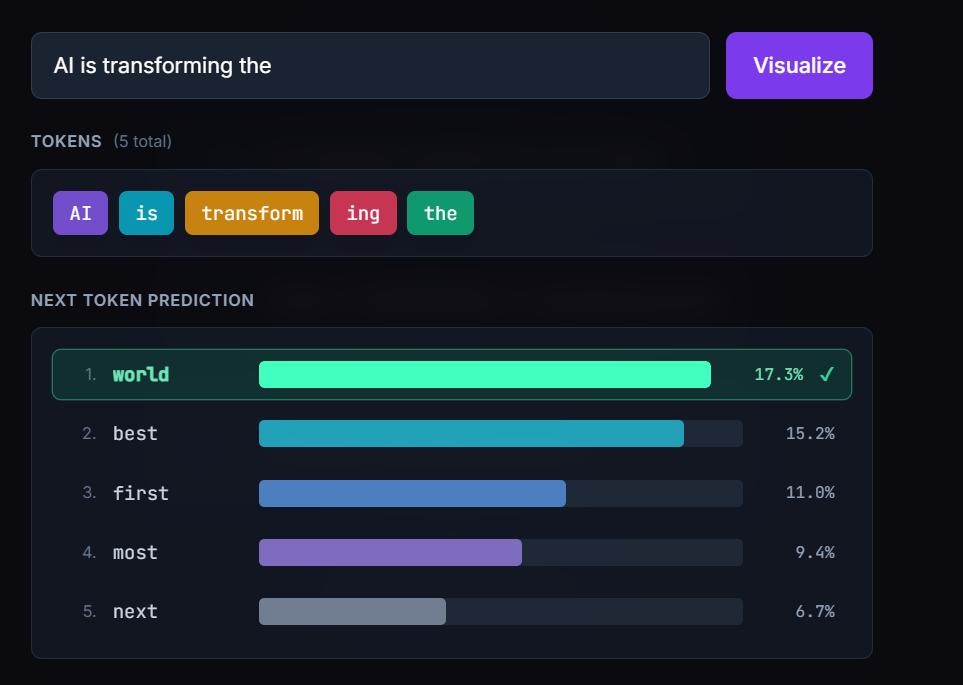
Go to the How LLMs work website and scroll down through the tutorial. LLMs are like the autocomplete feature on your phone texting apps, but much better. They predict the next word or token based on the context and their training with a vast amount of data. For example, how would you finish the sentence "AI is transforming the ..."? Did you pick the same next word as the LLM below?
It is important to remember that Generative AI is a fairly new technology; it is not perfect and can make mistakes. Common errors include hallucinations where the AI confidently invents fake information or sources often due to lack of accurate information in its training data. This is more likely to happen with languages or topics that are less common in the training data. Gen AI can also produce biased information if its training data is biased. It can also generate repetitive or long-winded text or struggle with arithmetic or complex logic. Users of Gen AI must critically evaluate the output and not blindly trust it, especially if it is being used for important decisions.
No, because AI-generated content is always copyrighted.
Not necessarily. Copyright and licensing rules depend on the terms of use of the AI tool. Currently only human-created content is protected by copyright law, but some AI tools may have licensing or attribution requirements.
Yes, because AI tools always provide original work.
No, AI-generated content is not guaranteed to be completely original because it is based on existing work by humans and the AI tool you use may have licensing or attribution requirements.
No, some content may require permission or credit before it is shared.
Correct! When using AI-generated content, people should consider check whether the AI tool requires a license or attribution, and whether the place where it is being shared has any rules about using AI-generated content.
Yes, attribution is only required for printed books.
Incorrect. Attribution requirements can apply to many types of content, not just printed books.
AI tools can generate images and other media that are difficult to distinguish from real content. These are often called deepfakes. Deepfakes can be used for entertainment, but they can also be used to spread misinformation or create content that is harmful or misleading.
Visit the Which One Is Real website and play one round of the Mixed or Images or Videos quiz. Try these together with a partner or a group. This could be a good POGIL group activity (What is POGIL, POGIL Role Cards).
Model drift means that the model’s performance has degraded over time due to changes in the real-world data. Modern AI systems have to be continuosly retrained on current news and events or have to retrieve that information from the Internet while answering prompts.
An AI model predicts traffic patterns for a city. After several new highways are built, the model’s predictions become much less accurate. What is the best explanation and the most appropriate action to fix this issue?
The model has experienced model drift, so humans should update the training data and retrain the model.
Correct! Model drift occurs when changes in real-world conditions reduce a model’s accuracy. Humans should monitor AI systems and update or retrain them when drift is detected.
The model has become corrupted, so it can no longer be used.
No, the decrease in accuracy is due to changes in real-world conditions, and the model can be still be fixed.
The model can still be used, but the city should publish a disclaimer about the model’s limitations.
Although this is a good temporary measure, the underlying problems should still be addressed.
Unfortunately, they would need to start over to train the model with the new information.
A company publicly explains that its chatbot was trained on customer support conversations, works best for common questions, and sometimes produces incorrect answers. Why is this information useful?
It increases transparency and helps users understand the chatbot’s appropriate uses and limitations.
Correct! Explaining how an AI system was trained, what it is designed to do, and its limitations helps users make informed decisions about when and how to use it.
It guarantees every answer the chatbot gives is correct.
Incorrect. Even transparent AI systems can make mistakes. Transparency helps users understand the system, but it does not guarantee correct answers.
It prevents model drift.
Incorrect. Providing information about an AI system does not prevent model drift, which occurs when a model’s performance changes because real-world data or conditions change over time.
It makes the chatbot respond faster.
Incorrect. Explaining how an AI system works does not affect its response speed.
Generative AI tools are designed to augment or help humans as partners to do a task. They respond to human prompts, assisting with tasks while remaining under human direction rather than acting autonomously. However, newer AI tools such as AI agents, agentic AI, or autonomous AI can plan and automate multi-step tasks with very little human supervision. Watch the following video to learn more about the differences between automation and augmentation.
make recommendations with human oversight and accountability
perform tasks autonomously with little or no human involvement
Goal:
Help humans to complete tasks
Fast and cheap automatic execution of tasks
Best for:
Complex and important decisions
Predictable and low-risk tasks
Activity1.3.15.
Decide whether each AI application is primarily an example of AI augmentation or AI automation. Drag each application on the left to the correct category name on the right. There will be 4 applications in each category.
A chatbot is given an AP CSP exam and answers 90 out of 100 questions correctly according to an answer key. Which of the following statements are true?
Watch the following video about Reinforcement Learning from Human Feedback (RLHF) which is a type of Human-In-the-Loop (HITL) augmented machine-learning system where humans rate and rank the AI’s results during training to improve accuracy and to teach the AI which responses are helpful, safe, and preferred by humans.
No. Although energy use may be a consideration in some cases, it is not the primary concern in this scenario.
Automated decisions could introduce bias.
Correct! Automated hiring systems can unintentionally reflect or amplify bias in their training data or design, so fairness should be evaluated alongside efficiency.
Automating hiring decisions is illegal.
No. Automating hiring decisions is not illegal, although there are some ethical concerns.
Computers never make mistakes.
No. Automated systems can make mistakes, so their outputs should be evaluated, especially in high-stakes decisions like hiring.
AI automation offer many advantages, but it also has potential drawbacks. Drag each item on the left to the correct category name: Benefits or Drawbacks.
Review the vocabulary in this lesson. Drag the vocabulary term from the left and drop it on its correct definition on the right. Click the "Check Me" button to see if you are correct.