From geometry, we know that every point on the perpendicular bisector of a segment \(\overline{PQ}\) is equidistant between \(P\) and \(Q\text{.}\) Use this fact to explain why the point \(O\) is the same distance from each vertex of your triangle.
Using the point at \(O\) as the center, draw the circle that passes through all three vertices of your triangle. The circle is called the circumscribing circle of the triangle.
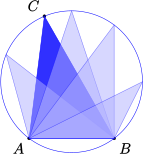
Choose any other point on the circle that is not on the arc \(\overset{\large\frown}{AB}\text{.}\) Call this point \(D\text{.}\) Draw the line segments \(\overline{AD}\) and \(\overline{BD}\) to create a second triangle. Measure the angle at \(D\text{;}\) it should be the same as the angle \(C\text{.}\)
In fact, all angles with vertex on the circle that subtend the same arc have the same measure. Verify this fact by creating two more angles that subtend the arc \(\overset{\large\frown}{AB}\text{.}\)
What is the length of the diameter of the circumscribing circle?
At this point, if your drawing is too cluttered, you may need to make a fresh copy of the circumscribing circle. On this circle draw just the side \(\overline{AB}\) from your original triangle.
Draw the diameter that passes through \(B\) (remember that \(O\) is the center of the circle), and label the other end of the diameter with the letter \(C'\text{.}\)
Draw triangle \(\Delta ABC'\text{,}\) and measure the angle at \(C'\text{.}\) It should be the same as angle \(C\) in your original triangle. (Why?) Let’s call this angle \(\theta\text{.}\)
Now measure angle \(\angle BAC'\text{.}\) It should be 90 degrees, This is another fact from geometry: Any angle that intercepts the diameter of a circle is a right angle. Put a right angle symbol at angle \(\angle BAC'\text{.}\)
Equating expressions for the diameter: The Law of Sines
You have now written an expression for the diameter of the circumscribing circle in terms of angle \(C\) and its opposite side. If you start the derivation with angle \(B\) and the arc \(\overset{\large\frown}{AC}\text{,}\) you will get another expression for the diameter. Write that expression here.
Measure the angle at \(C\text{.}\) and note that the larger arc \(\overset{\large\frown}{AB}\) subtended by \(\theta\) is more than half of the circle.
Choose a point \(D\) on the larger arc \(\overset{\large\frown}{AB}\text{.}\) In triangle \(\Delta ABD\text{,}\) the angle at \(D\) subtends the shorter arc connecting \(A\) and \(B\text{.}\) Measure the angle at \(D\text{.}\) You should find that the angles at \(C\) and \(D\) are supplementary.
Here is another fact from geometry: The measure of an inscribed angle in a circle is half the measure of the arc it subtends. Use this fact to explain why the angles at \(C\) and \(D\) are supplementary.
What can you say about the sines of angles \(C\) and \(D\text{?}\) Because it is an acute triangle, we can use our original derivation on \(\Delta ABD\text{,}\) and substitute \(C\) for \(D\) in the result.