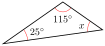
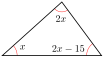
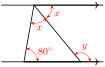
Because the sum of the angles is \(180\degree\text{,}\) we know that \(~x + 2x + 2x-15 = 180\text{.}\) Solving this equation gives \(~x=39\degree,~~2x=78\degree, ~~2x-15=63\degree\)
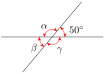
In trigonometry we often use lower-case Greek letters to represent unknown angles (or, more specifically, the measure of the angle in degrees). In the next exercise, we use the Greek letters \(\alpha\) (alpha), \(\beta\) (beta), and \(\gamma\) (gamma).
Angle \(\alpha\) is supplementary to \(50\degree\) so \(\alpha=130\degree\text{.}\) Then \(\beta\) is supplementary to \(\alpha\) and \(\gamma\) is supplementary to \(\beta\text{,}\) giving us \(\beta=50\degree, ~\gamma=130\degree.\)
Non-adjacent angles formed by the intersection of two straight lines are called vertical angles. In the previous exercise, the angles labeled \(\alpha\) and \(\gamma\) are vertical angles, as are the angles labeled \(\beta\) and \(50\degree\text{.}\)
Because they are the base angles of an isosceles triangle, \(\theta\) (theta) and \(\phi\) (phi) are equal. Also, \(\alpha=\theta\) because they are vertical angles, and similarly \(\beta=\phi\text{.}\) Therefore, \(\alpha=\beta\) because they are equal to equal quantities.
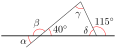
\(\alpha=40\degree\) because of vertical angles, and \(\beta\) is its supplement at \(40\degree\text{.}\)\(\delta=65\degree\text{,}\) the supplement of \(115\degree\text{,}\) and \(~\gamma= 180 - (65 + 40) = 75\degree\text{.}\)
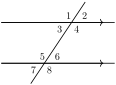
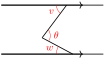
A line that intersects two parallel lines forms eight angles, as shown in the figure below. There are four pairs of vertical angles, and four pairs of corresponding angles, or angles in the same position relative to the transversal on each of the parallel lines.
For example, the angles labeled 1 and 5 are corresponding angles, as are the angles labeled 4 and 8. Finally, angles 3 and 6 are called alternate interior angles, and so are angles 4 and 5.
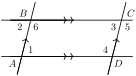
The parallelogram \(ABCD\) shown at right is formed by the intersection of two sets of parallel lines. Show that the opposite angles of the parallelogram are equal.
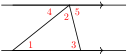
Angles 1 and 2 are equal because they are alternate interior angles, and angles 2 and 3 are equal because they are corresponding angles. Therefore angles 1 and 3, the opposite angles of the parallelogram, are equal. Similarly, you can show that angles 4, 5, and 6 are equal.
Note that angles 2 and 6 are supplementary because they form a straight angle. Angle 1 equals angle 2 because they are alternate interior angles, and similarly angle 4 equals angle 5. Angle 5 equals angle 6 because they are corresponding angles. Thus, angle 4 equals angle 6, and angle 1 equals angle 2. So angles 4 and 1 are supplementary because 2 and 6 are.
In the Section 1.1 Summary, you will find a list of vocabulary words and a summary of the facts from geometry that we reviewed in this section. You will also find a set of study questions to test your understanding, and a list of skills to practice in the homework problems.
Draw any quadrilateral (a four-sided polygon) and divide it into two triangles by connecting two opposite vertices by a diagonal. What is the sum of the angles in your quadrilateral?
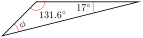
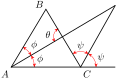
In Problems 21 and 22, the angle labeled \(\phi\) is called an exterior angle of the triangle, formed by one side and the extension of an adjacent side. Find \(\phi\text{.}\)
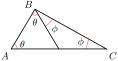
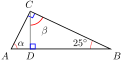
In Problems 25 and 26, the figures inscribed are regular polygons, which means that all their sides are the same length, and all the angles have the same measure. Find the angles \(\theta\) and \(\phi\text{.}\)
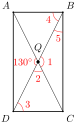
\(ABCD\) is a rectangle. The diagonals of a rectangle bisect each other. In the figure, \(\angle AQD = 130\degree\text{.}\) Find the angles labeled 1 through 5 in order, and give a reason for each answer.
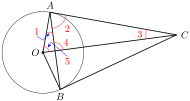
A tangent meets the radius of a circle at a right angle. In the figure,\(\angle AOB = 140\degree\text{.}\) Find the angles labeled 1 through 5 in order, and give a reason for each answer.