If we know one of the three trig values for an angle, we can find the other two by using these identities. Identities are useful for changing from one form to another when solving equations, and for finding exact values for trigonometric functions.
For example, if we know the sine of \(27\degree\text{,}\) can we find the sine of \(2(27\degree)=54\degree\) without using a calculator? Or, if we know \(\cos (\alpha)\) and \(\cos (\beta)\text{,}\) can we calculate \(\cos (\alpha + \beta)\text{?}\)
All of the identities that relate the trig ratios of different angles are derived from the sum and difference formulas. Let’s see why we need these formulas.
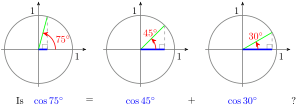
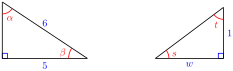
are equal for any values of \(\alpha\) and \(\beta\) ? We can test this hypothesis by evaluating both expressions for some specific values of \(\alpha\) and \(\beta\text{,}\) say \(\alpha=45\degree\) and \(\beta=30\degree\text{,}\) as shown below.
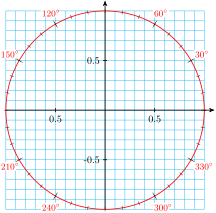
From the figure, you should be able to see that \(\cos (75\degree)\) is in fact smaller than either \(\cos (45\degree)\) or \(\cos (30\degree)\text{,}\) so it cannot be true that \(\cos (75\degree)\) is equal to \(\cos (45\degree) + \cos 3(0\degree)\text{.}\)
Because the values of the expressions in the previous Example and Exercise are different, it is not true that \(\cos (\alpha + \beta)\) is equal to \(\cos (\alpha) + \cos (\beta)\) for all angles \(\alpha\) and \(\beta\text{,}\) or that \(\sin (\alpha + \beta)\) is equal to \(\sin (\alpha) + \sin (\beta)\text{.}\)
It turns out that there is a relationship between the trig ratios for \(\alpha + \beta\) and the trig ratios of \(\alpha\) and \(\beta\text{,}\) but it is a little more complicated.
Notice that to find the sine or cosine of \(\alpha + \beta\) we must know (or be able to find) both trig ratios for both \(\alpha\) and \(\beta\text{.}\)
We can write \(105\degree\) as the sum of two special angles: \(105\degree = 60\degree + 45\degree\text{.}\) Now apply the sum of angles identity for cosine.
Thus, \(\cos (105\degree) = \dfrac{\sqrt{2}-\sqrt{6}}{4}\text{.}\) You can check that your calculator gives the same decimal approximation of about \(-0.2588\) for both \(\cos (105\degree)\) and \(\dfrac{\sqrt{2}-\sqrt{6}}{4}\text{.}\)
Suppose that \(\sin (\theta) = 0.6\) and \(\cos (\theta) = -0.8\text{.}\) Find an exact value for \(\sin\left(\theta + \dfrac{2\pi}{3}\right)\text{.}\)
Recall that \(\sin \left(\dfrac{2\pi}{3}\right) = \dfrac{\sqrt{3}}{2}\) and \(\cos \left(\dfrac{2\pi}{3}\right) = \dfrac{-1}{2}\text{.}\) Substituting these values into the sum formula for sine, we find
Suppose that \(\sin (\theta) = \dfrac{-5}{13}\) and \(\cos (\theta) = \dfrac{12}{13}\text{.}\) Find an exact value for \(\cos\left(\dfrac{\pi}{4} + \theta\right)\text{.}\)
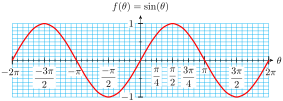
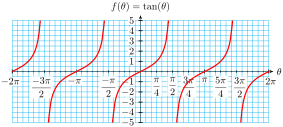
Look at the graph of \(f(\theta) = \sin (\theta)\text{,}\) and choose three positive values of \(\theta\text{.}\) Draw dots on the graph that show their function values.
The difference formulas for sine and cosine can be derived easily from the sum formulas, using the identities for negative angles. Note that the difference formulas are identical to the corresponding sum formulas, except for the signs.
Remember that \(\cos \left( \dfrac{\pi}{4}\right) = \dfrac{\sqrt{2}}{2},~~\cos\left( \dfrac{\pi}{6}\right) =\dfrac{\sqrt{3}}{2},~~\sin\left( \dfrac{\pi}{4}\right) = \dfrac{\sqrt{2}}{2}\text{,}\) and \(\sin \left( \dfrac{\pi}{6}\right) = \dfrac{1}{2}\text{.}\) Substituting all these values into the difference identity for cosine, we obtain the following.
You can check that your calculator gives the same decimal approximation of about \(0.9659\) for both \(\cos \left( \dfrac{\pi}{12}\right)\) and \(\dfrac{\sqrt{6}+\sqrt{2}}{4}\text{.}\)
As in the previous Example, use the fact that \(\dfrac{\pi}{12} = \dfrac{\pi}{4} - \dfrac{\pi}{6}\) and apply the difference identity for sine to find \(\dfrac{\sqrt{6}-\sqrt{2}}{4}\)
We observe that \(75\degree = 45\degree + 30\degree\text{,}\) so \(\tan (75\degree) = \tan (45\degree + 30\degree)\text{.}\) We can apply the sum formula for tangent.
Use the fact that \(\dfrac{\pi}{12} = \dfrac{\pi}{4} - \dfrac{\pi}{6}\) and apply the difference identity for tangent to find \(\dfrac{\sqrt{3}-1}{\sqrt{3}+1}\text{.}\)
There are a number of other very useful identities that can be derived from the sum and difference formulas. In particular, if we set \(\alpha = \beta = \theta\) in the sum of angles identities (also called addition formulas), we obtain the double angle formulas. These identities are used frequently, so it is helpful to know them well.
The first thing we can learn from the double angle formulas is that \(\sin (2\theta)\) is not equal to \(2\sin (\theta)\text{!}\) You can check this very easily by choosing a value for \(\theta\text{,}\) say \(45\degree\text{.}\) Then
so \(c = \sqrt{13}\text{.}\) Thus, \(\cos (\theta) = \dfrac{3}{\sqrt{13}}\) and \(\sin (\theta) = \dfrac{2}{\sqrt{13}}\text{.}\) Now we can use these values in the double angle identity to find \(\sin (2\theta)\text{.}\)
We can use the double angle formulas for cosine and tangent to find \(\cos (2\theta) = \dfrac{5}{13}\) and \(\tan (2\theta) = \dfrac{12}{5}\text{.}\) (But also note that, once we know \(\sin (2\theta)\text{,}\) we can calculate its cosine and tangent directly.)
Once we have all the trig functions in terms of a single angle, we try to write the equation in terms of a single trig function. In this case, we can factor the left side to separate the trig functions.
Solving this equation by factoring gives us \(\cos(t) = 1\) or \(\cos(t) = \dfrac{-1}{2}\text{,}\) form which we find \(t = 0,~ t=\dfrac{2\pi}{3}\text{,}\) and \(t=\dfrac{4\pi}{3}\text{.}\)
Recall the distributive law, \(a(b+c) = ab + ac\text{,}\) where the parentheses denote multiplication. Is the same law true when the parentheses denote a function? In other words, is it true that \(f(a+b) = f(a) + f(b)\text{?}\)
In the expression \(\sin (\theta + \phi)\text{,}\) do the parentheses denote multiplication or the application of a function? Does the distributive law apply to \(\sin (\theta + \phi)\text{?}\) Do you think that \(\sin (\theta + \phi) = \sin (\theta) + \sin (\phi)\) is an identity?
Yikes! More formulas. Compare the Difference of Angles Identities with the Sum of Angles Identities. If you have memorized the Sum formulas, how can you also memorize the Difference formulas?
Is it true that \(\sin (2\theta) = 2\sin (\theta)\text{?}\) Choose a value for \(\theta\) and try it. Sketch \(\theta\) and \(2\theta\) on a unit circle and show the sine of each.
Substitute \(\alpha = \theta\) and \(\beta = \theta\) into the sum of angles formulas for sine, cosine, and tangent to derive the double angle formulas.
Choose one of the three forms of the Double Angle Identity for Cosine. Use the Pythagorean Identity to convert from that form to each of the other two forms.
Identities are useful for changing from one form to another when solving equations, for simplifying expressions, and for finding exact values for trigonometric functions.
it is not true in general that \(\cos (\alpha + \beta)\) is equal to \(\cos (\alpha) + \cos (\beta)\) for all angles \(\alpha\) and \(\beta\text{,}\) or that \(\sin (\alpha + \beta)\) is equal to \(\sin (\alpha) + \sin (\beta)\text{.}\)
Given that \(~~\sin \left(\dfrac{7\pi}{12}\right) = \dfrac{\sqrt{2} + \sqrt{6}}{4}~~\text{,}\) find \(\sin \left(\dfrac{-7\pi}{12}\right)\text{.}\) Sketch both angles.
Given that \(~~\cos \left(\dfrac{7\pi}{12}\right) = \dfrac{\sqrt{2} - \sqrt{6}}{4}~~\text{,}\) find \(\cos \left(\dfrac{-7\pi}{12}\right)\text{.}\) Sketch both angles.
Suppose \(\cos (\theta) = \dfrac{15}{17}\) and \(\sin (\phi) = \dfrac{3}{5}\text{,}\) where \(\theta\) and \(\phi\) are in quadrant I. Evaluate the following.
Suppose \(\cos (\theta) = \dfrac{15}{17}\text{,}\) where \(\theta\) is in quadrant IV, and \(\sin (\phi) = \dfrac{3}{5}\text{,}\) where \(\phi\) is in quadrant II. Evaluate the following.
Prove the double angle identity \(\sin (2\theta) = 2\sin (\theta) \cos(\theta)\text{.}\) (Hint: Start with the sum of angles formula for sine and replace both \(\alpha\) and \(\beta\) by \(\theta\text{.}\))
Prove the double angle identity \(\cos (2\theta) = \cos^2 (\theta) - \sin^2 (\theta)\text{.}\) (Hint: Start with the sum of angles formula for sine and replace both \(\alpha\) and \(\beta\) by \(\theta\text{.}\))
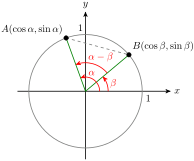
Write an expression for \((AB)^2\text{,}\) the square of the distance between the points \(A\) and \(B\text{,}\) using the Law of Cosines for \(\triangle AOB\text{.}\)
Equate the two expressions for \((AB)^2\) you obtained in (a) and (b). Simplify the equation to obtain \(\cos(\alpha - \beta) = \cos(\alpha) \cos(\beta) + \sin(\alpha) \sin(\beta)\text{.}\)