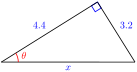
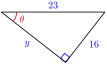
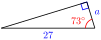
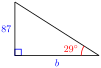
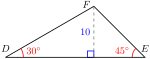
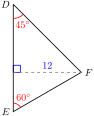
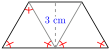
The three angles of a triangle are \(20\degree, 50\degree, \text{and}~ 110\degree,\) and the three sides are 15 cm, 6.7 cm, and 18.4 cm. Sketch and label the triangle.
In the triangle shown, \(\cos (\theta) = \dfrac{3}{5}\text{.}\) Can we conclude that \(a = 3\) and \(c = 5\text{?}\) Give two other possibilities for the values of \(a\) and \(c\text{.}\)
In the triangle shown, \(\tan (\theta) = \dfrac{5}{3}\text{.}\) Can we conclude that \(a = 5\) and \(b = 3\text{?}\) Give two other possibilities for the values of \(a\) and \(b\text{.}\)
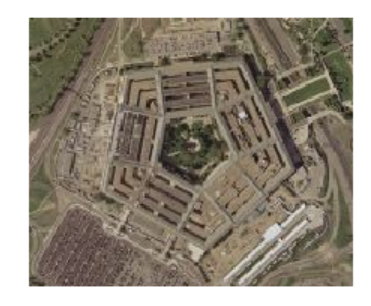
The Pentagon, which houses the U.S. Department of Defense, is in the shape of a regular pentagon. Each of the five outer walls is 921.6 feet long. What is the shortest distance from one of the outer walls to the opposite vertex of the pentagon?
A ramp is rising at an angle \(25\degree\) from horizontal. What is the distance (along the ramp) from the base of the ramp to the point on the ramp that is 1 meter higher than the base of the ramp?
A baseball diamond is a square with sides 90 feet long. The corners are called (in clockwise order) first base, second base, third base, and home plate. The sides are called baselines. A runner is on the baseline between first and second base, 20 feet from second base. How far is the runner from home plate? What is the angle between the baseline from home plate to first base and the line from home plate to the runner?
A runner is on the baseline between second and third base, 10 feet from second base. How far is the runner from home plate? What is the angle between the baseline from home plate to third base and the line from home plate to the runner?
Let \(l\) be the line that passes through the origin and the point \((4,7)\text{.}\) Let \(\theta\) be the angle that \(l\) makes with the positive \(x\)-axis.
Find the value of \(\theta\text{.}\) Hint: Draw the triangle with vertices at the origin, \((4,7)\text{,}\) and \((4,0)\text{,}\) labeling the angle at the origin \(\theta\text{.}\) What is \(\tan (\theta)\) ?)
Let \(l\) be the line that passes through the origin and the point \((a,b)\text{,}\) where \(a\) and \(b\) are positive numbers. Let \(\theta\) be the angle that \(l\) makes with the positive \(x\)-axis.
Find the value of \(\theta\text{.}\) Hint: Draw the triangle with vertices at the origin, \((a,b)\text{,}\) and \((a,0)\text{,}\) labeling the angle at the origin \(\theta\text{.}\) What is \(\tan (\theta)\) ?)
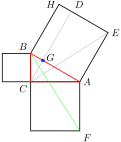
The figure illustrates a proof of the Pythagorean theorem given by Euclid. It shows that the area of the square on the hypotenuse \(\overline{AB}\) is the sum of the areas of the squares on legs \(\overline{BC}\) and \(\overline{AC}\text{.}\) We first draw a line segment from point \(C\) perpendicular to the hypotenuse \(\overline{AB}\) to meet the far side of the square on the hypotenuse. This segment meets \(\overline{AB}\) at \(G\) and the opposite side of the square at \(D\text{.}\)
How does the area of \(\triangle ABF\) compare with the area of the square on \(\overline{AC}\text{?}\) (Hint: Consider \(\overline{AF}\) to be the base of the triangle. What is the height?)
How does the area of \(\triangle ACE\) compare with the area of the rectangle \(AGDE\) ? (Hint: Consider \(\overline{AE}\) to be the base of the triangle. What is the height?)
An argument similar to parts (a)–(d) will show that the area of the square on \(\overline{BC}\) equals the area of the rectangle \(BGDH\text{.}\) Explain how writing the area of the square on \(\overline{AB}\) as the sum of the areas of two rectangles gives the Pythagorean theorem.