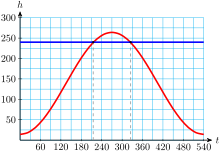
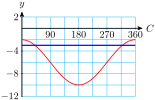
In the example above, we used a graph to solve the equation \(h = 240\text{,}\) or
\begin{equation*}
139 - 125\cos \left(\dfrac{2t}{3}\right) = 240
\end{equation*}
To find a more precise solution, we can use algebraic methods. To start, we’ll solve the slightly simpler equation
\begin{equation*}
139 - 125\cos(\theta) = 240
\end{equation*}
We’ll look for all solutions for \(\theta\) between \(0\degree\) and \(360\degree\text{.}\) We begin by isolating the trigonometric ratio on one side of the equation.
\begin{align*}
139 - 125\cos (\theta) \amp = 240 \amp \amp \blert{\text{Subtract 139 from both sides.}}\\
- 125\cos (\theta) \amp = 101 \amp \amp \blert{\text{Divide both sides by }{-125.}}\\
\cos(\theta) \amp = -0.808
\end{align*}
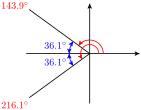
We have solved equations like this one before: we use the inverse cosine to solve for \(\theta\text{.}\) Remember that there are two angles between \(0\degree\) and \(360\degree\) that have a cosine of \(-0.808\text{,}\) one in the second quadrant and one in the third quadrant. The calculator will give us only the second quadrant solution.
\begin{equation*}
\theta = \cos^{-1}(-0.808) = 143.9\degree
\end{equation*}
To find the second solution, we need the third-quadrant angle whose cosine is \(-0.808\text{.}\)
To solve simple equations involving a single trigonometric ratio (either
\(\sin (\theta), \cos (\theta),\) or
\(\tan (\theta)\)), we can follow the steps below.
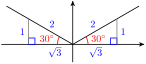
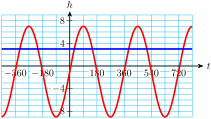
In the previous Example, we found two solutions of the equation
\(8 \sin (\theta) - 1 = 3\text{.}\) The equation actually has infinitely many solutions, as you can see in the figure below, which shows a graph of
\(y = 8 \sin (\theta) - 1\) and the horizontal line
\(y = 3\text{.}\) The line intersects the sine graph infinitely many times, twice in each cycle.
Each intersection represents a solution of the equation. Thus, all of the angles coterminal with
\(30\degree\) and
\(150\degree\) are also solutions. We can easily find these solutions by adding integer multiples of
\(360\degree\) to
\(30\degree\) or
\(150\degree\text{.}\) This is why, when solving a trigonometric equation, we usually list only the solutions in one cycle, typically those between
\(0\degree\) and
\(360\degree\text{.}\)