We have seen that it can be useful to resolve a vector into horizontal and vertical components. We can also break a vector into components that point in other directions.
Imagine the following experiment: Delbert holds a ball at shoulder height and then drops it, so that it falls to the ground. Francine holds a ball at shoulder height on an inclined ramp, then releases it so that it rolls downhill. Which ball will reach the ground first?
Although gravity causes both balls to speed up, the free-falling ball will reach the ground first. The force of gravity pulls straight down, the same direction as the motion of the free-falling ball, but the rolling ball must move at an angle to the pull of gravity, along the surface of the ramp. Only part of the gravitational force accelerates the rolling ball, and the rest of the force is counteracted by the surface of the ramp. What fraction of the gravitational force causes the ball to roll?
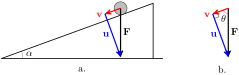
In figure (a), the gravitational force \({\bf{F}}\) is resolved into the sum of two vectors, \({\bf{F}}={\bf{u}}+{\bf{v}}\text{,}\) where \({\bf{v}}\) points down the ramp, and \({\bf{u}}\) is perpendicular to the ramp. The magnitude of \({\bf{v}}\) is called the component of \({\bf{F}}\) in the direction of motion, and is denoted by \(\text{comp}_{\bf{v}}{\bf{F}}\text{.}\) This is the portion of the gravitational force that moves the ball. From figure (b), we see that \(\text{comp}_{\bf{v}}{\bf{F}} = \|{\bf{F}}\| \cos (\theta)\text{,}\) where \(\theta\) is the angle between \({\bf{F}}\) and \({\bf{v}}\text{.}\)
With a little geometry, you can verify that in this example the angle \(\theta\) is the complement of the angle of inclination of the ramp, \(\alpha\text{.}\) (Think of similar triangles.) Now suppose that we increase the angle of inclination. As \(\alpha\) increases, \(\theta\) decreases, \(\cos (\theta)\) increases, and hence \(\text{comp}_{\bf{v}}{\bf{F}}\) increases. This result agrees with our experience: as the ramp gets steeper, the ball rolls faster.
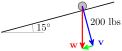
Delbert uses a sheet of plywood as a ramp for his wheelbarrow. The ramp is inclined at an angle of \(15\degree\) to the horizontal. The plywood can support a maximum weight of 200 pounds. What weight will the ramp support?
The component of the weight perpendicular to the ramp cannot be more than 200 pounds. If the weight of the wheelbarrow is \({\bf{w}}\text{,}\) and \({\bf{v}}\) is a vector perpendicular to the ramp, as shown below, then the angle between \({\bf{v}}\) and \({\bf{w}}\) is \(15\degree\text{,}\) by similar triangles. Thus, the component of \({\bf{w}}\) in the direction of \({\bf{w}}\) is
Delbert pushes a lawn mower whose handle makes a \(40\degree\) angle with the horizontal. If he applies a force of 30 pounds in the direction of the handle, what is the component of the force in the horizontal direction?
In the examples above, we computed the component of a force \({\bf{F}}\) in the direction of a vector \({\bf{v}}\) by knowing the angle between \({\bf{F}}\) and \({\bf{v}}\text{.}\) If the vectors are given in coordinate form (that is, \({\bf{v}} = a{\bf{i}} + b{\bf{j}}\)), we may not know the angle between them. Can we compute the component of a vector \({\bf{w}}\) in the direction of \({\bf{v}}\text{,}\) in terms of the coordinates of \({\bf{v}}\) and\({\bf{w}}\text{?}\)
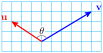
Suppose \({\bf{v}} = a{\bf{i}} + b{\bf{j}}\) and \({\bf{w}} = c{\bf{i}} + d{\bf{j}}\text{,}\) as shown below. We will need to compute the cosine of \(\theta\) in terms of \(a,~ b,~ c,~\) and \(d\text{.}\)
If \(~{\bf{v}} = a{\bf{i}} + b{\bf{j}}~\) and \(~{\bf{w}} = c{\bf{i}} + d{\bf{j}}\text{,}\) then the component of \({\bf{w}}\) in the direction of \({\bf{v}}\) is given by
Recall that the "component" of a vector is a scalar. If a vector \({\bf{w}}\) is resolved into two component vectors, \({\bf{w}} = {\bf{u}} + {\bf{v}}\text{,}\) its components are the lengths of the vectors \({\bf{u}}\) and \({\bf{v}}\text{.}\) The vectors \({\bf{u}}\) and \({\bf{v}}\) themselves are called the vector components of \({\bf{w}}\text{.}\)
Remember that the component of \({\bf{w}}\) in the direction of \({\bf{v}}\) is a scalar; it is the length of the projection of \({\bf{w}}\) onto \({\bf{v}}\text{.}\)
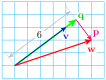
We would like to find a vector \({\bf{q}}\) of length 6 in the direction of \({\bf{v}}\text{,}\) as shown at right. Because \(\|{\bf{v}}\| = 5\text{,}\) we scale the components of \({\bf{v}}\) by \(\dfrac{6}{5}\) to get
Write the vector \({\bf{w}} = 6{\bf{i}} + 2{\bf{j}}\) as the sum of two components, one parallel to \({\bf{v}} = {\bf{i}} + {\bf{j}}\) and the other perpendicular to \({\bf{v}}\text{.}\)
The expression \(ac+bd\text{,}\) which we encountered above as part of the formula for \(\text{comp}_{\bf{v}}{\bf{w}}\text{,}\) is quite useful and is given a name; it is called the dot product of the vectors \({\bf{v}} = a{\bf{i}} + b{\bf{j}}\) and \({\bf{w}} = c{\bf{i}} + d{\bf{j}}\text{.}\)
It is easy to remember the formula for the dot product if we think of adding the product of the \({\bf{i}}\)-components and the product of the \({\bf{j}}\)-components of the two vectors.
In the examples above, you can see that the dot product of two vectors is a scalar. For this reason, the dot product is also called the scalar product.
Using the formula above, we have \(\text{comp}_{\bf{w}}{\bf{v}} = \dfrac{{\bf{v}} \cdot {\bf{w}}}{\|{\bf{w}}\|}\text{.}\) We first compute \({\bf{v}} \cdot {\bf{w}}\) and \(\|{\bf{w}}\|\text{.}\)
An even more important relationship, which gives geometric meaning to the dot product, follows from the formula for a component. We now have two ways to compute the component of \({\bf{w}}\) in the direction of \({\bf{v}}\text{:}\)
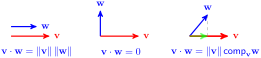
The dot product is a way of multiplying two vectors that depends on the angle between them.
If \(\theta = 0\degree\text{,}\) so that \({\bf{v}}\) and \({\bf{w}}\) point in the same direction, then \(\cos (\theta) = 1\) and \({\bf{v}} \cdot {\bf{w}}\) is just the product of their lengths, \(\|{\bf{v}}\|\|{\bf{w}}\|\text{.}\)
If \({\bf{v}}\) and \({\bf{w}}\) are perpendicular, then \(\cos (\theta) = 0\text{,}\) so \({\bf{v}} \cdot {\bf{w}} = 0\text{.}\) (Two vectors \({\bf{v}}\) and \({\bf{w}}\) are said to be orthogonal if their dot product is zero.)
If \(\theta\) is between \(0\degree\) and \(90\degree\text{,}\) the dot product multiplies the length of \({\bf{v}}\) times the component of \({\bf{w}}\) in the direction of \({\bf{v}}\text{.}\)
Thus, \(\|{\bf{v}}\|\|{\bf{w}}\| \cos (\theta) = 0\text{,}\) so \({\bf{v}}\) and \({\bf{w}}\) are orthogonal. Because neither \(\|{\bf{v}}\| = 0\) or \(\|{\bf{w}}\| = 0\text{,}\) it must be the case that \(\cos (\theta) = 0\text{,}\) so \(\theta = 90\degree\) or \(270\degree\text{.}\)
The component of a vector \({\bf{w}}\) in the direction of vector \({\bf{v}}\) is the length of the vector projection of \({\bf{w}}\) onto \({\bf{w}}\text{.}\)
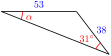
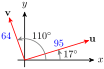
\({\bf{u}}\) has magnitude \(\sqrt{7}\) and direction \(112\degree\text{,}\) and \({\bf{v}}\) has magnitude \(\sqrt{14}\) and direction \(157\degree\text{.}\)
Gary pulls a loaded wagon along a flat road. The handle of the wagon makes an angle of \(50\degree\) to the horizontal. If Gary pulls with a force of 60 pounds, find the component of the force in the direction of motion.
Wassily is trying to topple a statue by pulling on a rope tied to the statue’s upraised arm. The rope is making a \(35\degree\) angle from horizontal. If Wassily is pulling on the rope with a force of 250 pounds, find the component of the force in the horizontal direction.
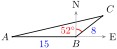
Steve’s boat is headed due north, and the sail points at an angle of \(15\degree\) east of north. The wind is blowing in the direction \(60\degree\) west of south, but because of the difference in air pressure between the front and back surfaces of the sail, the boat experiences a force of 400 pounds in the direction the sail is facing. Find the component of the force in the direction of the boat’s motion.
Show that the component of \({\bf{v}} = a{\bf{i}}+b{\bf{j}}\) in the direction of \({\bf{i}}\) is \(a\text{,}\) and the component of \({\bf{v}}\) in the direction of \({\bf{j}}\) is \(b\text{.}\)
Show that the dot product \({\bf{u}} \cdot {\bf{v}}\) gives the length of \({\bf{v}}\) times the component of \({\bf{u}}\) in the direction of \({\bf{v}}\text{.}\)
Start from the geometric definition \({\bf{v}} \cdot {\bf{w}} = \|{\bf{v}}\|\|{\bf{w}}\| \cos (\theta)\) and show that \({\bf{i}} \cdot {\bf{i}}=1,~~{\bf{j}} \cdot {\bf{j}}=1\) and \({\bf{i}} \cdot {\bf{j}}=0\text{.}\)
If \({\bf{u}}\) is a unit vector, and the angle between \({\bf{u}}\) and \({\bf{i}}\) is \(\alpha\text{,}\) show that \({\bf{u}} = \cos (\alpha) {\bf{i}} + \sin (\alpha) {\bf{j}}\text{.}\)