Appendix A Answers to Selected Exercises and Homework Problems

1 Triangles and Circles
1.1 Angles and Triangles
Homework 1.1

31.

Answer.
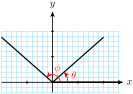
  1. They are base angles of an isosceles triangle.
  2. They are base angles of an isosceles triangle.
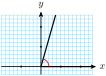
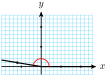
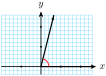
  3. \(\angle OAB\) corresponds to \(\theta\) of Problem 29, and \(\angle OBC\) corresponds to \(\phi\) of Problem 29.

45.

Answer.
  1. \(\displaystyle \angle 1 = \angle 4, \angle 3 = \angle 5\)
  2. \(\displaystyle 180\degree\)
  3. In the equation \(\angle 4 + \angle 2 + \angle 5 = 180\degree,\) substitute \(\angle 1\) for \(\angle 4\text{,}\) and substitute \(\angle 3\) for \(\angle 5\) to conclude that the sum of the angles in the triangle is \(180 \degree\text{.}\)

47.

Answer.
\(\angle 1 = 130\degree\) because vertical angles are equal. \(\angle 2 = 50\degree\) because it makes a straight angle with a \(130\degree\) angle. \(\angle 3 = 65\degree\) because it is a base angle of an isosceles triangle whose vertex angle is \(50\degree\text{.}\) \(\angle 4 = 65\degree\) for the same reason. \(\angle 5 = 25\degree\) because it is complementary to \(\angle 4\text{.}\)

1.2 Similar Triangles
Homework 1.2

1.

Answer.
\(\triangle PQT \cong \triangle SRT\text{,}\) \(x=7\text{,}\) \(y=3, \alpha=18\degree\)

3.

Answer.
\(\triangle PRE \cong \triangle URN, z=12\text{,}\) \(\theta = 10\degree\text{,}\) \(\phi = 70\degree\)

39.

Answer.
  1. \(\angle B = 70\degree\text{,}\) \(\angle CAD = 70\degree\text{,}\) \(\angle DAB = 20\degree\)
  2. \(\triangle DBA\) and \(\triangle DAC.\) The hypotenuse is \(BC\) in \(\triangle ABC\text{,}\) \(BA\) in \(\triangle DBA\text{,}\) and \(AC\) in \(\triangle DAC\text{.}\) The short leg is \(AB\) in \(\triangle ABC\text{,}\) \(DB\) in \(\triangle DBA\text{,}\) and \(DA\) in \(\triangle DAC\text{.}\) The longer leg is \(AC\) in \(\triangle ABC\text{,}\) \(DA\) in \(\triangle DBA\text{,}\) and \(DC\) in \(\triangle DAC\text{.}\)

1.3 Circles
Homework 1.3

17.

Answer.
The distance between the points \((x,y)\) and \((4,-1)\) is 3 units.

25.

Answer.
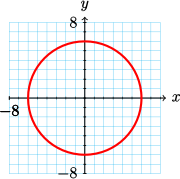
  1. \(x\) \(-5\) \(-4\) \(-3\) \(-2\) \(-1\) \(0\) \(1\) \(2\) \(3\) \(4\) \(5\)
    \(y\) \(0\) \(\pm 3\) \(\pm 4\) \(\pm \sqrt{21}\) \(\pm 2\sqrt{6} \) \(\pm 5\) \(\pm 2\sqrt{6}\) \(\pm \sqrt{21}\) \(\pm 4\) \(\pm 3 \) \(0\)
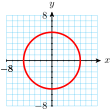
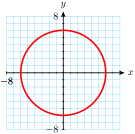
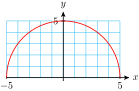
  2. circle on grid

31.

Answer.
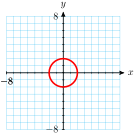
  1. No real value of \(y\) can satisfy \(x^2 +y^2 = 16\) unless \(-4 \le x \le 4.\)
  2. The graph has no points where \(x \gt 4\) and no points where \(x \lt -4. \)

41.

Answer.
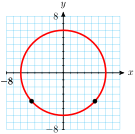
\(P(\dfrac{1}{2}, \dfrac{\sqrt{3}}{2}), Q(\dfrac{1}{2}, \dfrac{-\sqrt{3}}{2}), R(\dfrac{-3}{4}, \dfrac{\sqrt{7}}{4}), S(\dfrac{-3}{4}, \dfrac{-\sqrt{7}}{4})\)

1.4 Chapter 1 Summary and Review
Chapter 1 Review Problems

15.

Answer.
\(\alpha = 51\frac{3}{7}\degree\text{,}\) \(\beta = 64\frac{2}{7}\degree\)

17.

Answer.
\(\triangle ABC \cong \triangle EDC\text{,}\) \(\alpha = 40\degree\text{,}\) \(\beta = 130\degree\text{,}\) \(x=32\)

41.

Answer.
All side have length \(\sqrt{61},\) opposite sides have slopes \(\dfrac{5}{6}\) and \(\dfrac{-6}{5}\)

49.

Answer.
\((\dfrac{-1}{3}, \dfrac{2\sqrt{2}}{3}), (\dfrac{-1}{3}, \dfrac{-2\sqrt{2}}{3})\)

2 The Trigonometric Ratios
2.1 Side and Angle Relationships
Homework 2.1

3.

Answer.
The exterior angle is not equal to the sum of the opposite interior angles.

11.

Answer.
\(5^2 + 12^2 = 13^2\text{,}\) but the angle opposite the side of length 13 is \(85\degree\text{.}\)

21.

Answer.
The rectangle is \(6\sqrt{10}\) inches by \(18\sqrt{10}\) inches.

33.

Answer.
The distance from \((0,0)\) to \((3,3)\) is \(3\sqrt{2}\text{,}\) and the distance from \((3,3)\) to \((6,0)\) is also \(3\sqrt{2}\text{,}\) so the triangle is isosceles. The distance from \((0,0)\) to \((6,0)\) is 6, and \((3\sqrt{2})^2 + (3\sqrt{2})^2 = 6^2\) so the triangle is a right triangle.

2.2 Right Triangle Trigonometry
Homework 2.2

5.

Answer.
  1. \(\displaystyle 4\sqrt{13} \approx 14.42\)
  2. \(\sin\theta = 0.5547\text{,}\) \(\cos\theta = 0.8321\text{,}\) \(\tan\theta = 0.6667\)

7.

Answer.
  1. \(\displaystyle 4\sqrt{15} \approx 15.49\)
  2. \(\sin(\theta) = 0.9682\text{,}\) \(\cos(\theta) = 0.2500\text{,}\) \(\tan(\theta) = 3.8730\)

9.

Answer.
  1. \(\displaystyle 2\sqrt{67} \approx 16.37\)
  2. \(\sin(\theta) = 0.2116\text{,}\) \(\cos(\theta) = 0.9774\text{,}\) \(\tan(\theta) = 0.2165\)

47.

Answer.
\(~~~~\) \(\sin(\theta)\) \(\cos(\theta)\) \(\tan(\theta)\)
\(\theta\) \(\frac{3}{5}\) \(\frac{4}{5}\) \(\frac{3}{4}\)
\(\phi\) \(\frac{4}{5}\) \(\frac{3}{5}\) \(\frac{4}{3}\)

49.

Answer.
\(~~~~\) \(\sin(\theta)\) \(\cos(\theta)\) \(\tan(\theta)\)
\(\theta\) \(\frac{1}{\sqrt{5}}\) \(\frac{2}{\sqrt{5}}\) \(\frac{1}{2}\)
\(\phi\) \(\frac{2}{\sqrt{5}}\) \(\frac{1}{\sqrt{5}}\) \(2\)

51.

Answer.
  1. \(\theta\) and \(\phi\) are complements.
  2. \(\sin(\theta) = \cos(\phi)\) and \(\cos(\theta) = \sin(\phi)\text{.}\) The side opposite \(\theta \) is the side adjacent to \(\phi\text{,}\) and vice versa.

53.

Answer.
  1. As \(\theta\) increases, \(\tan(\theta)\) increases also. The side opposite \(\theta\) increases in length while the side adjacent to \(\theta\) remains fixed.
  2. As \(\theta\) increases, \(\cos (\theta)\) decreases. The side adjacent to \(\theta\) remains fixed while the hypotenuse increases in length.

55.

Answer.
As \(\theta\) decreases toward \(0\degree\text{,}\) the side opposite \(\theta\) approaches a length of 0, so sin \((\theta)\) approaches 0. But as \(\theta\) increases toward \(90\degree\text{,}\) the length of the side opposite \(\theta\) approaches the length of the hypotenuse, so \(\sin(\theta)\) approaches 1.

59.

Answer.
\(\dfrac{21}{20}\) is the ratio of hypotenuse to the adjacent side, which is the reciprocal of \(\cos(\theta)\text{.}\)

65.

Answer.
Although the triangles may differ in size, the ratio of the side adjacent to the angle to the hypotenuse of the triangle remains the same because the triangles would all be similar, and hence corresponding sides are proportional.

2.3 Solving Right Triangles
Homework 2.3

29.

Answer.
\(\cos (15\degree) = 0.9659~\) and \(~\cos^{-1} (0.9659) = 15\degree\)

31.

Answer.
\(\tan (65\degree) = 2.1445~\) and \(~\tan^{-1} (2.1445) = 65\degree\)

33.

Answer.
\(\sin^{-1}(0.6) \approx 36.87\degree\) is the angle whose sine is \(0.6\text{.}\) \((\sin 6\degree)^{-1} \approx 9.5668\) is the reciprocal of \(\sin (6\degree)\text{.}\)

59.

Answer.
\(\theta\) \(~~~0\degree~~~\) \(~~~30\degree~~~\) \(~~~45\degree~~~\) \(~~~60\degree~~~\) \(~~~90\degree~~~\)
\(\sin (\theta)\) \(0\) \(\dfrac{1}{2} \) \(\dfrac{\sqrt{2}}{2} \) \(\dfrac{\sqrt{3}}{2} \) \(1\)
\(\cos (\theta)\) \(1\) \(\dfrac{\sqrt{3}}{2} \) \(\dfrac{\sqrt{2}}{2} \) \(\dfrac{1}{2} \) \(0\)
\(\tan (\theta)\) \(0\) \(\dfrac{1}{\sqrt{3}} \) \(1\) \(\sqrt{3}\) undefined

69.

Answer.
\(d = 2\sqrt{3},~e = 2\sqrt{2}, f = \sqrt{2} + \sqrt{6}, ~F = 75\degree\)

2.4 Chapter 2 Summary and Review
Chapter 2 Review Problems

3.

Answer.
If \(A \lt B \lt 58\degree\text{,}\) then \(A+B+C \lt 180\degree\)

29.

Answer.
\(A = 30\degree,~ a = \dfrac{23\sqrt{3}}{3},~ c = \dfrac{46\sqrt{3}}{3} \)

31.

Answer.
\(F = 105\degree,~ d = 10\sqrt{2},~ e = 20,~ f = 10 + 10\sqrt{3} \)

3 Laws of Sines and Cosines
3.1 Obtuse Angles
Homework 3.1

3.

Answer.
  1. \(\displaystyle (5,2)\)
  2. \(\displaystyle \sqrt{29}\)
  3. \(\displaystyle \cos (\theta) = \dfrac{5}{\sqrt{29}},~~\sin (\theta) = \dfrac{2}{\sqrt{29}},~~\tan (\theta) = \dfrac{2}{5}\)

5.

Answer.
  1. \(\displaystyle (-4,7)\)
  2. \(\displaystyle \sqrt{65}\)
  3. \(\displaystyle \cos (\theta) = \dfrac{-4}{\sqrt{65}},~~\sin (\theta) = \dfrac{7}{\sqrt{65}},~~\tan (\theta) = \dfrac{-7}{4}\)

7.

Answer.
  1. \(\sin (\theta) = \dfrac{9}{\sqrt{97}}\text{,}\) \(~\cos (\theta) = \dfrac{4}{\sqrt{97}}\)
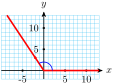
  2. angle
  3. \(\sin (180\degree - \theta) = \dfrac{9}{\sqrt{97}}\text{,}\) \(~\cos (180\degree - \theta) = \dfrac{-4}{\sqrt{97}}\)
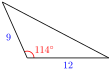
  4. \(\displaystyle \theta = 66\degree,~~180\degree - \theta = 114\degree\)

9.

Answer.
  1. \(\sin (\theta) = \dfrac{8}{\sqrt{89}}\text{,}\) \(~\cos (\theta) = \dfrac{-5}{\sqrt{89}}\)
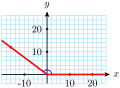
  2. angle
  3. \(\sin (180\degree - \theta) = \dfrac{8}{\sqrt{89}}\text{,}\) \(~\cos (180\degree - \theta) = \dfrac{5}{\sqrt{89}}\)
  4. \(\displaystyle \theta = 122\degree,~~180\degree - \theta = 58\degree\)

21.

Answer.
\(\theta\) \(~~~0\degree~~~\) \(~~~30\degree~~~\) \(~~~45\degree~~~\) \(~~~60\degree~~~\) \(~~~90\degree~~~\) \(~~~120\degree~~~\) \(~~~135\degree~~~\) \(~~~150\degree~~~\) \(~~~180\degree~~~\)
\(\cos (\theta)\) \(1\) \(\dfrac{\sqrt{3}}{2}\) \(\dfrac{1}{\sqrt{2}}\) \(\dfrac{1}{2}\) \(0\) \(\dfrac{-1}{2}\) \(\dfrac{1}{\sqrt{2}}~\) \(\dfrac{-\sqrt{3}}{2}\) \(-1\)
\(\sin (\theta)\) \(0\) \(\dfrac{1}{2}\) \(\dfrac{1}{\sqrt{2}}\) \(\dfrac{\sqrt{3}}{2}\) \(1\) \(\dfrac{\sqrt{3}}{2}\) \(\dfrac{1}{\sqrt{2}}\) \(\dfrac{1}{2}\) \(0\)
\(\tan (\theta)\) \(0\) \(\dfrac{1}{\sqrt{3}}\) \(1\) \(\sqrt{3}\) \(\text{undefined}\) \(-\sqrt{3}\) \(-1\) \(\dfrac{-1}{\sqrt{3}}\) \(0\)

23.

Answer.
  1. \(\displaystyle \sin (\theta) = \sin (180\degree - \theta)\)
  2. \(\displaystyle \cos (\theta) = -\cos (180\degree - \theta)\)
  3. \(\displaystyle \tan (\theta) = -\tan (180\degree - \theta)\)

27.

Answer.
  1. \(\displaystyle \theta \approx 81.2\degree,~~\phi \approx 98.8\degree\)
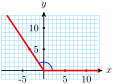
  2. angles
  3. \(\displaystyle \sin (\theta) = \sin (\phi) = \dfrac{\sqrt{156279}}{400} \approx 0.9883\)

35.

Answer.
\(\sin (123\degree) = q\text{,}\) \(~\cos (33\degree) = q\text{,}\) \(~\cos (147\degree) = -q\)

37.

Answer.
\(\cos (106\degree) = -m\text{,}\) \(~\sin (16\degree) = m\text{,}\) \(~\sin (164\degree) = m\)

63.

Answer.
Bob found an acute angle. The obtuse angle is the supplement of \(17.46\degree\text{,}\) or \(162.54\degree\text{.}\)

65.

Answer.
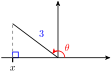
  1. triangle
  2. \(\cos (\theta) = \dfrac{x}{3}\text{,}\) \(~\sin (\theta) = \dfrac{\sqrt{9 - x^2}}{3}\text{,}\) \(~\tan (\theta) = \dfrac{\sqrt{9 - x^2}}{x}\)

67.

Answer.
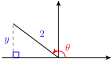
  1. triangle
  2. \(\cos (\theta) = \dfrac{-\sqrt{4 - y^2}}{2}\text{,}\) \(~\sin (\theta) = \dfrac{y}{2}\text{,}\) \(~\tan (\theta) = \dfrac{-y}{\sqrt{4 - y^2}}\)

69.

Answer.
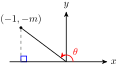
  1. triangle
  2. \(\cos (\theta) = \dfrac{-1}{\sqrt{1+ m^2}}\text{,}\) \(~\sin (\theta) = \dfrac{-m}{\sqrt{1+ m^2}}\text{,}\) \(~\tan (\theta) = m\)

3.2 The Law of Sines
Homework 3.2

15.

Answer.
triangle
\(b = 2.98\text{,}\) \(~A = 36.54\degree\text{,}\) \(~B = 99.46\degree\)

39.

Answer.
\(A = 40.44\degree,~B = 114.56\degree\) or \(A = 139.56\degree,~B = 15.44\degree\)

3.3 The Law of Cosines
Homework 3.3

27.

Answer.
Law of Cosines: \(61^2 = 29^2 + 46^2 - 2\cdot 29 \cdot 46 \cos (\phi)\)

29.

Answer.
Law of Sines: \(\dfrac{a}{\sin (46\degree)} = \dfrac{16}{\sin (25\degree)}\)

31.

Answer.
First the Law of Cosines: \(x^2 = 47^2 + 29^2 - 2 \cdot 47 \cdot 29 \cos (81\degree)\text{,}\) then either the Law of Sines: \(\dfrac{\sin (\theta)}{47} = \dfrac{\sin (81\degree)}{x}\) or the Law of Cosines: \(47^2 = x^2 + 29^2 - 2 \cdot x \cdot 29\cos (\theta)\)

33.

Answer.
Law of Cosines: \(9^2 = 4^2 + z^2 - 2\cdot 4 \cdot z \cos (28\degree)\text{,}\) or use the Law of Sines first to find the (acute) angle opposite the side of length 4, then find the angle opposite the side of length \(z\) by subtracting the sum of the known angles from \(180\degree\text{,}\) then using the Law of Sines again.

39.

Answer.
  1. triangle
  2. \(a = 116.52\text{,}\) \(~ A = 85.07\degree\text{,}\) \(~C = 56.93\degree\) or \(a = 37.93\text{,}\) \(~ A = 18.93\degree\text{,}\) \(~C = 123.07\degree\)

57.

Answer.
  1. First figure: \(b - x\) is the base of the small right triangle. Second: \(-x\) is the horizontal distance between \(P\) and the \(x\)-axis, so \(b + (-x)\) or \(b - x\) is the base of the large right triangle. Third: \(x = 0\text{,}\) and \(b\) is the base of a right triangle.
  2. First: \(x\) and \(y\) are the legs of a right triangle, \(a\) is the hypotenuse. Second: \(-x\) and \(y\) are the legs of a right triangle with hypotenuse \(a\text{.}\) Third: \(x = 0\) and \(y = a\)
  3. \(\displaystyle x = a \cos (C)\)

59.

Answer.
\begin{align*} b^2 + c^2 \amp = (a^2 + c^2 - 2ac \cos (B)) + (a^2 + b^2 - 2bc \cos (C))\\ \amp = 2a^2 + b^2 + c^2 - 2a(c \cos (B) + b \cos (C)) \end{align*}
so \(2a^2 = 2a(c \cos (B) + b \cos (C))\text{,}\) and dividing both sides by \(2a\) yields \(a = (c \cos (B) + b \cos (C)\)

61.

Answer.
For the first equation, start with the Law of Cosines in the form
\begin{equation*} a^2 = b^2 + c^2 - 2bc \cos (A) \end{equation*}
Add \(2ab + 2bc \cos (A) - a^2\) to both sides of the equation, factor the right side, then divide both sides by \(2bc\text{.}\)
For the second equation, start with the Law of Cosines in the form
\begin{equation*} b^2 + c^2 - 2bc \cos (A) = a^2 \end{equation*}
Add \(2bc - b^2 - c^2\) to both sides of the equation, factor the right side, then divide both sides by \(2bc\text{.}\)

3.4 Chapter 3 Summary and Review
Chapter 3 Review Problems

5.

Answer.
  1. triangle
  2. \(\cos (\theta) = \dfrac{-2}{\sqrt{13}}\text{,}\) \(~\sin (\theta) = \dfrac{3}{\sqrt{13}}\text{,}\) \(~\tan (\theta)= \dfrac{-3}{2} \)
  3. \(\displaystyle \theta = 123.7\degree\)

7.

Answer.
  1. triangle
  2. \(\cos (\theta) = \dfrac{-4}{5}\text{,}\) \(~\sin (\theta) = \dfrac{3}{5}\text{,}\) \(~\tan (\theta) = \dfrac{-3}{4} \)
  3. \(\displaystyle \theta = 143.1\degree\)

9.

Answer.
  1. triangle
  2. \(\cos (\theta) = \dfrac{-\sqrt{11}}{6}\text{,}\) \(~\sin (\theta) = \dfrac{5}{6}\text{,}\) \(~\tan (\theta) = \dfrac{-5}{\sqrt{11}} \)
  3. \(\displaystyle \theta = 123.6\degree\)

11.

Answer.
  1. triangle
  2. \(\cos (\theta) = \dfrac{-7}{25}\text{,}\) \(~\sin (\theta) = \dfrac{24}{25}\text{,}\) \(~\tan (\theta) = \dfrac{-24}{7} \)
  3. \(\displaystyle \theta = 106.3\degree\)

57.

Answer.
  1. \(OW\) bisects the central angle at \(O\text{,}\) and the inscribed angle \(\theta\) is half the central angle at \(O\text{.}\)
  2. \(\displaystyle \sin \theta = \dfrac{s}{2r}\)
  3. \(\displaystyle r = \dfrac{s}{2 \sin (\theta)}\)
  4. \(\displaystyle d = \dfrac{s}{\sin (\theta)}\)

4 Trigonometric Functions
4.1 Angles and Rotation
Homework 4.1

51.

Answer.
  1. angles
  2. \(\sin (120\degree) = \dfrac{\sqrt{3}}{2},~\cos (120\degree) = \dfrac{-1}{2},~\tan (120\degree) = -\sqrt{3},\)
    \(\sin (240\degree) = \dfrac{-\sqrt{3}}{2},~\cos (240\degree) = \dfrac{-1}{2},~\tan (240\degree) = \sqrt{3},\)
    \(\sin (300\degree) = \dfrac{-\sqrt{3}}{2},~\cos (300\degree) = \dfrac{1}{2},~\tan (300\degree) = -\sqrt{3}\)

53.

Answer.
  1. angles
  2. \(\sin (135\degree) = \dfrac{1}{\sqrt{2}},~\cos (135\degree) = \dfrac{-1}{\sqrt{2}},~(\tan 135\degree) = -1,\)
    \(\sin (225\degree) = \dfrac{-1}{\sqrt{2}},~\cos (225\degree) = \dfrac{-1}{\sqrt{2}},~\tan (225\degree) = 1,\)
    \(\sin (315\degree) = \dfrac{-1}{\sqrt{2}},~\cos (315\degree) = \dfrac{1}{\sqrt{2}},~\tan (315\degree) = -1\)

4.2 Graphs of Trigonometric Functions
Homework 4.2

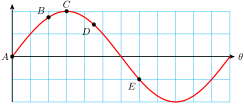
5.

Answer.
  1. \(\displaystyle \left(-225\degree, \dfrac{1}{\sqrt{2}}\right)\)
  2. \(\displaystyle \left(-135\degree, \dfrac{-1}{\sqrt{2}}\right)\)
  3. \(\displaystyle (-90\degree, -1)\)
  4. \(\displaystyle \left(45\degree, \dfrac{1}{\sqrt{2}}\right)\)
  5. \(\displaystyle (180\degree, 0)\)
  6. \(\displaystyle \left(315\degree, \dfrac{-1}{\sqrt{2}}\right)\)

7.

Answer.
  1. \(\displaystyle \left(-240\degree, \dfrac{-1}{2}\right)\)
  2. \(\displaystyle \left(-210\degree, \dfrac{-\sqrt{3}}{2}\right)\)
  3. \(\displaystyle \left(-60\degree, \dfrac{-1}{2}\right)\)
  4. \(\displaystyle \left(30\degree, \dfrac{\sqrt{3}}{2}\right)\)
  5. \(\displaystyle \left(120\degree, \dfrac{-1}{2}\right)\)
  6. \(\displaystyle \left(270\degree, 0\right)\)

9.

Answer.
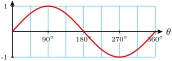
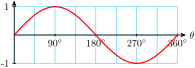
  1. \(\theta\) \(0\degree\) \(90\degree\) \(180\degree\) \(270\degree\) \(360\degree\)
    \(f(\theta)\) \(0\) \(1\) \(0\) \(-1\) \(0\)
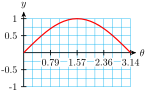
    cosine graph
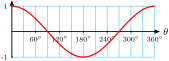
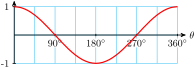
  2. \(\theta\) \(0\degree\) \(90\degree\) \(180\degree\) \(270\degree\) \(360\degree\)
    \(f(\theta)\) \(1\) \(0\) \(-1\) \(0\) \(1\)
    cosine graph

23.

Answer.
  1. \(\theta\) \(81\degree\) \(82\degree\) \(83\degree\) \(84\degree\) \(85\degree\) \(86\degree\) \(87\degree\) \(88\degree\) \(89\degree\)
    \(\tan (\theta)\) \(6.314\) \(7.115\) \(8.144\) \(9.514\) \(11.43\) \(14.301\) \(19.081\) \(28.636\) \(57.29\)
  2. \(\displaystyle \tan (\theta)~ \text{approaches}~ \infty\)
  3. \(\theta\) \(99\degree\) \(98\degree\) \(97\degree\) \(96\degree\) \(95\degree\) \(94\degree\) \(93\degree\) \(92\degree\) \(91\degree\)
    \(\tan (\theta)\) \(-6.314\) \(-7.115\) \(-8.144\) \(-9.514\) \(-11.43\) \(-14.301\) \(-19.081\) \(-28.636\) \(-57.29\)
  4. \(\displaystyle \tan (\theta)~ \text{approaches}~ -\infty\)
  5. The calculator gives an error message because \(\tan (90\degree)\) is undefined.

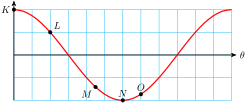
37.

Answer.
\(A(0\degree, -3)\text{,}\) \(~B\left(135\degree, \dfrac{3}{\sqrt{2}}\right)\text{,}\) \(~C\left(300\degree, \dfrac{-3}{2}\right)\)

39.

Answer.
\(P(112.5\degree, 1)\text{,}\) \(~Q(180\degree, 0)\text{,}\) \(~R(337.5\degree,-1)\)

41.

Answer.
\(X\left(45\degree, -3 + \dfrac{1}{\sqrt{2}}\right)\text{,}\) \(~Y(90\degree, -3)\text{,}\) \(~Z(300\degree,-2)\)

43.

Answer.
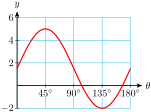
amp\(= 4\text{,}\) period \(= 360\degree\text{,}\) midline: \(y = 3\)

45.

Answer.
amp\(= 5\text{,}\) period \(= 180\degree\text{,}\) midline: \(y = 0\)

47.

Answer.
amp\(= 3\text{,}\) period \(= 120\degree\text{,}\) midline: \(y = -4\)

4.3 Using Trigonometric Functions
Homework 4.3

47.

Answer.
\(y + 5 = (\tan 28\degree)(x - 3)~\) or \(~y + 5 = 0.532(x - 3)\)

49.

Answer.
\(y - 12 = (\tan 112\degree)(x + 8)~\) or \(~y - 12 = -2.475(x + 8)\)

69.

Answer.
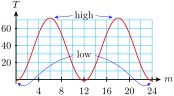
  1. Emotional high: Oct 5 and Nov 3, low: Oct 19; Physical high: Sep 30 and Oct 23, low: Oct 12 and Nov 4; Intellectual high: Oct 10, low: Oct 26
  2. Emotional: 28 days, physical: 23 days, intellectual: 32 days
  3. 5152 days

4.4 Chapter 4 Summary and Review
Chapter 4 Review Problems

5.

Answer.
  1. \(\displaystyle I,~60\degree;~ 120\degree,~ 240\degree,~ 300\degree\)
  2. \(\displaystyle IV,~25\degree;~ 155\degree,~ 205\degree,~ 335\degree\)
  3. \(\displaystyle II,~80\degree;~ 80\degree,~ 260\degree,~ 280\degree\)
  4. \(\displaystyle III,~70\degree;~ 70\degree,~ 110\degree,~ 290\degree\)

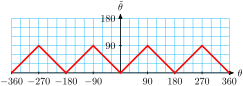
7.

Answer.
  1. \(\theta\) \(30\degree\) \(60\degree\) \(90\degree\) \(120\degree\) \(150\degree\) \(180\degree\) \(210\degree\) \(240\degree\) \(270\degree\) \(300\degree\) \(330\degree\) \(360\degree\)
    \(f(\theta)\) \(30\) \(60\) \(90\) \(60\) \(30\) \(0\) \(30\) \(60\) \(90\) \(60\) \(30\) \(0\)
  2. graph of referance angle vs angle

43.

Answer.
\(y = 1.5 \cos (\dfrac{\theta}{3}),~ M(-90\degree, \dfrac{3\sqrt{3}}{4}), N(180\degree, \dfrac{3}{4})\)

45.

Answer.
\(y = 3 + 3 \sin 2\theta,~ A(-45\degree, 6), B(120\degree, 3 - \dfrac{3\sqrt{3}}{2})\)

63.

Answer.
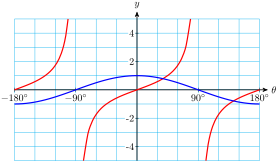
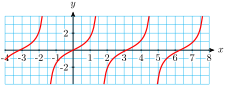
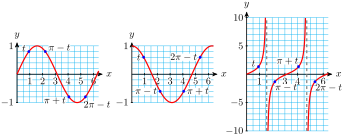
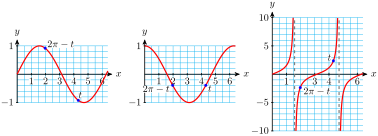
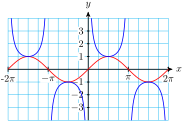
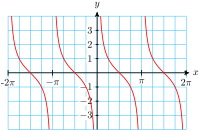
cosine and tangent graphs
The \(\theta\)-intercepts of \(\cos \theta\) occur at the vertical asymptotes of \(\tan \theta\text{.}\)

5 Equations and Identities
5.1 Algebra with Trigonometric Ratios
Homework 5.1

5.2 Solving Equations
Homework 5.2

5.

Answer.
I: \(18\degree;\) II: \(162\degree;\) III: \(198\degree;\) IV: \(342\degree\)

7.

Answer.
I: \(52\degree;\) II: \(128\degree;\) III: \(232\degree;\) IV: \(308\degree\)

29.

Answer.
\(\theta = 60\degree, ~\theta = 120\degree,~\theta = 240\degree,~\) or \(~ \theta = 300\degree\)

31.

Answer.
\(\theta = 45\degree,~\theta = 135\degree,~\theta = 225\degree, ~\) or \(~ \theta = 315\degree\)

53.

Answer.
\(\theta = 54.74\degree, ~\theta = 125.26\degree,~\theta = 234.74\degree,~\) or \(~ \theta = 305.26\degree\)

55.

Answer.
\(\theta = 0\degree\text{,}\) \(~\theta = 180\degree\text{,}\) \(~\theta = 191.54\degree,~\) or \(~ \theta = 348.46\degree\)

57.

Answer.
\(\theta = 60\degree\text{,}\) \(~ \theta = 180\degree\text{,}\) or \(~ \theta = 300\degree\)

59.

Answer.
\(\theta = 26.57\degree\text{,}\) \(~\theta = 161.57\degree\text{,}\) \(~\theta = 206.57\degree\text{,}\) or \(~ \theta = 341.57\degree\)

61.

Answer.
\(\theta = 78.69\degree\text{,}\) \(~\theta = 108.43\degree\text{,}\) \(~\theta = 258.69\degree\text{,}\) or \(~ \theta = 288.43\degree\)

5.3 Trigonometric Identities
Homework 5.3

19.

Answer.
\begin{equation*} \begin{aligned}[t] \Big(\cos (\theta) - \sin (\theta)\Big)^2 \amp = \cos^2 (\theta) - 2\cos (\theta) \sin (\theta) + \sin^2 (\theta)\\ \amp = \Big(\cos^2 (\theta )+ \sin^2 (\theta)\Big) - 2\sin(\theta) \cos (\theta) = 1 - 2\sin(\theta) \cos (\theta)\\ \end{aligned} \end{equation*}

21.

Answer.
\(\tan (\theta) \cos (\theta) = \dfrac{\sin (\theta)}{\cos (\theta)}\cdot \cos (\theta) = \sin (\theta) \)

23.

Answer.
\begin{equation*} \begin{aligned}[t] \cos^4 (x) - \sin^4 (x) \amp = \Big(\cos^2 (x) - \sin^2 (x)\Big)\Big(\cos^2 (x) + \sin^2 (x)\Big)\\ \amp = \Big(\cos^2 (x) - \sin^2 (x)\Big)(1) = \cos^2 (x) - \sin^2 (x)\\ \end{aligned} \end{equation*}

25.

Answer.
\(\dfrac{\sin (u)}{1 + \cos (u)} \cdot \dfrac{1 - \cos (u)}{1 - \cos (u)} = \dfrac{\sin (u)\Big(1 - \cos (u)\Big)}{1 - \cos^2 (u)} = \dfrac{\sin (u)\Big(1 - \cos (u)\Big)}{\sin^2 (u)} = \dfrac{1 - \cos (u)}{\sin (u)}\)

51.

Answer.
\(\theta = 90\degree, ~\theta = 180\degree, ~\theta = 270\degree\)

53.

Answer.
\(\theta = 90\degree, ~\theta = 210\degree, ~\theta = 330\degree\)

61.

Answer.
\(\cos (\phi) = \dfrac{-4\sqrt{3}}{7},~ \tan (\phi) = \dfrac{-1}{4\sqrt{3}}\)

63.

Answer.
\(\sin (\theta) =\dfrac{-1}{\sqrt{5}}\text{,}\) \(~ \cos (\theta) = \dfrac{2}{\sqrt{5}}\)

65.

Answer.
\(\sin (\theta) =\dfrac{-3}{5}\text{,}\) \(~ \cos (\theta) = \dfrac{-4}{5}\)

67.

Answer.
\(\sin (\theta) =\dfrac{\sqrt{3}}{2}\text{,}\) \(~ \cos (\theta) = \dfrac{-1}{2}\text{,}\) \(~ \tan (\theta) = \sqrt{3}\)

69.

Answer.
\(\sin (\beta) =\dfrac{2}{\sqrt{5}}\text{,}\) \(~ \cos (\beta) = \dfrac{-1}{\sqrt{5}}\text{,}\) \(~ \tan (\beta) = -2\)

71.

Answer.
\begin{equation*} \begin{aligned}[t] \amp \sin (C) =\dfrac{1}{\sqrt{5}},~ \cos (C) = \dfrac{2}{\sqrt{5}},~ \tan (C) = \dfrac{1}{2}\\ \text{or}~~\amp \sin (C) =\dfrac{1}{\sqrt{5}},~ \cos (C) = \dfrac{-2}{\sqrt{5}},~ \tan (C) = \dfrac{-1}{2}\\ \end{aligned} \end{equation*}

73.

Answer.
\(\dfrac{\tan (\alpha)}{1 + \tan (\alpha)} = \dfrac{\dfrac{\sin (\alpha)}{\cos (\alpha)}}{1 + \dfrac{\sin (\alpha)}{\cos (\alpha)}} \cdot \dfrac{\cos (\alpha)}{\cos (\alpha)} = \dfrac{\sin (\alpha)}{\sin (\alpha) + \cos (\alpha)}\)

75.

Answer.
\(\dfrac{1 + \tan^2 (\beta)}{1 - \tan^2 (\beta)} = \dfrac{\dfrac{1}{\cos^2 (\beta)}}{1 - \dfrac{\sin^2 (\beta)}{\cos^2 (\beta)}} \cdot \dfrac{\cos^2 (\beta)}{\cos^2 (\beta)} = \dfrac{1}{\cos^2 (\beta) - \sin^2 (\beta)}\)

77.

Answer.
angle
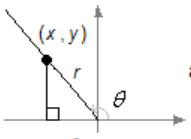
  1. By the distance formula, \(\sqrt{x^2 + y^2} = r\text{,}\) or \(x^2 + y^2 = r^2\text{.}\)
  2. \(\displaystyle \dfrac{x^2}{r^2} + \dfrac{y^2}{r^2} = 1\)
  3. \(\displaystyle \left(\dfrac{x}{r}\right)^2 + \left(\dfrac{y}{r}\right)^2 = 1\)
  4. \(\displaystyle \Big(\cos (\theta)\Big)^2 + \Big(\sin (\theta)\Big)^2 = 1\)

5.4 Chapter 5 Summary and Review
Chapter 5 Review Problems

33.

Answer.
\(90\degree\text{,}\) \(~ 270\degree\text{,}\) \(~ 120\degree\text{,}\) \(~ 240\degree\)

37.

Answer.
\(30\degree\text{,}\) \(~ 150\degree\text{,}\) \(~ 210\degree\text{,}\) \(~ 330\degree\)

55.

Answer.
\(\dfrac{1 - \cos^2 (\alpha)}{\tan (\alpha)} = \sin^2 (\alpha) \cdot \dfrac{\cos (\alpha)}{\sin (\alpha)} = \sin (\alpha) \cos (\alpha)\)

57.

Answer.
\begin{equation*} \begin{aligned}[t] \dfrac{\dfrac{\sin (\theta)}{\cos (\theta)} - \sin (\theta) \cos (\theta)}{\sin (\theta) \cdot \dfrac{\sin (\theta)}{\cos (\theta)}} \amp = \dfrac{\sin (\theta) - \sin (\theta) \cos^2 (\theta)}{\sin^2 (\theta)}\\ \amp = \dfrac{\sin (\theta) \Big(1 - \cos^2 (\theta)\Big)}{\sin^2 (\theta)} = \dfrac{\sin (\theta) \sin^2 (\theta)}{\sin^2 (\theta)} = \sin (\theta)\\ \end{aligned} \end{equation*}

71.

Answer.
\(\sin (\beta) = \dfrac{-6}{\sqrt{85}},~ \cos (\beta) = \dfrac{-7}{\sqrt{85}},~ \tan (\beta) = \dfrac{6}{7}\)

73.

Answer.
\(\sin (\alpha) = \dfrac{\sqrt{21}}{5},~ \cos (\alpha) = \dfrac{-2}{5},~ \tan (\alpha) = \dfrac{-\sqrt{21}}{2}\)

6 Radians
6.1 Arclength and Radians
Homework 6.1

1.

Answer.
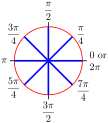
Radians \(0\) \(\dfrac{\pi}{4}\) \(\dfrac{\pi}{2}\) \(\dfrac{3\pi}{4}\) \(\pi\) \(\dfrac{5\pi}{4}\) \(\dfrac{3\pi}{2}\) \(\dfrac{7\pi}{4}\) \(2 \pi\)
Degrees \(0\degree\) \(45\degree\) \(90\degree\) \(135\degree\) \(180\degree\) \(225\degree\) \(270\degree\) \(315\degree\) \(360\degree\)
circle

3.

Answer.
  1. \(\displaystyle 120\degree = \dfrac{2\pi}{3} \text{radians}\)
  2. \(\displaystyle 240\degree = \dfrac{4\pi}{3} \text{radians}\)
  3. \(\displaystyle 480\degree = \dfrac{8\pi}{3} \text{radians}\)
  4. \(\displaystyle 600\degree = \dfrac{10\pi}{3} \text{radians}\)

5.

Answer.
  1. \(\displaystyle 45\degree = \dfrac{\pi}{4} \text{radians}\)
  2. \(\displaystyle 135\degree = \dfrac{3\pi}{4} \text{radians}\)
  3. \(\displaystyle 225\degree = \dfrac{5\pi}{4} \text{radians}\)
  4. \(\displaystyle 315\degree = \dfrac{7\pi}{4} \text{radians}\)

25.

Answer.
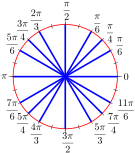
Radians \(\dfrac{\pi}{6}\) \(\dfrac{\pi}{4}\) \(\dfrac{\pi}{3}\)
Degrees \(30\degree\) \(45\degree\) \(60\degree\)

27.

Answer.
Radians \(\dfrac{7\pi}{6}\) \(\dfrac{5\pi}{4}\) \(\dfrac{4\pi}{3}\)
Degrees \(210\degree\) \(225\degree\) \(240\degree\)

51.

Answer.
unit circle
\(\left(\dfrac{-\sqrt{3}}{2}, \dfrac{1}{2}\right)\text{,}\) \(~\left(\dfrac{-\sqrt{3}}{2}, \dfrac{-1}{2}\right)\)

6.2 The Circular Functions
Homework 6.2

1.

Answer.
\(\hphantom{0000}\) a b c d
\(t\) \(\dfrac{\pi}{4}\) \(\dfrac{3\pi}{4}\) \(\dfrac{5\pi}{4}\) \(\dfrac{7\pi}{4}\)
\(x\) \(\dfrac{1}{\sqrt{2}}\) \(\dfrac{-1}{\sqrt{2}}\) \(\dfrac{-1}{\sqrt{2}}\) \(\dfrac{1}{\sqrt{2}}\)
\(y\) \(\dfrac{1}{\sqrt{2}}\) \(\dfrac{1}{\sqrt{2}}\) \(\dfrac{-1}{\sqrt{2}}\) \(\dfrac{-1}{\sqrt{2}}\)

3.

Answer.
\(\hphantom{0000}\) a b c d
\(t\) \(\dfrac{\pi}{3}\) \(\dfrac{2\pi}{3}\) \(\dfrac{4\pi}{3}\) \(\dfrac{5\pi}{3}\)
\(x\) \(\dfrac{1}{2}\) \(\dfrac{-1}{2}\) \(\dfrac{-1}{2}\) \(\dfrac{1}{2}\)
\(y\) \(\dfrac{\sqrt{3}}{2}\) \(\dfrac{\sqrt{3}}{2}\) \(\dfrac{-\sqrt{3}}{2}\) \(\dfrac{-\sqrt{3}}{2}\)

5.

Answer.
  1. \(\displaystyle \sin (0.4) \approx 0.39,~ \cos (0.4) \approx 0.92,~ \tan (0.4) \approx 0.42\)
  2. \(\displaystyle \sin (1.2) \approx 0.93,~ \cos (1.2) \approx 0.36,~ \tan (1.2) \approx 2.6\)
  3. \(\displaystyle \sin (2) \approx 0.91,~ \cos (2) \approx -0.42,~ \tan (2) \approx -2.2\)

7.

Answer.
  1. \(\displaystyle \sin (2.8) \approx 0.33,~ \cos (2.8) \approx -0.94,~ \tan (2.8) \approx -0.36\)
  2. \(\displaystyle \sin (3.5) \approx -0.35,~ \cos (3.5) \approx -0.94,~ \tan (3.5) \approx 0.37\)
  3. \(\displaystyle \sin (5) \approx -0.96,~ \cos (5) \approx 0.28,~ \tan (5) \approx -3.3\)

27.

Answer.
\(\sin (3.5)\text{,}\) \(\sin (0.5)\text{,}\) \(\sin (2.5)\text{,}\) \(\sin (1.5)\)

29.

Answer.
\(\cos (3)\text{,}\)\(\cos (4)\text{,}\) \(\cos (2)\text{,}\) \(\cos (5)\)

47.

Answer.
\(~\theta~\) \(~~~\sin (\theta)~~~\) \(~~~\cos (\theta)~~~\) \(~~~\tan (\theta)~~~\)
\(\dfrac{7\pi}{6}\) \(\dfrac{-1}{2}\) \(\dfrac{-\sqrt{3}}{2}\) \(\dfrac{1}{\sqrt{3}}\)
\(\dfrac{5\pi}{4}\) \(\dfrac{-1}{\sqrt{2}}\) \(\dfrac{-1}{\sqrt{2}}\) \(1\)
\(\dfrac{4\pi}{3}\) \(\dfrac{-\sqrt{3}}{2}\) \(\dfrac{-1}{2}\) \(\sqrt{3}\)

59.

Answer.
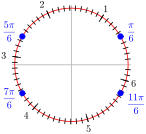
\(\cos (5) \approx 0.28\) mi east, \(\sin (5) \approx -0.96\) mi north, or about 0.96 mi south

67.

Answer.
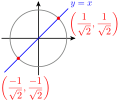
  1. circle
    Intersections: \(\left(\dfrac{1}{\sqrt{2}},\dfrac{1}{\sqrt{2}}\right)\) and \(\left(\dfrac{-1}{\sqrt{2}},\dfrac{-1}{\sqrt{2}}\right)\)
  2. \((\cos\left(\dfrac{\pi}{4}\right),\sin\left(\dfrac{\pi}{4}\right))\) and \(\left(\cos\left(\dfrac{5\pi}{4}\right),\sin\left(\dfrac{5\pi}{4}\right)\right)\)

75.

Answer.
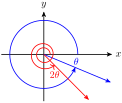
Any point \((x,y)\) on the terminal side of \(\theta\) satisfies \(\cos (\theta) = \dfrac{x}{r}\text{,}\) \(~ \sin (\theta) = \dfrac{y}{r}\text{.}\) For the point \(P\) where \(r = 1\text{,}\) \(~\cos (\theta) = x\text{,}\) \(~\sin (\theta) = y\text{.}\) The arc of length \(t\) is spanned by an angle \(\theta\) in standard position. Because arclength is \(r\theta\) and \(r = 1\text{,}\) \(~ t = \theta,\) so \(x = \cos (t)\text{,}\) \(~ y = \sin (t)\text{.}\)

77.

Answer.
The two right triangles shown are similar, so their sides are proportional. The hypotenuse of the large triangle is \(r\) times the hypotenuse of the small triangle, so the two legs of the large triangle must be \(r\) times the legs of the small triangle. Thus, because the coordinates of the vertex on the unit circle are \((\cos (\theta), \sin (\theta))\text{,}\) the coordinates of \(P\) must be \((r\cos (\theta), r\sin (\theta))\text{.}\)

6.3 Graphs of the Circular Functions
Homework 6.3

1.

Answer.
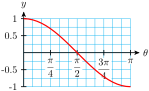
  1. \(\theta\) \(0\) \(\dfrac{\pi}{12}\) \(\dfrac{\pi}{6}\) \(\dfrac{\pi}{4}\) \(\dfrac{\pi}{3}\) \(\dfrac{5\pi}{12}\) \(\dfrac{\pi}{2}\) \(\dfrac{7\pi}{12}\) \(\dfrac{2\pi}{3}\) \(\dfrac{3\pi}{4}\) \(\dfrac{5\pi}{6}\) \(\dfrac{11\pi}{12}\) \(\pi\)
    \(\cos (\theta)\) \(1\) \(0.97\) \(0.87\) \(0.71\) \(0.50\) \(0.26\) \(0\) \(-0.26\) \(-0.50\) \(-0.71\) \(-0.87\) \(-0.97\) \(-1\)
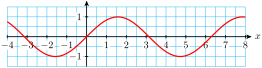
  2. cosine graph

61.

Answer.
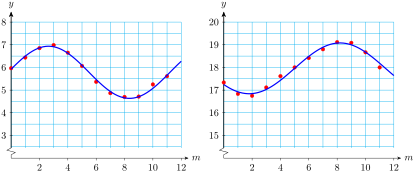
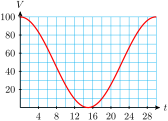
sinusoidal graph
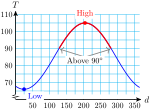
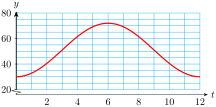
d. High: day 204, \(105\degree\text{;}\) low: day 25, \(66\degree\) e. \(d \approx 128\) to \(d \approx 281\)

79.

Answer.
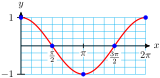
  1. \(x\) \(0\) \(\dfrac{\pi}{2}\) \(\pi\) \(\dfrac{3\pi}{2}\) \(2\pi\)
    \(\cos (x)\) \(1\) \(0\) \(-1\) \(0\) \(1\)
    cosine graph
  2. Domain: \((-\infty, \infty) \text{,}\) Range: \([-1,1]\)

6.4 Chapter 6 Summary and Review
Chapter 6 Review Problems

23.

Answer.
  1. \(\displaystyle (r \cos (\alpha), r \sin (\alpha))\)
  2. \(\displaystyle (-r \cos (\alpha), r \sin (\alpha))\)
  3. \(\displaystyle (-r \cos (\alpha), -r \sin (\alpha))\)
  4. \(\displaystyle (r \cos (\alpha), -r \sin (\alpha))\)

7 Circular Functions
7.1 Transformations of Graphs
Homework 7-1

1.

Answer.
amplitude \(2\text{,}\) period \(2\pi\text{,}\) midline \(y=-3\)

3.

Answer.
amplitude \(1\text{,}\) period \(\dfrac{\pi}{2}\text{,}\) midline \(y=0\)

5.

Answer.
amplitude \(5\text{,}\) period \(6\pi\text{,}\) midline \(y=0\)

31.

Answer.
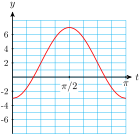
  1. \(t\) \(2t\) \(\cos (2t)\) \(-5\cos (2t)\) \(2-5\cos (2t)\)
    \(0\) \(0\) \(1\) \(-5\) \(-3\)
    \(\dfrac{\pi}{4}\) \(\dfrac{\pi}{2}\) \(0\) \(0\) \(2\)
    \(\dfrac{\pi}{2}\) \(\pi\) \(-1\) \(5\) \(7\)
    \(\dfrac{3\pi}{4}\) \(\dfrac{3\pi}{2}\) \(0\) \(0\) \(2\)
    \(\pi\) \(2\pi\) \(1\) \(-5\) \(-3\)
  2. sinusoidal graph

33.

Answer.
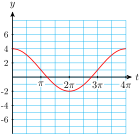
  1. \(t\) \(\dfrac{t}{2}\) \(\cos \left(\dfrac{t}{2}\right)\) \(3\cos \left(\dfrac{t}{2}\right)\) \(1+3\cos \left(\dfrac{t}{2}\right)\)
    \(0\) \(0\) \(1\) \(3\) \(4\)
    \(\pi\) \(\dfrac{\pi}{2}\) \(0\) \(0\) \(1\)
    \(2\pi\) \(\pi\) \(-1\) \(-3\) \(-2\)
    \(3\pi\) \(\dfrac{3\pi}{2}\) \(0\) \(0\) \(1\)
    \(4\pi\) \(2\pi\) \(1\) \(3\) \(4\)
  2. sinusoidal graph

35.

Answer.
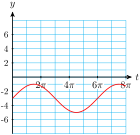
  1. \(t\) \(\dfrac{t}{3}\) \(\sin \left(\dfrac{t}{3}\right)\) \(2\sin \left(\dfrac{t}{3}\right)\) \(-3+2\sin \left(\dfrac{t}{3}\right)\)
    \(0\) \(0\) \(0\) \(0\) \(-3\)
    \(\dfrac{3\pi}{2}\) \(\dfrac{\pi}{2}\) \(1\) \(2\) \(-1\)
    \(3\pi\) \(\pi\) \(0\) \(0\) \(-3\)
    \(\dfrac{9\pi}{2}\) \(\dfrac{3\pi}{2}\) \(-1\) \(-2\) \(-5\)
    \(6\pi\) \(2\pi\) \(0\) \(0\) \(-3\)
  2. sinusoidal graph

53.

Answer.
  1. \(x\) \(\dfrac{-\pi}{4}\) \(\dfrac{-\pi}{8}\) \(0\) \(\dfrac{\pi}{8}\) \(\dfrac{\pi}{4}\)
    \(\tan 2x\) undef \(-1\) \(0\) \(1\) undef
    transformed tangent function
  2. period \(\dfrac{\pi}{2}\text{,}\) midline \(y=0\)

55.

Answer.
  1. \(x\) \(\dfrac{-\pi}{6}\) \(\dfrac{-\pi}{12}\) \(0\) \(\dfrac{\pi}{12}\) \(\dfrac{\pi}{6}\)
    \(4+2\tan 3x\) undef \(2\) \(0\) \(6\) undef
    transformed tangent graph
  2. period \(\dfrac{\pi}{3}\text{,}\) midline \(y=4\)

57.

Answer.
  1. \(x\) \(-2\pi\) \(-\pi\) \(0\) \(\pi\) \(2\pi\)
    \(3-\tan \left(\dfrac{x}{4}\right)\) undef \(4\) \(0\) \(2\) undef
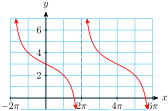
    transformed tangent graph
  2. period \(4\pi\text{,}\) midline \(y=3\)

59.

Answer.
\(\dfrac{\pi}{12}\text{,}\) \(~\dfrac{5\pi}{12}\text{,}\) \(~\dfrac{7\pi}{12}\text{,}\) \(~\dfrac{11\pi}{12}\text{,}\) \(~\dfrac{13\pi}{12}\text{,}\) \(~\dfrac{17\pi}{12}\text{,}\) \(~\dfrac{19\pi}{12}\text{,}\) \(~\dfrac{23\pi}{12}\)

61.

Answer.
\(\dfrac{7\pi}{12}\text{,}\) \(~\dfrac{11\pi}{12}\text{,}\) \(~\dfrac{19\pi}{12}\text{,}\) \(~\dfrac{23\pi}{12}\)

63.

Answer.
\(\dfrac{\pi}{12}\text{,}\) \(~\dfrac{5\pi}{12}\text{,}\) \(~\dfrac{3\pi}{4}\text{,}\) \(~\dfrac{13\pi}{12}\text{,}\) \(~\dfrac{17\pi}{12}\text{,}\) \(~\dfrac{7\pi}{4}\)

7.2 The General Sinusoidal Function
Homework 7-2

1.

Answer.
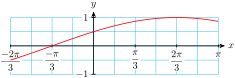
  1. \(x\) \(-\pi\) \(\dfrac{-5\pi}{6}\) \(\dfrac{-2\pi}{3}\) \(\dfrac{-\pi}{2}\) \(\dfrac{-\pi}{3}\) \(\dfrac{-\pi}{6}\) \(0\) \(\dfrac{\pi}{6}\) \(\dfrac{\pi}{3}\) \(\dfrac{\pi}{2}\) \(\dfrac{2\pi}{3}\) \(\dfrac{5\pi}{6}\) \(\pi\)
    \(f(x)\) \(0\) \(\dfrac{-1}{2}\) \(\dfrac{-\sqrt{3}}{2}\) \(-1\) \(\dfrac{-\sqrt{3}}{2}\) \(\dfrac{-1}{2}\) \(0\) \(\dfrac{1}{2}\) \(\dfrac{\sqrt{3}}{2}\) \(1\) \(\dfrac{\sqrt{3}}{2}\) \(\dfrac{1}{2}\) \(0\)
    \(g(x)\) \(\dfrac{\sqrt{3}}{2}\) \(\dfrac{1}{2}\) \(0\) \(\dfrac{-1}{2}\) \(\dfrac{-\sqrt{3}}{2}\) \(-1\) \(\dfrac{-\sqrt{3}}{2}\) \(\dfrac{-1}{2}\) \(0\) \(\dfrac{1}{2}\) \(\dfrac{\sqrt{3}}{2}\) \(1\) \(\dfrac{\sqrt{3}}{2}\)
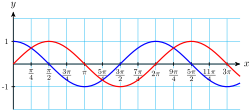
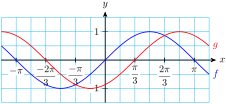
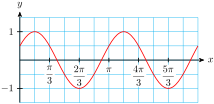
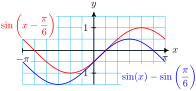
  2. sine and translated sine
  3. \(\dfrac{\pi}{3}\) to the right
  4. \(\displaystyle \dfrac{5\pi}{6}\)
  5. \(\displaystyle \dfrac{-2\pi}{3},~\dfrac{\pi}{3}\)

3.

Answer.
  1. \(x\) \(-\pi\) \(\dfrac{-3\pi}{4}\) \(\dfrac{-\pi}{2}\) \(\dfrac{-\pi}{4}\) \(0\) \(\dfrac{\pi}{4}\) \(\dfrac{\pi}{2}\) \(\dfrac{3\pi}{4}\) \(\pi\)
    \(f(x)\) \(0\) \(1\) undef \(-1\) \(0\) \(1\) undef \(-1\) \(0\)
    \(g(x)\) \(1\) undef \(-1\) \(0\) \(1\) undef \(-1\) \(0\) \(1\)
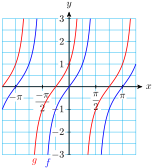
  2. translated tangent function
  3. \(\dfrac{\pi}{4}\) to the left
  4. \(\displaystyle -\pi,~ 0,~ \pi\)
  5. \(\displaystyle \dfrac{-\pi}{4},~\dfrac{-3\pi}{4}\)

5.

Answer.
  1. amplitude 2, shift \(\dfrac{\pi}{6}\) to the left
  2. \(x\) \(x+\dfrac{\pi}{6}\) \(\cos\left(x+\dfrac{\pi}{6}\right) \) \(-2\cos\left(x+\dfrac{\pi}{6}\right)\)
    \(\dfrac{-7\pi}{6}\) \(-\pi\) \(-1\) \(2\)
    \(\dfrac{-2\pi}{3}\) \(\dfrac{-\pi}{2}\) \(0\) \(0\)
    \(\dfrac{-\pi}{6}\) \(0\) \(1\) \(-2\)
    \(\dfrac{\pi}{3}\) \(\dfrac{\pi}{2}\) \(0\) \(0\)
    \(\dfrac{5\pi}{6}\) \(\pi\) \(-1\) \(2\)
    \(\dfrac{4\pi}{3}\) \(\dfrac{3\pi}{2}\) \(0\) \(0\)
    \(\dfrac{11\pi}{6}\) \(2\pi\) \(1\) \(-2\)
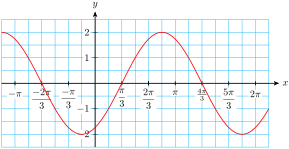
  3. sinusoidal graph
  4. \(\displaystyle \dfrac{\pi}{2},~ \dfrac{7\pi}{6}\)
  5. \(\displaystyle \dfrac{\pi}{3},~ \dfrac{4\pi}{3}\)

11.

Answer.
  1. period \(\pi\text{,}\) shift \(\dfrac{\pi}{6}\) to the right
  2. \(x\) \(2x\) \(2x-\dfrac{\pi}{3} \) \(\cos\left(2x-\dfrac{\pi}{3}\right)\)
    \(\dfrac{\pi}{6}\) \(\dfrac{\pi}{3}\) \(0\) \(1\)
    \(\dfrac{5\pi}{12}\) \(\dfrac{5\pi}{6}\) \(\dfrac{\pi}{2}\) \(0\)
    \(\dfrac{2\pi}{3}\) \(\dfrac{4\pi}{3}\) \(\pi\) \(-1\)
    \(\dfrac{11\pi}{12}\) \(\dfrac{11\pi}{6}\) \(\dfrac{3\pi}{2}\) \(0\)
    \(\dfrac{7\pi}{6}\) \(\dfrac{7\pi}{3}\) \(2\pi\) \(1\)
  3. sinusoidal graph
  4. \(\displaystyle \dfrac{\pi}{6},~ \dfrac{7\pi}{6}\)
  5. \(\displaystyle \dfrac{5\pi}{12},~ \dfrac{11\pi}{12},~ \dfrac{13\pi}{6},~ \dfrac{23\pi}{12}\)

13.

Answer.
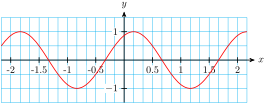
  1. period 2, shift \(\dfrac{1}{3}\) to the left
  2. \(x\) \(\pi x\) \(\pi x+\dfrac{\pi}{3} \) \(\sin\left(\pi x+\dfrac{\pi}{3}\right)\)
    \(\dfrac{-1}{3}\) \(\dfrac{-\pi}{3}\) \(0\) \(0\)
    \(\dfrac{1}{6}\) \(\dfrac{\pi}{6}\) \(\dfrac{\pi}{2}\) \(1\)
    \(\dfrac{2}{3}\) \(\dfrac{2\pi}{3}\) \(\pi\) \(0\)
    \(\dfrac{7}{6}\) \(\dfrac{7\pi}{6}\) \(\dfrac{3\pi}{2}\) \(-1\)
    \(\dfrac{5}{3}\) \(\dfrac{5\pi}{3}\) \(2\pi\) \(0\)
  3. sinusoidal graph
  4. \(\displaystyle \dfrac{-11}{6},~ \dfrac{1}{6}\)
  5. \(\displaystyle \dfrac{-4}{3},~ \dfrac{-1}{3},~ \dfrac{2}{3},~ \dfrac{5}{3}\)

15.

Answer.
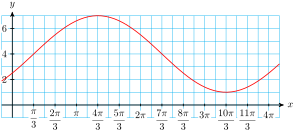
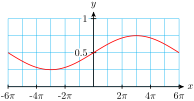
  1. midline \(y=4\text{,}\) period \(4\pi\text{,}\) horizontal shift \(\dfrac{\pi}{3}\) to the right, amplitude 3
  2. \(x\) \(\dfrac{x}{2}\) \(\dfrac{x}{2}-\dfrac{\pi}{6} \) \(\sin\left(\dfrac{x}{2}-\dfrac{\pi}{6}\right)\) \(3\sin\left(\dfrac{x}{2}-\dfrac{\pi}{6}\right)+4\)
    \(\dfrac{\pi}{3}\) \(\dfrac{\pi}{6}\) \(0\) \(0\) \(4\)
    \(\dfrac{4\pi}{3}\) \(\dfrac{2\pi}{3}\) \(\dfrac{\pi}{2}\) \(1\) \(7\)
    \(\dfrac{7\pi}{3}\) \(\dfrac{7\pi}{6}\) \(\pi\) \(0\) \(3\)
    \(\dfrac{10\pi}{3}\) \(\dfrac{5\pi}{3}\) \(\dfrac{3\pi}{2}\) \(-1\) \(1\)
    \(\dfrac{13\pi}{3}\) \(\dfrac{13\pi}{6}\) \(2\pi\) \(0\) \(4\)
  3. sinusoidal graph
  4. no solution for \(0 \le x \le 2\pi\)
  5. \(\displaystyle \dfrac{\pi}{3}\)

25.

Answer.
  1. \(\displaystyle f(x)=4\sin \left[\dfrac{1}{4}\left(x-\dfrac{7\pi}{3}\right)\right]\)
  2. \(\displaystyle f(x)=-4\cos \left[\dfrac{1}{4}\left(x-\dfrac{\pi}{3}\right)\right]\)

7.3 Solving Equations
Homework 7-3

1.

Answer.
\(\dfrac{3\pi}{8}\text{,}\) \(~ \dfrac{7\pi}{8}\text{,}\) \(~ \dfrac{11\pi}{8}\text{,}\) \(~ \dfrac{15\pi}{8}\)

3.

Answer.
\(0\text{,}\) \(~ \dfrac{\pi}{2}\text{,}\) \(~ \pi\text{,}\) \(~ \dfrac{3\pi}{2}\text{,}\) \(~ 2\pi\)

5.

Answer.
\(\dfrac{2\pi}{9}\text{,}\) \(~ \dfrac{4\pi}{9}\text{,}\) \(~ \dfrac{8\pi}{9}\text{,}\) \(~ \dfrac{10\pi}{9}\text{,}\) \(~ \dfrac{14\pi}{9}\text{,}\) \(~ \dfrac{16\pi}{9}\)

7.

Answer.
\(\dfrac{\pi}{12}\text{,}\) \(~ \dfrac{5\pi}{12}\text{,}\) \(~ \dfrac{13\pi}{12}\text{,}\) \(~ \dfrac{17\pi}{12}\)

9.

Answer.
\(\dfrac{\pi}{18}\text{,}\) \(~ \dfrac{7\pi}{18}\text{,}\) \(~ \dfrac{13\pi}{18}\text{,}\) \(~ \dfrac{19\pi}{18}\text{,}\) \(~ \dfrac{25\pi}{18}\text{,}\) \(~ \dfrac{31\pi}{18}\)

13.

Answer.
\(0.540\text{,}\) \(~ 1.325\text{,}\) \(~ 2.110\text{,}\) \(~ 2.896\text{,}\) \(~ 3.681\text{,}\) \(~ 4.467\text{,}\) \(~ 5.252\text{,}\) \(~ 6.037\)

15.

Answer.
\(1.114\text{,}\) \(~ 2.027\text{,}\) \(~ 3.209\text{,}\) \(~ 4.122\text{,}\) \(~ 5.303\text{,}\) \(~ 6.216\)

17.

Answer.
\(0.702\text{,}\) \(~ 2.440\text{,}\) \(~ 3.843\text{,}\) \(~ 5.582\)

19.

Answer.
\(0\text{,}\) \(~ 1\text{,}\) \(~ 2\text{,}\) \(~ 3\text{,}\) \(~ 4\text{,}\) \(~ 5\text{,}\) \(~ 6\)

21.

Answer.
\(\dfrac{\pi}{6}\text{,}\) \(~ \dfrac{2\pi}{3}\text{,}\) \(~ \dfrac{7\pi}{6}\text{,}\) \(~ \dfrac{5\pi}{3}\)

23.

Answer.
\(\dfrac{5\pi}{12}\text{,}\) \(~ \dfrac{7\pi}{12}\text{,}\) \(~ \dfrac{13\pi}{12}\text{,}\) \(~ \dfrac{5\pi}{4}\text{,}\) \(~ \dfrac{7\pi}{4}\text{,}\) \(~ \dfrac{23\pi}{12}\)

27.

Answer.
\(\dfrac{7}{6}\text{,}\) \(~ \dfrac{11}{6}\text{,}\) \(~ \dfrac{19}{6}\text{,}\) \(~ \dfrac{23}{6}\text{,}\) \(~ \dfrac{31}{6}\text{,}\) \(~ \dfrac{35}{6}\)

29.

Answer.
\(1.14\text{,}\) \(~ 1.62\text{,}\) \(~ 3.23\text{,}\) \(~ 3.72\text{,}\) \(~ 5.24\text{,}\) \(~ 5.81\)

31.

Answer.
\(0.44\text{,}\) \(~ 1.44\text{,}\) \(~ 2.44\text{,}\) \(~ 3.44\text{,}\) \(~ 4.44\text{,}\) \(~ 5.44\)

35.

Answer.
\(0.564\text{,}\) \(~ 1.182\text{,}\) \(~ 2.658\text{,}\) \(~ 3.276\text{,}\) \(~ 4.752\text{,}\) \(~ 5.371\)

43.

Answer.
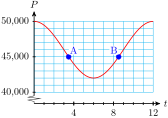
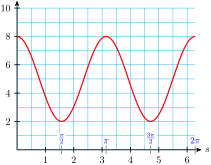
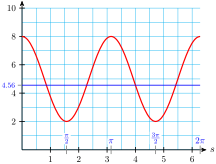
  1. \(\displaystyle P(t)=4000\cos\left(\dfrac{\pi}{6}t\right)+46,000\)
  2. \(t=\cos^{-1}\left( \dfrac{-1}{4} \right)\cdot\dfrac{6}{\pi}\approx3.48\) months (Dec) or \(t=12-\cos^{-1}\left( \frac{-1}{4} \right)\cdot\frac{6}{\pi}\approx 8.52\) months (June)
  3. sinusoidal graph
    \(P(t)\) is less than 45,000 between \(A\) and \(B\text{.}\)

45.

Answer.
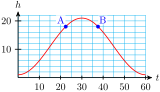
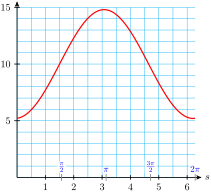
  1. \(\displaystyle h(t)=11-10\cos\left(\dfrac{\pi}{30}t\right)\)
  2. \(t=\cos\left(-0.7 \right)\cdot \dfrac{30}{\pi}\approx 22.40\) sec or \(t=60-\cos\left(-0.7 \right)\cdot \dfrac{30}{\pi}\approx 37.60\) sec
  3. sinusoidal graph
    Delbert is above 18 m between \(A\) and \(B\text{.}\)

7.4 Chapter 7 Summary and Review
Review Problems

1.

Answer.
amp: \(2\text{,}\) period: \(\dfrac{2\pi}{3} \text{;}\) mid: \(y=4\)

13.

Answer.
  1. period: \(4\pi\text{,}\) shift: \(\dfrac{\pi}{3}\) left
  2. \(x\) \(\dfrac{x}{2}\) \(\dfrac{x}{2}+\dfrac{\pi}{6} \) \(\sin\left(\dfrac{x}{2}+\dfrac{\pi}{6}\right)\)
    \(\dfrac{-2\pi}{3}\) \(\dfrac{\pi}{3}\) \(\dfrac{-\pi}{6}\) \(\dfrac{-1}{2}\)
    \(\dfrac{-\pi}{3}\) \(\dfrac{-\pi}{6}\) \(0\) \(0\)
    \(0\) \(0\) \(\dfrac{\pi}{6}\) \(\dfrac{1}{2}\)
    \(\dfrac{\pi}{6}\) \(\dfrac{\pi}{12}\) \(\dfrac{\pi}{4}\) \(\dfrac{1}{\sqrt{2}}\)
    \(\dfrac{\pi}{3}\) \(\dfrac{\pi}{6}\) \(\dfrac{\pi}{3}\) \(\dfrac{\sqrt{3}}{2}\)
    \(\dfrac{2\pi}{3}\) \(\dfrac{\pi}{3}\) \(\dfrac{\pi}{2}\) \(1\)
    \(\pi\) \(\dfrac{\pi}{2}\) \(\dfrac{2\pi}{3}\) \(\dfrac{\sqrt{3}}{2}\)
  3. sinusoidal graph
  4. \(\displaystyle \dfrac{2\pi}{3} \)
  5. \(\displaystyle \dfrac{-\pi}{3} \)

15.

Answer.
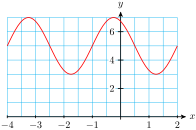
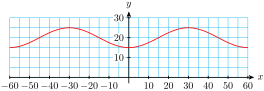
  1. mid: \(y=20\text{,}\) period: 0, amp: 5
  2. Fill in the table of values.
    \(x\) \(\dfrac{\pi}{30}x \) \(\cos\left(\dfrac{\pi}{30}x\right)\) \(20-5\cos\left(\dfrac{\pi}{30}x\right)\)
    \(-5\) \(\dfrac{-\pi}{6}\) \(\dfrac{\sqrt{3}}{2}\) \(20-\dfrac{\sqrt{3}}{2}\)
    \(0\) \(0\) \(1\) \(15\)
    \(5\) \(\dfrac{\pi}{6}\) \(\dfrac{\sqrt{3}}{2}\) \(20-\dfrac{\sqrt{3}}{2}\)
    \(10\) \(\dfrac{\pi}{3}\) \(\dfrac{1}{2}\) \(17.5\)
    \(15\) \(\dfrac{\pi}{2}\) \(0\) \(20\)
    \(50\) \(\pi\) \(-1\) \(25\)
  3. sinusoidal graph
  4. 15, 45

25.

Answer.
\(\dfrac{7\pi}{12}\text{,}\) \(\dfrac{11\pi}{12}\text{,}\) \(\dfrac{19\pi}{12}\text{,}\) \(\dfrac{23\pi}{12}\)

27.

Answer.
\(0\text{,}\) \(\dfrac{\pi}{4}\text{,}\) \(\dfrac{\pi}{2}\text{,}\) \(\dfrac{3\pi}{4}\text{,}\) \(\pi\text{,}\) \(\dfrac{5\pi}{4}\text{,}\) \(\dfrac{7\pi}{4}\text{,}\) \(2\pi\)

33.

Answer.
\(\dfrac{\pi}{24} \text{,}\) \(\dfrac{5\pi}{24} \text{,}\) \(\dfrac{25\pi}{24} \text{,}\) \(\dfrac{29\pi}{24} \)

8 More Functions and Identities
8.1 Sum and Difference Formulas
Homework 8-1

1.

Answer.
angles
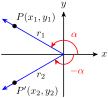
\(x_2=x_1\text{,}\) \(y_2=-y_1\text{,}\) and \(r_2=r_1\text{.}\) Thus, \(\cos(-\alpha)=\dfrac{x_2}{r_2} =\dfrac{x_1}{r_1}=\cos(\alpha) \text{,}\) \(\sin(-\alpha)=\dfrac{y_2}{r_2} =\dfrac{-y_1}{r_1}=-\sin(\alpha) \text{,}\) and \(\tan(-\alpha)=\dfrac{y_2}{x_2} =\dfrac{-y_1}{x_1}=-\tan(\alpha) \text{.}\)

7.

Answer.
\(\cos(45\degree + 45\degree)=\cos(90\degree)=0\text{,}\) but \(\cos (45\degree) +\cos (45\degree) = \frac{1}{\sqrt{2}}+\frac{1}{\sqrt{2}}=\sqrt{2} \)

9.

Answer.
\(\tan(87\degree -29\degree)\approx 1.600\text{,}\) but \(\tan (87\degree) -\tan (29\degree) \approx 18.527 \)

21.

Answer.
\(\cos (15\degree)=\dfrac{\sqrt{6}+\sqrt{2}}{4} \text{,}\) \(\tan (15\degree) = 2-\sqrt{3}\)

35.

Answer.
\(1=2\left(\dfrac{1}{\sqrt{2}} \right)\left(\dfrac{1}{\sqrt{2}} \right) \)

37.

Answer.
\(\frac{1}{2} =\left(\dfrac{\sqrt{3}}{2} \right)^2 - \left(\dfrac{1}{2} \right)^2 \)

75.

Answer.
  1. \(\displaystyle \cos \left(\dfrac{\pi}{2} -\theta\right) = \cos\frac{\pi}{2} \cos(\theta) + \sin \frac{\pi}{2}\sin\theta = \sin (\theta)\)
  2. \(\displaystyle \sin \left(\dfrac{\pi}{2} -\theta\right) = \sin\frac{\pi}{2} \cos(\theta) - \cos \frac{\pi}{2}\sin(\theta)= \cos (\theta)\)

77.

Answer.
\(\begin{aligned}[t]\sin(2\theta) \amp=\sin(\theta + \theta)\\ \amp= \sin(\theta)\cos(\theta) + \sin(\theta)\cos(\theta) \\ \amp= 2\sin(\theta)\cos(\theta) \end{aligned}\)

89.

Answer.
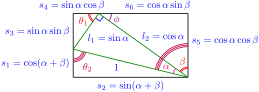
triangle inscribed in rectangle
  1. \(\displaystyle l_1=\sin(\alpha), \, l_2=\cos(\alpha) \)
  2. \(\theta_1\) and \(\beta\) are both complements of \(\phi\text{;}\) \(\theta_2\) and \(\alpha+\beta\) are alternate interior angles
  3. \(s_1=\cos(\alpha+\beta) \text{,}\) \(s_2=\sin(\alpha+\beta) \)
  4. \(s_3=\sin(\alpha)\sin(\beta) \text{,}\) \(s_4=\sin(\alpha)\cos(\beta) \)
  5. \(s_5=\cos(\alpha)\cos(\beta) \text{,}\) \(s_6=\cos(\alpha)\sin(\beta) \)
  6. \(\sin(\alpha+\beta) = \sin(\alpha)\cos(\beta) +\cos(\alpha)\sin(\beta) \text{,}\) \(\cos(\alpha+\beta) = \cos(\alpha)\cos(\beta) +\sin(\alpha)\sin(\beta) \)

91.

Answer.
  1. \(\displaystyle (AB)^2=2-2\cos(\alpha-\beta)\)
  2. \(\displaystyle (AB)^2=(\cos(\alpha)-\cos(\beta))^2 + (\sin(\alpha) - \sin(\beta))^2 \)
  3. \(\displaystyle \begin{aligned}[t] 2-2\cos(\alpha-\beta)\amp = (\cos(\alpha)-\cos(\beta))^2 + (\sin(\alpha) - \sin(\beta))^2 \\ 2-2\cos(\alpha-\beta)\amp = \cos^2(\alpha) -2\cos(\alpha)\cos(\beta) + \cos^2 (\beta) + \,\\ \amp\hphantom{000000000} +\sin^2 (\alpha) - 2\sin(\alpha)\sin(\beta) + \sin^2(\beta) \\ 2-2\cos(\alpha-\beta)\amp = 1+1 - 2(\cos(\alpha) \cos(\beta) - \sin(\alpha)\sin(\beta)) \\ -2\cos(\alpha-\beta)\amp = -2(\cos(\alpha) \cos(\beta) - \sin(\alpha)\sin(\beta)) \\ \cos(\alpha-\beta)\amp = \cos(\alpha) \cos(\beta) - \sin(\alpha)\sin(\beta)) \end{aligned}\)

8.2 Inverse Trigonometric Functions
Homework 8-2

1.

Answer.
No inverse: Some horizontal lines intersect the curve in more than one point.

25.

Answer.
triangles
  1. \(\displaystyle \alpha=\tan^{-1}\left(\dfrac{1}{x}\right) \)
  2. \(\displaystyle \beta=\tan^{-1}\left(\dfrac{5}{x} \right) - \tan^{-1}\left(\dfrac{1}{x}\right) \)
  3. \(\beta=45\degree - \tan^{-1}\left(\dfrac{1}{5}\right) \text{,}\) so the painting subtends an angle of \(45\degree - \tan^{-1}\left(\dfrac{1}{5}\right) \approx 33.7\degree \) when Martin is 5 meters from the wall.

27.

Answer.
\(t=\dfrac{1}{2\pi\omega}\left( \sin^{-1}\dfrac{V}{V_0}-\phi \right) \)

45.

Answer.
\(x\) \(-1\) \(\frac{-\sqrt{3}}{2}\) \(\frac{-\sqrt{2}}{2}\) \(\frac{-1}{2}\) \(0\) \(\frac{1}{2}\) \(\frac{\sqrt{2}}{2}\) \(\frac{\sqrt{3}}{2}\) \(1\)
\(\cos^{-1}(x)\) \(\pi\) \(\frac{5\pi}{6} \) \(\frac{3\pi}{4} \) \(\frac{2\pi}{3} \) \(\frac{\pi}{2} \) \(\frac{\pi}{3} \) \(\frac{\pi}{4} \) \(\frac{\pi}{6} \) \(0 \)
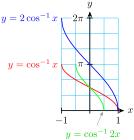
arccosine

47.

Answer.
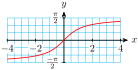
\(x\) \(-\sqrt{3}\) \(-1\) \(\frac{-1}{\sqrt{3}}\) \(0\) \(\frac{1}{\sqrt{3}}\) \(1\) \(\sqrt{3}\)
\(\cos^{-1}(x)\) \(\frac{-\pi}{2} \) \(\frac{-\pi}{3} \) \(\frac{-\pi}{6} \) \(0 \) \(\frac{\pi}{6} \) \(\frac{\pi}{4} \) \(\frac{\pi}{3} \)
arctangent

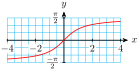
65.

Answer.
\(\sin (2\theta)= \dfrac{2x\sqrt{25-x^2}}{25} \text{,}\) \(\cos (2\theta)= \dfrac{25-2x^2}{25} \)

71.

Answer.
  1. Domain: \(-1\le x \le 1\text{,}\) range: \(\left\{\dfrac{\pi}{2}\right\} \)
  2. Let \(\theta=\sin^{-1}(x)\text{.}\) Then \(x=\sin(\theta)= \cos\left(\dfrac{\pi}{2} - \theta \right) \) and \(\cos^{-1}(x)= \dfrac{\pi}{2} - \theta \text{.}\) So \(~\sin^{-1}(x)+\cos^{-1}(x) = \theta + \left(\dfrac{\pi}{2} - \theta\right) = \dfrac{\pi}{2} \) .

8.3 The Reciprocal Functions
Homework 8-3

17.

Answer.
\(\theta\) \(0\) \(\dfrac{\pi}{6}\) \(\dfrac{\pi}{4}\) \(\dfrac{\pi}{3}\) \(\dfrac{\pi}{2}\) \(\dfrac{2\pi}{3}\) \(\dfrac{3\pi}{4}\) \(\dfrac{5\pi}{6}\) \(\pi\)
\(\sec (\theta)\) \(1\) \(\dfrac{2\sqrt{3}}{3}\) \(\sqrt{2}\) \(2\) undefined \(-2\) \(-\sqrt{2}\) \(-\dfrac{2\sqrt{3}}{3}\) \(-1\)
\(\csc (\theta)\) undefined \(2\) \(\sqrt{2}\) \(\dfrac{2\sqrt{3}}{3}\) \(1\) \(\dfrac{2\sqrt{3}}{3}\) \(\sqrt{2}\) \(2\) undefined
\(\cot (\theta)\) undefined \(\sqrt{3}\) \(1\) \(\dfrac{\sqrt{3}}{3}\) \(0\) \(\dfrac{-\sqrt{3}}{3}\) \(-1\) \(-\sqrt{3}\) undefined

21.

Answer.
\(\sin (\theta) = \dfrac{4}{5}\text{,}\) \(~\cos (\theta) = \dfrac{3}{5}\text{,}\) \(~\tan (\theta) = \dfrac{4}{3}\text{,}\) \(~\sec (\theta) = \dfrac{5}{3}\text{,}\) \(~\csc (\theta) = \dfrac{5}{4}\text{,}\) \(~\cot (\theta) = \dfrac{3}{4}\)

23.

Answer.
\(\sin (\theta) = \dfrac{4}{\sqrt{41}}\text{,}\) \(~\cos (\theta) = \dfrac{5}{\sqrt{41}}\text{,}\) \(~\tan (\theta) = \dfrac{4}{5}\text{,}\) \(~\sec (\theta) = \dfrac{\sqrt{41}}{5}\text{,}\) \(~\csc (\theta) = \dfrac{\sqrt{41}}{4}\text{,}\) \(~\cot (\theta) = \dfrac{5}{4}\)

25.

Answer.
\(\sin (\theta) = \dfrac{5}{\sqrt{74}}\text{,}\) \(~\cos (\theta) = \dfrac{-7}{\sqrt{74}}\text{,}\) \(~\tan (\theta) = \dfrac{-5}{7}\text{,}\) \(~\sec (\theta) = \dfrac{-\sqrt{74}}{7}\text{,}\) \(~\csc (\theta) = \dfrac{\sqrt{74}}{5}\text{,}\) \(~\cot (\theta) = \dfrac{-7}{5}\)

27.

Answer.
\(\sin (\theta) = \dfrac{-5}{8}\text{,}\) \(~\cos (\theta) = \dfrac{\sqrt{39}}{8}\text{,}\) \(~\tan (\theta) = \dfrac{5}{\sqrt{39}}\text{,}\) \(~\sec (\theta) = \dfrac{-8}{\sqrt{39}}\text{,}\) \(~\csc (\theta) = \dfrac{-8}{5}\text{,}\) \(~\cot (\theta) = \dfrac{\sqrt{39}}{5}\)

33.

Answer.
\(\sin (\theta) = \dfrac{7}{\sqrt{x^2+49}}\text{,}\) \(~\cos (\theta) = \dfrac{x}{\sqrt{x^2+49}}\text{,}\) \(~\tan (\theta) = \dfrac{7}{x}\text{,}\) \(~\sec (\theta) = \dfrac{\sqrt{x^2+49}}{x}\text{,}\) \(~\csc (\theta) = \dfrac{\sqrt{x^2+49}}{7}\text{,}\) \(~\cot (\theta) = \dfrac{x}{7}\)

35.

Answer.
\(\sin (\theta) = S\text{,}\) \(~\cos (\theta) = \sqrt{1-S^2}\text{,}\) \(~\tan (\theta) = \dfrac{S}{\sqrt{1-S^2}}\text{,}\) \(~\sec (\theta) = \dfrac{1}{\sqrt{1-S^2}}\text{,}\) \(~\csc (\theta) = \dfrac{1}{S}\text{,}\) \(~\cot (\theta) = \dfrac{\sqrt{1-S^2}}{S}\)

37.

Answer.
\(\sin (\theta) = \dfrac{-\sqrt{9-a^2}}{3}\text{,}\) \(~\cos (\theta) = \dfrac{a}{3}\text{,}\) \(~\tan (\theta) = \dfrac{-\sqrt{9-a^2}}{a}\text{,}\) \(~\sec (\theta) = \dfrac{3}{a}\text{,}\) \(~\csc (\theta) = \dfrac{-3}{\sqrt{9-a^2}}\text{,}\) \(~\cot (\theta) = \dfrac{-a}{\sqrt{9-a^2}}\)

41.

Answer.
angle
\(~\sin (\theta) = \dfrac{-\sqrt{3}}{2}\text{,}\) \(~\cos (\theta) = \dfrac{1}{2}\text{,}\) \(~\tan (\theta) = -\sqrt{3}\text{,}\) \(~\sec (\theta) = 2\text{,}\) \(~\csc (\theta) = \dfrac{-2\sqrt{3}}{3}\text{,}\) \(~\cot (\theta) = \dfrac{-\sqrt{3}}{3}\)

43.

Answer.
triangle
\(\sin (\alpha) = \dfrac{1}{3}\text{,}\) \(~\cos (\alpha) = \dfrac{2\sqrt{2}}{3}\text{,}\) \(~\tan (\alpha) = \dfrac{\sqrt{2}}{4}\text{,}\) \(~\sec (\alpha) = \dfrac{3\sqrt{2}}{4}\text{,}\) \(~\csc (\alpha) = 3\text{,}\) \(~\cot (\alpha) = 2\sqrt{2}\)

45.

Answer.
angle
\(\sin (\gamma) = \dfrac{-4}{\sqrt{17}}\text{,}\) \(\cos (\gamma) = \dfrac{-1}{\sqrt{17}}\text{,}\) \(\tan (\gamma) = 4\text{,}\) \(\sec (\gamma) = -\sqrt{17}\text{,}\) \(\csc (\gamma) = \dfrac{-\sqrt{17}}{4}\text{,}\) \(\cot (\gamma) = \dfrac{1}{4}\)

53.

Answer.
\(x\) \(0\) \(\dfrac{\pi}{4}\) \(\dfrac{\pi}{2}\) \(\dfrac{3\pi}{4}\) \(\pi\) \(\dfrac{5\pi}{4}\) \(\dfrac{3\pi}{2}\) \(\dfrac{7\pi}{4}\) \(2\pi\)
\(\sec (x)\) \(1\) \(\sqrt{2}\) undefined \(-\sqrt{2}\) \(-1\) \(-\sqrt{2}\) undefined \(\sqrt{2}\) \(1\)
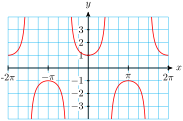
secant

57.

Answer.
\(x\) \(0\) \(\dfrac{\pi}{4}\) \(\dfrac{\pi}{2}\) \(\dfrac{3\pi}{4}\) \(\pi\) \(\dfrac{5\pi}{4}\) \(\dfrac{3\pi}{2}\) \(\dfrac{7\pi}{4}\) \(2\pi\)
\(\cot (x)\) undefined \(1\) \(0\) \(-1\) undefined \(1\) \(0\) \(-1\) undefined
cotangent

59.

Answer.
\(\begin{aligned}[t]\dfrac{\csc (x)}{\cot (x)} \amp=\dfrac{\dfrac{1}{\sin (x)}}{\dfrac{\cos (x)}{\sin (x)}}\\ \amp= \dfrac{1}{\sin (x)}\div \dfrac{\cos (x)}{\sin (x)} \\ \amp= \dfrac{1}{\sin (x)}\cdot \dfrac{\sin (x)}{\cos (x)} \\ \amp= \dfrac{1}{\cos (x)} \\ \amp= \sec (x)\end{aligned}\)

61.

Answer.
\(\dfrac{\sec (x) \cot (x)}{\csc (x)}=\dfrac{\dfrac{1}{\cos (x)} \cdot \dfrac{\cos (x)}{\sin (x)}}{\dfrac{1}{\sin (x)}} = \dfrac{\dfrac{1}{\sin (x)}}{\dfrac{1}{\sin (x)}} = 1\)

63.

Answer.
\(\tan (x) \csc (x) = \dfrac{\sin (x)}{\cos (x)} \cdot \dfrac{1}{\sin (x)} = \dfrac{1}{\cos (x)} = \sec (x)\)

77.

Answer.
\(\sec (s) = \dfrac{-5}{4}\text{,}\) \(~\csc (s) = \dfrac{5}{3}\text{,}\) \(~\cot (s) = \dfrac{-4}{3}\)

79.

Answer.
\(\sec (s) = \dfrac{1}{\sqrt{1-w^2}}\text{,}\) \(~\csc (s) = \dfrac{1}{w}\text{,}\) \(~\cot (s) = \dfrac{\sqrt{1-w^2}}{w}\)

89.

Answer.
\(\begin{aligned}[t] \cos^2 (\theta) + \sin^2 (\theta) \amp = 1\\ \dfrac{\cos^2 (\theta)}{\cos^2 (\theta)}+\dfrac{\sin^2 (\theta)}{\cos^2 (\theta)}\amp = \dfrac{1}{\cos^2 (\theta)}\\ 1 + \tan^2 (\theta) \amp = \sec^2 (\theta) \end{aligned}\)

91.

Answer.
  1. \(\displaystyle \csc (\theta) = -\sqrt{26}\)
  2. \(\displaystyle \sin (\theta) = \dfrac{-\sqrt{26}}{26},~\cos (\theta) = \dfrac{-5\sqrt{26}}{26},~\tan (\theta) = \dfrac{1}{5},~\sec (\theta) = \dfrac{-\sqrt{26}}{5}\)

93.

Answer.
\(\cos (t) = \pm \sqrt{1-\sin^2 (t)}\text{,}\) \(~\tan (t) = \dfrac{\pm \sin (t)}{\sqrt{1-\sin^2 (t)}}\text{,}\) \(~\sec (t) = \dfrac{\pm 1}{\sqrt{1-\sin^2 (t)}}\text{,}\) \(~\csc (t) = \dfrac{1}{\sin (t)}\text{,}\) \(~ \cot (t) = \dfrac{\pm \sqrt{1-\sin^2 (t)}}{\sin (t)}\)

95.

Answer.
\(\begin{aligned}[t] \dfrac{a}{\sin (A)} \amp = \dfrac{b}{\sin (B)} = \dfrac{c}{\sin (C)}\\ a \cdot\dfrac{1}{\sin (A)} \amp = b \cdot \dfrac{1}{\sin (B)} = c \cdot \dfrac{1}{\sin (C)}\\ a \csc (A) \amp = b \csc (B) = c \csc (C) \end{aligned}\)

8.4 Chapter Summary and Review
Review Problems

39.

Answer.
Because \(\abs{\sin (\theta)} \le 1, ~\sin^{-1}(t)\) is undefined for \(\abs{t} \gt 1\text{.}\) If \(x \not= 0\text{,}\) then either \(\abs{x} \gt 1\) or \(\abs{\dfrac{1}{x}} \gt 1\text{.}\) If \(x=0\text{,}\) then \(\dfrac{1}{x}\) is undefined.

43.

Answer.
\(\sin (\theta) = \dfrac{13}{\sqrt{313}}\text{,}\) \(~\cos (\theta) = \dfrac{12}{\sqrt{313}}\text{,}\) \(~\tan (\theta) = \dfrac{13}{12}\text{,}\) \(~\sec (\theta) = \dfrac{\sqrt{313}}{12}\text{,}\) \(~\csc (\theta) = \dfrac{\sqrt{313}}{13}\text{,}\) \(~\cot (\theta) = \dfrac{12}{13}\)

45.

Answer.
\(\sin (\theta) = \dfrac{1}{3}\text{,}\) \(~\cos (\theta) = \dfrac{-2\sqrt{2}}{3}\text{,}\) \(~\tan (\theta) = \dfrac{-1}{2\sqrt{2}}\text{,}\) \(~\sec (\theta) = \dfrac{-3}{2\sqrt{2}}\text{,}\) \(~\csc (\theta) = 3\text{,}\) \(~\cot (\theta) = -2\sqrt{2}\)

47.

Answer.
\(\sin (\theta) = \dfrac{-9}{\sqrt{106}}\text{,}\) \(~\cos (\theta) = \dfrac{-5}{\sqrt{106}}\text{,}\) \(~\tan (\theta) = \dfrac{9}{5}\text{,}\) \(~\sec (\theta) = \dfrac{-\sqrt{106}}{5}\text{,}\) \(~\csc (\theta) = \dfrac{-\sqrt{106}}{9}\text{,}\) \(~\cot (\theta) = \dfrac{5}{9}\)

49.

Answer.
\(\sin (\alpha) = \dfrac{-\sqrt{11}}{6}\text{,}\) \(~\cos (\alpha) = \dfrac{-5}{6}\text{,}\) \(~\tan (\alpha) = \dfrac{\sqrt{11}}{5}\text{,}\) \(~\sec (\alpha) = \dfrac{-6}{5},\)\(~\csc (\alpha) = \dfrac{-6}{\sqrt{11}}\text{,}\) \(~\cot (\alpha) = \dfrac{5}{\sqrt{11}}\)

51.

Answer.
\(\sin (\theta )= \dfrac{s}{4},\) \(~\cos (\theta) = \dfrac{\sqrt{16-s^2}}{4},\) \(~\tan (\theta) = \dfrac{s}{\sqrt{16-s^2}},\) \(~\sec (\theta) = \dfrac{4}{\sqrt{16-s^2}},\) \(~\csc (\theta) = \dfrac{4}{s},\) \(~\cot (\theta) = \dfrac{\sqrt{16-s^2}}{s}\)

53.

Answer.
\(\sin (\theta) = \dfrac{w}{\sqrt{w^2+144}},\) \(~\cos (\theta) = \dfrac{-12}{\sqrt{w^2+144}},\) \(~\tan (\theta) = \dfrac{-w}{12},\) \(~\sec (\theta) = \dfrac{-\sqrt{w^2+144}}{12},\) \(~\csc (\theta) = \dfrac{\sqrt{w^2+144}}{w},\) \(~\cot (\theta) = \dfrac{-12}{w}\)

55.

Answer.
\(\sin (\alpha) = \dfrac{k}{2},\) \(~\cos (\alpha) = \dfrac{-\sqrt{4-k^2}}{2},\) \(~\tan (\alpha) = \dfrac{-k}{\sqrt{4-k^2}},\) \(~\sec (\alpha) = \dfrac{-2}{\sqrt{4-k^2}},\) \(~\csc (\alpha) = \dfrac{2}{k},\) \(~\cot (\alpha) = \dfrac{-\sqrt{4-k^2}}{k}\)

57.

Answer.
\(\sin (\theta) =0.3\text{,}\) \(\cos (\theta) = -0.4\text{,}\) \(\tan (\theta) = -0.75\text{,}\) \(\sec (\theta) = -2.5\text{,}\) \(\csc (\theta) \approx 3.33\text{,}\) \(\cot \theta (\approx) -1.33\)

83.

Answer.
  1. \(\displaystyle AC = \tan (\alpha),~DC = \tan (\beta),~AD = \tan (\alpha) - \tan (\beta)\)
  2. They are right triangles that share \(\angle B\text{.}\)
  3. \(\angle A = \angle F,~ \angle B\) is the complement of \(\angle A,\) and \(\angle FDC\) is the complement of \(\angle F\text{.}\)
  4. \(\dfrac{CF}{CD} = \tan (\alpha),\) so \(CF = \tan (\alpha) \tan (\beta)\)
  5. They are right triangles with \(\angle A = \angle F\text{.}\)
  6. \(\angle EBD = \alpha - \beta,\) so \(\tan (\alpha - \beta) = \dfrac{\text{opp}}{\text{adj}} = \dfrac{DE}{BE};~~\dfrac{DE}{BE}\) and \(\dfrac{AD}{BF}\) are ratios of corresponding sides of similar triangles; \(AD = \tan (\alpha) - \tan (\beta)\) by part (a), \(BF = BC + CF = 1 + \tan (\alpha) \tan (\beta)\) by part (d).

85.

Answer.
\(d=25\csc (112\degree),~\alpha = 45\degree,~a \approx 19.07,~b \approx 10.54\)

9 Vectors
9.1 Geometric Form
Homework 9-1

29.

Answer.
\(\|{\bf{v}}\| = \sqrt{85} \approx 9.22,~ \theta = 229.4\degree\)

41.

Answer.
  1. \(\displaystyle v_x \approx -1.23,~ v_y \approx 3.38,~ w_x \approx -0.32,~ w_y \approx -2.23\)
  2. 1.9 km, \(54.5\degree\) west of north

51.

Answer.
\(u_x = 2\text{,}\) \(~ u_y = 1\text{,}\) \(~ v_x = 1\text{,}\)\(~ v_y = -3\text{,}\) \(~ A_x = 1\text{,}\) \(~ A_y = 4\text{;}\) \(~ A_x = u_x - v_x\text{,}\) \(~ A_y = u_y - v_y\)

9.2 Coordinate Form
Homework 9-2

5.

Answer.
  1. \({\bf{u}}+{\bf{v}} = -2{\bf{i}}+5{\bf{j}}\) and \(\|{\bf{u}}+{\bf{v}}\| = \sqrt{29}\)
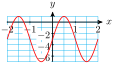
  2. \(\displaystyle \|{\bf{u}}\|+\|{\bf{v}}\| \ge \|{\bf{u}}+{\bf{v}}\|\)

61.

Answer.
  1. \(\displaystyle \|{\bf{v}}\| = 10,~ 2\|{\bf{v}}\| = 20 = 2 \cdot 10\)
  2. \(\displaystyle \|k{\bf{v}}\| = \sqrt{(ka)^2 +(kb)^2} = k\sqrt{a^2 + b^2}\)

9.3 The Dot Product
Homework 9-3

7.

Answer.
  1. \(\displaystyle {\bf{w}} = \left(\dfrac{56}{13}{\bf{i}}+\dfrac{84}{13}{\bf{j}}\right) + \left(\dfrac{48}{13}{\bf{i}}-\dfrac{32}{13}{\bf{j}}\right)\)
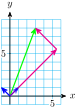
  2. vectors

41.

Answer.
  1. \(\displaystyle \dfrac{1}{\sqrt{2}}{\bf{i}}+\dfrac{1}{\sqrt{2}}{\bf{j}}~~\text{and}~~\dfrac{-1}{\sqrt{2}}{\bf{i}}+\dfrac{1}{\sqrt{2}}{\bf{j}}\)
  2. \(\displaystyle {\bf{u}} \cdot {\bf{v}} = 0\)
  3. \(\dfrac{11}{\sqrt{2}}\) and \(\dfrac{5}{\sqrt{2}}\)
  4. orthogonal vectors

47.

Answer.
\(\begin{aligned}[t] ({\bf{u}}-{\bf{v}}) \cdot ({\bf{u}}+{\bf{v}}) \amp= (a-c)(a+c)+(b-d)(b+d)\\ \amp= (a^2+b^2)-(c^2+d^2)\end{aligned}\)

49.

Answer.
\(\dfrac{a \cdot 1 + b \cdot 0}{1} = a\) and \(\dfrac{a \cdot 0 + b \cdot 1}{1} = b\)

51.

Answer.
  1. Both \({\bf{i}} \cdot {\bf{i}}=1\) and \({\bf{j}} \cdot {\bf{j}}=1\) because \(1 \cdot 1 \cos 0 = 1\text{;}\) \({\bf{i}} \cdot {\bf{j}} = 1 \cdot 1 \cos 90\degree =0\)
  2. \(\displaystyle (a{\bf{i}}+b{\bf{j}}) \cdot (c{\bf{i}}+d{\bf{j}}) = ac(1) + ad(0) + bc(0) + bd(1) = ac+bd\)

53.

Answer.
  1. \(\displaystyle \|{\bf{u}}-{\bf{v}}\|^2 = {\bf{u}} \cdot {\bf{u}} - 2{\bf{u}} \cdot {\bf{v}} +{\bf{v}} \cdot {\bf{v}}= \|{\bf{u}}\|^2+\|{\bf{v}}\|^2 - 2\|{\bf{u}}\|\|{\bf{v}}\|\cos \theta\)
  2. Let \(a = \|{\bf{u}}\|,~ b = \|{\bf{v}}\|,~c = \|{\bf{u}}-{\bf{v}}\|\text{,}\) and \(C = \theta\)

9.4 Chapter Summary and Review
Review Problems

17.

Answer.
  1. \({\bf{F_1}}=-200{\bf{i}},~{\bf{F_2}}=-60\sqrt{2}{\bf{i}}-60\sqrt{2}{\bf{j}},~{\bf{F_3}}=50\sqrt{3}{\bf{i}}+50{\bf{j}},\) \({\bf{F_4}}=-125{\bf{i}}+125\sqrt{3}{\bf{j}}\)
  2. \(\displaystyle -73.25{\bf{i}}+181.65{\bf{j}}\)

10 Polar Coordinates and Complex Numbers
10.1 Polar Coordinates
Homework 10-1

73.

Answer.
\begin{align*} d \amp =\sqrt{(x_2-x_1)^2+(y_2-y_1)^2}\\ \amp = \sqrt{(r_2\cos(\theta_2)-r_1\cos(\theta_1))^2 +(r_2\sin(\theta_2)-r_1\sin(\theta_1))^2}\\ \amp = \sqrt{r_2^2\cos^2(\theta_2) - 2r_2r_1\cos(\theta_2)\cos(\theta_1)+r_1^2\cos^2(\theta_1)+r_2^2\sin^2(\theta_2) - 2r_2r_1\sin(\theta_2)\sin(\theta_1)+r_1^2\sin^2(\theta_1)}\\ \amp = \sqrt{r_2^2+r_1^2 - 2r_2r_1(\cos(\theta_2)\cos(\theta_1)-\sin(\theta_2)\sin(\theta_1))}\\ \amp = \sqrt{r_1^2 + r_2^2 - 2r_1r_2\cos (\theta_2 - \theta_1)} \end{align*}

10.2 Polar Graphs
Homework 10-2

5.

Answer.
\(\theta\) \(0\) \(\dfrac{\pi}{4}\) \(\dfrac{\pi}{2}\) \(\dfrac{3\pi}{4}\) \(\pi\) \(\dfrac{5\pi}{4}\) \(\dfrac{3\pi}{2}\) \(\dfrac{7\pi}{4}\)
\(r=2\) \(2\) \(2\) \(2\) \(2\) \(2\) \(2\) \(2\) \(2\)
\(\theta\) \(0\) \(\dfrac{\pi}{4}\) \(\dfrac{\pi}{2}\) \(\dfrac{3\pi}{4}\) \(\pi\) \(\dfrac{5\pi}{4}\) \(\dfrac{3\pi}{2}\) \(\dfrac{7\pi}{4}\)
\(r=-2\) \(-2\) \(-2\) \(-2\) \(-2\) \(-2\) \(-2\) \(-2\) \(-2\)
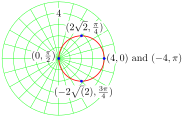
The graph of \(r=2\) begins at the right-most point (and proceeds counter-clockwise); the graph of \(r=-2\) begins at the left-most point.
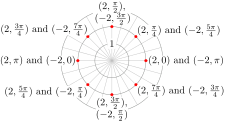
polar points on circle

7.

Answer.
  1. circle on polar grid
  2. \(\theta\) \(\pi\) \(\dfrac{5\pi}{4}\) \(\dfrac{3\pi}{2}\) \(\dfrac{7\pi}{4}\) \(2\pi\)
    \(r\) \(-4\) \(-2\sqrt{2}\) \(0\) \(2\sqrt{2}\) \(4\)
    The graph is traced again.
  3. center: \((2,0)\text{,}\) radius: \(2\)
  4. \(\displaystyle (x-2)^2+y^2=4\)

9.

Answer.
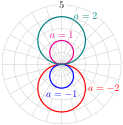
  1. circcles on polar grid
  2. For \(a \gt 0\text{,}\) \(a\) is the radius of a circle centered on the positive \(y\)-axis; for \(a \lt 0\text{,}\) \(\abs{a}\) is the radius of a circle centerd on the negative \(y\)-axis.

11.

Answer.
  1. cardioid
    \(\theta\) \(0\) \(\dfrac{\pi}{2}\) \(\pi\) \(\dfrac{3\pi}{2}\) \(2\pi\)
    \(r\) \(1\) \(2\) \(1\) \(0\) \(1\)
  2. cardioid
    \(\theta\) \(0\) \(\dfrac{\pi}{2}\) \(\pi\) \(\dfrac{3\pi}{2}\) \(2\pi\)
    \(r\) \(-1\) \(0\) \(-1\) \(-2\) \(-1\)
  3. cardioid
    \(\theta\) \(0\) \(\dfrac{\pi}{2}\) \(\pi\) \(\dfrac{3\pi}{2}\) \(2\pi\)
    \(r\) \(1\) \(0\) \(1\) \(2\) \(1\)
  4. cardioid
    \(\theta\) \(0\) \(\dfrac{\pi}{2}\) \(\pi\) \(\dfrac{3\pi}{2}\) \(2\pi\)
    \(r\) \(-1\) \(-2\) \(-1\) \(0\) \(-1\)

13.

Answer.
  1. limacon
    \(\theta\) \(0\) \(\dfrac{\pi}{2}\) \(\pi\) \(\dfrac{3\pi}{2}\) \(2\pi\)
    \(r\) \(3\) \(2\) \(1\) \(2\) \(3\)
  2. limacon
    \(\theta\) \(0\) \(\dfrac{\pi}{2}\) \(\pi\) \(\dfrac{3\pi}{2}\) \(2\pi\)
    \(r\) \(1\) \(2\) \(3\) \(2\) \(1\)
  3. limacon
    \(\theta\) \(0\) \(\dfrac{\pi}{2}\) \(\pi\) \(\dfrac{3\pi}{2}\) \(2\pi\)
    \(r\) \(3\) \(1\) \(-1\) \(1\) \(3\)
  4. limacon
    \(\theta\) \(0\) \(\dfrac{\pi}{2}\) \(\pi\) \(\dfrac{3\pi}{2}\) \(2\pi\)
    \(r\) \(-1\) \(1\) \(3\) \(1\) \(-1\)

15.

Answer.
  1. 4-petal rose
    3-petal rose
    8-petal rose
    5 petal rose
    There are \(n\) petals if \(n\) is odd, and \(2n\) petals if \(n\) is even.
  2. \(n=2:~ \dfrac{\pi}{4},\) \(~ \dfrac{3\pi}{4},~\)\(\dfrac{5\pi}{4},~\)\(\dfrac{7\pi}{4};~\) \(n=3:~\dfrac{\pi}{6},~\)\(\dfrac{5\pi}{6},~\)\(\dfrac{3\pi}{2};\) \(n=4:~ \dfrac{\pi}{8},~\)\(\dfrac{3\pi}{8},~\)\(\dfrac{5\pi}{8},~\)\(\dfrac{7\pi}{8},~\)\(\dfrac{9\pi}{8},~\)\(\dfrac{11\pi}{8},~\)\(\dfrac{13\pi}{8},~\)\(\dfrac{15\pi}{8};\) \(n=5:~~\dfrac{\pi}{10},~\)\(\dfrac{\pi}{2},~\)\(\dfrac{9\pi}{10},~\)\(\dfrac{13\pi}{10},~\)\(\dfrac{17\pi}{10}\)
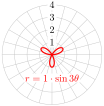
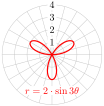
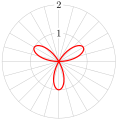
  3. 3-petal rose
    3-petal rose
    3-petal rose
    \(a\) is the length of the petal.

21.

Answer.
  1. \(\theta\) \(0\) \(\dfrac{\pi}{12}\) \(\dfrac{\pi}{6}\) \(\dfrac{\pi}{4}\) \(\dfrac{\pi}{3}\) \(\dfrac{5\pi}{12}\) \(\dfrac{\pi}{2}\) \(\dfrac{7\pi}{12}\) \(\dfrac{2\pi}{3}\)
    \(3\theta\) \(0\) \(\dfrac{\pi}{4}\) \(\dfrac{\pi}{2}\) \(\dfrac{3\pi}{4}\) \(\pi\) \(\dfrac{5\pi}{4}\) \(\dfrac{3\pi}{2}\) \(\dfrac{7\pi}{4}\) \(2\pi\)
    \(r\) \(0\) \(\dfrac{\sqrt{2}}{2}\) \(1\) \(\dfrac{\sqrt{2}}{2}\) \(0\) \(\dfrac{-\sqrt{2}}{2}\) \(-1\) \(\dfrac{-\sqrt{2}}{2}\) \(0\)
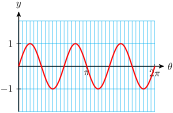
    sinusoidal curve
  2. \(\theta\) \(0\) \(\dfrac{\pi}{12}\) \(\dfrac{\pi}{6}\) \(\dfrac{\pi}{4}\) \(\dfrac{\pi}{3}\) \(\dfrac{5\pi}{12}\) \(\dfrac{\pi}{2}\) \(\dfrac{7\pi}{12}\) \(\dfrac{2\pi}{3}\)
    \(3\theta\) \(0\) \(\dfrac{\pi}{4}\) \(\dfrac{\pi}{2}\) \(\dfrac{3\pi}{4}\) \(\pi\) \(\dfrac{5\pi}{4}\) \(\dfrac{3\pi}{2}\) \(\dfrac{7\pi}{4}\) \(2\pi\)
    \(r\) \(0\) \(\dfrac{\sqrt{2}}{2}\) \(1\) \(\dfrac{\sqrt{2}}{2}\) \(0\) \(\dfrac{-\sqrt{2}}{2}\) \(-1\) \(\dfrac{-\sqrt{2}}{2}\) \(0\)
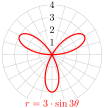
    three-petal rose

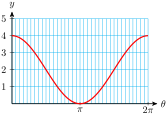
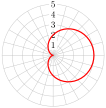
23.

Answer.
  1. \(\theta\) \(0\) \(\dfrac{\pi}{4}\) \(\dfrac{\pi}{2}\) \(\dfrac{3\pi}{4}\) \(\pi\) \(\dfrac{5\pi}{4}\) \(\dfrac{3\pi}{2}\) \(\dfrac{7\pi}{4}\) \(2\pi\)
    \(y\) \(4\) \(2+\sqrt{2}\) \(2\) \(2-\sqrt{2}\) \(0\) \(2-\sqrt{2}\) \(2\) \(2+\sqrt{2}\) \(4\)
    sinusoidal graph
  2. \(\theta\) \(0\) \(\dfrac{\pi}{4}\) \(\dfrac{\pi}{2}\) \(\dfrac{3\pi}{4}\) \(\pi\) \(\dfrac{5\pi}{4}\) \(\dfrac{3\pi}{2}\) \(\dfrac{7\pi}{4}\) \(2\pi\)
    \(y\) \(4\) \(2+\sqrt{2}\) \(2\) \(2-\sqrt{2}\) \(0\) \(2-\sqrt{2}\) \(2\) \(2+\sqrt{2}\) \(4\)
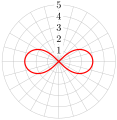
    cardioid

67.

Answer.
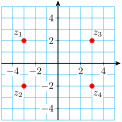
\((0,0)\text{,}\)\(~ \left(\dfrac{1}{2},\dfrac{\pi}{3}\right)\text{,}\)\(~ \left(\dfrac{1}{2},\dfrac{5\pi}{3}\right) \)

69.

Answer.
\((0,0)\text{,}\) \(~ \left(\dfrac{3}{\sqrt{2}}, \dfrac{\pi}{4}\right)\text{,}\) \(~ \left(\dfrac{-3}{\sqrt{2}}, \dfrac{5\pi}{4}\right)\)

71.

Answer.
\(\left(1, \dfrac{\pi}{2}\right)\text{,}\) \(~\left(1, \dfrac{3\pi}{2}\right)\)

73.

Answer.
\(\left(\dfrac{4+\sqrt{2}}{2},\dfrac{3\pi}{4}\right)\text{,}\) \(~\left(\dfrac{4-\sqrt{2}}{2},\dfrac{7\pi}{4}\right)\)

10.3 Complex Numbers
Homework 10-3

61.

Answer.
\begin{align*} z_1+z_2 \amp =(a+bi)+(c+di)=(a+c)+(b+d)i\\ \amp =(c+a)+(d+b)i=(c+di)+(a+bi)=z_2+z_1 \end{align*}
\begin{align*} z_1z_2 \amp =(a+bi)(c+di) = (ac-bd)+(ad+bc)i\\ \amp =(ca-db)+(da+cb)i=z_2z_1 \end{align*}

65.

Answer.
No. Let \(t=i\) and \(z=-i\text{.}\) Then \(w=t+z=i-i=0,\) so \(\abs{w}=0,\) but \(\abs{t}+\abs{z}=\abs{i}+\abs{-i}=1+1=2.\)

10.4 Polar Form for Complex Numbers
Homework 10-4

1.

Answer.
\(1\text{,}\) \(~i\text{,}\) \(~-1\text{,}\)\(~-i\text{,}\) \(~1\)
powers of i

13.

Answer.
\(3\left(\cos \left(\dfrac{\pi}{2}\right) + i\sin \left(\dfrac{\pi}{2}\right)\right)\text{,}\) \(3\left(\cos \left(\dfrac{3\pi}{2}\right) + i\sin \left(\dfrac{3\pi}{2}\right)\right)\)

15.

Answer.
\(2\sqrt{3}\left(\cos \left(\dfrac{7\pi}{6}\right) + i\sin \left(\dfrac{7\pi}{6}\right)\right)\text{,}\) \(2\sqrt{3}\left(\cos \left(\dfrac{11\pi}{6}\right) + i\sin \left(\dfrac{11\pi}{6}\right)\right)\)

17.

Answer.
\(4.47(\cos (2.68) + i\sin (2.68)),~\) \(4.47(\cos (5.82) + i\sin (5.82))\)

19.

Answer.
\(8.60(\cos (5.78) + i\sin (5.78)),~\) \(8.60(\cos (0.51) + i\sin (0.51))\)

21.

Answer.
\(5(\cos (0.93) + i\sin (0.93)),~\) \(5(\cos (5.36) + i\sin (5.36)),~\) \(5(\cos (2.21) + i\sin (2.21)),~\) \(5(\cos (4.07) + i\sin (4.07))\)

23.

Answer.
If \(z=r(\cos (\theta)+ i\sin (\theta)),\) then \(\bar{z}=r(\cos (2\pi -\theta) + i\sin (2\pi -\theta)\)

25.

Answer.
\(z_1z_2 = 2\left(\cos \left(\dfrac{\pi}{6}\right) + i\sin \left(\dfrac{\pi}{6}\right)\right) = \sqrt{3} + i\text{;}\)\(~~\dfrac{z_1}{z_2}=8\left(\cos \left(\dfrac{\pi}{2}\right) + i\sin \left(\dfrac{\pi}{2}\right)\right) = 8i\)

27.

Answer.
\(z_1z_2 = 6\left(\cos \left(\dfrac{9\pi}{10}\right) + i\sin \left(\dfrac{9\pi}{10}\right)\right)\text{;}\) \(~~\dfrac{z_1}{z_2}=\dfrac{3}{2}\left(\cos \left(\dfrac{3\pi}{10}\right) + i\sin \left(\dfrac{3\pi}{10}\right)\right)\)

31.

Answer.
\(z_1z_2 = 4\sqrt{2}(\cos \dfrac{7\pi}{12} + i\sin \dfrac{7\pi}{12})\text{;}\) \(~~\dfrac{z_1}{z_2}=2\sqrt{2}(\cos \dfrac{13\pi}{12} + i\sin \dfrac{13\pi}{12})\)

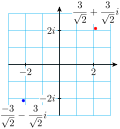
43.

Answer.
  1. \(3(\cos \dfrac{\pi}{4} + i\sin \dfrac{\pi}{4})\text{,}\) \(~3(\cos \dfrac{3\pi}{4} + i\sin \dfrac{3\pi}{4})\)
  2. \(\dfrac{3}{\sqrt{2}}+\dfrac{3}{\sqrt{2}}i\text{,}\) \(~\dfrac{-3}{\sqrt{2}}-\dfrac{3}{\sqrt{2}}i\)
square roots

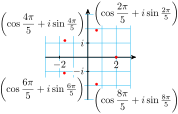
45.

Answer.
  1. \(2,~2\left(\cos \dfrac{2\pi}{5} + i\sin \dfrac{2\pi}{5}\right)\text{,}\) \(~2\left(\cos \dfrac{4\pi}{5} + i\sin \dfrac{4\pi}{5}\right)\) , \(~2\left(\cos \dfrac{6\pi}{5} + i\sin \dfrac{6\pi}{5}\right)\text{,}\) \(2\left(\cos \dfrac{8\pi}{5} + i\sin \dfrac{8\pi}{5}\right)\)
  2. \(2,~0.618+1.9i\text{,}\) \(-1.618+1.176i\text{,}\) \(-1.618-1.176i\text{,}\) \(0.618-1.902i\)
fifth roots of complex number

47.

Answer.
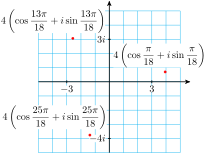
  1. \(4\left(\cos \dfrac{\pi}{18} + i\sin \dfrac{\pi}{18}\right)\text{,}\) \(~4\left(\cos \dfrac{13\pi}{18} + i\sin \dfrac{13\pi}{18}\right)\text{,}\) \(~4\left(\cos \dfrac{25\pi}{18} + i\sin \dfrac{25\pi}{18}\right)\)
  2. \(1.97+0.347i\text{,}\) \(~-1.286+1.532i\text{,}\) \(~-0.684-1.879i\)
cube roots of complex number

49.

Answer.
\(\abs{z} = \abs{\cos (\theta) + i\sin (\theta)} = \sqrt{\cos^2(\theta) + \sin^2(\theta)} = 1\)

51.

Answer.
  1. \(\displaystyle 1,~(\cos \dfrac{2\pi}{3} + i\sin \dfrac{2\pi}{3}),~(\cos \dfrac{4\pi}{3} + i\sin \dfrac{4\pi}{3})\)
  2. \(\displaystyle 1,~i,~-1,~-i\)
  3. \(1,~(\cos \dfrac{2\pi}{5} + i\sin \dfrac{2\pi}{5}),~(\cos \dfrac{4\pi}{5} + i\sin \dfrac{4\pi}{5}),\) \((\cos \dfrac{6\pi}{5} + i\sin \dfrac{6\pi}{5}),~(\cos \dfrac{8\pi}{5} + i\sin \dfrac{8\pi}{5})\)
  4. \(1,~(\cos \dfrac{\pi}{3} + i\sin \dfrac{\pi}{3}),~(\cos \dfrac{2\pi}{3} + i\sin \dfrac{2\pi}{3}),~-1,\) \((\cos \dfrac{4\pi}{3} + i\sin \dfrac{4\pi}{3}),~(\cos \dfrac{5\pi}{3} + i\sin \dfrac{5\pi}{3})\)

53.

Answer.
\((\omega_k)^n = 1^n \left(\cos \left(n \cdot \dfrac{2\pi k}{n}\right) + i\sin \left(n \cdot \dfrac{2\pi k}{n}\right)\right) = 1(\cos 2\pi k + i\sin 2\pi k) = 1\)

55.

Answer.
\(8^{1/4}\left(\cos \left(\dfrac{3\pi}{8}\right) + i\sin \left(\dfrac{3\pi}{8}\right)\right)\text{,}\) \(~8^{1/4}\left(\cos \left(\dfrac{5\pi}{8}\right) + i\sin \left(\dfrac{5\pi}{8}\right)\right)\text{,}\) \(~8^{1/4}\left(\cos \left(\dfrac{11\pi}{8}\right) + i\sin \left(\dfrac{11\pi}{8}\right)\right)\text{,}\) \(~8^{1/4}\left(\cos \left(\dfrac{13\pi}{8}\right) + i\sin \left(\dfrac{13\pi}{8}\right)\right)\)

57.

Answer.
\(\sqrt{2}\text{,}\) \(~\sqrt{2}\left(\cos \left(\dfrac{\pi}{3}\right) + i\sin \left(\dfrac{\pi}{3}\right)\right)\text{,}\) \(~\sqrt{2}\left(\cos \left(\dfrac{2\pi}{3}\right) + i\sin \left(\dfrac{2\pi}{3}\right)\right)\text{,}\) \(~-\sqrt{2}\text{,}\) \(~\sqrt{2}\left(\cos \left(\dfrac{4\pi}{3}\right) + i\sin \left(\dfrac{4\pi}{3}\right)\right)\text{,}\) \(~\sqrt{2}\left(\cos \left(\dfrac{5\pi}{3}\right) + i\sin \left(\dfrac{5\pi}{3}\right)\right)\)

59.

Answer.
\(\sqrt{2}\left(\cos \left(\dfrac{\pi}{3}\right) + i\sin \left(\dfrac{\pi}{3}\right)\right)\text{,}\) \(~\sqrt{2}\left(\cos \left(\dfrac{2\pi}{3}\right) + i\sin \left(\dfrac{2\pi}{3}\right)\right)\text{,}\) \(~\sqrt{2}\left(\cos \left(\dfrac{4\pi}{3}\right) + i\sin \left(\dfrac{4\pi}{3}\right)\right)\text{,}\) \(~\sqrt{2}\left(\cos \left(\dfrac{5\pi}{3}\right) + i\sin \left(\dfrac{5\pi}{3}\right)\right)\)

61.

Answer.
  1. \(\displaystyle \cos^2 (\theta) - \sin^2 (\theta) +(2\sin (\theta) \cos (\theta))i\)
  2. \(\displaystyle \cos (2\theta) + i\sin (2\theta)\)
  3. \(\displaystyle \sin (2\theta) = 2\sin (\theta) \cos (\theta);~~\cos (2\theta) = \cos^2 (\theta) - \sin^2 (\theta)\)

65.

Answer.
  1. \(\displaystyle z_1z_2 = (ac-bd) + (ad+bc)i\)
  2. \(\displaystyle a=r\cos(\alpha),~b=r\sin(\alpha),~c=R\cos(\beta),~d=R\sin(\beta)\)
  3. \((ac-bd) + (ad+bc)i = (rR\cos(\alpha)\cos(\beta) - rR\sin(\alpha)\sin(\beta))\) \(+ (rR\cos(\alpha)\sin(\beta)+rR\sin(\alpha)\cos(\beta))i\)
  4. \(\displaystyle rR(\cos (\alpha+\beta) +i\sin (\alpha+\beta))\)

10.5 Chapter Summary and Review
Review Problems

33.

Answer.
\(\left(4, \dfrac{\pi}{6}\right)\text{,}\) \(~\left(4, \dfrac{5\pi}{6}\right)\)

61.

Answer.
\(3\sqrt{2}\left(\cos\left(\dfrac{7\pi}{4}\right)+ i\sin\left(\dfrac{7\pi}{4}\right)\right)\)

65.

Answer.
\(2\left(\cos\left(\dfrac{4\pi}{3}\right)+i\sin\left(\dfrac{4\pi}{3}\right)\right)\)

67.

Answer.
\(\begin{aligned}[t] z_1z_2 \amp=16(\cos (\pi) +i\sin (\pi)) \\ \amp=-16,~\dfrac{z_1}{z_2} \\ \amp=4\left(\cos\left(\dfrac{-2\pi}{3}\right)+i\sin\left(\dfrac{-2\pi}{3}\right)\right) \\ \amp=-2-2\sqrt{3}i \end{aligned}\)

69.

Answer.
\(\begin{aligned}[t] z_1z_2\amp=\dfrac{5}{2}\left(\cos\left(\dfrac{-\pi}{3}\right)+i\sin\left(\dfrac{-\pi}{3}\right)\right) \\ \amp=\dfrac{5}{4}-\dfrac{5\sqrt{3}}{2}i\end{aligned},\) \(\begin{aligned}[t] \dfrac{z_1}{z_2} \amp=10\left(\cos\left(\dfrac{-5\pi}{6}\right)+i\sin\left(\dfrac{-5\pi}{6}\right)\right) \\ \amp=-5\sqrt{3}-5i \end{aligned}\)

79.

Answer.
\(3(\cos\theta+i\sin \theta),\) for \(\theta=\dfrac{\pi}{6},~\) \(\dfrac{\pi}{2},~\) \(\dfrac{5\pi}{6},~\) \(\dfrac{7\pi}{6},~\) \(\dfrac{3\pi}{2},~\) \(\dfrac{11\pi}{6}\)

81.

Answer.
\(\sqrt{2}(\cos(\theta)+i\sin (\theta)),\) for \(\theta=\dfrac{\pi}{3},~\) \(\dfrac{2\pi}{3},~\) \(\dfrac{4\pi}{3},~\) \(\dfrac{5\pi}{3}\)