In Section 10.3 we represented the sum of two complex numbers graphically as a vector addition. Is there a way to visualize the product or quotient of two complex numbers? One way to explore a new idea is to consider a simple case. What happens to the vector representing a complex number when we multiply the number by \(i\text{?}\)
The vectors are shown at right. We see that multiplication by \(i\) corresponds to rotating the vector around the origin by \(90\degree\) in the counterclockwise direction.
The previous example suggests that multiplication by a complex number results in a rotation. Polar coordinates are well suited to processes that involve rotation, because they use angles to specify location. Thus, we will next represent complex numbers in an alternate polar form.
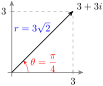
The figure below shows the complex number \(~z=3+3i\text{,}\) represented as a vector in the complex plane. The distance \(r\) from the origin to \(z\) is
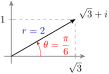
Of course, we can always recover the Cartesian form of a complex number from its polar form by evaluating the trigonometric functions. We’ll check the result of the previous example:
\begin{align*}
z \amp = 2\left(\cos \left(\dfrac{\pi}{6}\right) + i\sin \left(\dfrac{\pi}{6}\right)\right)\\
\amp = 2\left(\dfrac{\sqrt{3}}{2} + i \cdot \dfrac{1}{2}\right) = \sqrt{3} + i
\end{align*}
This formula, which you will prove in the Homework Problems, says that the product of two complex numbers in polar form is the complex number with modulus \(rR\) and argument \(\alpha + \beta\text{.}\) Thus, to find the product of two complex numbers, we multiply their lengths and add their arguments.
We multiply the moduli, \(2 \cdot 2 =4\text{,}\) and add the arguments, \(\dfrac{\pi}{6}+\dfrac{\pi}{3} = \dfrac{\pi}{2}\text{.}\) The polar form of the product is thus
Note that \(z\) and \(w\) are the numbers from the previous Example and Exercise, namely \(~z=\sqrt{3} + i~\) and \(~w=1+i\sqrt{3}\text{.}\) You can compute the product \(zw\) in Cartesian form to check that you get the same result, \(4i\text{.}\)
The figure at right shows the graphs of \(z\) and \(w\text{,}\) and their product, \(zw\text{.}\) You can see that multiplying \(z\) by \(w\) rotates the graph of \(z\) by the argument of \(w\text{,}\) namely \(\dfrac{\pi}{3}\) or \(60\degree\text{.}\)
If \(~z_1=r\left(\cos \left(\alpha\right)+i\sin \left(\alpha\right)\right)~\) and \(~z_2=R\left(\left(\cos \beta\right)+i\sin \left(\beta\right)\right)\text{,}\) then
Because raising to a power is just repeated multiplication, we can also use the polar form to simplify powers of a complex number. For example, if \(z=r(\cos(\alpha)+i\sin (\alpha))\text{,}\) then
\begin{equation*}
z^2=z \cdot z = r \cdot r(\cos(\alpha+ \alpha) +i\sin (\alpha + \alpha))
\end{equation*}
We compute \(z^2\) by squaring the modulus, \(r\text{,}\) and doubling the argument, \(\alpha\text{,}\) so the polar form is
We use the polar form, \(z= 2\left(\cos \left(\dfrac{\pi}{6}\right) + i\sin \left(\dfrac{\pi}{6}\right)\right)\text{,}\) and apply De Moivre’s theorem. Then
The Cartesian form of \(z^4\) is thus \(16\left(\dfrac{-1}{2} + i\dfrac{\sqrt{3}}{2}\right)\text{,}\) or \(-8+8i\sqrt{3}\text{.}\) You can check that you get this same result if you compute \(\left(\sqrt{3} + i\right)^4\) by expanding the power.
DeMoivre’s Theorem also works for rational values of \(n\text{,}\) so we can compute roots of complex numbers. For example, by applying the theorem with \(n=\dfrac{1}{2}\text{,}\) we see that one of the square roots of \(z=r\left(\cos(\alpha)+i\sin (\alpha)\right)\) is
Now, every number,whether real or complex, has two square roots. To find the other root, remember that we can add a multiple of \(2\pi\) to the argument of \(z\text{,}\) that is, we can also write the polar form of \(z\) as
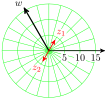
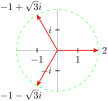
The three roots are shown at right. Note that they are evenly spaced around a circle of radius 2. You can check that adding further muliples of \(2\pi\) to the argument does not generate any new cube roots.
Let \(\omega = \cos \left(\dfrac{2\pi}{n}\right) + i\sin \left(\dfrac{2\pi}{n}\right)\text{,}\) where \(n\) is a positive integer. Show that the \(n\) distinct \(n^{th}\) roots of unity are \(\omega,~\omega^2,~\omega^3,~ \cdots,~\omega^{n-1}\text{.}\)
Suppose that \(z=a+bi\) and that \(a\) and \(b\) are both real numbers.
If \(a \not= 0\) and \(b=0\text{,}\) then what is the slope of the segment in the complex plane joining the origin to \(z\text{?}\) What is the slope of the segment joining the origin to \(zi\text{?}\)
If \(a = 0\) and \(b \not=0\text{,}\) then what is the slope of the segment in the complex plane joining the origin to \(z\text{?}\) What is the slope of the segment joining the origin to \(zi\text{?}\)
Now suppose that \(z_1=r(\cos (\alpha) +i \sin (\alpha))\) and \(z_2=R(\cos (\beta) +i \sin (\beta))\text{.}\) Write \(a,~b,~c\) and \(d\) in terms of \(r,~R,~\alpha\) and \(\beta\text{.}\)
Let \(z_1=r(\cos (\alpha) +i \sin (\alpha))\) and \(z_2=R(\cos (\beta) +i \sin (\beta))\text{.}\) Prove the quotient rule as follows: Set \(w=\dfrac{r}{R}(\cos (\alpha - \beta) + i\sin (\alpha - \beta)),\) and show that \(z_1=wz_2\text{.}\)