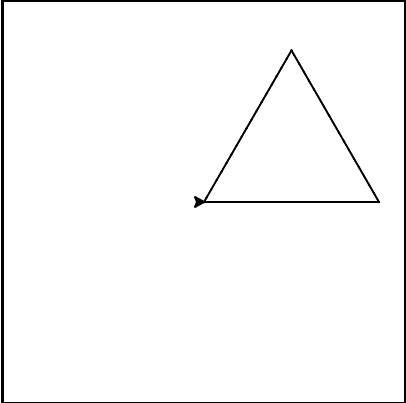
That last piece of code is actually a pattern for a wide variety of geometric shapes. Here’s the code to draw a triangle. It may not be obvious why we turn 120 in this program, but it will be soon.
The Total Turtle Trip Theorem states that the turtle will draw a closed figure with n sides when the sum of the angles turned is a multiple of 360. In the triangle example, 3 * 120 = 360 and in the pentagon example, 5 * 72 = 360.
Change the ?? in line 7 below to the amount to turn each time to draw a 12-sided polygon, which is called a dodecagon. If you get it right the turtle will draw a 12-sided closed polygon.
The following program uses a turtle to draw a triangle as shown below, but the lines are mixed up. The program should do all necessary set-up and create the turtle. After that, iterate (loop) 3 times, and each time through the loop the turtle should go forward 100 pixels, and then turn left 120 degrees. Drag the needed blocks of statements from the left column to the right column and put them in the right order with the correct indention. There may be additional blocks that are not needed in a correct solution. Click on Check to see if you are right. You will be told if any of the lines are in the wrong order or are the wrong blocks.
from turtle import *
---
space = Screen()
---
marie = Turtle()
---
for i in range(3):
---
for i in range(3) #paired
---
    marie.forward(100)
---
    marie.forward(100 #paired
---
    marie.left(120)
---
    marie.turn(120) #paired