Skip to main content
Contents Index
Search Book
Search Results:
No results.
Read aloud Readability settings Prev Up Next Profile title here \(\newcommand\DLGray{\color{Gray}}
\newcommand\DLO{\color{BurntOrange}}
\newcommand\DLRa{\color{WildStrawberry}}
\newcommand\DLGa{\color{Green}}
\newcommand\DLGb{\color{PineGreen}}
\newcommand\DLBa{\color{RoyalBlue}}
\newcommand\DLBb{\color{Cerulean}}
\newcommand\ds{\displaystyle}
\newcommand\ddx{\frac{d}{dx}}
\newcommand\os{\overset}
\newcommand\us{\underset}
\newcommand\ob{\overbrace}
\newcommand\obt{\overbracket}
\newcommand\ub{\underbrace}
\newcommand\ubt{\underbracket}
\newcommand\ul{\underline}
\newcommand\laplacesym{\mathscr{L}}
\newcommand\lap[1]{\laplacesym\left\{#1\right\}}
\newcommand\ilap[1]{\laplacesym^{-1}\left\{#1\right\}}
\newcommand\tikznode[3][]
{\tikz[remember picture,baseline=(#2.base)]
\node[minimum size=0pt,inner sep=0pt,#1](#2){#3};
}
\newcommand{\lt}{<}
\newcommand{\gt}{>}
\newcommand{\amp}{&}
\definecolor{fillinmathshade}{gray}{0.9}
\newcommand{\fillinmath}[1]{\mathchoice{\colorbox{fillinmathshade}{$\displaystyle \phantom{\,#1\,}$}}{\colorbox{fillinmathshade}{$\textstyle \phantom{\,#1\,}$}}{\colorbox{fillinmathshade}{$\scriptstyle \phantom{\,#1\,}$}}{\colorbox{fillinmathshade}{$\scriptscriptstyle\phantom{\,#1\,}$}}}
\newcommand{\sfrac}[2]{{#1}/{#2}}
\)
Section 13.2 Unit Step Function Variants
The basic unit step \(u(t)\) switches a function on at \(t=0\text{.}\) But what if you need the switch to flip later, flip off, or even turn on for just a short while? This paragraph introduces three key variants:
\(u_c(t)\text{:}\) switches ON at a chosen time \(c\text{.}\)
\(1 - u_c(t)\text{:}\) switches OFF at time \(c\text{.}\)
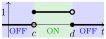
\(u_c(t) - u_d(t)\text{:}\) switches ON for a window from \(c\) to \(d\text{.}\)
Together, these act like a complete toolkit for modeling stepwise ON/OFF behavior in real systems.
Subsection Shifted Unit Step Function
Checkpoint 263 Prep-Questions.
(a) 📖❓ True or False: Shifting a Function.
(b) 📖❓ When Does It Switch?
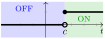
Sometimes you need the step to turn ON at a different time. The
shifted unit step function , written
\(u_c(t)\text{,}\) is simply the basic step shifted right (if
\(c \gt 0\) ) or left (if
\(c \lt 0\) ):
📜 Shifted Unit Step Function.
\begin{equation*}
u_c(t) = u(t - c) =
\left\{
\begin{array}{ll}
1, \amp t \ge c \\
0, \amp t \lt c
\end{array}
\right.
\end{equation*}
Before \(t=c\text{,}\) \(u_c(t)\) is OFF; after \(t=c\text{,}\) it turns ON.
Exploring the Effect of \(c\) .
Consider the product of the parabolic function and the shifted unit step function
\begin{equation*}
\left(\frac{1}{5}t^2 - 1\right) u_c(t)\text{.}
\end{equation*}
Use the tool to see how changing \(c\) affects the ON/OFF behavior of the parabola.
An interactive plot of the parabola one-fifth t squared minus 1 multiplied by the shifted unit step u-sub-c of t; the reader drags the switch point c along the t-axis and hovers over the labels to highlight each graph and see how c turns the parabola on and off.
Hover over the labels \(g(t)\text{,}\) \(\left(\frac15 t^2 - 1\right)\) and \(u_c(t)\) to highlight its graph.
Drag the value of \(c\text{,}\) initially at \((0,0)\text{,}\) along the \(t\) axis.
Checkpoint 264 📖❓ Effect of \(u_c(t)\) on a Function.
What does multiplying a function
\(f(t)\) by
\(u_{5}(t)\) do?
It forces \(f(t)\) OFF before \(t = 5\text{,}\) then switches it ON at \(t = 5\text{.}\)
Exactly! Multiplying by \(u_5(t)\) means the function is 0 before \(t = 5\) and normal after.
It multiplies \(f(t)\) by \(5\text{.}\)
Not quite. \(u_5(t)\) is not a scaling factor; it’s a switching function.
It adds \(5\) to \(f(t)\text{.}\)
Nope, \(u_5(t)\) does not alter the function’s output directly. It controls when it turns on.
It delays \(f(t)\) by 5 seconds.
Close, but that’s what happens when you write \(f(t - 5)\text{.}\) Multiplying by \(u_5(t)\) just turns it ON at \(t = 5\text{.}\)
So, to activate a function at
\(t = c\text{,}\) simply multiply it by
\(u_c(t)\text{.}\) This switch-like behavior will be useful later when we write piecewise functions in terms of
\(u_c\text{.}\)
Subsection Reversed Unit Step Function
Checkpoint 265 Prep-Questions.
(a) 📖❓ When Does It Switch?
(b) 📖❓ Understanding ON/OFF Language.
What does it mean when we say a function
\(g(t)\) is "OFF" for
\(t \gt 4\text{?}\)
That \(g(t)\) becomes negative for \(t \gt 4\text{.}\)
OFF doesn’t mean negative. It means the function is multiplied by \(0\text{,}\) it’s gone.
That \(g(t)\) stops increasing after \(t = 4\text{.}\)
Not quite. Saying a function is OFF means it’s set to 0, not just leveled off.
That \(g(t)\) is multiplied by 0 for all \(t \gt 4\text{.}\)
Exactly. OFF means the function is inactive because it’s being multiplied by 0.
That \(g(t)\) is undefined for \(t \gt 4\text{.}\)
Nope, OFF doesn’t mean undefined. The function is still defined, but multiplication by \(0\) turns it off.
What if you need the opposite behavior — a switch that turns a function OFF at
\(t=c\text{?}\)
This reverse behavior can be built using the unit step function itself. Since
\(u_c(t)\) jumps from 0 to 1 at
\(t = c\text{,}\) we can reverse the switch with the subtraction:
\(1-u_c(t)\text{.}\)
📜 Reversed Unit Step Function.
\begin{equation*}
1 - u_c(t) =
\left\{
\begin{array}{ll}
1, \amp t \lt c \\
0, \amp t \ge c
\end{array}
\right.
\end{equation*}
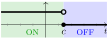
Before \(t=c\text{,}\) \(u_c(t)\) is ON; after \(t=c\text{,}\) it turns OFF.
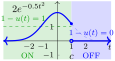
🌌 Example 266 Switching OFF an Exponential.
Describe the product below and express it in piecewise form.
\begin{equation*}
h(t) = 2e^{-0.5t^2}\left(1 - u_1(t)\right)
\end{equation*}
Solution .
Here, the exponential function \(2e^{-0.5t^2}\) is ON before \(t = 1\) and switches OFF afterward. In piecewise form, this looks like:
\begin{equation*}
h(t) =
\left\{
\begin{array}{ll}
2e^{-0.5t^2}, \amp t \lt 1 \\
0, \amp t \ge 1
\end{array}
\right.
\end{equation*}
Checkpoint 267 📖❓ Reversed Switch Logic.
Which of the following is equivalent to the function
\begin{equation*}
f(t) = \begin{cases}
t,\amp t \lt -2 \\
0,\amp t \ge -2
\end{cases}
\end{equation*}
\(t \cdot u_{-2}(t)\)
This would set \(t\) to 1 at \(t = -2\text{,}\) but we want it to turn OFF there.
\(t \cdot (1 - u_{-2}(t))\)
Correct! \(1 - u_{-2}(t)\) is ON before \(t = -2\) and OFF afterward, matching the piecewise definition.
\((t - 2) \cdot u_{-2}(t)\)
This starts a different function at \(t = -2\text{.}\) It’s neither \(t\) nor OFF before then.
\(t + 2\)
This is just a shifted version of \(t\text{,}\) not a piecewise function that shuts off.
With both
\(u_c(t)\) and
\(1 - u_c(t)\) in hand, you can now switch functions ON or OFF exactly when you need. Next, we will cover the last switch, which turns functions ON for a limited window of time over a finite interval.
Subsection Windowed Unit Step Function
Checkpoint 268 Prep-Questions.
(a) 📖❓ True or False: Interval Notation.
The interval
\([2, 5)\) includes
\(t = 2\) but not
\(t = 5\text{.}\)
True.
The square bracket means included and the parenthesis means excluded , so \(t = 2\) is in the interval, but \(t = 5\) is not.
False.
The square bracket means included and the parenthesis means excluded , so \(t = 2\) is in the interval, but \(t = 5\) is not.
(b) 📖❓ When Is the Window ON?
The final variant combines the first two ideas to create a “time window” where a function is ON for a limited interval, then turns OFF again.
We can build this behavior by subtracting two step functions:
\(u_c(t)\) turns ON at \(t = c\text{.}\)
\(u_d(t)\) turns ON at \(t = d\text{,}\) flipping us back to OFF since we are subtracting.
So the difference \(u_c(t) - u_d(t)\) is the ON-window we need.
📜 Windowed Unit Step Function.
\begin{equation*}
u_c(t) - u_d(t) =
\left\{
\begin{array}{ll}
1, \amp c \le t \lt d \\
0, \amp \text{otherwise}
\end{array}
\right.
\end{equation*}
Between \(t=c\) and \(t=d\text{,}\) \(u_c(t)\) is ON and OFF otherwise.
This “windowed” switch models limited bursts of activity (like a force that acts for a few seconds, then disappears).
Effect of \(c\) and \(d\) .
Drag
\(c\) and d along the t-axis in the first two plots to see how u-sub-c of t and u-sub-d of t combine so that their difference forms an ON-window between c and d.
Checkpoint 269 📖❓ Selecting the ON-Interval Expression.
Which expression represents a function,
\(f(t)\text{,}\) that is active (ON) on the interval
\([2, 5)\) and
\(0\) elsewhere?
\(\ f(t)\left(u_2(t) - u_5(t)\right)\)
Correct!
\(\ 2f(t) + 5f(t)\)
Incorrect
\(\ f(t)\left(u_5(t) - u_2(t)\right)\)
Incorrect
\(\ f(t)\ u_5(t) - u_2(t) \)
Incorrect
As with previous step functions, this step function switches ON any function over the interval
\([c,d)\) and OFF everywhere else.
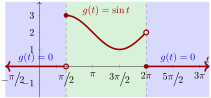
🌌 Example 270 Switching ON a Sine Wave for a While.
Write the function that equals
\(\sin t + 2\) only on
\([\frac{\pi}{2}, 2\pi)\) and is
\(0\) elsewhere, using step functions.
Solution .
Since this function is \(\sin t + 2\) only on a finite window, we multiply it by the following difference of shifted unit step functions:
\begin{equation*}
g(t)
= \left(\sin t + 2\right)
\cdot \left(u_{\sfrac{\pi}{2}}(t) - u_{2\pi}(t)\right)\text{.}
\end{equation*}
In piecewise form, this function is
\begin{equation*}
g(t) = \left\{
\begin{array}{ll}
\sin t + 2, \amp \sfrac{\pi}{2} \le t \lt 2\pi \\
0, \amp \text{otherwise}
\end{array}
\right.
\end{equation*}
and its graph is given by
Explore the Product \(f(t) \cdot (u_c(t)-u_d(t))\) .
Instructions:
Hover over \(g(t)\) to hightlight the graph of \((\sin t + 2)(u_c(t) - u_d(t))\text{.}\)
Hovering over \((\sin t + 2)\) or \((u_c(t) - u_d(t))\) highlights their individual graph.
Drag the value of \(c\) and \(d\) along the \(t\) axis.
An interactive plot of the quantity sine t plus 2 multiplied by the window u-sub-c of t minus u-sub-d of t; the reader drags c and d along the t-axis and hovers over the labels to watch the windowed sine burst change width.
Together, these three step function variants give you complete control over when a function is active. In the next section, we’ll combine them to rewrite entire piecewise functions in a single, neat formula.
Checkpoint 271 🤔💭 Unit Step Function Variants Reading Questions.
(a) 📖❓ What Does \(u_c(t)\) Do?
The unit step function
\(u_c(t)\) is multiplied by another function
\(f(t)\text{.}\) What does
\(u_c(t)\) do in this context?
It switches \(f(t)\) ON at \(t=c\) and keeps it ON forever.
Correct — \(u_c(t)\) equals 0 before \(t=c\) and 1 afterward.
It switches \(f(t)\) OFF at \(t=c\text{.}\)
Not quite — that would be \(1-u_c(t)\text{.}\)
It reverses the direction of \(f(t)\) at \(t=c\text{.}\)
No — there’s no “reverse” here, just ON/OFF switching.
It multiplies \(f(t)\) by \(t\) after \(t=c\text{.}\)
No — \(u_c(t)\) is either 0 or 1; it doesn’t add factors of \(t\text{.}\)
You have attempted
of
activities on this page.