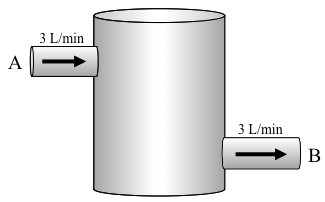
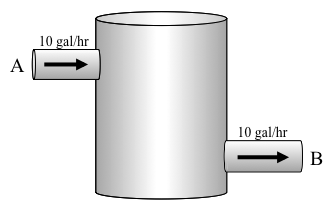
We’re about to start working on applications involving mixing solutions in tanks. That means we need to be mindful of units (for example--we can’t add miles and kilograms), mass balance, and volumes. We also can develop some intuition that will be helpful when we tackle more complicated questions.
Consider the equation \(s \cdot X = d,\) where \(s\) is a speed and has units of miles/hour. The variable \(d\) represents distance and has units miles. What units must the variable \(X\) have?
Consider the equation \(M - N\cdot P = Z,\) where \(M\) has units of ft \(\cdot\) lb/sec, \(N\) has units of ft, \(P\) has units of lb/sec. What must the units of \(Z\) be?
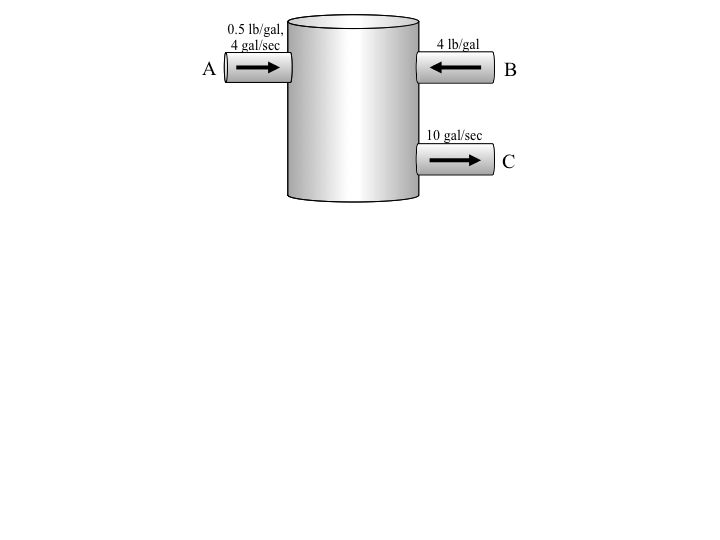
The concentration (in lb/gal) of salt in each brine solution is shown in the figure. Assuming the tank level doesn’t change, at what rate (in lb/sec) is salt entering the tank?
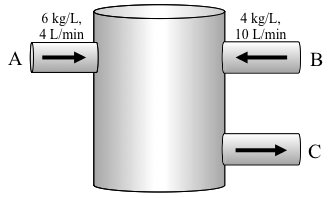
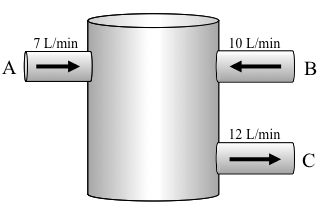
If the tank has a capacity of 1500 L, and is empty at time \(t = 0\) minutes, write a function \(V(t)\) for volume of liquid in the tank at time \(t\) minutes.
Suppose the tank initially contains 50 L of water that is dark red due to food coloring and that the liquid entering the tank is pure water. Imagine that we allow the pure water to enter the tank and the mixed solution to drain out of the tank for a really long time; you can think about it happening for years, if it helps. What color would you expect the water in the tank to be after a really long time?
Suppose the tank initially contains 50 L of pure water and that the liquid entering the tank is water that is dark red due to food coloring. Imagine that we allow the dark red water to enter the tank and the mixed solution to drain out of the tank for a really long time; you can think about it happening for years, if it helps. What color would you expect the water in the tank to be after a really long time?
Suppose the tank initially contains 50 gallons of a salt water solution (also called a brine) with concentration 6 lb/gal, and that the liquid entering the tank is pure water.
Imagine that we allow the pure water to enter the tank and the mixed solution to drain out of the tank for a really long time; you can think about it happening for years, if it helps. What concentration of salt do you expect there to be in the tank after a long time?
Suppose the tank initially contains 50 L of a brine with concentration 6 kg/L, and that the liquid entering the tank is a brine with concentration 8 kg/L.
Imagine that we allow the brine to enter the tank and the mixed solution to drain out of the tank for a really long time; you can think about it happening for years, if it helps. What concentration of salt do you expect there to be in the tank after a long time?
How much salt do you expect to be in the tank after a long time? (Note that this is a slightly different than asking about the concentration of salt. Hint: use units!)