Solve the following systems of differential equations. The worked solutions below take a different road than the eigenvalue method: they apply the Laplace transform from the previous chapters to each equation, turning the system into simultaneous algebraic equations. Both methods produce the same solutions — as you work through these, notice how the exponential rates that appear are exactly the eigenvalues of each system’s coefficient matrix.
Suppose a mixture containing 0.3 kg of sugar per liter runs into a tank initially filled with 400 L of water containing 2 kg of sugar. The liquid enters at 10 L/min,the mixture is kept uniform by stirring, and the mixture flows out at the same rate.
Use your answer to question to determine the concentration of sugar in the tank after a long time. Does your answer make sense in terms of the physical scenario? Explain.
A brine solution of salt flows at a constant rate of 4 L/min into a large tank that initially holds 100 L of pure water. The solution inside the tank is kept well-stirred and flows out of the tank at a rate of 3 L/min. Suppose the concentration of salt in the brine entering the tank is \(0.2\) kg/L. Then
Two large tanks, each holding 100 L of liquid, are interconnected by pipes, with the liquid flowing from tank 1 into tank 2 at 3 L/min and from tank 2 into tank 1 at 1 L/min. The liquid in each tank is kept well stirred. A brine solution with a salt concentration of 0.01 kg/L flows into tank 1 at a rate of 4 L/min. The (diluted) solution flows out of the system from tank 1 at 2 L/min and from tank 2 at 2 L/min.Initially, tank 1 contains pure water and tank 2 contains 6 kg of salt.
Write a system of differential equations for\(x_1(t) \) (the amount of salt, in kg, in tank 1 at time \(t \) )and \(x_2(t) \) (the amount of salt, in kg, in tank 2 at time \(t \) ).
A simplified mathematical model for an arms race between two countries whose expenditures for defense are expressed by the variables \(x(t)\) and \(y(t)\) is given by the linear system
\begin{align*}
\frac{dx}{dt} \amp = 2y - x + a \amp x(0) = 1\\
\frac{dy}{dt} \amp = 4x - 3y + b \amp y(0) = 4
\end{align*}
where \(a \) and \(b \) are constants that measure the trust (or distrust!) each country has for the other.
How can we interpret the fact that the coefficient of \(y \) is positive in the equation for \(\frac{dx}{dt}\text{?}\) Does it make sense? Would the DE make sense if the coefficient were negative instead?
How can we interpret the fact that the coefficient of \(y \) is negative in the equation for \(\frac{dy}{dt}\text{?}\) Does it make sense? Would the DE make sense if the coefficient were positive instead?
Suppose country X trusts country Y, but country Y doesn’t trust country X. What can we say about \(a\) and \(b\text{?}\) Should they be positive, negative, or zero?
Rewrite the system of differential equations in matrix form by using the vector \(\vec{X} = \begin{bmatrix} x\\y \end{bmatrix}.\) Notice that for this system, the right hand side should be of the form \(A\vec{X} + \vec{B}.\)
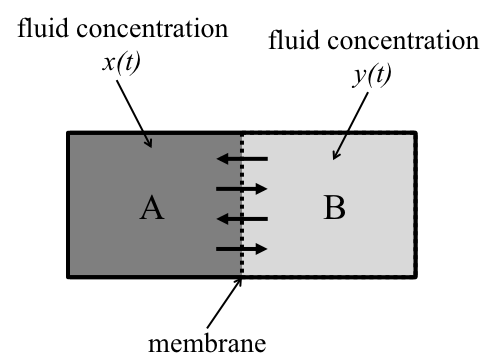
Suppose compartments A and B are filled with fluids and are separated by a permeable membrane. The figure is a compartmental representation of the exterior and interior of a cell. Suppose, too, that a nutrient necessary for cell growth passes through the membrane.
A model for the amounts \(x(t)\) and \(y(t)\) of the nutrient in compartments A and B, respectively, at time \(t\) is given by the linear system of differential equations:
where \(V_A\) and \(V_B\) are the volumes of the compartments (so \(\sfrac{x}{V_A}\) and \(\sfrac{y}{V_B}\) are the concentrations), and \(\kappa > 0 \) is a permeability factor. Let \(x(0) = x_0\) and \(y(0) = y_0\text{.}\)
In the first equation, explain why it makes sense for \(y\) to have a positive coefficient and \(x \) to have a negative coefficient.
Notice that if we add these two equations, we get \(\frac{dx}{dt} + \frac{dy}{dt} = 0, \) or, equivalently, \(\frac{d}{dt}[x+y] = 0.\) Explain what this means and why it makes sense.
A tank contains 100 liters of water. Salt is being added at a rate of 5 grams per minute. If the mixture is kept uniform by stirring and salt is being removed from the tank at a rate of 2 liters per minute, set up the differential equation that models the amount of salt \(y(t)\) in the tank at any time \(t\).