1.
(a) Unit Step Behavior.
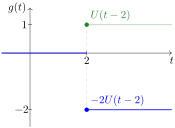
What is the only possible set of values that any unit step function \(u_c(t)\) can take?
-
1 only
-
Unit step functions are OFF before \(t = c\text{,}\) so they can also be 0.
-
0 and 1
-
Correct! Unit step functions are always either 0 (OFF) or 1 (ON).
-
any real number
-
No, unit step functions are discrete switches, not continuous functions.
-
any nonnegative number
-
Even though the values are nonnegative, only 0 and 1 are ever used.
(b) Rewriting an ON Interval.
Which expression represents a function that is ON from \(t = 1\) to \(t = 4\) and OFF otherwise?
-
\(\quad u_1(t) - u_4(t)\)
-
This expression turns ON at \(t = 1\) and back OFF at \(t = 4\text{.}\)
-
\(\quad u_1(t)\)
-
This stays ON after \(t = 1\text{,}\) but never switches OFF at \(t = 4\text{.}\)
-
\(\quad 1 - u_4(t)\)
-
This is ON before \(t = 4\text{,}\) but never turns ON at \(t = 1\text{.}\)
-
\(\quad u_4(t) - u_1(t)\)
-
That would actually be negative during the interval from \(t = 1\) to \(t = 4\text{,}\) not what we want.
(c) Multiplying by a Step Function.
What is the effect of multiplying a function \(f(t)\) by \(u_6(t)\text{?}\)
-
It shifts \(f(t)\) 6 units to the left.
-
Shifting the input would require \(f(t + 6)\text{,}\) not multiplication by \(u_6(t)\text{.}\)
-
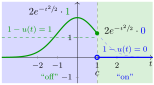
It keeps \(f(t)\) OFF before \(t = 6\) and turns it ON at \(t = 6\text{.}\)
-
Correct. \(u_6(t)\) acts as a switch that activates \(f(t)\) at \(t = 6\text{.}\)
-
It subtracts 6 from the output of \(f(t)\text{.}\)
-
Step functions don’t affect the output directly, they control when the function is active.
-
It delays \(f(t)\) by 6 units.
-
Delaying would require rewriting the input as \(f(t - 6)\text{,}\) not just multiplying by \(u_6(t)\text{.}\)
(d) Equivalent to Piecewise Form.
Which step-function expression is equivalent to the piecewise function
\begin{equation*}
f(t) = \left\{
\begin{array}{ll}
3, \amp 0 \le t \lt 2 \\
0, \amp \text{otherwise}
\end{array}
\right.
\end{equation*}
-
\(\quad 3 \cdot (u_0(t) - u_2(t))\)
-
This turns 3 ON at \(t = 0\) and OFF again at \(t = 2\text{.}\)
-
\(\quad 3 \cdot u_2(t)\)
-
This turns ON at \(t = 2\text{,}\) not \(t = 0\text{.}\)
-
\(\quad 3 \cdot (1 - u_2(t))\)
-
This would be ON before \(t = 2\text{,}\) but it wouldn’t stop at \(t = 0\text{,}\) it’s ON too early.
-
\(\quad 3 \cdot u_0(t)\)
-
This is ON at \(t = 0\text{,}\) but it stays ON forever, it doesn’t turn OFF at \(t = 2\text{.}\)
(e) Reading a Step Expression.
What interval is the function \(5 \cdot (1 - u_6(t))\) activated on?
-
\(\quad t \lt 6\)
-
\(1 - u_6(t)\) is ON before \(t = 6\) and OFF afterward.
-
\(\quad t \gt 6\)
-
That would be true of \(u_6(t)\text{,}\) not its reversal.
-
\(\quad t = 6\) only
-
This is a step function, not a spike, it applies to intervals, not points.
-
\(\quad t \ge 6\)
-
Again, that’s when \(u_6(t)\) turns ON, not when its complement is active.
(f) Using the Shift Rule.
Suppose \(\lap{f(t)} = F(s)\text{.}\) What is \(\lap{f(t)\cdot u_4(t)}\text{?}\)
-
\(\quad e^{-4s} \cdot \lap{f(t+4)}\)
-
This is the shift rule in action: delay the function, then shift its input left.
-
\(\quad e^{4s} \cdot F(s)\)
-
The exponent should be negative, delaying adds \(e^{-cs}\text{.}\)
-
\(\quad \lap{f(t - 4)}\)
-
This shifts the function right but doesn’t match the form used in the shift rule.
-
\(\quad \lap{f(t)} \cdot u_4(t)\)
-
The Laplace transform applies to the whole product, you can’t apply it to one piece separately.
(g) Shifting Inside the Transform.
Which of the following is equal to \(\lap{(t^2)\cdot u_2(t)}\text{?}\)
-
\(\quad e^{-2s} \cdot \lap{(t + 2)^2}\)
-
This follows directly from the shift rule, replace \(t\) with \(t + 2\text{.}\)
-
\(\quad e^{-2s} \cdot \lap{t^2}\)
-
We must shift the input, \(t^2\) becomes \((t + 2)^2\text{.}\)
-
\(\quad \lap{t^2} \cdot u_2(t)\)
-
You can’t break apart the transform like this, it applies to the whole product.
-
\(\quad e^{-2s} \cdot (t^2 + 4t + 4)\)
-
That’s the shifted polynomial, but we want the Laplace transform of that expression, not the polynomial itself.
(h) Interpreting a Full Step Form.
The function \(f(t)\) is written as:
\begin{equation*}
f(t) = 2t \cdot u_0(t) + (3 - 2t) \cdot u_1(t) - 3 \cdot u_4(t)
\end{equation*}
What can you infer about the original piecewise function?
-
It had three intervals: \(0 \le t \lt 1\text{,}\) \(1 \le t \lt 4\text{,}\) and \(t \ge 4\text{.}\)
-
Each change in the step function corresponds to a new piece of the function.
-
It is active only for \(t \ge 1\text{.}\)
-
No, \(u_0(t)\) activates the function at \(t = 0\text{.}\)
-
It is always equal to \(2t\text{.}\)
-
Only the first term is \(2t\text{,}\) and it gets overridden by the later terms.
-
The function turns off completely at \(t = 1\text{.}\)
-
It doesn’t turn OFF at \(t = 1\text{,}\) it switches to a new expression.
(i) Transform of a function that turns off.
Which of the following expressions is equivalent to the Laplace transform of \(t(1 - u_4(t))\text{?}\)
-
\(\lap{t} - \lap{t \cdot u_4(t)}\)
-
\(\lap{t \cdot u_4(t)}\)
-
\(e^{-4s} \lap{t}\)
-
\(\lap{0}\)
(j) Multiplying a Function by \(u_c(t)\).
Consider the parabola multiplied by two different shifted unit step functions:
\begin{equation*}
\left(\dfrac{1}{5}t^2 - 1\right) u_2(t), \qquad \left(\dfrac{1}{5}t^2 - 1\right) u_{-1}(t)\text{.}
\end{equation*}
Describe the ON/OFF behavior of the parabola in each case.