Note first that at
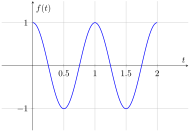
\(t = 0\text{,}\) \(f(t)\) is at its maximum,
\(f(0) = 1\text{.}\) Hence, we will be looking for a formula for
\(f(t)\) in the family of functions
\(A\cos(Bt) + C\text{.}\) To find values for the constants
\(A\text{,}\) \(B\) and
\(C\text{,}\) we have to find the period, amplitude, and midline.
We see the same cycle repeating between \(0 \lt t \lt 1\) and \(1 \lt t \lt 2\text{.}\) This means the period of \(f(t)\) is \(1\) and so
\begin{equation*}
B = \frac{2\pi}{1} = 2 \pi.
\end{equation*}
From the graph, we know
\begin{equation*}
f_\text{max} = 1, \quad f_\text{min} = -1.
\end{equation*}
Therefore, the amplitude is \(\frac{f_\text{max} - f_\text{min}}{2} = \frac{1 - (-1)}{2} = 1\text{,}\) which implies \(\abs{A} = 1\text{.}\) To determine if \(A = 1\) or \(A = -1\text{,}\) notice that \(f(t)\) is at its maximum at \(t = 0\) just as cosine is, meaning we do not have a reflection over the \(t\)-axis. This tells us that \(A = 1\text{.}\) We now know that \(f(t)\) is of the form
\begin{equation*}
f(t) = \cos(2\pi t) + C.
\end{equation*}
To find \(C\text{,}\) note that the equilibrium of \(f(t)\) is \(\frac{f_\text{max} + f_\text{min}}{2} = \frac{1 + (-1)}{2} = 0\) and the midline is \(y = 0\text{.}\) Hence, \(C = 0\) and the final formula that corresponds to the graph \(y = f(t)\) is:
\begin{equation*}
f(t) = \cos(2\pi t).
\end{equation*}