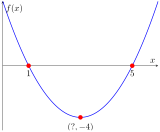
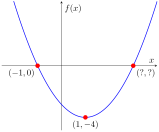
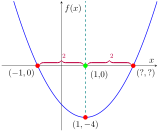
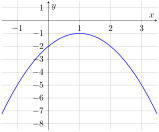
The graph of every quadratic parabola is symmetric with respect to the vertical line passing through its vertex. In this case, we can see that the vertical line through the vertex
\((1,-4)\) crosses the
\(x\)-axis at the point
\((1,0)\text{.}\)
By symmetry, each
\(x\)-intercept must be the same horizontal distance from the point
\((1,0)\text{.}\) As
\((-1,0)\) is a horizontal distance of
\(2\) units from
\((1,0)\text{,}\) the second horizontal intercept must be
\((3,0)\text{.}\)
Alternatively, we could use the fact that the
\(x\)-coordinate of the vertex,
\(x=1\text{,}\) is the midpoint between the given horizontal intercept
\(x_1=-1\) and the second horizontal intercept
\(x_2\) that we are tasked with finding. Using the formula for the
\(x\)-coordinate of the vertex:
\begin{align*}
x\text{--coordinate of the vertex}\amp=\frac{x_1+x_2}{2}\\
1\amp=\frac{-1+x_2}{2}\\
2\cdot 1\amp=\frac{-1+x_2}{\cancel{2}}\cdot \cancel{2}\\
2\amp=-1+x_2\\
2 \textcolor{blue}{+1}\amp=-1+x_2\textcolor{blue}{+1}\\
3 \amp= x_2
\end{align*}
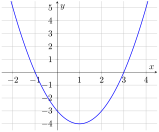
Whether we use a visual approach or the formula, we arrive at the same conclusion: the second horizontal intercept is at the point
\((3,0)\text{.}\)