State the definition of the logarithm base \(b\) and rewrite an expression in logarithmic form as an equivalent expression in exponential form, and vice versa.
Let \(b\) such that \(b\gt0\text{,}\)\(b\neq1\) be given. Then for every \(x\gt0\text{,}\) the logarithm base \(b\) of \(x\text{,}\) denoted \(\log_{b}x\text{,}\) is defined so that
We have the logarithm base \(2\) in this example. The value of \(\log_2 8\) is the exponent such that \(2\) to this exponent equals \(8\text{,}\) which is \(3\text{:}\)
The logarithm base \(3\) of \(\frac{1}{9}\text{,}\)\(\log_3\frac{1}{9}\text{,}\) is the exponent such that \(3\) to this power equals \(\frac{1}{9}\text{.}\) This exponent is \(-2\text{:}\)
The logarithm base \(10\) of \(0.001=\frac{1}{1000}\) is the exponent such that \(10\) to that power equals \(\frac{1}{1000}\text{.}\) Because we can write
Note: If the argument inside the logarithm is a more complicated expression rather than just a number or a variable, we use parentheses around it. Often we use parentheses even if the argument is just a number or a variable. In other words, \(\log_{10}x\) and \(\log_{10}(x)\) are two different ways to denote the same thing. However, \(\log_{10}(x+3)\) and \(\log_{10} x+3\) are not the same, as in one case \(x+3\) is inside the logarithm and in the other case only \(x\) is inside the logarithm. It would be more clear for us to write \(\log_{10} (x)+3\) rather than \(\log_{10} x+3\text{,}\) as the parentheses emphasize that \(x\) is inside the logarithm and the addition of 3 is not.
We are looking for a number such that \(10\) to that number is equal to \(-100\text{:}\)
\begin{equation*}
10^?=-100
\end{equation*}
Would it be \(-2\text{?}\) Definitely not as \(10^{-2}=\frac{1}{100}\text{.}\) There is no number such that \(10\) to that number is \(-100\) as \(10^p\) is always positive by properties of exponential functions.
We are looking for an exponent such that \(10\) to this exponent equals \(5\text{:}\)
\begin{equation*}
10^?=5.
\end{equation*}
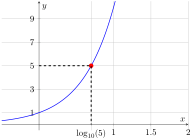
Notice \(10^0=1\) so \(0\) is too small, and \(10^1=10\) so \(1\) is too large. The exponent that we are looking for is somewhere between \(0\) and \(1\text{.}\) The graph of \(y=10^x\) shows that such a number exists.
Clearly there is a number between \(0.5\) and \(1\) such that \(10\) to that number is \(5\text{.}\) That number is by definition \(\log_{10}(5)\text{.}\) What’s the simplest way to approximate it? Use your calculator! Most likely you have two buttons on your calculator related to logarithms: “log” and “ln”. “log” is the logarithm of base \(10\text{.}\) We use our calculator and obtain:
While the logarithm base \(2\) has some importance in the theory of music and other applications, the applications we will focus on rely heavily on the common logarithm and natural logarithm, which we will define below.
This quantity is undefined. The natural logarithm, as any other logarithm, is defined for positive inputs only. There is no number \(p\) such that \(e^p=0\text{,}\) since \(e^p\) is always positive.
Using the “ln” button of your calculator, \(\ln 2\approx0.693\text{,}\) rounded to three decimal places. As with many logarithms, \(\ln 2\) is an irrational number, so we can only have its decimal approximation. As a check, \(e^{0.693}\approx 1.99970\)—almost \(2\text{.}\)
Using the “log” button of your calculator, \(\log 2\approx 0.301\text{,}\) rounded to three decimal places. As a check, \(10^{0.301}\approx 1.99986\)—practically \(2\text{.}\)
Using a calculator, \(\log (e^{-0.078})\approx -0.0339\text{.}\) To double check, we find that \(10^{-0.0339}\approx 0.9249\text{,}\)\(e^{-0.078}\approx 0.9249\text{.}\)
SubsectionGraphs of Functions \(y=\log(x)\) and \(y=\ln(x)\)
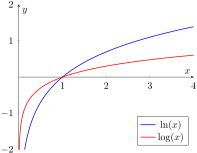
The common logarithm \(\log (x)\) is defined for every positive input \(x\) and so is the natural logarithm \(\ln (x)\text{.}\) We can consider the two logarithmic functions \(y=\log(x)\) and \(y=\ln(x)\) with domains \(x\gt0\text{.}\) The graphs of the common logarithm function and the natural logarithm function have a similar shape:
We see that both functions \(y=\log x\) and \(y=\ln x\) are defined for all \(x\gt0\) and not defined for \(x\leq 0\text{.}\) Both functions are \(0\) at \(x=1\text{:}\)\(\log 1=0\) and \(\ln 1=0\text{.}\) Furthermore, both functions are positive for \(x\gt1\) and negative for \(0\lt x\lt1\text{.}\) We also notice that for positive inputs \(x\) which are closer and closer to \(0\text{,}\) outputs are getting “more and more negative,” and both graphs approach the \(y\)-axis without ever crossing it. We say that the \(y\)-axis is a vertical asymptote for \(y=\log x\) and \(y=\ln x\text{.}\) Recall that exponential functions have a horizontal asymptote at the \(x\)-axis. Finally, both functions are increasing.
For each of the following, use your calculator to evaluate the given expression. Round off to four decimal places. For undefined expressions, state “undefined”.