A commonly used base in the context of exponential functions is the Euler constant. The constant is denoted by the letter \(e\) and its approximate value is
\begin{equation*}
e \approx 2.718281827 \dots
\end{equation*}
The constant \(e\) is an irrational number which, much like \(\pi\text{,}\) appears in various areas of mathematics. It is sufficient for you to remember that \(e \approx 2.718\) or even
\begin{equation*}
e \approx 2.71
\end{equation*}
Your calculator will give you a better approximation of \(e\text{.}\) A precise definition of \(e\) is complicated, and will not be covered in this text.
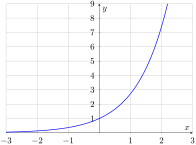
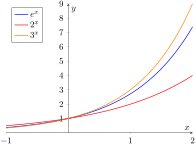
We call \(e\) the natural base and, when used as the base of an exponential function, we get the so-called natural exponential function \(y = e^x\text{.}\) Since \(e\gt 1\text{,}\) the graph of a natural exponential function is increasing, just as any other exponential function with growth factor larger than \(1\text{:}\)
In most applications, especially in life sciences, people tend to rewrite all exponential functions in terms of the natural base \(e\text{.}\) How can this be done? Suppose we have an exponential function \(f(x) = A \cdot b^x\) where \(b\) is any positive number. By the graph above, we can see that there exists a constant \(k\) such that
\begin{equation*}
b = e^k.
\end{equation*}
This means that one can rewrite any exponential function as
\begin{equation*}
f(x) = A \cdot b^x = A \cdot (e^k)^x = A \cdot e^{k x}.
\end{equation*}
Remark: The constant \(k\) in the formula \(Q(t) = A \cdot e^{k t}\) is called the continuous growth rate or, when expressed as a percent, the continuous percent growth rate. The relevance of this terminology will become more clear if you go on to study calculus.
The value of the constant \(k\) depends on the units of \(t\)—years, days, hours etc. Hence, we will sometimes say the “continuous annual growth rate” \(k\) or the “continuous daily growth rate” \(k\) etc., to emphasize the units of \(t\) unless the units of \(t\) are clear from the context.
Note: Any exponential in base-\(e\) form, say \(Q(t) = A \cdot e^{k t}\text{,}\) can easily be converted to standard form \(Q(t) = A \cdot b^t\) by taking \(b = e^k\text{.}\) Going the other way around, that is, finding the exact value of \(k\) for a given \(b\) requires solving the following equation for \(k\text{:}\)
\begin{equation*}
e^k = b.
\end{equation*}
Since the unknown \(k\) is in the exponent, the equation cannot be solved algebraically until Chapter 6 since it requires logarithms.
From the base-\(e\) form, the continuous growth rate is \(k = 0.035 = 3.5\%\) and the initial value of the investment is \(A=2500\text{.}\) Notice that
as \(e^{0.035} \approx 1.0356\text{.}\) Hence, the growth factor is \(b=1.0356\) and the annual percent growth rate is \(r=0.0356 = 3.56\%\text{.}\) This shows that the continuous growth rate and the annual percent growth rate are close but not equal.
A patient treated for thyroid cancer is given an injection of 10 \(\mu\)g of Iodine-131. Let \(I(t)\) be the amount of Iodine-131 left in the patient’s body \(t\) days after the injection. Assume that the continuous daily decay rate of Iodine-131 is \(8.66\%\text{.}\)
The continuous growth rate is given as \(k = -8.66\% = -0.0866\text{.}\) Hence, it will be easier to find a formula for \(I(t)\) in the form \(I(t) = A e^{k t}\text{.}\) The initial amount is \(A = 10\text{,}\) so
The daily percent growth rate is \(r = 0.917 - 1 = -0.083 = -8.3\%\text{.}\) Observe that the two rates, \(k=-8.66\%\) and \(r=-8.3\%\text{,}\) differ significantly.
For each of the following, determine if the given exponential function is increasing or decreasing. For each function, identify its continuous growth rate.
For each of the following, rewrite the given exponential function in the form \(y=A\cdot b^t\text{.}\) Round off the base \(b\) to four decimal places.
A common antidepressant Paxil has a continuous hourly growth rate of \(-3.3\%\text{.}\) A patient takes an initial dose of \(30\) mg. Let \(P(t)\) be the amount of Paxil left in a patient’s body from the initial dose \(t\) hours later.
A radioactive isotope of Iodine, Iodine-123, is often used in medical imaging as a contrast. An initial amount of \(12\)\(\mu\)g of Iodine-123 is administered to a patient. Let \(I(t)\) be the amount of Iodine-123, in \(\mu\)g, remaining in the patient’s body after \(t\) hours. Given that the continuous hourly decay rate of Iodine-123 is \(5.33\%\text{,}\) write a formula for \(I(t)\text{.}\) How much Iodine-123 is left after \(24\) hours?