Consider the function \(f(x) = x^3\text{.}\) What would happen if we multiply this function by a nonzero number? For instance, what would the graphs of \(g(x) = 4x^3\) and \(h(x) = \frac{1}{2}x^3\) look like? In this case, the graph of \(g(x) = 4x^3\) is the graph of \(f(x) = x^3\)stretched vertically by multiplying each of the original outputs of \(f(x) = x^3\) by \(4\) and the graph of \(h(x) = \frac{1}{2}x^3\) is the graph of \(f(x) = x^3\)compressed vertically by dividing each of the original outputs of \(f(x) = x^3\) by \(2\) (equivalently, we can think of this as multiplying the original outputs by \(\frac{1}{2}\)).
What if we were to multiply by a negative number? The graph of \(j(x) = - 4x^3\) is the graph of \(f(x) = x^3\)stretched vertically by multiplying each of the original outputs of \(f(x) = x^3\) by \(4\text{,}\) but also reflected over the \(x\)-axis.
In general, if we begin with the graph of a function \(y = f(x)\text{,}\) then the function \(g(x) = af(x)\) can be given by the formula \(g(x) = a y\text{.}\) That is, the \(y\)-values of \(g(x)\) are the \(y\)-values of \(f(x)\) adjusted by the multiplication of the number \(a\text{.}\) Hence, the graph of \(g(x) = af(x)\) is the graph of \(f(x)\) either stretched (if \(|a| \gt 1\)) or compressed (if \(|a| \lt 1\)) vertically, and additionally reflected over the \(x\)-axis if \(a\) is negative.
Given a function \(f(x)\) and a constant \(a\text{,}\)\(g(x) = af(x)\) is a vertical scaling of the graph of \(f(x)\) and also a reflection of \(f(x)\) over the \(x\)-axis if \(a\) is negative. In either case:
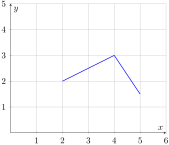
A table of values for a function \(f(t)\) is given below. Give the table of values for \(g(t)\text{,}\) whose graph is that of \(f(t)\) reflected over the \(t\)-axis and compressed vertically by a factor of \(10\text{.}\)
A reflection over the \(t\)-axis will change the sign of every output of \(f(t)\text{,}\) while vertical compression by a factor of \(10\) means that every output must be divided by 10. We could think of \(g(t)\) as having the formula \(g(t) = - \frac{1}{10}f(t)\) and the resulting table of values would be
Vertical scaling results from multiplying all the outputs of a given function by the same number. We can also take an original function and multiply all of its inputs by the same number. Consider \(f(x) = {2}^{x}\text{.}\) The function \(g(x) = 2^{-x}\) is the graph of \(f(x) = 2^x\)reflected over the \(y\)-axis while \(h(x) = 2^{(4x)}\) is the graph of \(f(x) = 2^x\)scaled horizontally by dividing each original input by \(4\) (or, equivalently, multiplying each original input by \(\frac{1}{4}\)).
Given a function \(f(x)\) and a constant \(b\text{,}\)\(g(x) = f(bx)\) is a horizontal scaling of the graph of \(f(x)\) and also a reflection of \(f(x)\) over the \(y\)-axis if \(b\) is negative. In either case
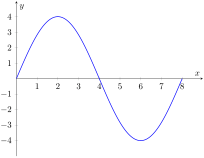
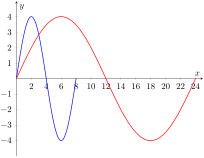
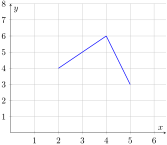
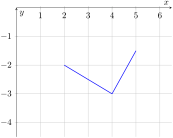
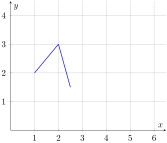
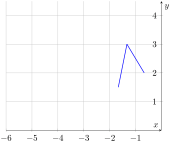
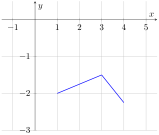
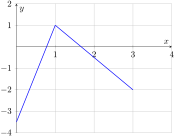
The graph of a function \(y = f(x)\) is shown below. Write the formula for the function \(g(x)\) whose graph is that of \(f(x)\) stretched horizontally by a factor of \(3\) and also graph \(g(x)\text{.}\)
In order to stretch \(f(x)\) by a factor of \(3\text{,}\) we need to multiply each of its inputs by \(3\text{.}\) To accomplish this, we must let the \(b\) in the horizontal scaling formula be given by \(\frac{1}{3}\text{.}\) Why? The function \(g(x) = f(bx)\) is the graph of \(f(x)\) scaled horizontally by multiplying each of its inputs by \(\frac{1}{b}\text{.}\) Since we need to multiply each input by \(3\text{,}\) we need \(\frac{1}{b} = 3\text{,}\) which implies that \(b = \frac{1}{3}\text{.}\) So \(g(x) = f\left(\frac{1}{3}x\right)\text{.}\) The graph of \(g(x)\) is formed by taking each ordered pair on \(f(x)\) and leaving its \(y\)-value the same but multiplying its \(x\)-value by \(3\text{.}\)
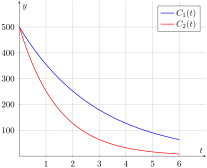
A certain medication metabolizes so that the concentration in the body \(t\) hours after taking a 500 mg dose is modeled by the function \(C_1(t) = 500{(0.71)}^t\text{.}\) A 500 mg dose of a different medication follows the same pattern but metabolizes twice as fast. Use your knowledge of horizontal scaling to represent drug concentration curve \(C_2\) of this different medication.
In order for the second medication to metabolize twice as fast as the first while following the same pattern, the graph of \(C_2\) must be the graph of \(C_1\) compressed horizontally by dividing each of the inputs of \(C_1\) by 2 (or, equivalently, multiplying them by \(\frac{1}{2}\)). For instance, the concentration of the first medication 6 hours after a dose should be the same as the concentration of the second medication 3 hours after a dose. This corresponds to
SubsectionCombining Shifts, Scaling, and Reflections
The transformations of functions introduced in this section can be combined with each other and with horizontal/vertical shifting as described in the previous section. When identifying the transformations that have been applied to an original function, we work our way from the inside of the function out by looking at what is happening to the variable \(x\) and in what order via order of operations. This is explained below.
The graph of \(g(x)\) is the graph of \(f(x)\) reflected over the \(y\)-axis, compressed vertically by a factor of \(5\text{,}\) and shifted up \(3\) units.
The graph of \(g(x)\) is the graph of \(f(x)\) shifted to the right \(2\) units, stretched horizontally by a factor of \(5\text{,}\) reflected over the \(y\) axis, stretched vertically by a factor of \(6\text{,}\) and shifted up \(10\) units.
The graph of \(f(x)\) is the graph of \(y=x^3\) shifted left \(4\) units, scaled vertically by a factor of \(2\text{,}\) and reflected over the \(x\)-axis.
The graph of \(g(t)\) is the graph of \(y=\sqrt[3]{t}\) shifted right \(5\) units, compressed horizontally by a factor of \(2\text{,}\) and shifted up \(9\) units.
The graph of \(h(w)\) is the graph of \(y=e^w\) compressed horizontally by a factor of \(2\text{,}\) reflected over the \(y\)-axis, compressed vertically by a factor of \(4\text{,}\) and shifted down \(7\) units.
The graph of \(y\) is the graph of \(f(x)=2^x\) shifted left \(1\) unit, compressed horizontally by a factor of \(7\text{,}\) and shifted down \(3\) units.