Determine the quadrant containing the terminal side of an angle given in radians and compute the arc length spanned by an angle on a circle of a given radius.
We are working toward defining the two important trigonometric functions \(f(t) = \sin(t)\) and \(f(t) = \cos(t)\text{.}\) These functions, referred to as the sine function and the cosine function respectively, are periodic functions which are commonly used in applied sciences to model periodic processes.
The first step is to define the trigonometric ratios \(\sin(\alpha)\) and \(\cos(\alpha)\) for any angle \(\alpha\text{,}\) positive or negative. We also have to learn how to measure angles in radians rather than in degrees. In this section we define positive and negative angles of any size and radian measure.
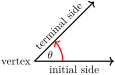
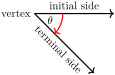
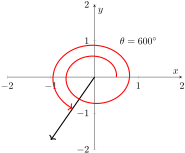
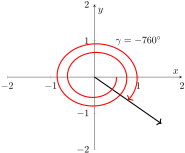
For a given angle, we designate one side as the initial side and the other as the terminal side. We imagine the angle being swept out starting from the initial side and ending at the terminal side, as shown below. When the rotation from the initial side to terminal side is counterclockwise, we say that the angle is positive; when the rotation is clockwise, we say that the angle is negative.
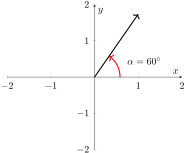
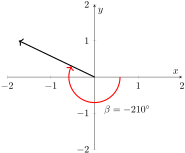
We say that an angle is in standard position if it is located on the \(xy\)-plane with the vertex at the origin \((0, 0)\) and initial side aligned with the positive \(x\)-axis. Again, counterclockwise rotations generate positive angles while clockwise rotations yield negative angles:
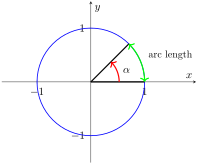
The radian measure of a positive angle \(\alpha\) is equal to the length of the arc spanned by the angle on the circle of radius \(1\) centered at the vertex of the angle:
Recall that the unit circle on the \(xy\)-plane is the circle of radius \(1\) centered at the origin \((0, 0)\text{.}\) Here is the precise definition of one radian.
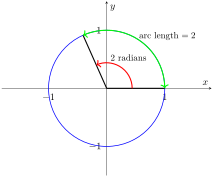
The angle of \(1\) radian spans the arc of length \(1\) on the unit circle—the length of the arc and the length of the radius are the same. Imagine “picking up” the radius of the unit circle like a yardstick and wrapping it over a piece of the circle to obtain the arc of the same length as the radius. If you measure the arc of length equal to twice the radius, the arc will correspond to the angle of \(2\) radians, and so on:
The first thing we notice is that the angle of \(1\) radian, denoted by \(1\) rad, is a relatively large angle while the angle of \(1^{\circ}\) is a very small angle. To understand why this is, let’s look at the full angle of \(360^{\circ}\) in terms of radians. The circumference of a circle of radius \(r\) is \(C = 2\pi r\text{.}\) That means the circumference of the unit circle is simply \(C = 2\pi\text{.}\) Therefore, the angle that spans the whole circle—one complete counterclockwise revolution—is the angle of \(2\pi\) radians, or \(360^{\circ}\text{.}\) Hence, we have the following relationship between degrees and radians:
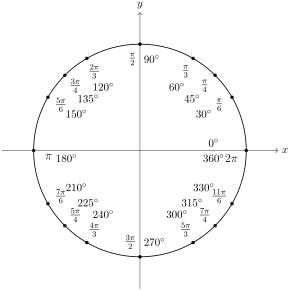
The figure below shows a few angles on the unit circle together with their radian measure. From now on, you should try to get used to radian measure and think about angles in terms of radians rather than degrees.
In which quadrant is the angle of \(2\) radians? An angle of \(5\) radians? (In other words, in which quadrants are the terminal sides of these angles?)
Refer to Figure 8.2.10. The second quadrant includes angles between \(\pi/2 \approx 1.57\) radians and \(\pi \approx 3.14\) radians. The angle of \(2\) radians must lie in the second quadrant. The angle of \(5\) radians is between \(3\pi/2 \approx 4.71\) and \(2\pi \approx 6.28\) radians, so \(5\) radians is in the fourth quadrant.
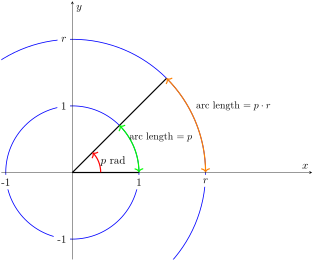
An angle of \(p\) radians spans an arc of length \(p\) on the unit circle. By similarity of circular sectors, the same angle of \(p\) radians spans the arc of length \(p \cdot r\) on the circle of radius \(r\text{:}\)
For each of the following, convert the angle from degrees to radians. Give both exact answers and, when appropriate, approximations to three decimal places. Also identify which quadrant each angle lies in.
For each of the following, convert the angle from radians to degrees. Give both exact answers and, when appropriate, approximations to three decimal places. Also identify which quadrant each angle lies in.