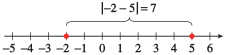
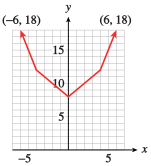
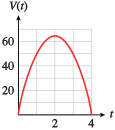
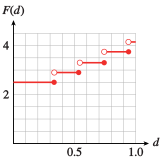
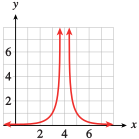
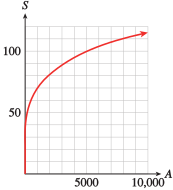
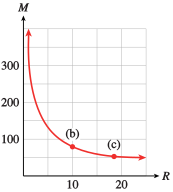
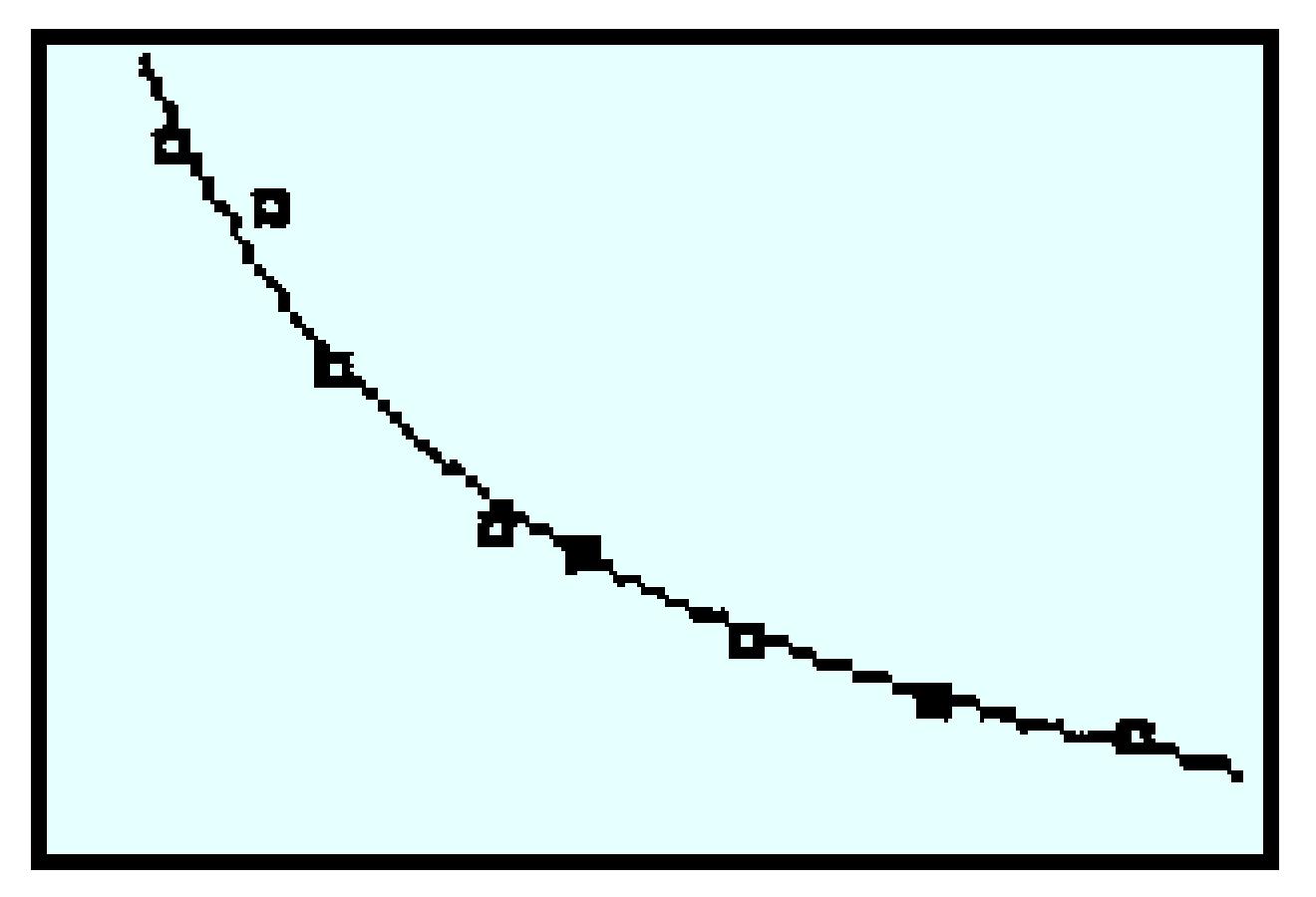
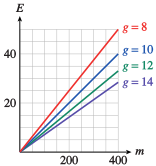
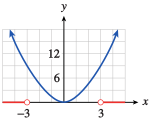
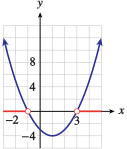
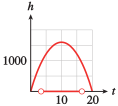
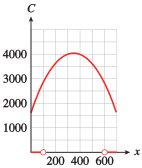
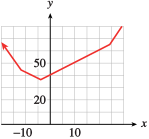
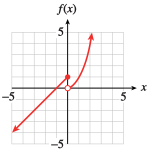
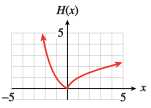
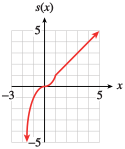
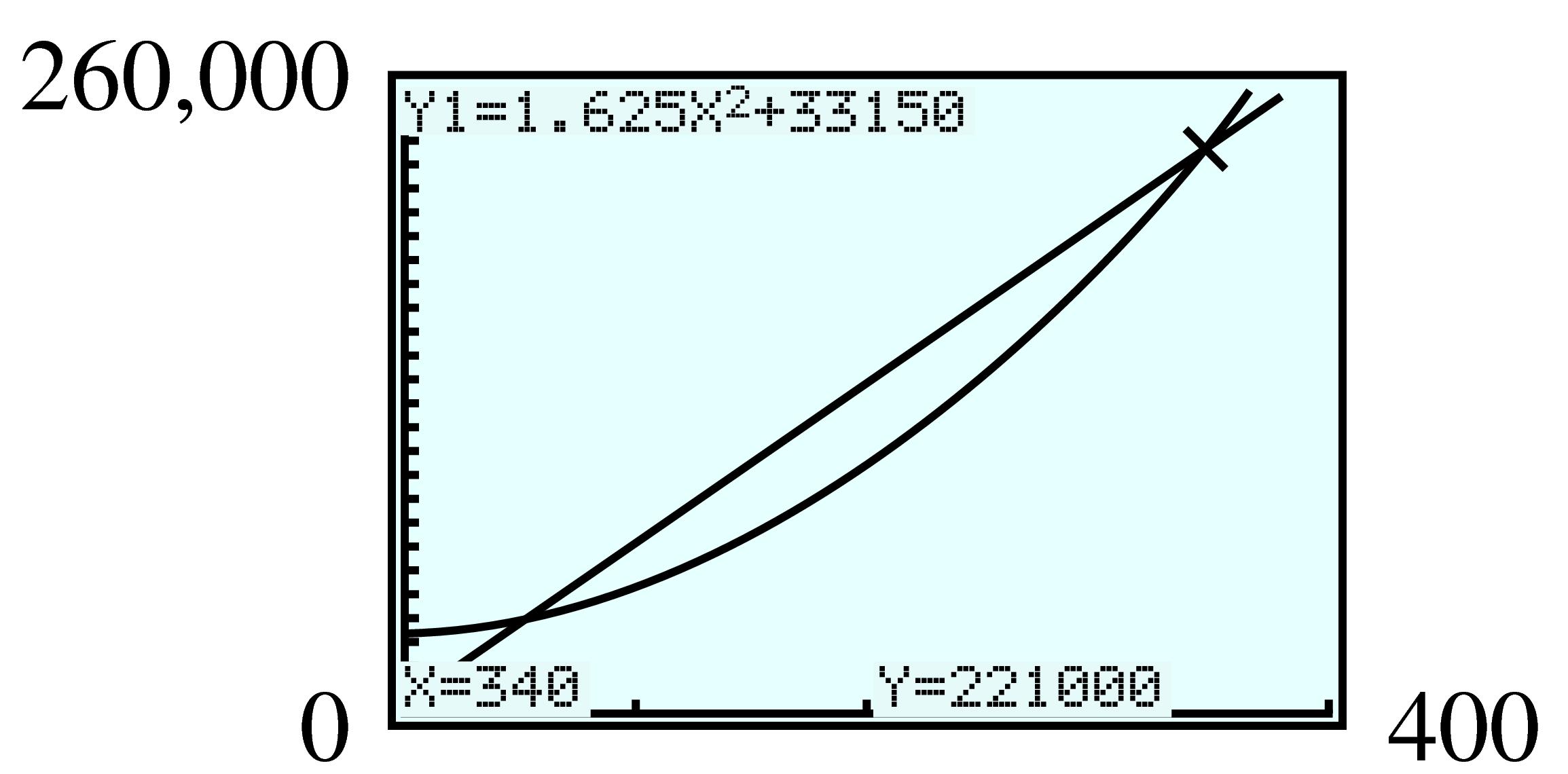
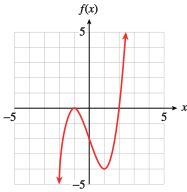
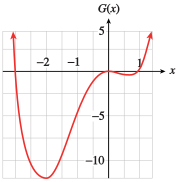
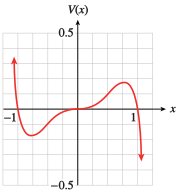
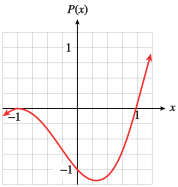
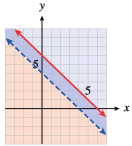
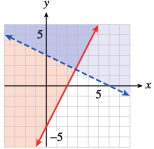
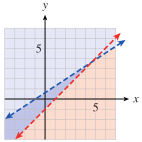
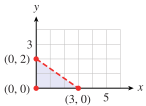
Appendix G Answers to Selected Exercises

1 Functions and Their Graphs
1.1 Linear Models
Homework 1.1

5.

Answer.
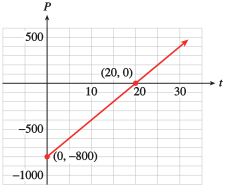
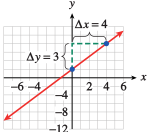
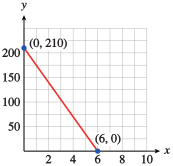
  1. \(\displaystyle P=-800+40t\)
  2. \((0,-800)\text{,}\) \((20,0)\)
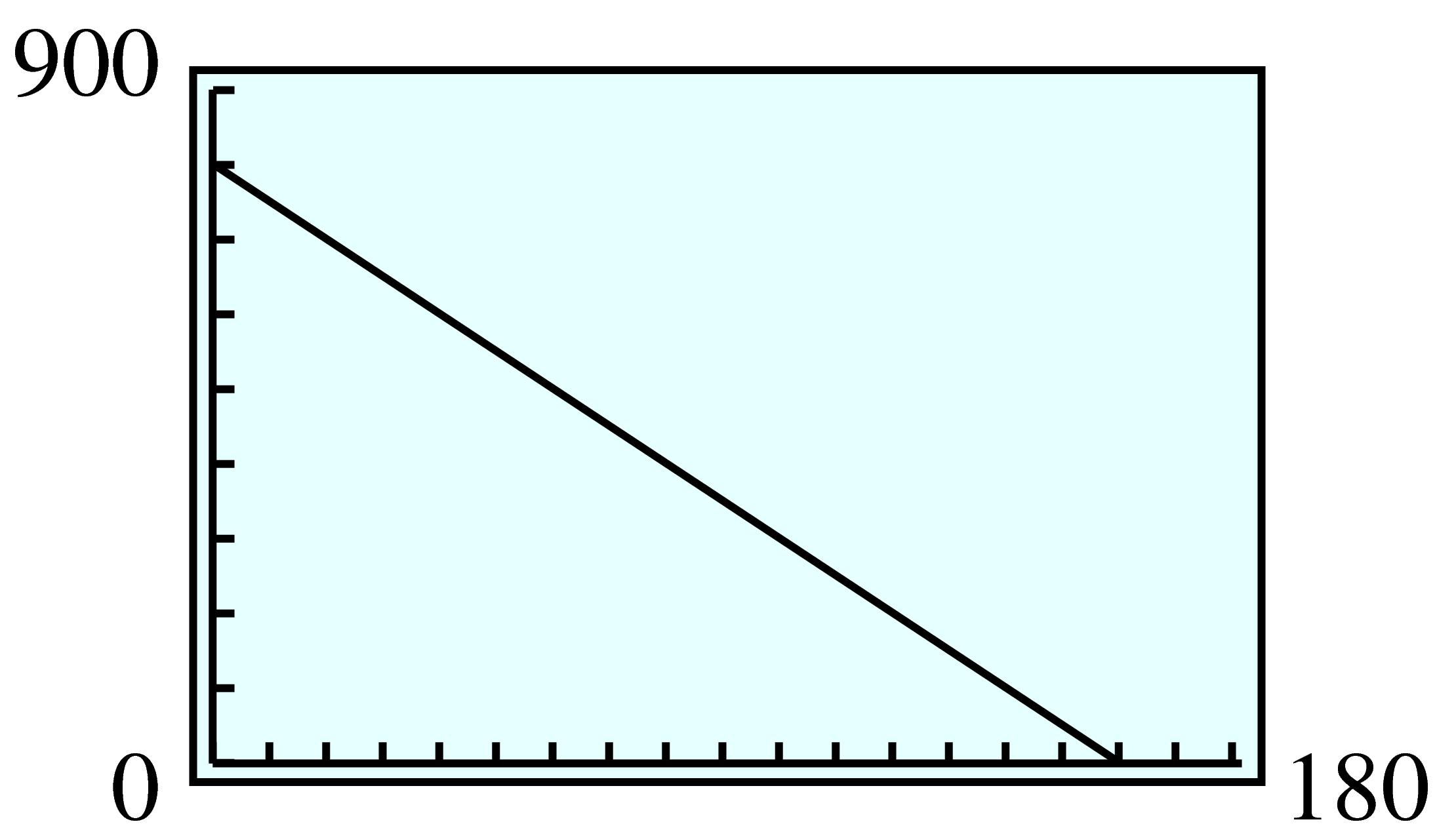
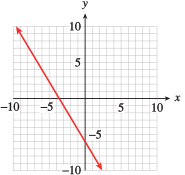
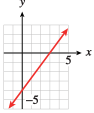
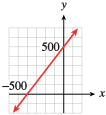
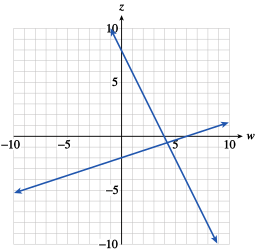
    graph of profit vs hours
  3. The \(P\)-intercept, \(-800\text{,}\) is the initial \((t = 0)\) value of the profit. Phil and Ernie start out \(\$800\) in debt. The \(t\)-intercept, \(20\text{,}\) is the number of hours required for Phil and Ernie to break even.

1.2 Functions
Homework 1.2

3.

Answer.
Not a function; incomes may differ for same number of years of education.

7.

Answer.
Input: items purchased; output: price of item. Yes, a function because each item has only one price.

9.

Answer.
Input: topics; output: page or pages on which topic occurs. No, not a function because the same topic may appear in more than one page.

11.

Answer.
Input: students’ names; output: students’ scores on quizzes, tests, etc. No, not a function because the same student can have different grades on different tests.

13.

Answer.
Input: person stepping on scales; output: person’s weight. Yes, a function because a person cannot have two different weights at the same time.

51.

Answer.
  1. \(N(6000) = 2000\text{:}\) \(2000\) cars will be sold at a price of $\(6000\text{.}\)
  2. \(N(p)\) decreases with increasing \(p\) because fewer cars will be sold when the price increases.
  3. \(2N(D)\) represents twice the number of cars that can be sold at the current price.

77.

Answer.
  1. \(x\) \(0\) \(10\) \(20\) \(30\) \(40\) \(50\) \(60\) \(70\) \(80\) \(90\) \(100\)
    \(f(x)\) \(800\) \(840\) \(840\) \(800\) \(720\) \(600\) \(440\) \(240\) \(0\) \(-280\) \(-600\)
    \(a = 50\) and \(b = 60\)
  2. \(x\) \(50\) \(51\) \(52\) \(53\) \(54\) \(55\) \(56\) \(57\) \(58\)
    \(f(x)\) \(600\) \(585.8\) \(571.2\) \(556.2\) \(540.8\) \(525\) \(508.8\) \(492.2\) \(475.2\)
    \(c = 56\) and \(d = 57\)
  3. \(x\) \(56\) \(56.1\) \(56.2\) \(56.3\) \(56.4\) \(56.5\) \(56.6\)
    \(f(x)\) \(508.8\) \(507.158\) \(505.512\) \(503.862\) \(502.208\) \(500.55\) \(498.888\)
    \(p = 56.5\) and \(q = 56.6\)
  4. \(\displaystyle s = 56.55\)
  5. \(\displaystyle f (56.55) = 499.7195\)

1.3 Graphs of Functions
Homework 1.3

17.

Answer.
  1. \(f (1000) = 1495\text{:}\) The speed of sound at a depth of \(1000\) meters is approximately \(1495\) meters per second.
  2. \(d = 570\) or \(d = 1070\text{:}\) The speed of sound is \(1500\) meters per second at both a depth of \(570\) meters and a depth of \(1070\) meters.
  3. The slowest speed occurs at a depth of about \(810\) meters and the speed is about \(1487\) meters per second, so \(f (810) = 1487\text{.}\)
  4. \(f\) increases from about \(1533\) to \(1541\) in the first \(110\) meters of depth, then drops to about \(1487\) at \(810\) meters, then rises again, passing \(1553\) at a depth of about \(1600\) meters.

19.

Answer.
  1. \(f(1985)=41\text{:}\) The federal debt in \(1985\) was about \(41\%\) of the gross domestic product.
  2. \(t = 1942\) or \(t = 1955\text{:}\) The federal debt was \(70\%\) of the gross domestic product in \(1942\) and \(1955\text{.}\)
  3. In about \(1997\text{,}\) the debt was about \(67\%\) of the gross domestic product, so \(f (1997)\approx 67.3\text{.}\)
  4. The percentage basically dropped from 1946 to 1973, but there were small rises around 1950, 1954, 1958, and 1968, so the longest time interval was from 1958 to 1967.

31.

Answer.
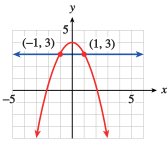
  1. He has an error: \(f(-3)\) cannot have both the value \(5\) and also the value \(-2\text{,}\) and \(f(-1)\) cannot have both values \(2\) and \(-4\text{.}\)
  2. Her readings are possible for a function: each input has only one output.

37.

Answer.
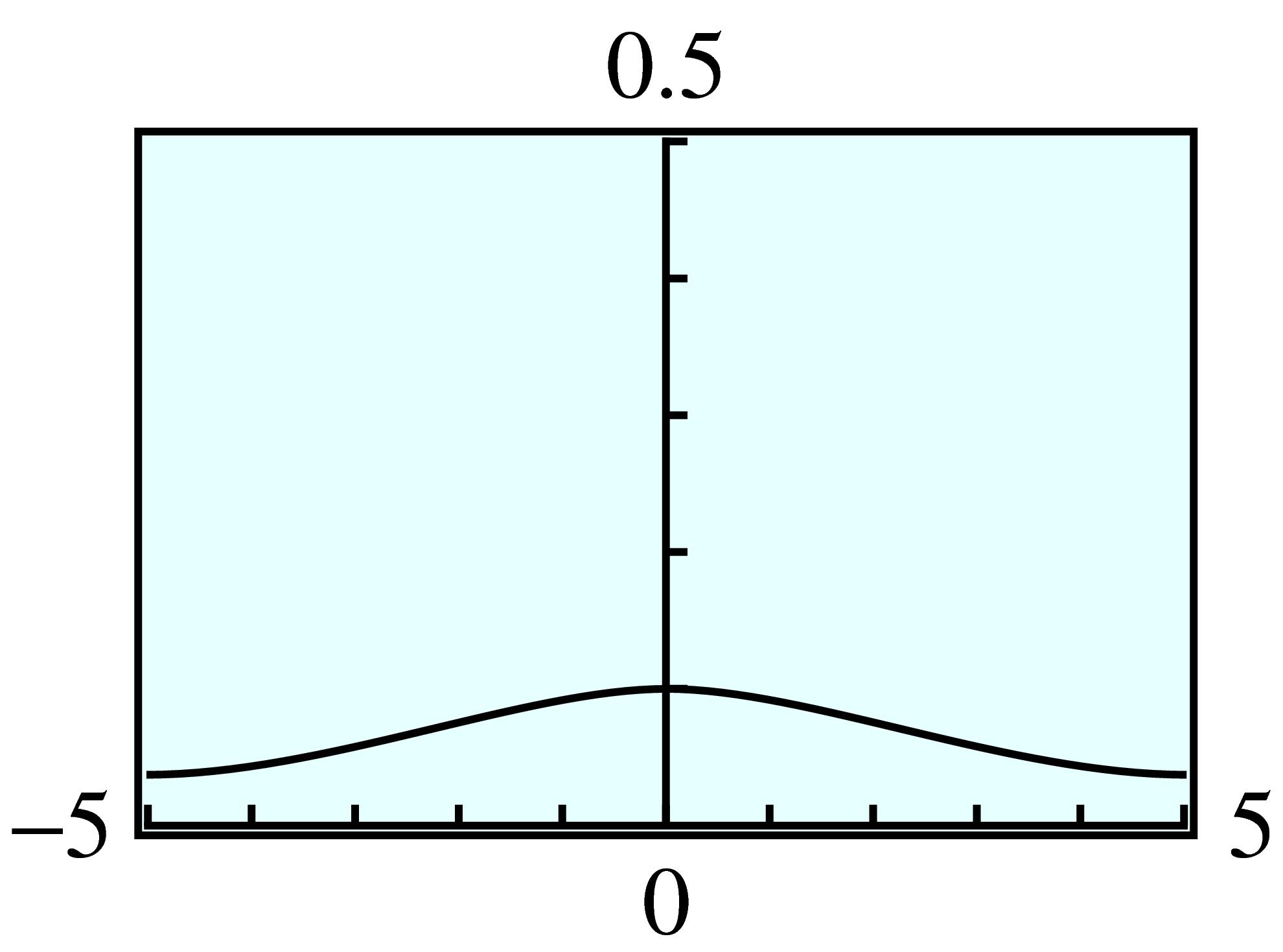
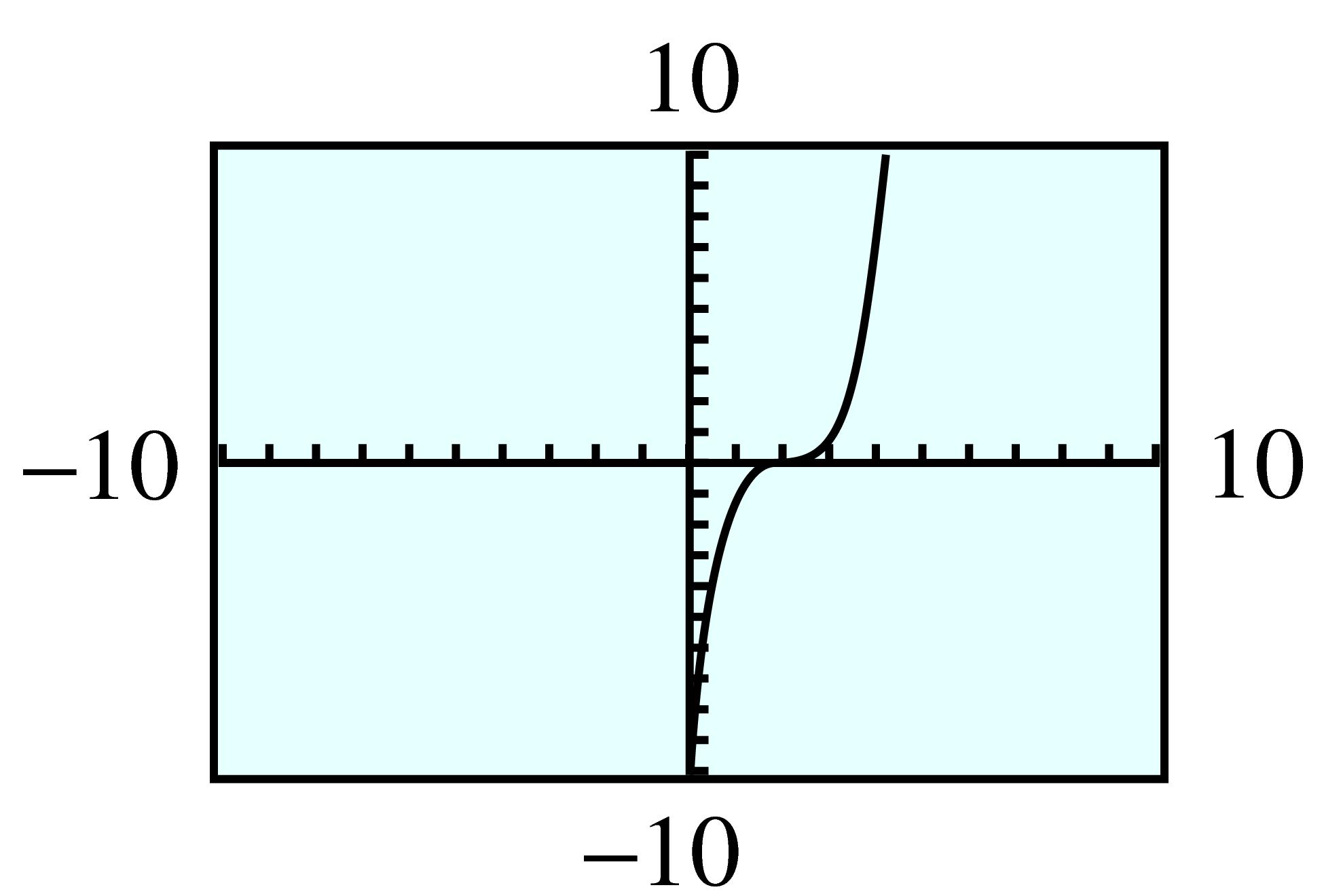
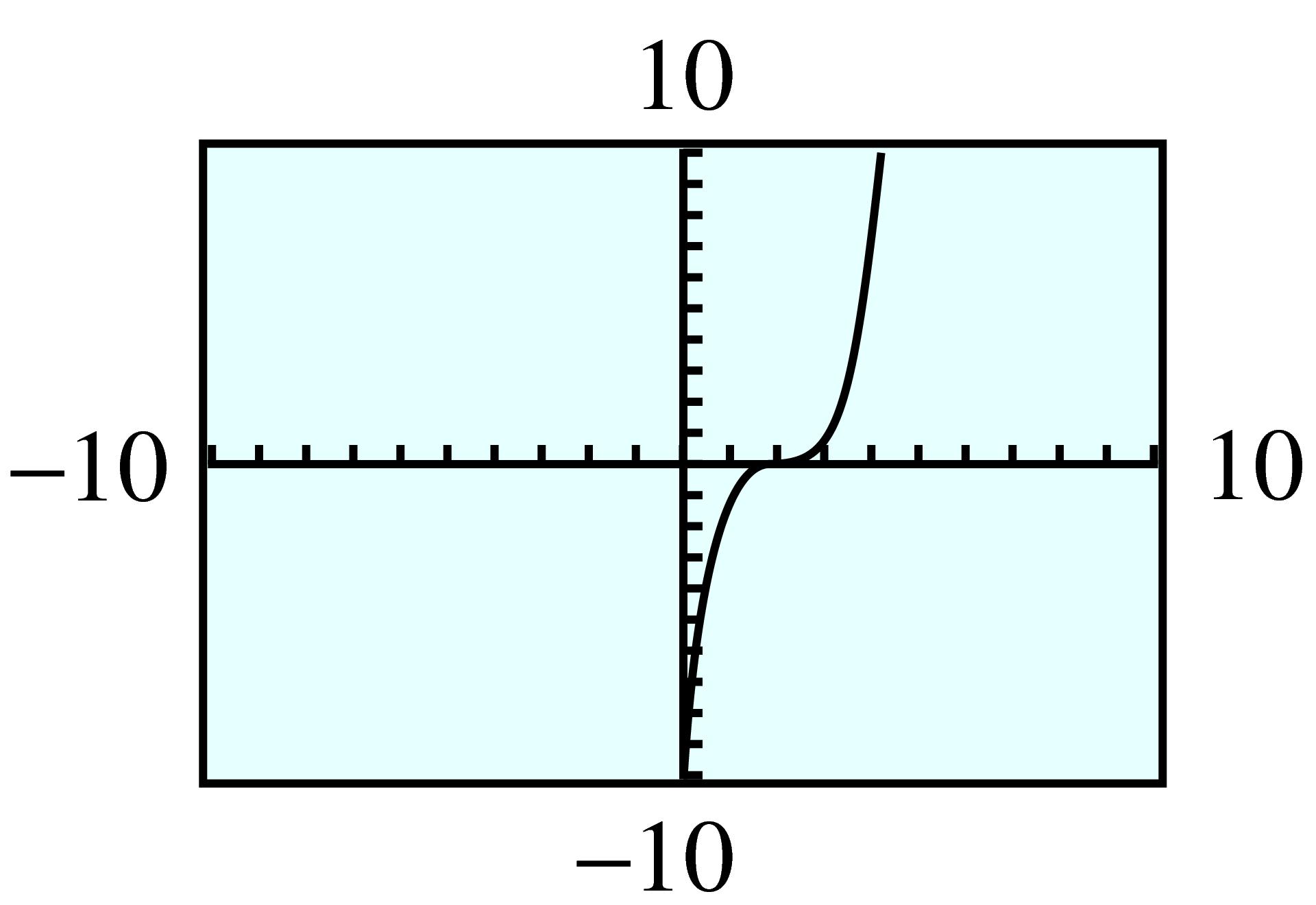
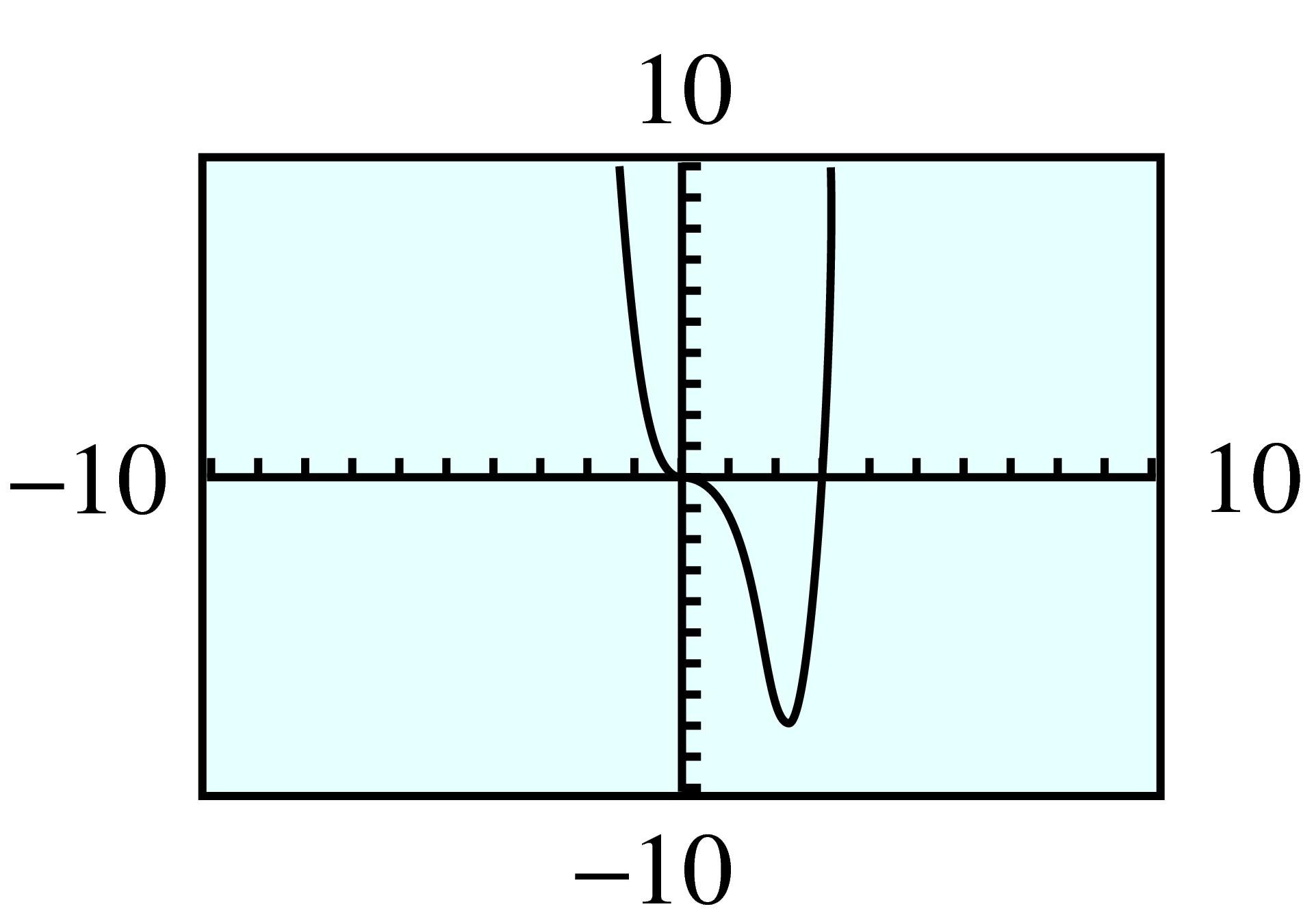
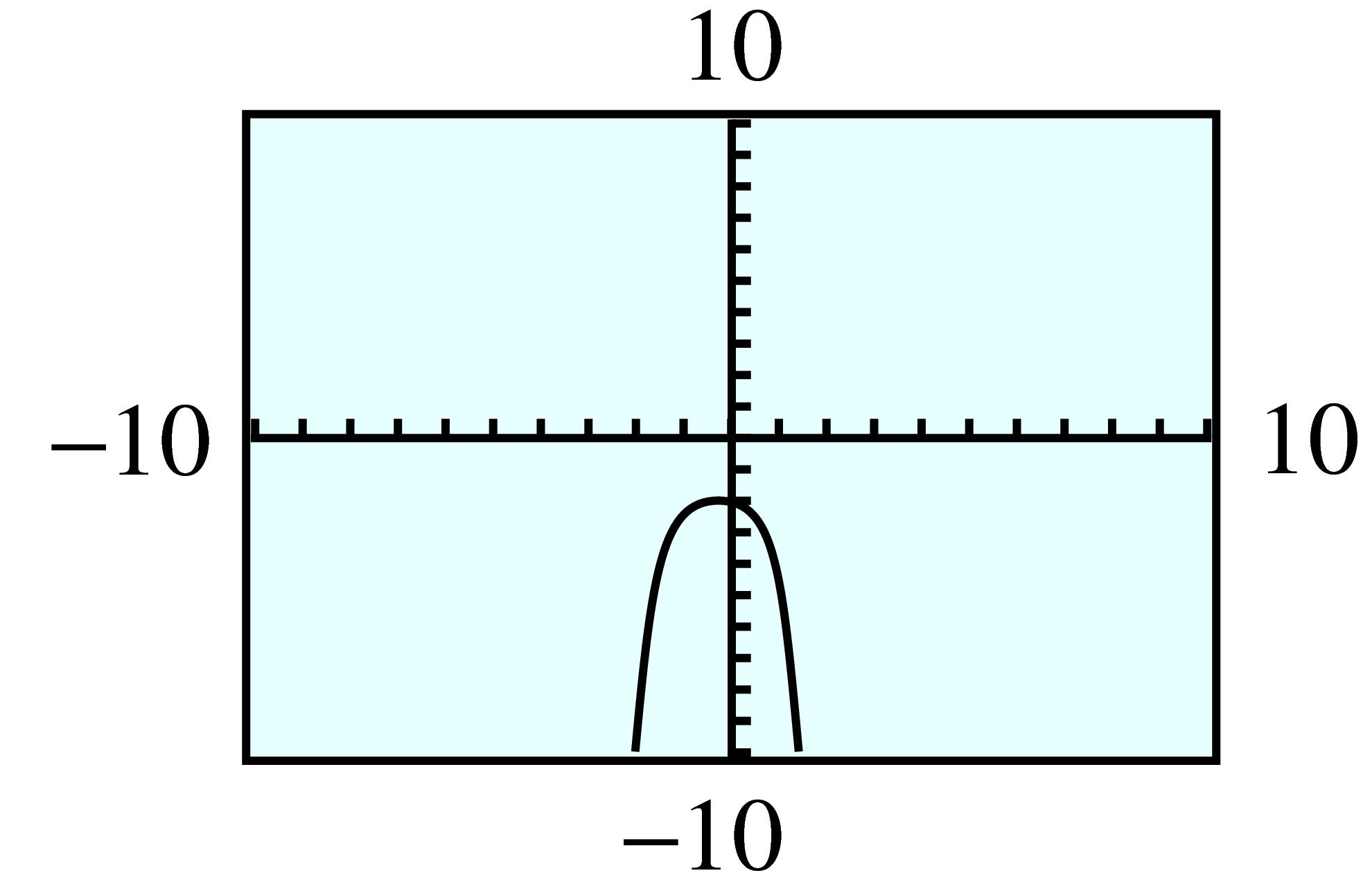
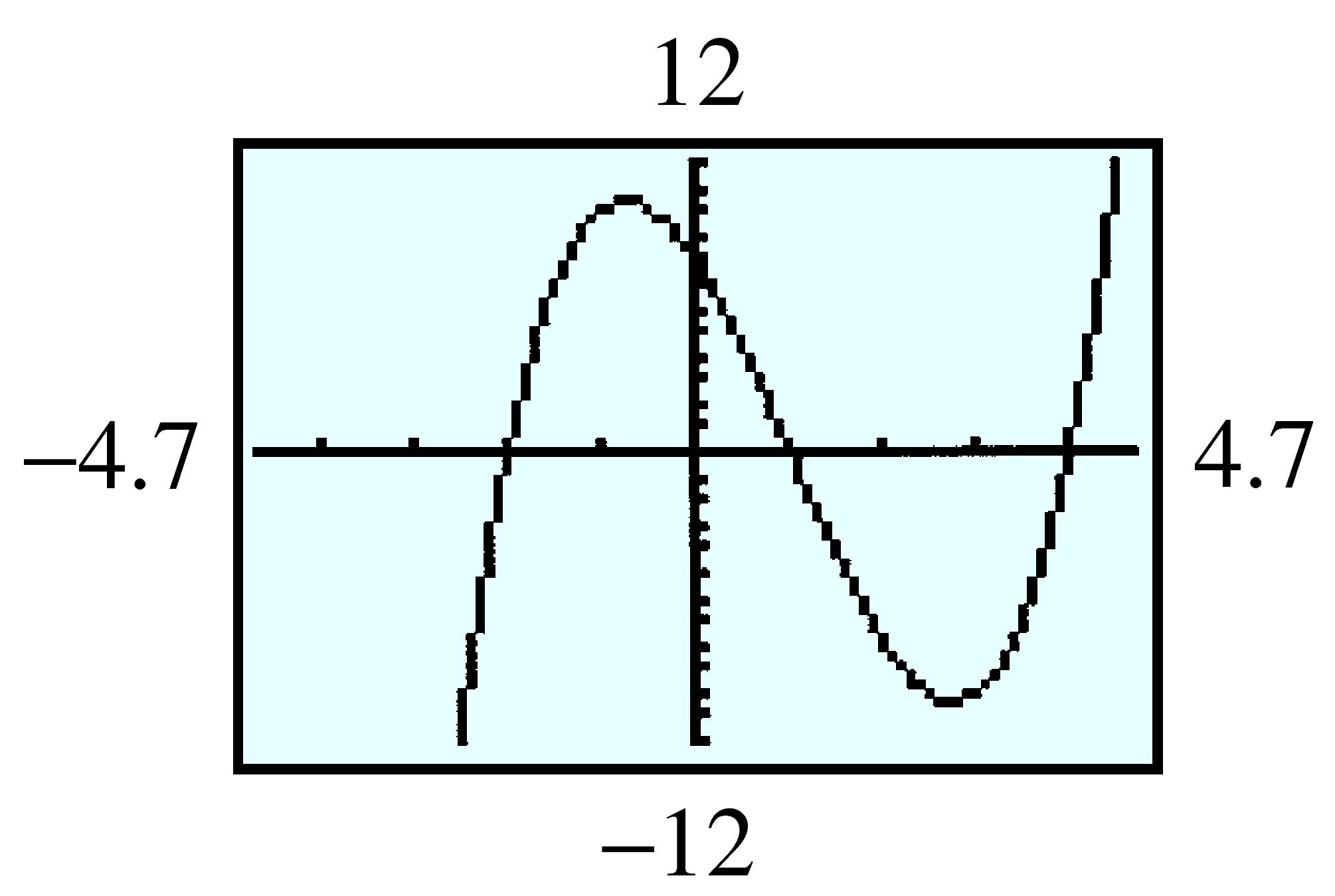
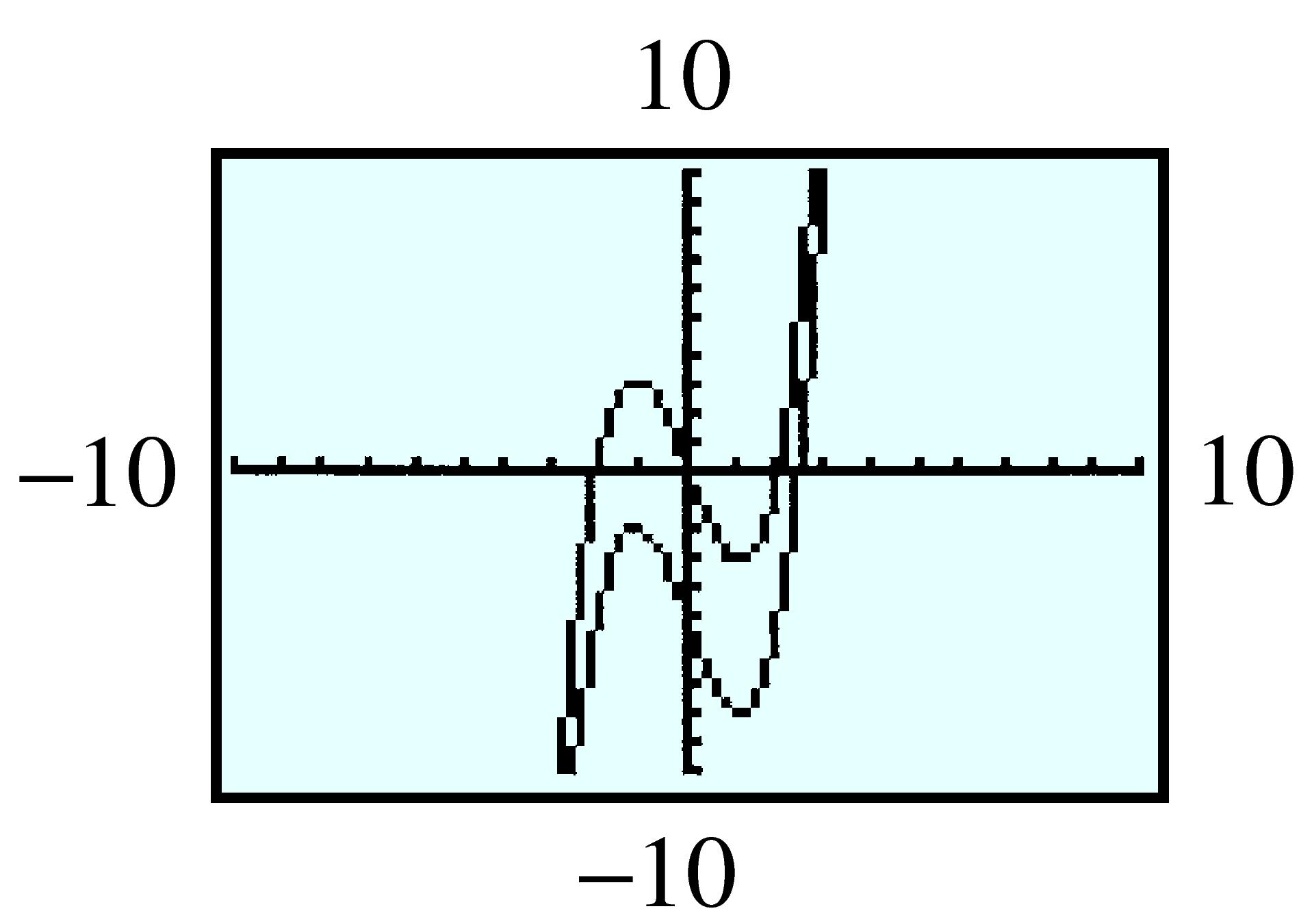
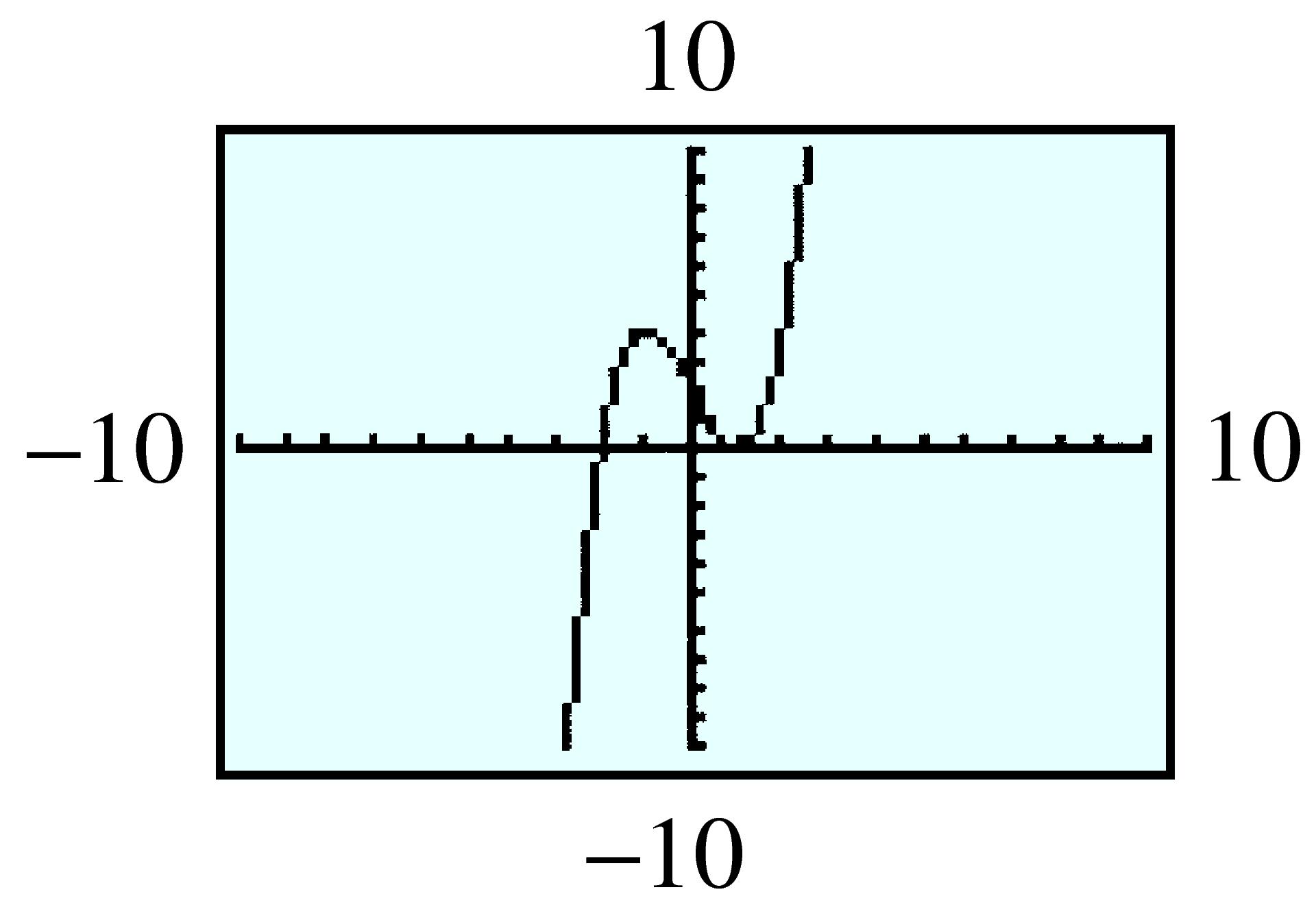
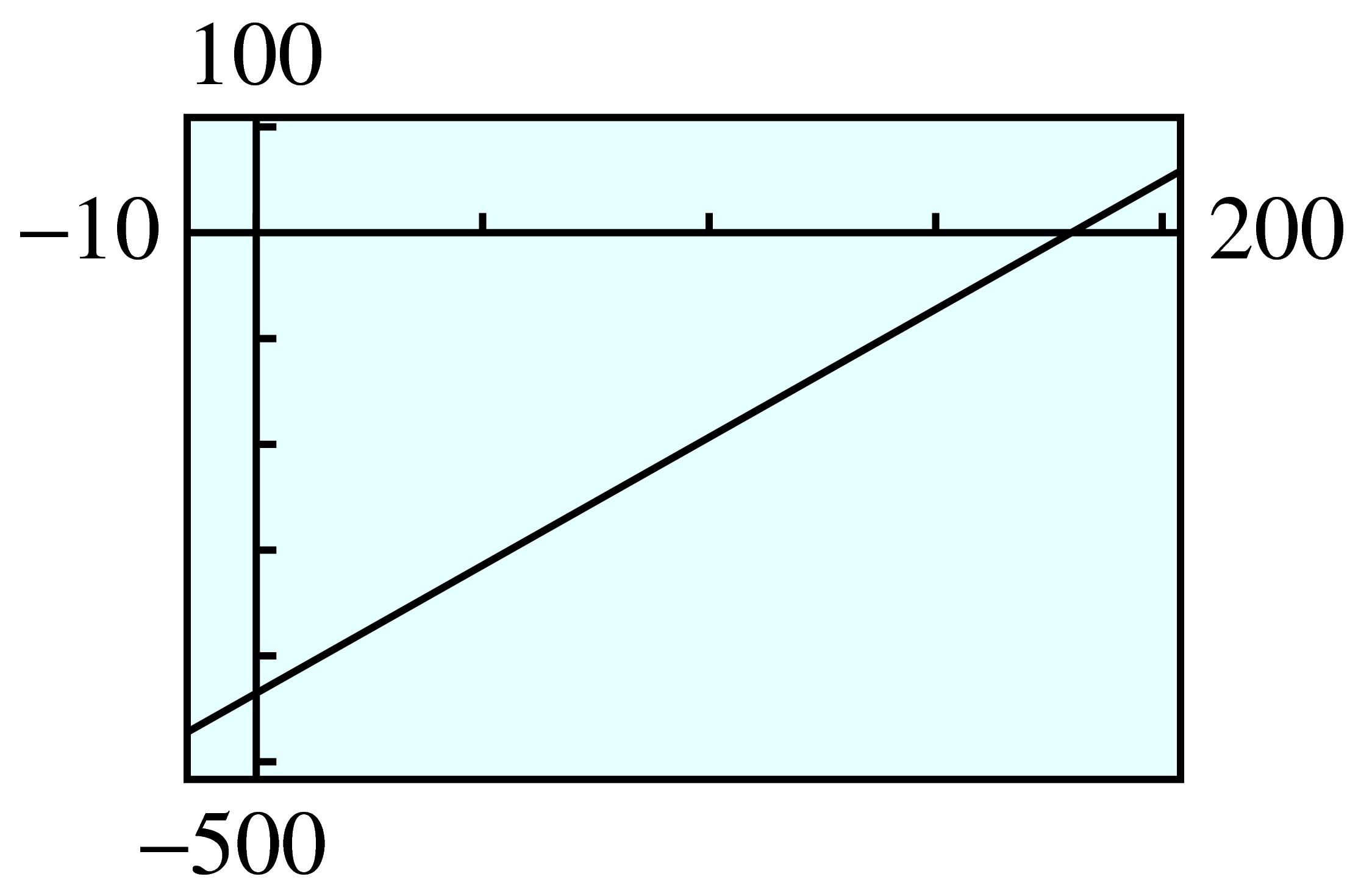
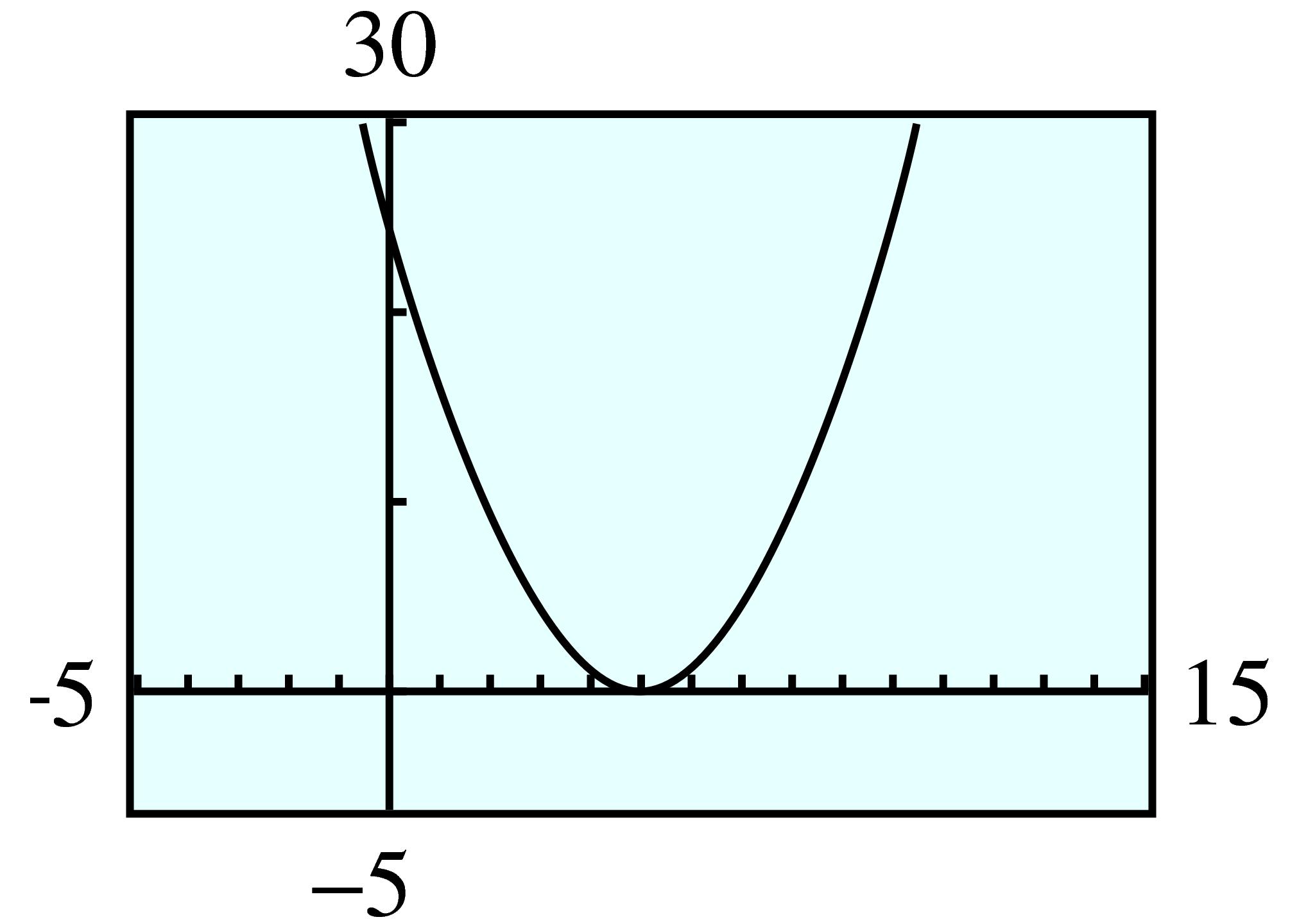
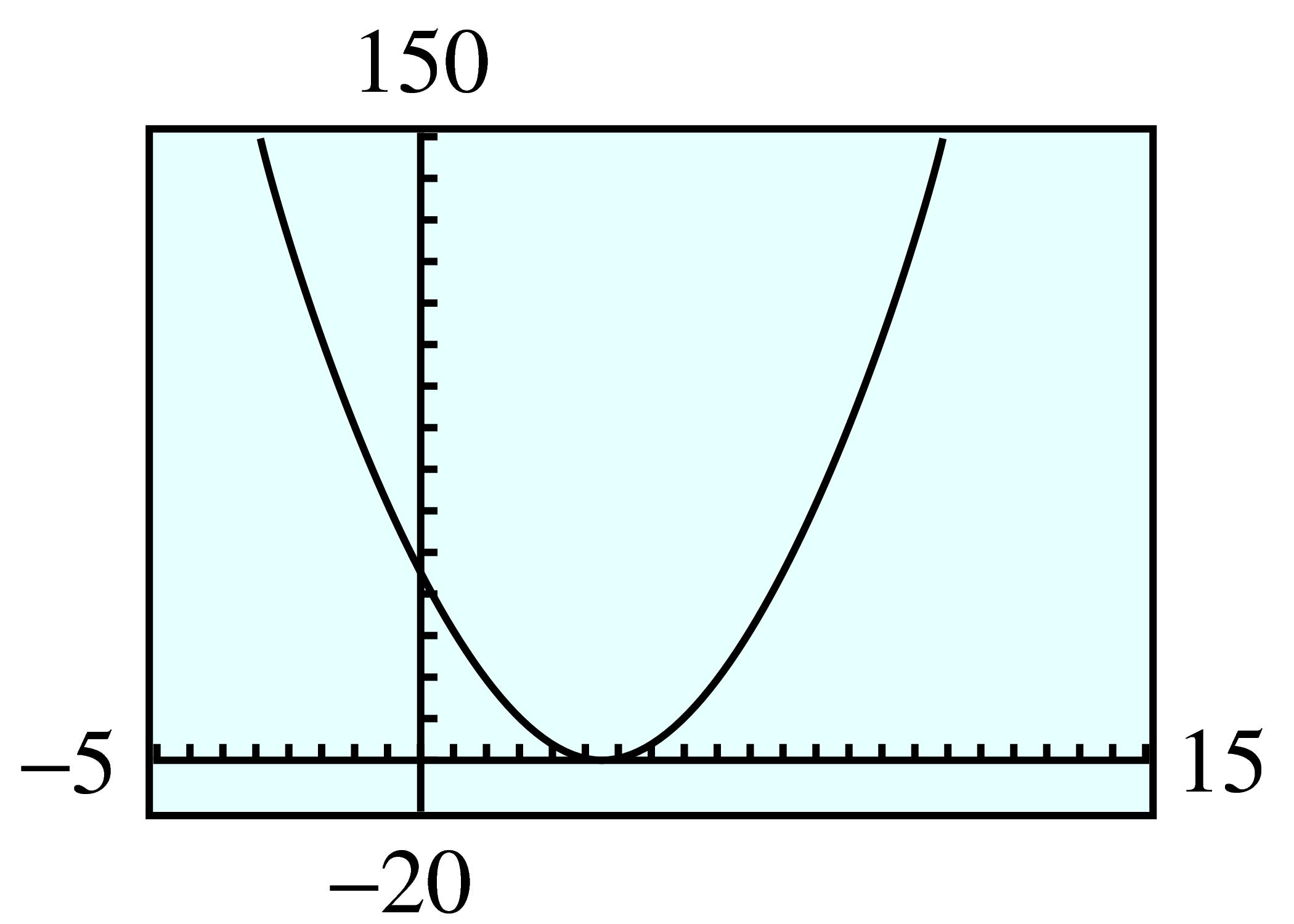
  1. standard GC window
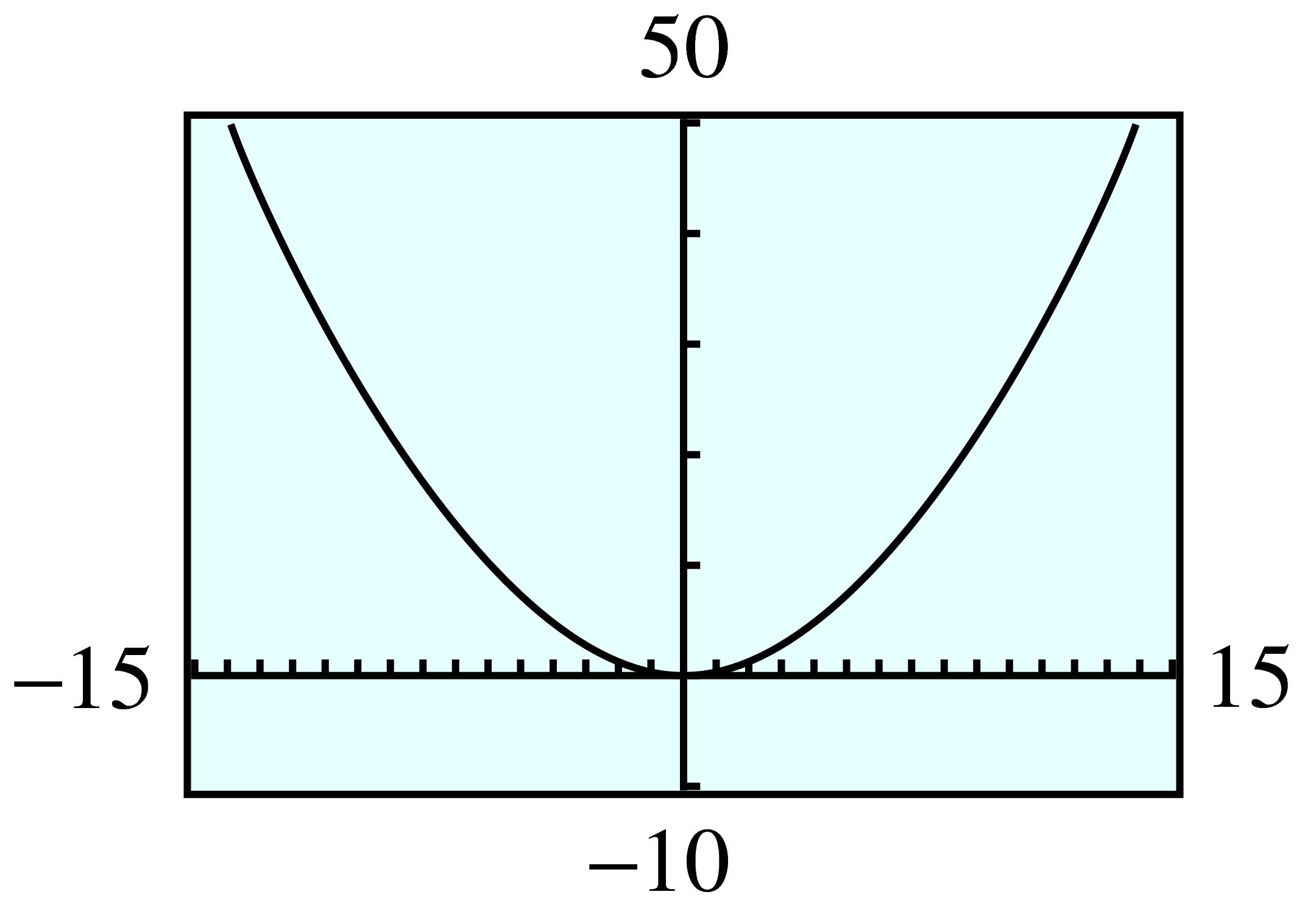
  2. curve visible in GC window
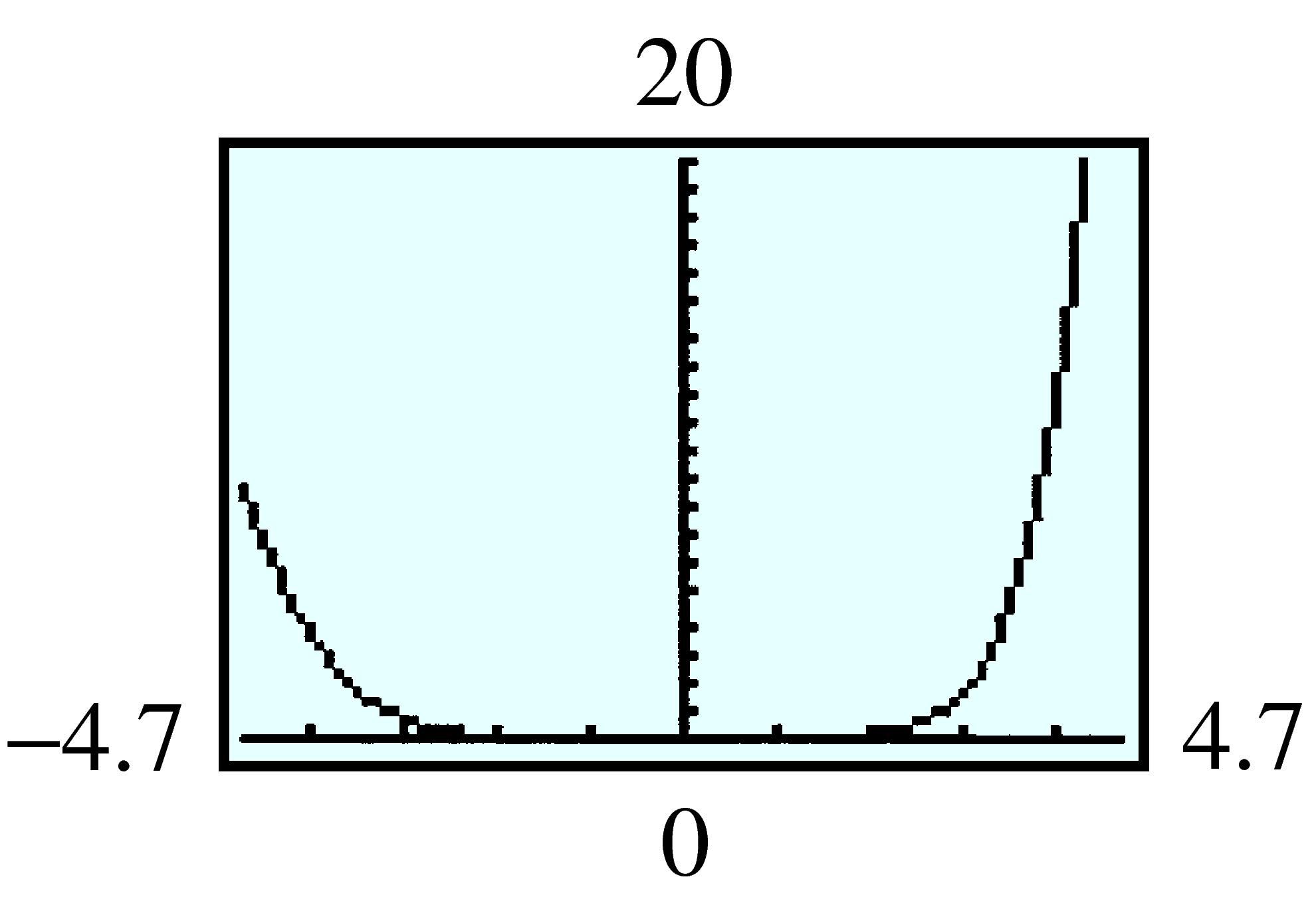
    The curve cannot be distinguished from the \(x\)-axis in the standard window because the values of \(y\) are closer to zero than the resolution of the calculator can display. The second window provides sufficient resolution to see the curve.

39.

Answer.
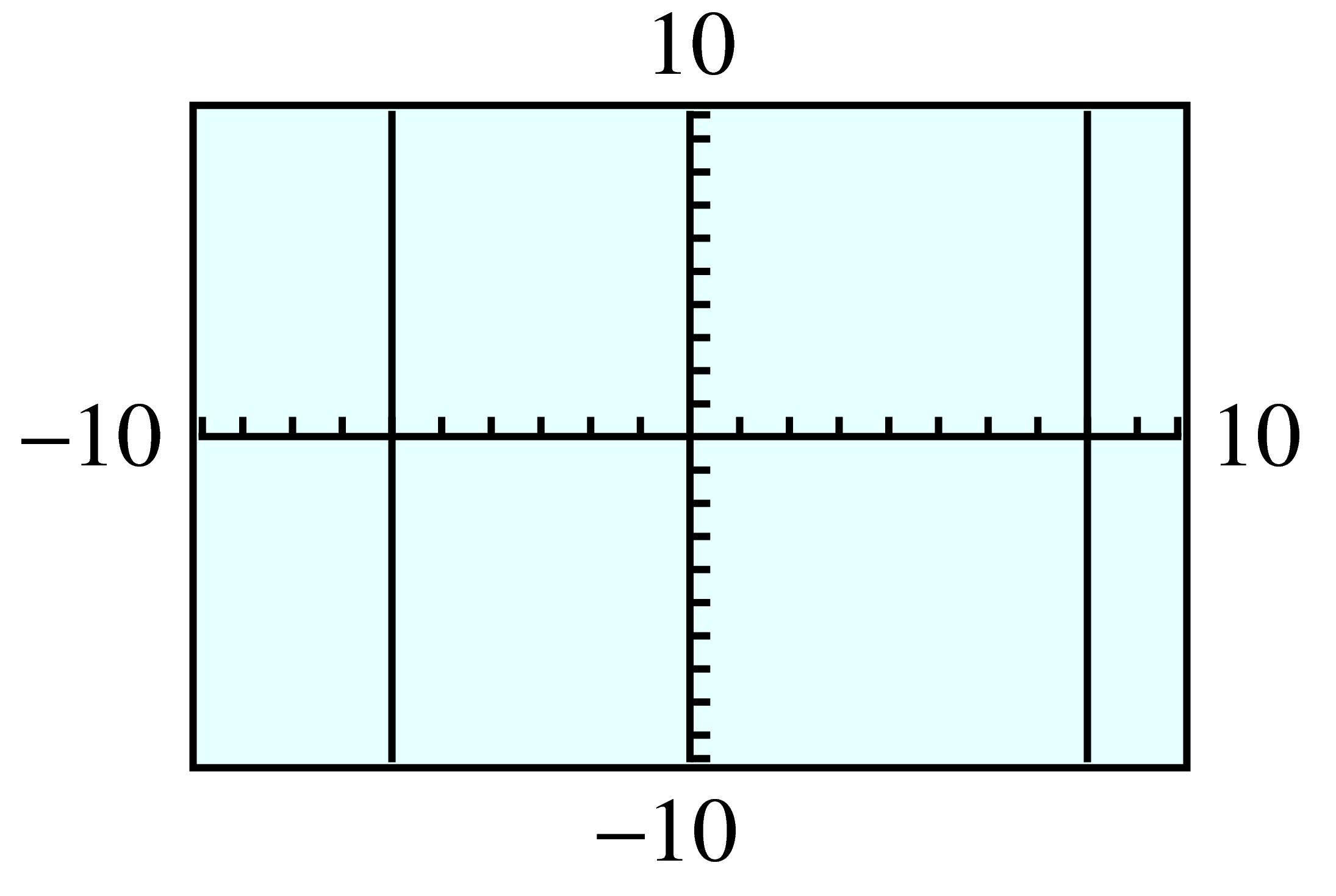
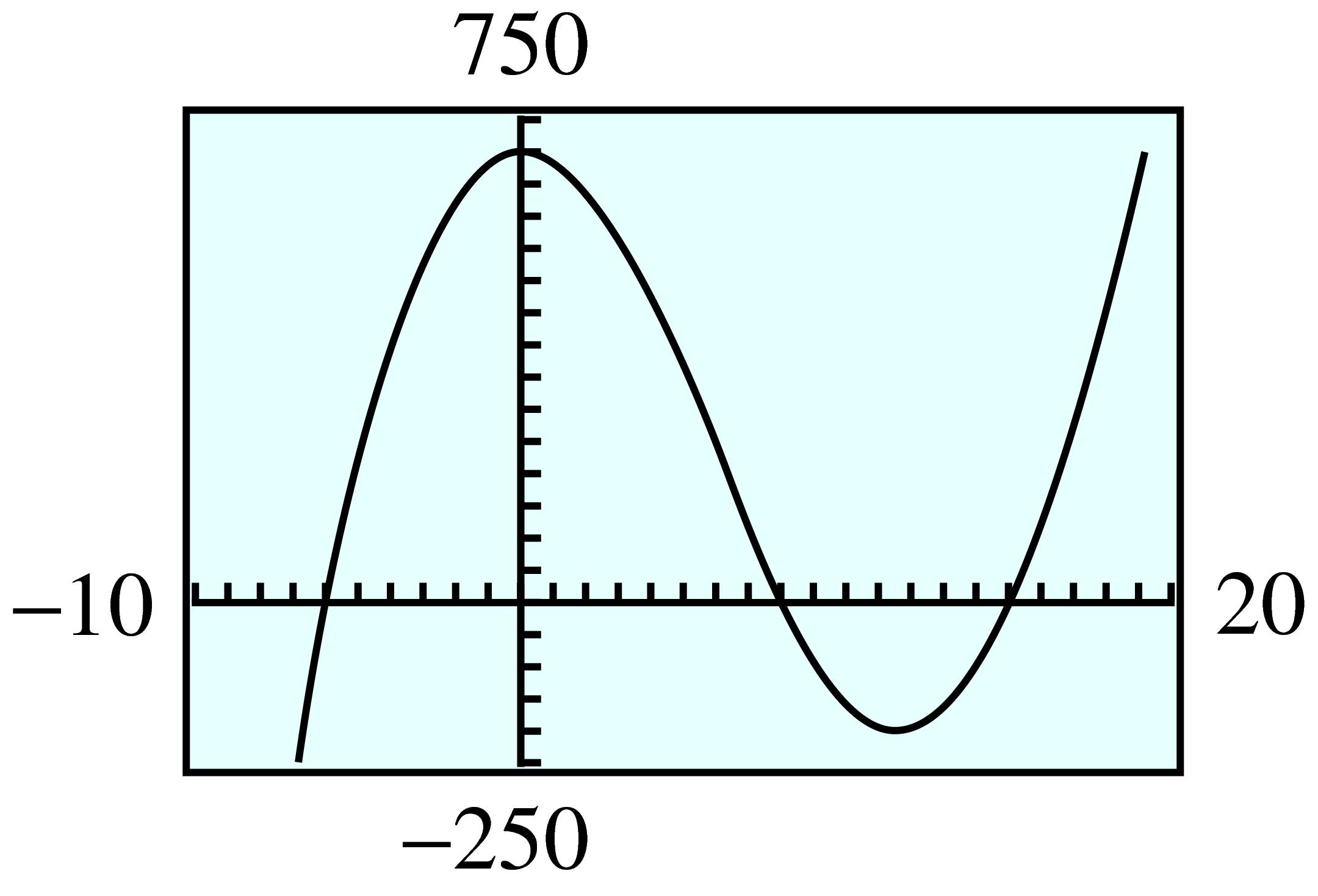
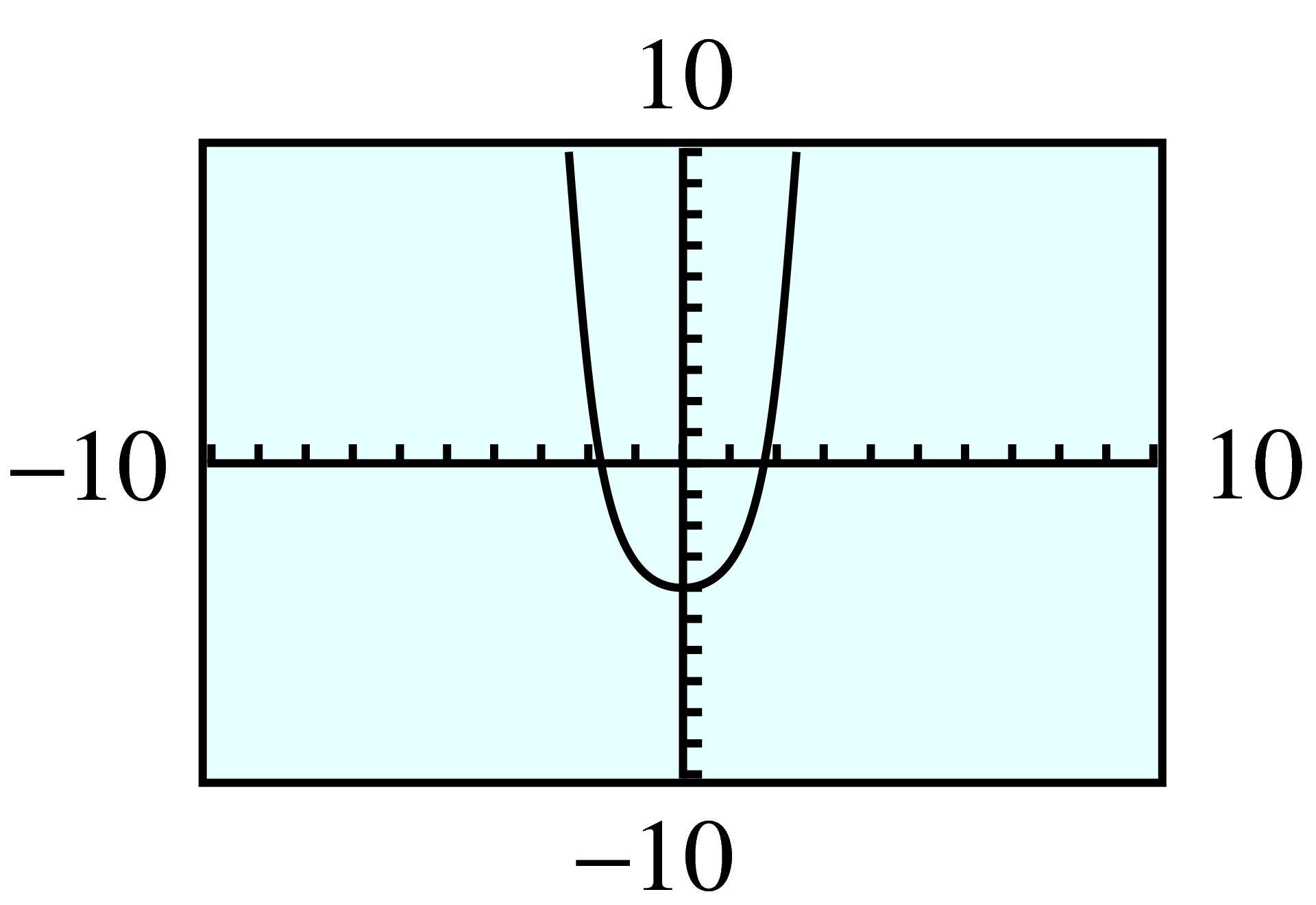
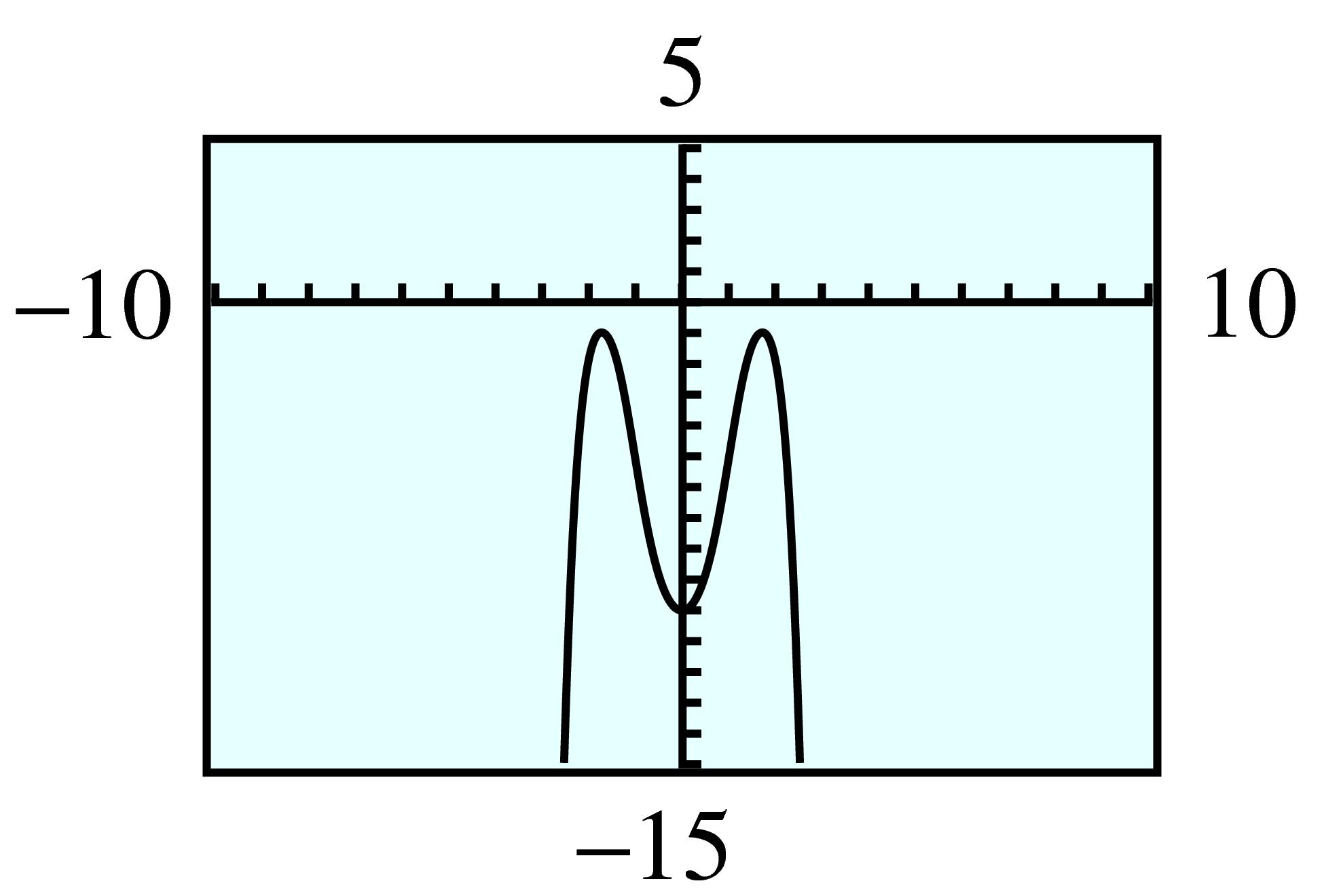
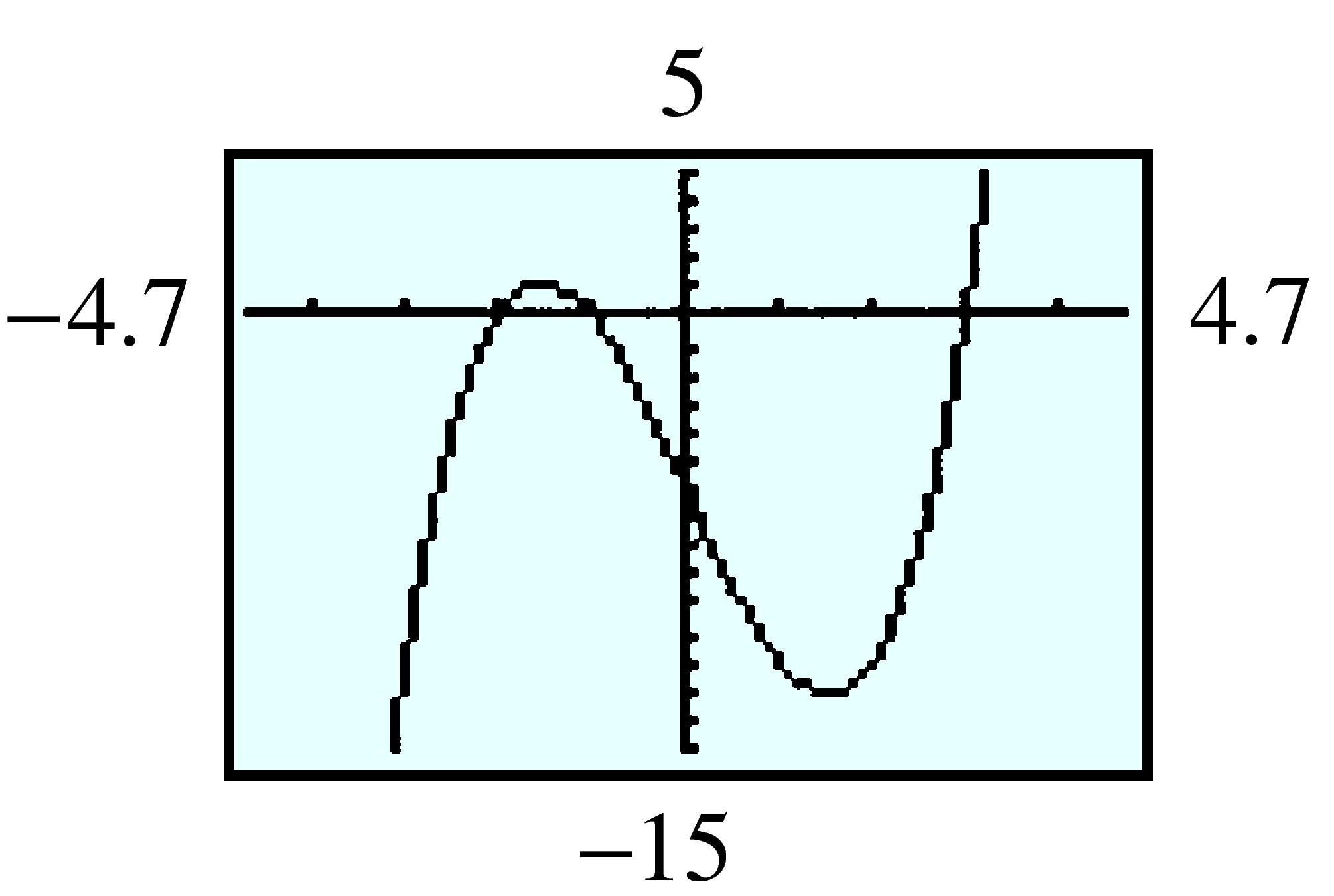
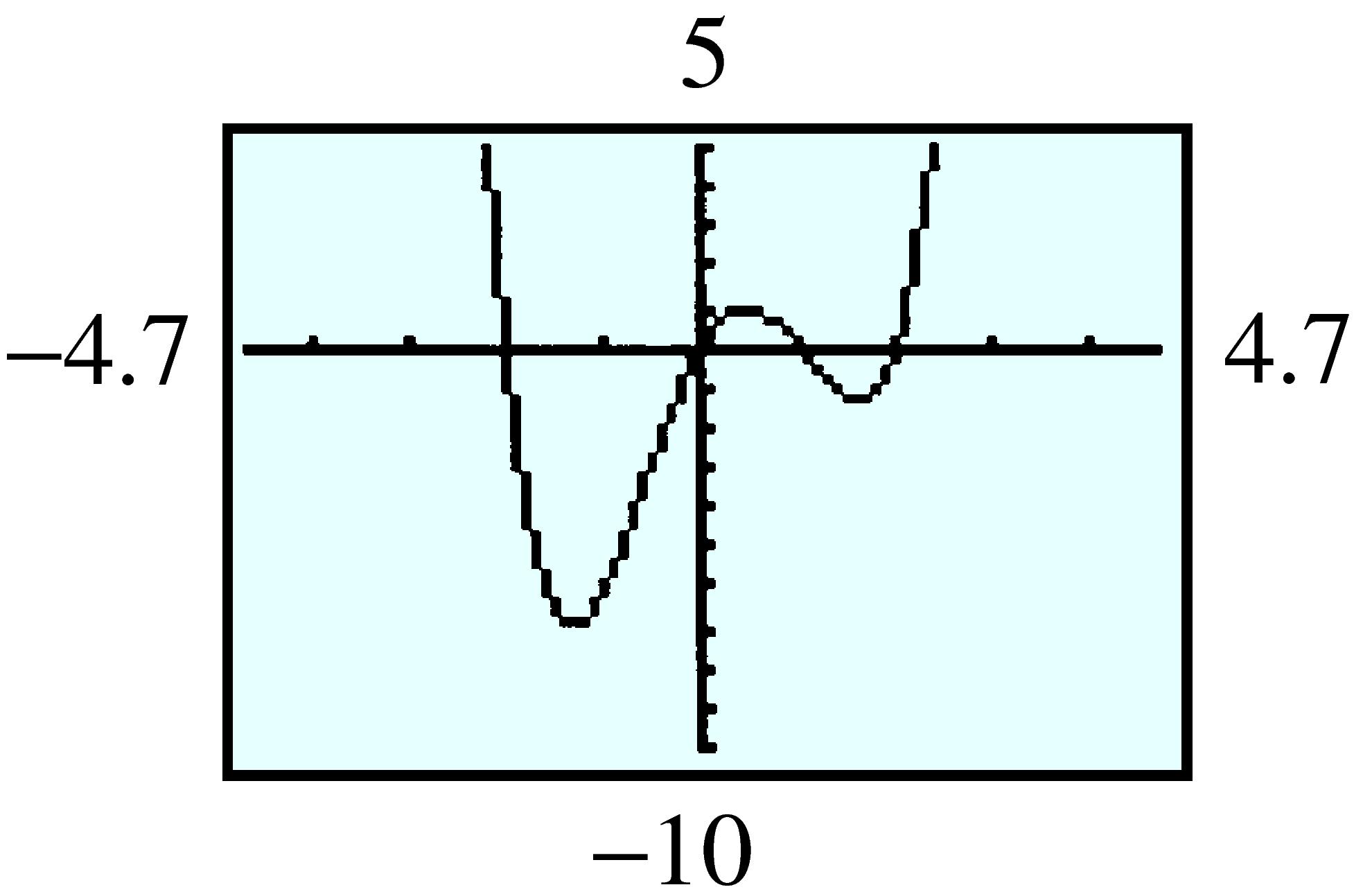
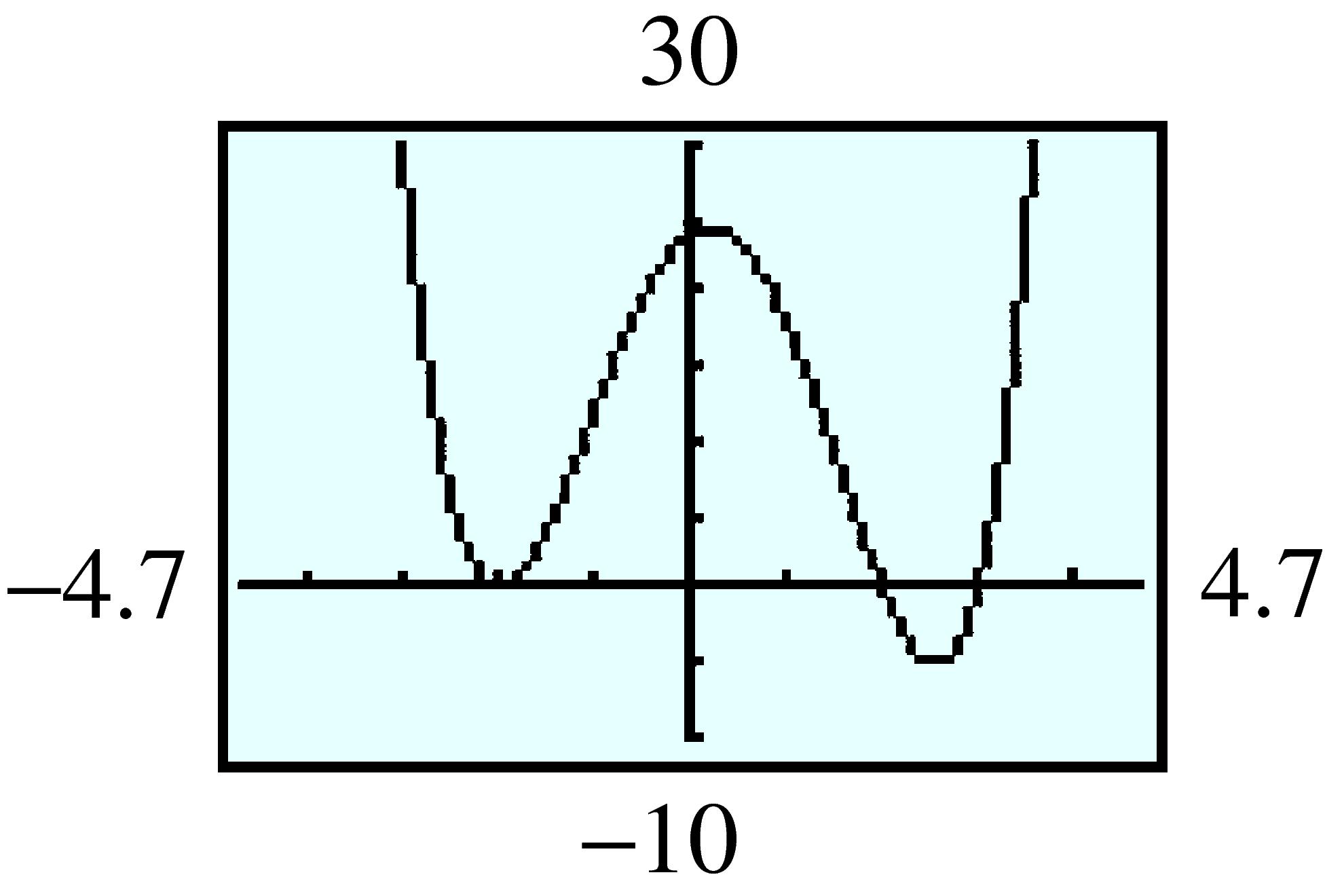
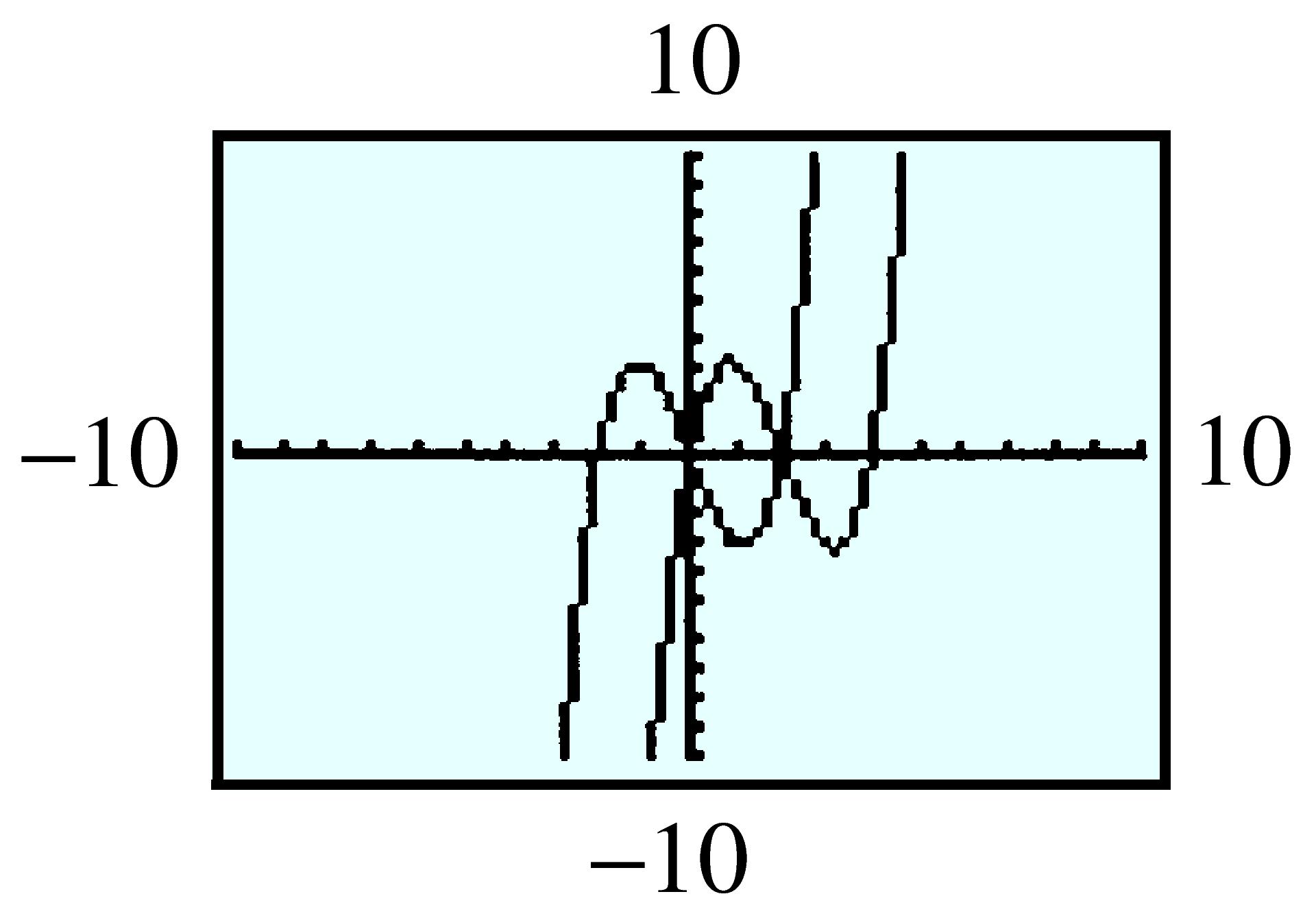
  1. standard GC window
  2. curve visible in GC window
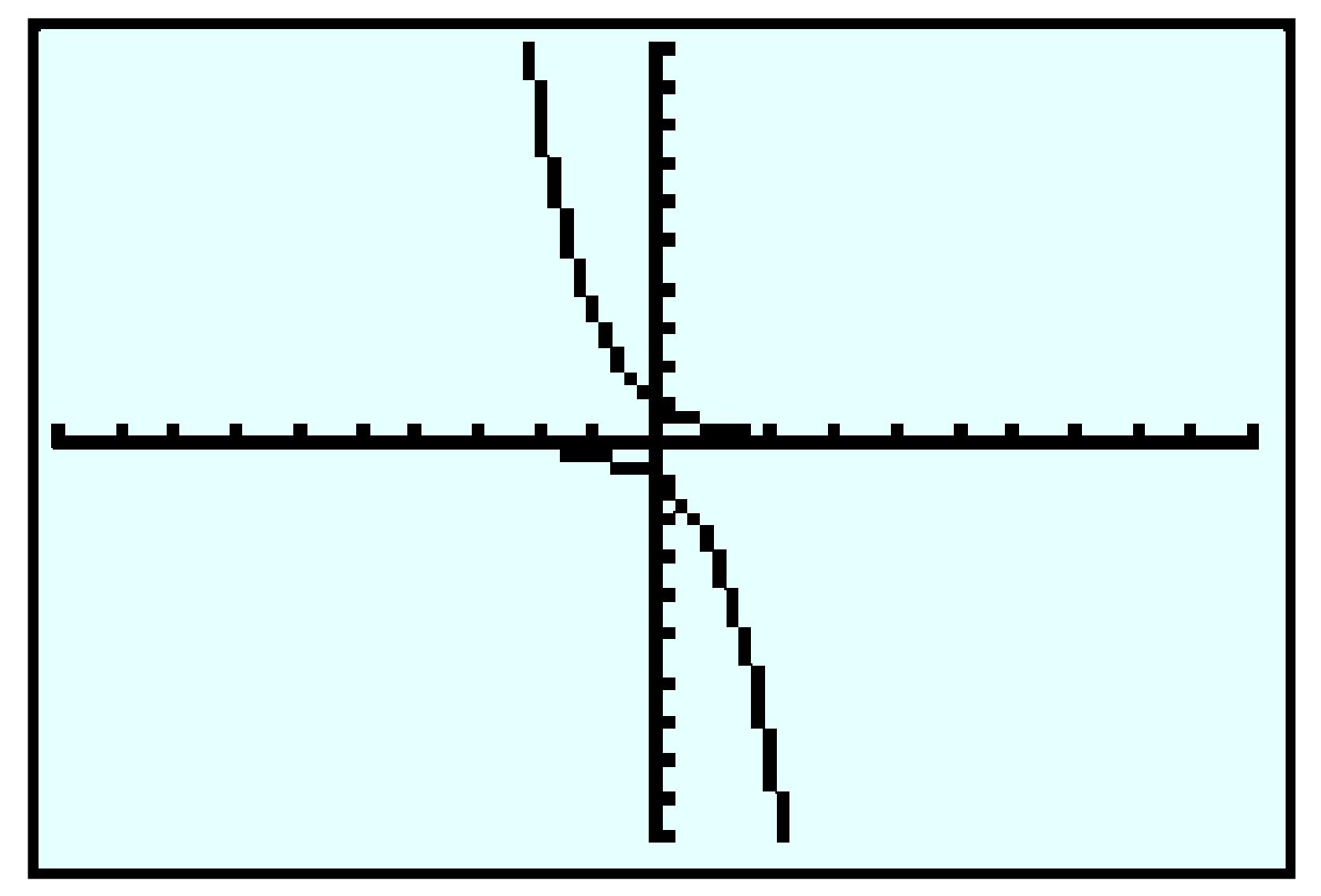
    The curve looks like two vertical lines in the standard window because that window covers too small a region of the plane. The second window allows us to see the turning points of the curve.

1.4 Slope and Rate of Change
Homework 1.4

19.

Answer.
\(\dfrac{100}{7}\) ft \(\approx 14.286\) ft \(\approx 14\) ft \(~3.4\) in

1.5 Linear Functions
Homework 1.5

19.

Answer.
\(m =\dfrac{-A}{B}\text{,}\) \(x\)-intercept \(\left(\dfrac{C}{A},0\right) \text{,}\) \(y\)-intercept \(\left(0,\dfrac{C}{B}\right) \)

21.

Answer.
  1. \(\displaystyle a = 100 + 150t\)
  2. The slope tells us that the skier’s altitude is increasing at a rate of \(150\) feet per minute, the vertical intercept that the skier began at an altitude of \(200\) feet.

23.

Answer.
  1. \(\displaystyle G = 25 + 12.5t\)
  2. The slope tells us that the garbage is increasing at a rate of \(12.5\) tons per year, the vertical intercept that the dump already had \(25\) tons (when the new regulations went into effect).

25.

Answer.
  1. \(\displaystyle M = 7000 - 400w\)
  2. The slope tells us that Tammy’s bank account is diminishing at a rate of $\(400\) per week, the vertical intercept that she had $\(7000\) (when she lost all sources of income).

27.

Answer.
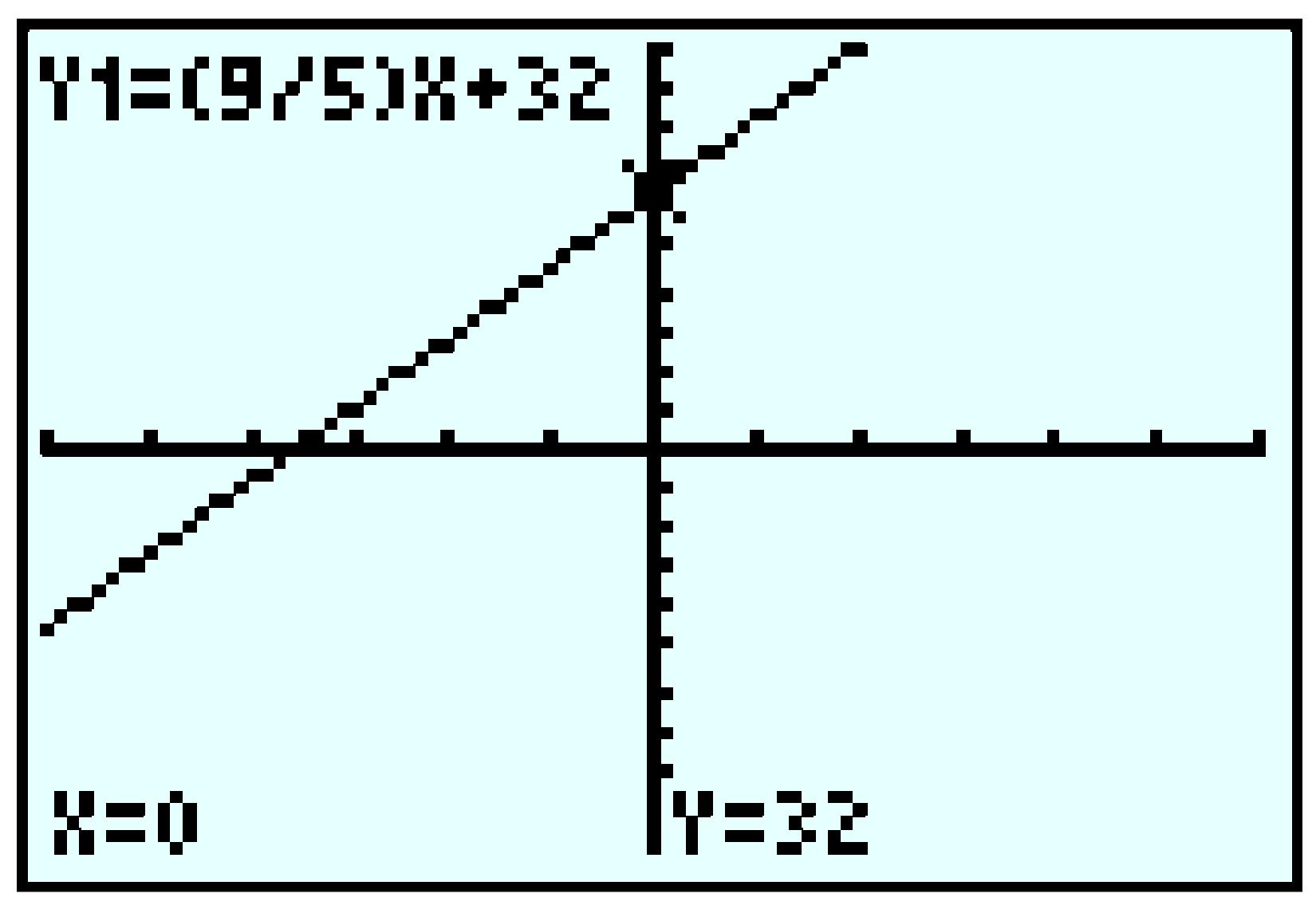
  1. \(50\degree\)F
  2. \(-20\degree\)C
  3. GC graph
  4. The slope, \(\frac{9}{5} = 1.8\text{,}\) tells us that Fahrenheit temperatures increase by \(1.8\degree\) for each increase of \(1\degree\) Celsius.
  5. \(C\)-intercept \(\left(-17\frac{7}{9}, 0\right)\text{:}\) \(-17\frac{7}{9}\degree\) C is the same as \(0\degree\)F; \(F\)-intercept \((0, 32)\text{:}\) \(0\degree\)C is the same as \(32\degree\)F.

43.

Answer.
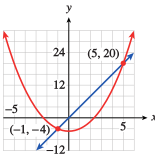
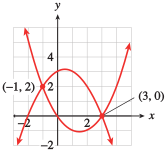
  1. \((-4, 4)\text{:}\) neither; \((0, 3)\text{:}\) \(y = px + q\text{;}\) \((3, 2)\text{:}\) both; \((2, 1)\text{:}\) neither; \((1,-2)\text{:}\) \(y = tx + v\)
  2. \(p =\dfrac{-1}{3}\text{,}\) \(q = 3\text{,}\) \(t = 2\text{,}\) \(v = -4\)

61.

Answer.
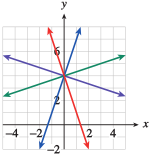
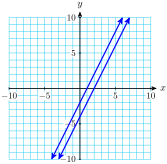
  1. four lines through the same point
  2. The lines with slope \(3\) and \(\frac{-1}{3}\) are perpendicular to each other, and the lines with slope \(-3\) and \(\frac{1}{3}\) are perpendicular to each other.

63.

Answer.
\(m = -0.0018\) degree/foot, so the boiling point drops with altitude at a rate of \(0.0018\) degree per foot. \(b = 212\text{,}\) so the boiling point is \(212\degree\) at sea level (where the elevation \(h = 0\)).

1.6 Linear Regression
Homework 1.6

19.

Answer.
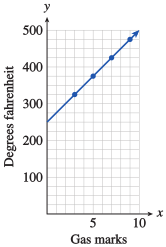
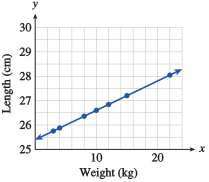
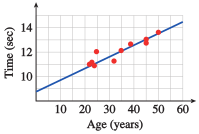
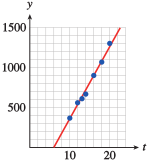
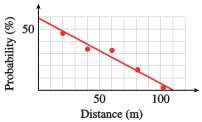
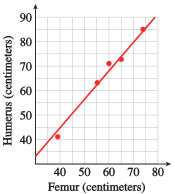
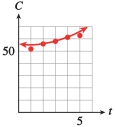
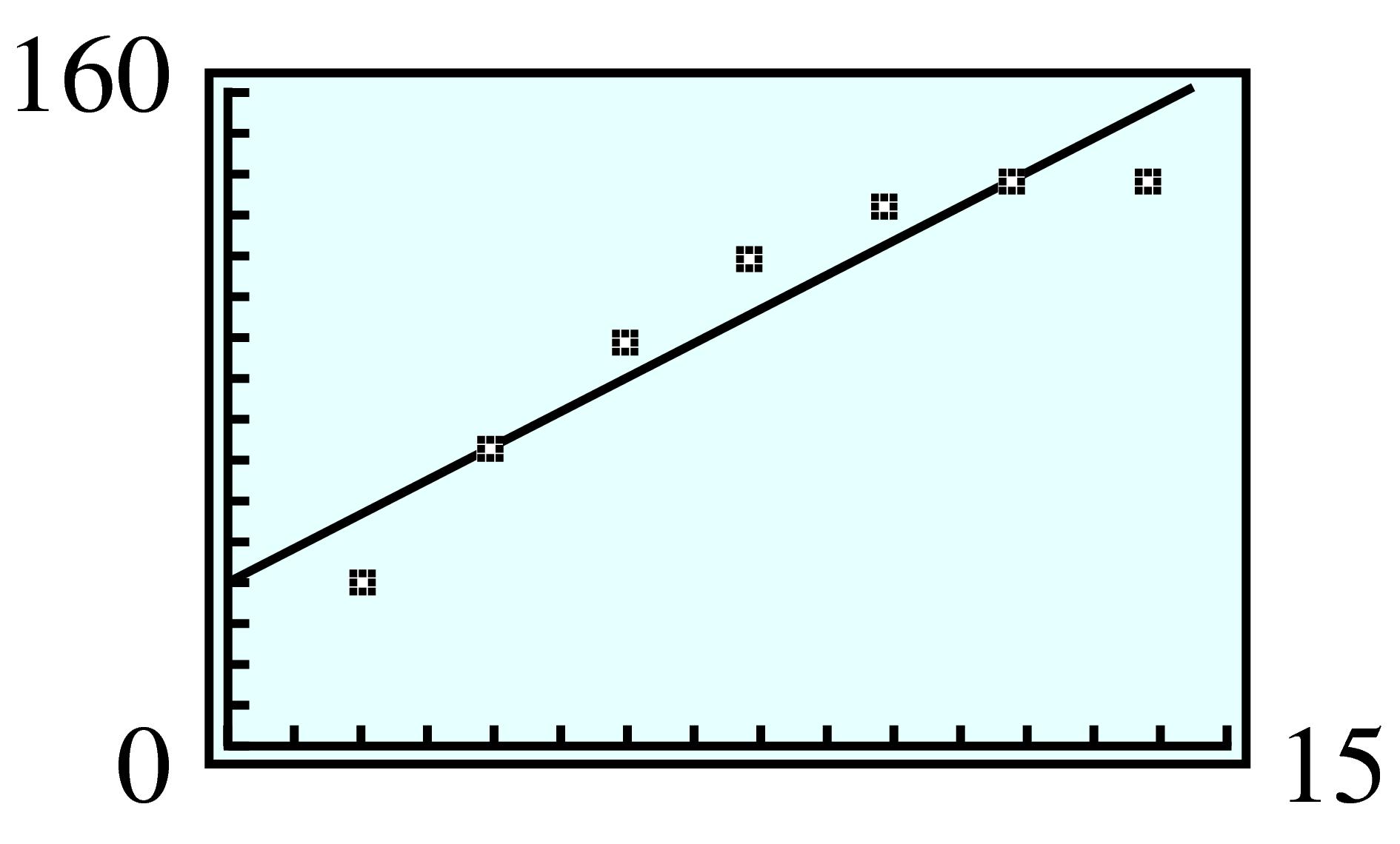
  1. scatterplot with regression line
  2. \(\displaystyle y = 90.49t - 543.7\)
  3. \(90.49\) dollars/year: Each additional year of education corresponds to an additional $\(90.49\) in weekly earnings.
  4. No: The degree or diploma attained is more significant than the number of years. So, for example, interpolation for the years of education between a bachelor’s and master’s degree may be inaccurate because earnings with just the bachelor’s degree will not change until the master’s degree is attained. And the years after the professional degree will not add significantly to earnings, so extrapolation is inappropriate.

33.

Answer.
2 min: \(21\degree\)C; 2 hr: \(729\degree\)C; The estimate at 2 minutes is reasonable; the estimate at 2 hours is not reasonable.

1.7 Chapter Summary and Review
Chapter 1 Review Problems

5.

Answer.
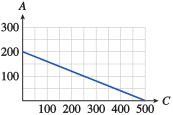
  1. \(\displaystyle 2C + 5A = 1000\)
  2. \((500, 0)\text{,}\) \((0, 200)\)
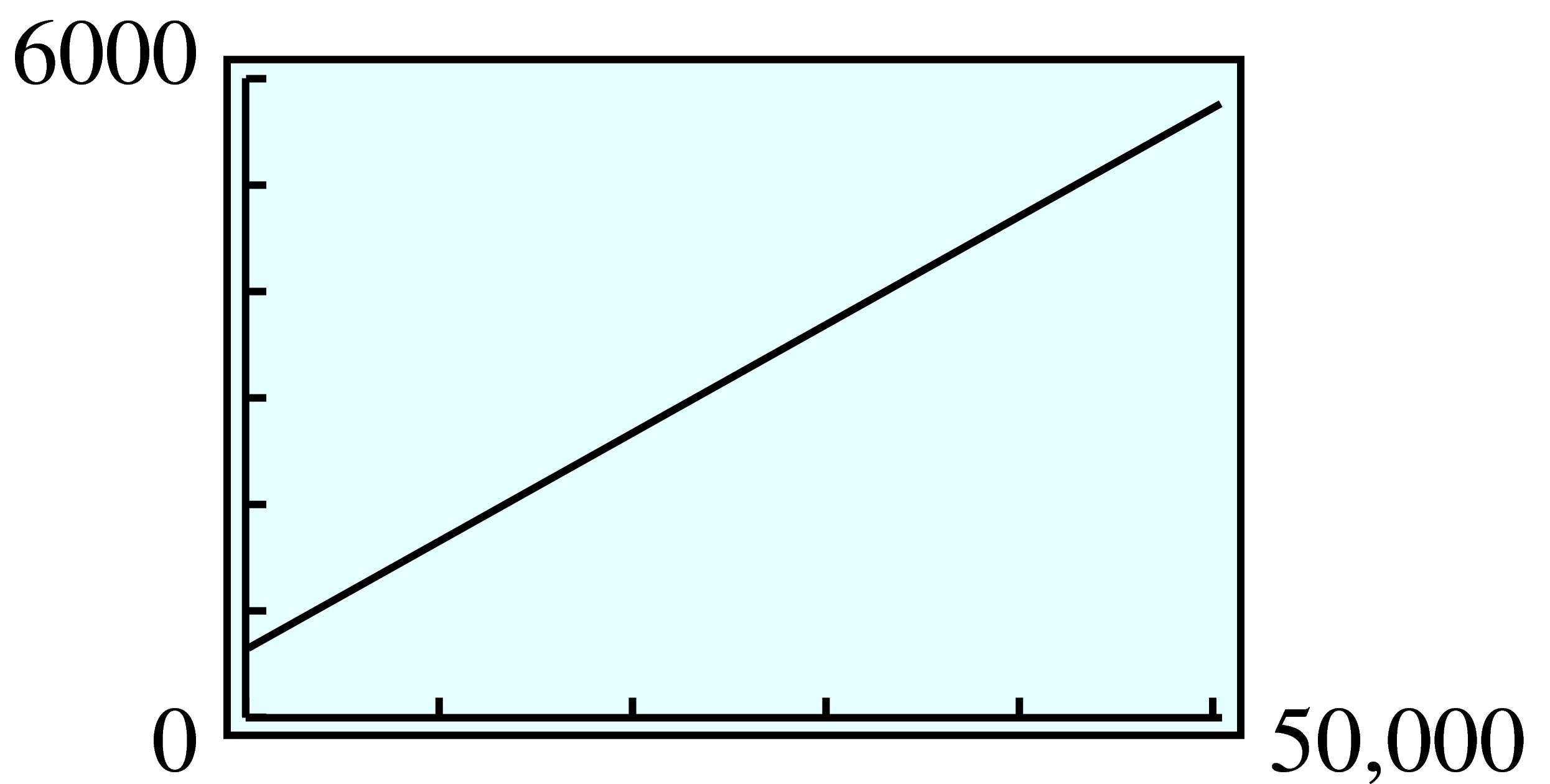
    Adult tickets vs Children’s tickets
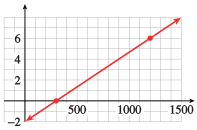
  3. \(C\)-intercept: If no adult tickets are sold, he must sell \(500\) children’s tickets; \(A\)-intercept: If no children’s tickets are sold, he must sell \(200\) adult tickets.

19.

Answer.
\(N(10) = 7000\text{:}\) Ten days after the new well is opened, the company has pumped a total of \(7000\) barrels of oil.

37.

Answer.
\(f (a) + f (b) = 2a^2 + 2b^2 - 8, ~~f (a + b) = 2a^2 + 4ab + 2b^2 - 4\)

57.

Answer.
\(d\) \(V\)
\(-5\) \(-4.8\)
\(-2\) \(-3\)
\(1\) \(-1.2\)
\(6\) \(1.8\)
\(10\) \(4.2 \)

2 Modeling with Functions
2.1 Nonlinear Models
Homework 2.1

23.

Answer.
\(\sqrt{128}\) in. by \(\sqrt{128}\) in. \(\approx 11.3\) in. \({}\times{} 11.3\) in.

69.

Answer.
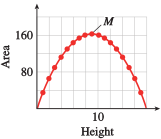
  1. Height Base Area Height Base Area
    \(1\) \(34\) \(34\) \(10\) \(16 \) \(160\)
    \(2\) \(32\) \(64\) \(11\) \(14\) \(154\)
    \(3\) \(30\) \(90\) \(12\) \(12\) \(144\)
    \(4\) \(28\) \(112\) \(13\) \(10\) \(130\)
    \(5\) \(26\) \(130\) \(14\) \(8\) \(112\)
    \(6\) \(24\) \(144\) \(15\) \(6\) \(90\)
    \(7\) \(22\) \(154\) \(16\) \(4\) \(64\)
    \(8\) \(20\) \(160\) \(17\) \(2\) \(34\)
    \(9\) \(18\) \(162\) \(18\) \(0\) \(0\)
  2. points and curve
  3. \(162\) sq ft, with base \(18\) ft, height \(9\) ft
  4. Base: \(36 - 2x\text{;}\) area: \(x (36 - 2x)\)
  5. See (a)
  6. \(6.5\) ft or \(11.5\) ft

71.

Answer.
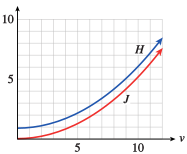
  1. \(v\) \(0\) \(1\) \(2\) \(3\) \(4\) \(5\) \(6\) \(7\) \(8\) \(9\) \(10\) \(11\)
    \(J\) \(0\) \(0.05\) \(0.2\) \(0.46\) \(0.82\) \(1.28\) \(1.84\) \(2.5\) \(3.27\) \(4.13\) \(5.1\) \(6.17\)
  2. two curves
  3. \(v\) \(0\) \(1\) \(2\) \(3\) \(4\) \(5\) \(6\) \(7\) \(8\) \(9\) \(10\) \(11\)
    \(H\) \(0.9\) \(0.95\) \(1.1\) \(1.36\) \(1.72\) \(2.18\) \(2.74\) \(3.4\) \(4.17\) \(5.03\) \(6.0\) \(7.07\)
  4. \(5.5\) meters
  5. \(10.15\) meters per second

2.2 Some Basic Functions
Homework 2.2

19.

Answer.
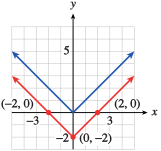
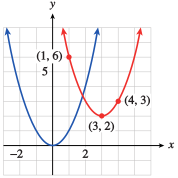
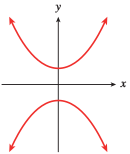
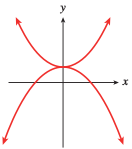
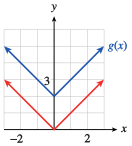
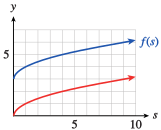
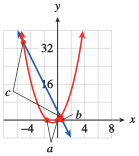
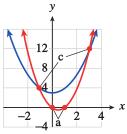
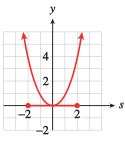
Graph (b) is the basic graph shifted 2 units down; graph (c) is the basic graph shifted 1 unit up.

21.

Answer.
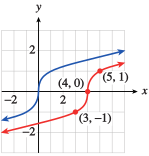
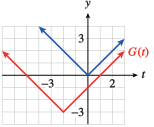
Graph (b) is the basic graph shifted 1.5 units left; graph (c) is the basic graph shifted 1 unit right.

23.

Answer.
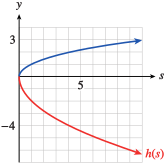
Graph (b) is the basic graph reflected about the \(x\)-axis; graph (c) is the basic graph reflected about the \(y\)-axis.

39.

Answer.
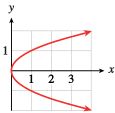
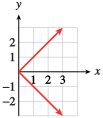
  1. \(x\) \(-\frac{1}{2} \) \(-1 \) \(-2 \) undefined \(2 \) \(1 \) \(\frac{1}{2} \)
    \(y\) \(-2\) \(-1 \) \(-\frac{1}{2} \) \(0 \) \(\frac{1}{2} \) \(1 \) \(2 \)
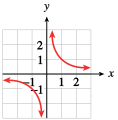
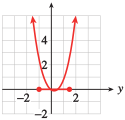
    absolute value rotated 90 degrees

53.

Answer.
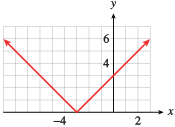
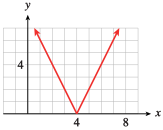
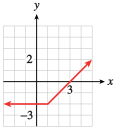
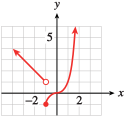
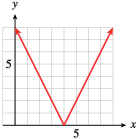
\(f(x) = \begin{cases} 8-2x \amp x\lt 4\\ 2x-8 \amp x\ge 4 \end{cases}\)
piecewise function

55.

Answer.
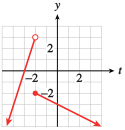
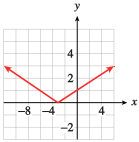
\(g(t) = \begin{cases} -1-\dfrac{t}{3} \amp t\lt -3\\ 1+\dfrac{t}{3} \amp t\ge -3 \end{cases}\)
piecewise function

57.

Answer.
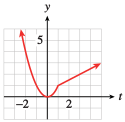
\(F(x) = \begin{cases} -x^3 \amp x\lt 0\\ x^3 \amp x\ge 0 \end{cases}\)
piecewise function

63.

Answer.
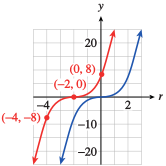
  1. Not always true (unless \(b=0\)): \(f (1 + 2)\ne f (1) + f (2)\) because \(3m+b \ne 3m+2b \text{.}\)
  2. Not always true: \(f (1\cdot 2)\ne f (1)\cdot f (2)\) because \(2m+b \ne 2m^2 + 3mb + b^2 \text{.}\)

67.

Answer.
The distributive law shows a relationship between multiplication and addition that always holds. The equation \(f (a + b) = f (a) + f (b)\) is not about multiplication and may or may not be true.

2.3 Transformations of Graphs
Homework 2.3

19.

Answer.
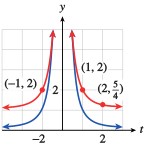
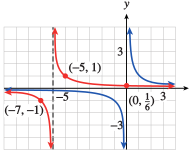
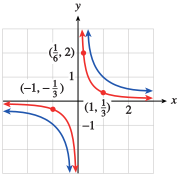
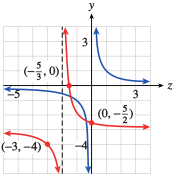
A vertical stretch by a factor of \(3\text{:}\) \(y = \dfrac{3}{x}\)

21.

Answer.
A vertical compression, the scale factor is \(\dfrac{1}{2}\text{:}\) \(y = \dfrac{1}{2}x^3\)

43.

Answer.
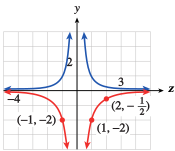
\(y = \dfrac{1}{2}\cdot\dfrac{1}{x^2}\) is a vertical compression with factor \(dfrac{1}{2} \) of \(y = \dfrac{1}{x^2}\text{.}\)

45.

Answer.
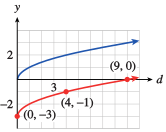
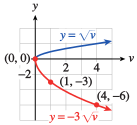
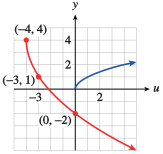
\(y = 2\sqrt[3]{x}\) is a vertical stretch with factor \(2 \) of \(y = \sqrt[3]{x}\text{.}\)

47.

Answer.
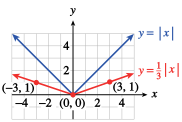
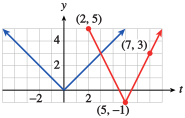
\(y = 3\abs{x}\) is a vertical stretch with factor \(3 \) of \(y = \abs{x}\text{.}\)

49.

Answer.
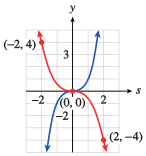
\(y = \dfrac{1}{8}x^3 \) is a vertical compression with factor \(\dfrac{1}{8} \) of \(y = x^3\text{.}\)

71.

Answer.
  1. \(y = f(x - 20)\text{:}\) Students scored \(20\) points higher than Professor Hilbert’s class.
  2. \(y = 1.5 f(x)\text{:}\) The class is about \(50\%\) larger than Hilbert’s, but the classes scored the same.

73.

Answer.
  1. \(y = f(x - 5000)\text{:}\) Taxpayers earn $\(5000\) more than Californians in each tax rate
  2. \(y = f(x) - 0.2\text{:}\) Taxpayers pay \(0.2\%\) less tax than Californians on the same income.

2.4 Functions as Mathematical Models
Homework 2.4

47.

Answer.
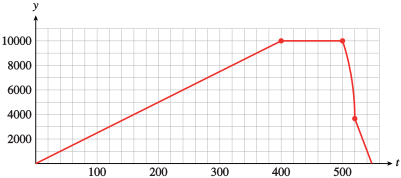
  1. piecewise curve
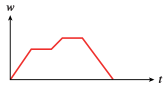
    During the first 400 seconds Bob’s altitude is climbing with the aircraft; then the aircraft maintains a constant altitude of 10,000 feet for the next 100 seconds; after jumping from the plane, Bob falls for 20 seconds before opening the parachute; he falls at a constant rate after the chute opens.
  2. \(240\) seconds (4 minutes) and \(500 + \sqrt{250}\approx 515.8\)

49.

Answer.
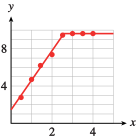
  1. points and piecewise linear function
  2. \(m\approx 3.2\) mm/cc: The height of precipitate increases by \(1\) mm for each additional cc of lead nitrate
  3. \(\displaystyle f(x)= \begin{cases} 1.34 + 3.2x \amp x \lt 2.6\\ 9.6 \amp x\ge 2.6 \end{cases}\)
  4. The increasing portion of the graph corresponds to the period when the reaction was occurring, and the horizontal section corresponds to when the potassium iodide is used up.

2.5 The Absolute Value Function
Homework 2.5

53.

Answer.
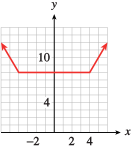
piecewise linear
  1. \(\displaystyle f(x) = \begin{cases} -2x, \amp x\lt -4 \\ 8, \amp -4\le x\le 4 \\ 2x, \amp x\gt 4 \end{cases} \)
  2. The graphs looks like like a trough. The middle horizontal section is \(y = p + q\) for \(-p \le x\le q\text{,}\) the left side, \(x\lt -p\text{,}\) has slope \(-2\) and the right side, \(x\gt q\text{,}\) has slope \(2\text{.}\)
  3. \(\displaystyle g(x) = \begin{cases} -2x+q-p, \amp x\lt -p \\ p+q, \amp -p\le x\le q \\ 2x+p-q, \amp x\gt q \end{cases} \)

2.6 Domain and Range
Homework 2.6

23.

Answer.
Domain: nonnegative integers; The range includes all whole number multiples of \(2.50\) up to \(20\times 2.50 = 50\text{,}\) all integer multiples of \(2.25\) from \(21\times 2.25 = 47.25\) to \(50 \times 2.25 = 112.50\) and all integer multiples of \(2.10\) from \(51\times 2.10 = 107.10\) onwards: \(0, 2.50, 5.00, 7.50, \ldots, 50\text{,}\) \(47.25, 49.50, 51.75, \ldots , 112.50\text{,}\) \(107.10, 109.20, 111.30, \ldots\)

47.

Answer.
Domain: \([-1.25, 2.75]\text{;}\) Range: \(\left[\dfrac{4}{17} , 4\right]\)

49.

Answer.
Domain: \((3, 6]\text{;}\) Range: \(\left[-\infty,\dfrac{-1}{3} \right]\)

51.

Answer.
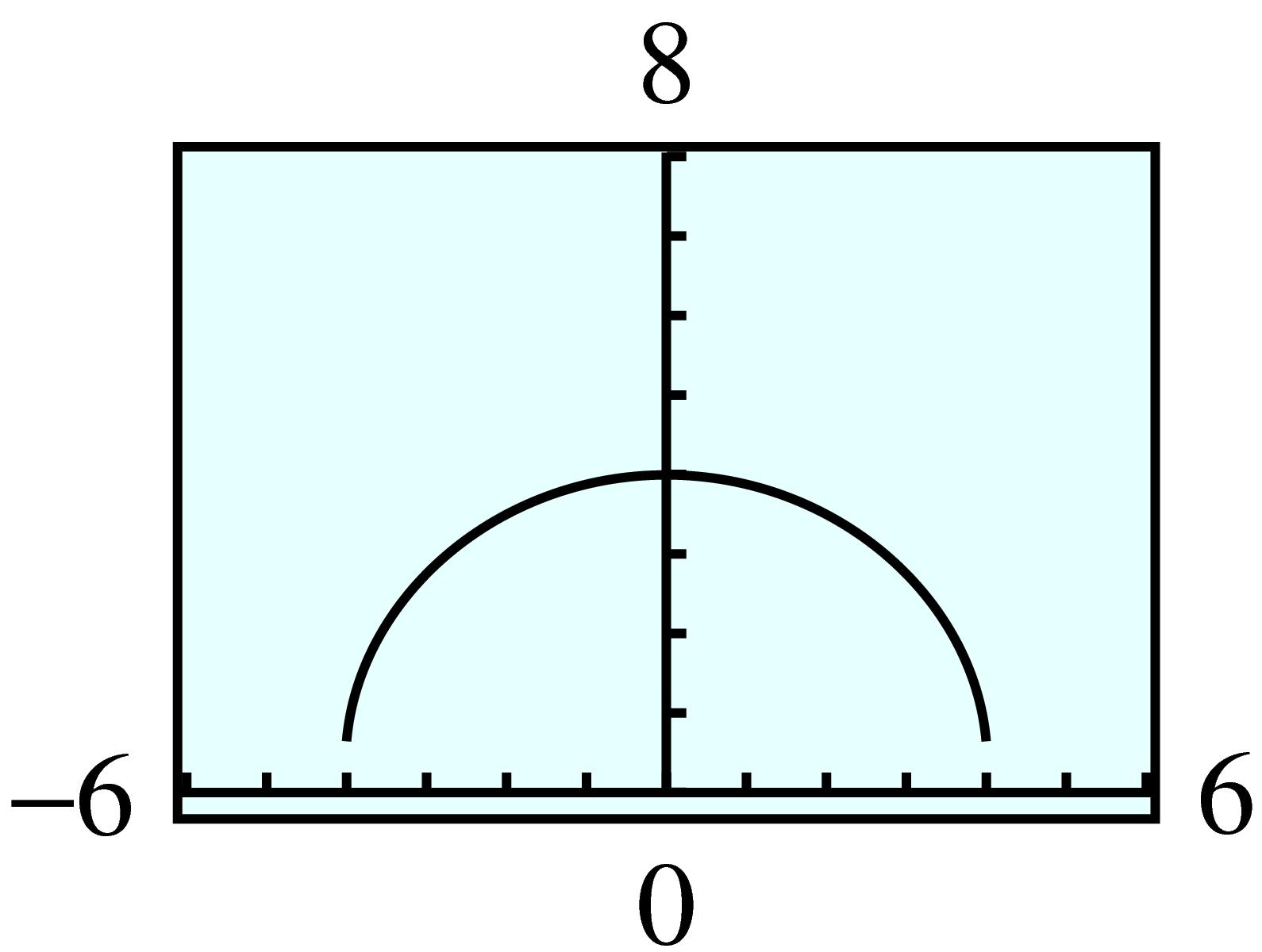
  1. Squaring both sides of the equation gives the equation of the circle centered on the origin with radius \(4\text{,}\) but the points in the third and fourth quadrants are extraneous solutions introduced by squaring. (The original equation allowed only \(y\ge 0\text{.}\))
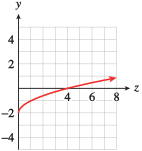
  2. Domain: \([-4, 4]\text{;}\) Range: \([0, 4]\)
  3. GC graph
    The calculator does not show the graph extending down to the \(x\)-axis.

2.7 Chapter Summary and Review
Chapter 2 Review Problems

49.

Answer.
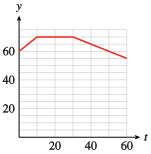
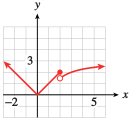
\(g(t) = \begin{cases} 60+t, \amp 0\le t \lt 10\\ 70, \amp 10\le t \lt 30\\ 70 - \frac{1}{2}(t - 30), \amp 30\le t \le 60 \end{cases}\)
piecewise

79.

Answer.
Domain: \((-2, 4]\text{;}\) Range: \(\left[\dfrac{1}{6} , \infty\right)\)

3 Power Functions
3.1 Variation
Homework 3.1

3.

Answer.
  1. \(\text{Width (feet)} \) \(2\) \(2.5\) \(3\)
    \(\text{Length (feet)} \) \(12\) \(9.6\) \(8\)
    \(\text{Length}\times \text{width} \) \(\alert{24}\) \(\alert{24}\) \(\alert{24}\)
    \(24\) square feet
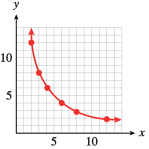
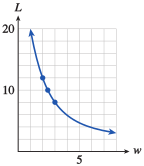
  2. \(\displaystyle L = \dfrac{24}{w} \)
  3. inverse variation

29.

Answer.
(c) \(\dfrac{y}{x^p}\) is not constant for any exponent \(p\text{.}\)

53.

Answer.
If \(y = kx^2\text{,}\) then dividing both sides of the equation by \(x^2\) gives \(\dfrac{y}{x^2} = k\text{.}\)

3.2 Integer Exponents
Homework 3.2

1.

Answer.
\(n\) \(-5\) \(-4\) \(-3\) \(-2\) \(-1\) \(0\) \(1\) \(2\) \(3\) \(4\) \(5\)
\(3^n\) \(\frac{1}{243} \) \(\frac{1}{81} \) \(\frac{1}{27} \) \(\frac{1}{9} \) \(\frac{1}{3} \) \(1\) \(3\) \(9\) \(27\) \(81\) \(243\)
Each time \(n\) increases by \(1\text{,}\) we multiply the power in the bottom row by \(3\text{.}\)

13.

Answer.
  1. \(x\) \(1\) \(2\) \(4\) \(8\) \(16\)
    \(x^{-2}\) \(1 \) \(0.25 \) \(0.06 \) \(0.02 \) \(0.00 \)
  2. The values of \(f (x)\) decrease, because \(x^{-2}\) is the reciprocal of \(x^2\text{.}\)
  3. \(x\) \(1\) \(0.5\) \(0.25\) \(0.125\) \(0.0625\)
    \(x^{-2}\) \(1 \) \(4 \) \(16 \) \(64 \) \(256 \)
  4. The values of \(f (x)\) increase toward infinity, because \(x^{-2}\) is the reciprocal of \(x^2\text{.}\)

15.

Answer.
b. (ii), (iii), and (iv) have the same graph, because they represent the same function.

55.

Answer.
  1. No, because \(\frac{1}{(x+y)^2}\) is not \(\frac{1}{x^2} + \frac{1}{y^2}\text{.}\)
  2. Let \(x = 1\text{,}\) \(y = 2\text{,}\) then \((x + y)^{-2} = (1 + 2)^{-2} = 3^{-2} = \frac{1}{9}\text{,}\) but \(x^{-2} + y^{-2} = 1^{-2} + 2^{-2} = 1 + \frac{1}{4} = \frac{5}{4}\)

57.

Answer.
  1. \(\displaystyle x + x^{-1} = x + \dfrac{1}{x} = \dfrac{x^2}{x}+\dfrac{1}{x}= \dfrac{x^2 + 1}{x}\)
  2. \(\displaystyle x^3 + x^{-3} = x^3 + \dfrac{1}{x^3} = \dfrac{x^6}{x^3}+\dfrac{1}{x^3}= \dfrac{x^6 + 1}{x^3}\)
  3. \(\displaystyle x^n + x^{-n} = x^n + \dfrac{1}{x^n} = \dfrac{x^{2n}}{x^n}+\dfrac{1}{x^n}= \dfrac{x^{2n} + 1}{x^2}\)

59.

Answer.
\begin{align*} a^{-2}a^{-3} \amp= \frac{1}{a^2}\cdot\frac{1}{a^3}=\frac{1}{a^2\cdot a^3} \\ \amp= \frac{1}{a^{2+3}} \amp\amp \text{By the first law of exponents.} \\ \amp= \frac{1}{a^5}=a^{-5} \end{align*}

61.

Answer.
\begin{align*} \frac{a^{-2}}{a^{-6}} \amp= a^{-2}\div a^{-6} = \frac{1}{a^2}\div\frac{1}{a^6} \\ \amp= \frac{1}{a^{2}}\cdot\frac{a^6}{1} = \frac{a^6}{a^2} \\ \amp= a^{6-2}\amp\amp \text{By the second law of exponents.} \\ \amp= a^4 \end{align*}

3.3 Roots and Radicals
Homework 3.3

43.

Answer.
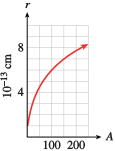
  1. \(6.5\times 10^{-13}\) cm; \(1.17\times 10^{-36} \text{ cm}^3\)
  2. \(\displaystyle 1.8\times 10^{14} g/\text{cm}^3\)
  3. Element Carbon Potassium Cobalt Technetium Radium
    Mass
    number, \(A\)
    \(14\) \(40\) \(60\) \(99\) \(226\)
    Radius, \(r\)
    (\(10^{-13}\) cm)
    \(3.1\) \(4.4\) \(5.1\) \(6\) \(7.9\)
  4. cube root

55.

Answer.
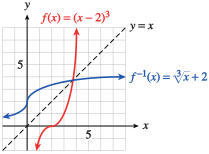
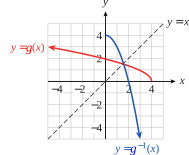
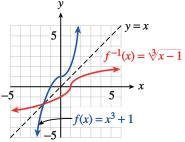
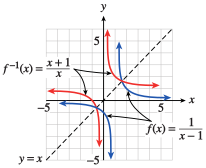
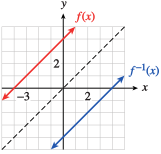
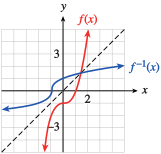
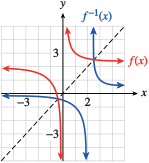
The graphs of \(y_1\) and \(y_2\) are symmetric about \(y_3 = x\text{.}\)

57.

Answer.
The graphs of \(y_1\) and \(y_2\) are symmetric about \(y_3 = x\text{.}\)

61.

Answer.
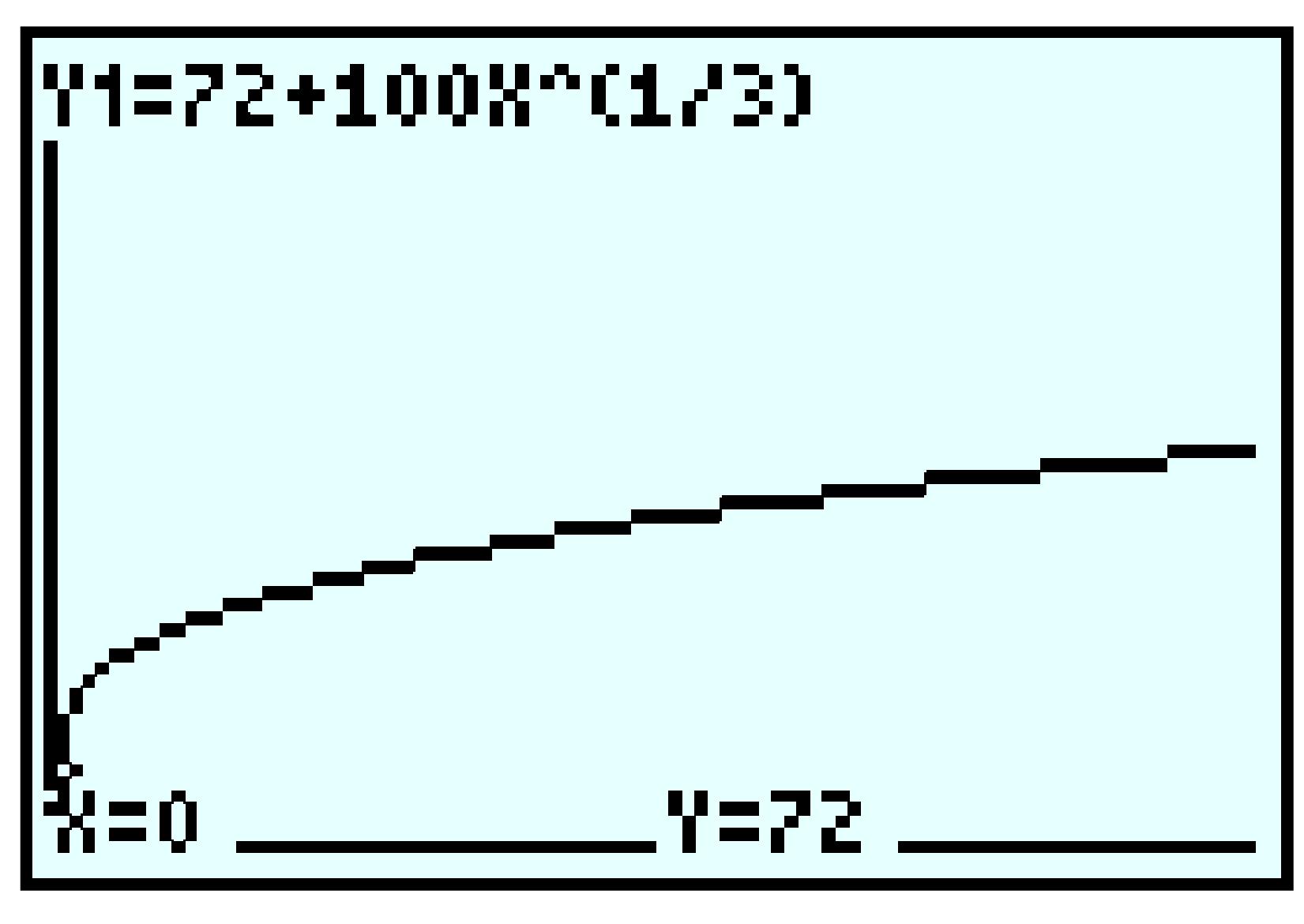
  1. \(\displaystyle x^{1/2}\)
  2. \(\displaystyle \left(x^{1/2} \right)^{1/2} \)
  3. \begin{equation*} \begin{aligned}[t] \sqrt{\sqrt{x}}\amp =\left(x^{1/2} \right)^{1/2} \amp\amp\text{By definition of fractional exponents.}\\ \amp=x^{1/4} \amp\amp\text{By the third law of exponents.}\\ \amp=\sqrt[4]{x} \amp\amp\text{By definition of fractional exponents.} \end{aligned} \end{equation*}

63.

Answer.
\(\displaystyle{\frac{1}{4}x^{1/2}-2x^{-1/2}+\frac{1}{\sqrt{2}}x}\)

3.4 Rational Exponents
Homework 3.4

21.

Answer.
All the graphs are increasing and concave up. For \(x \gt 1\text{,}\) each graph increases more quickly than the previous one.

29.

Answer.
  1. Home range size: II, lung volume: III, brain mass: I, respiration rate: IV
  2. If \(p\gt 1\text{,}\) the graph is increasing and concave up. If \(0\lt p\lt 1\text{,}\) the graph is increasing and concave down. If \(p\lt 0\text{,}\) the graph is decreasing and concave up.

3.5 Joint Variation
Homework 3.5

7.

Answer.
  1. \(\displaystyle C = f (s,w)\)
  2. \(f (4.5, 160) = 110\text{,}\) so someone walking \(4.5\) mph and weighing \(160\) pounds burns \(110\) calories per mile.
  3. \(s\gt 4.5\text{.}\) A person who weighs \(160\) pounds must walk faster than \(4.5\) mph in order to burn more than \(110\) calories per mile.
  4. \(7\) mph
  5. Find the row with your walking speed in the left column and move along that row until you are in the column with your weight at the top. The value in that row and column is the number of calories you burn per mile.

13.

Answer.
  1. In each row, \(R = kp\) for some constant \(k\) that depends on the row.
  2. In each column, \(R = cd^2\) for some constant \(c\) that depends on the column.
  3. \(\displaystyle R = 1.57d^2 p\)
  4. \(588.75\) pounds: When we keep \(p\) constant and double \(d\text{,}\) \(R\) is multiplied by a factor of \(4\text{.}\) So the value at \(d = 2\frac{1}{2} \text{,}\) \(p = 60\) should be \(4\) times the value at \(d = 1\frac{1}{4} \text{,}\) \(p = 60\text{.}\)

15.

Answer.
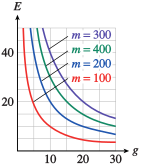
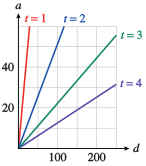
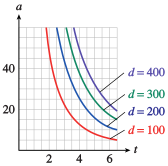
  1. \(\displaystyle a=\dfrac{2d}{t^2} \)
  2. Mercedes-Benz: \(19.05~ \text{ft}/\text{sec}^2\text{,}\) Porsche: \(19.73~ \text{ft}/\text{sec}^2\text{,}\) Dodge: \(20.47~ \text{ft}/\text{sec}^2\text{,}\) Saleen: \(23.59~ \text{ft}/\text{sec}^2\text{,}\) Ford: \(25.66~ \text{ft}/\text{sec}^2\)
  3. four lines
  4. four inverse square

19.

Answer.
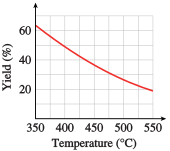
  1. Percent Ammonia
    Pressure (atmospheres)
    Temperature
    (\(\degree\)C)
    \(50\) \(100\) \(150\) \(200\) \(250\) \(300\) \(350\) \(400\)
    \(350\) \(25\) \(38\) \(46\) \(53\) \(58\) \(62\) \(66\) \(68\)
    \(400\) \(16\) \(26\) \(33\) \(38\) \(45\) \(48\) \(53\) \(56\)
    \(450\) \(9\) \(17\) \(23\) \(28\) \(32\) \(37\) \(40\) \(43\)
    \(500\) \(6\) \(11\) \(16\) \(20\) \(23\) \(27\) \(29\) \(32\)
    \(550\) \(4\) \(8\) \(11\) \(14\) \(17\) \(19\) \(22\) \(24\)
  2. The ammonia yield decreases.
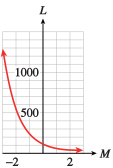
  3. yield vs temperature

3.6 Chapter Summary and Review
Chapter 3 Review Problems

33.

Answer.
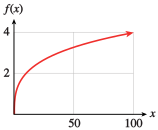
  1. \(x\) \(0\) \(1 \) \(5\) \(10\) \(20\) \(50\) \(70\) \(100\)
    \(f(x)\) \(0 \) \(1 \) \(1.62\) \(2.00 \) \(2.46 \) \(3.23\) \(3.58\) \(3.98\)
  2. increasing concave up

4 Exponential Functions
4.1 Exponential Growth and Decay
Homework 4.1

9.

Answer.
A: \(20\%\text{;}\) B: \(2\%\text{;}\) C: \(7.5\%\text{;}\) D: \(100\%\text{;}\) E: \(115\%\)

31.

Answer.
  1. In the expression \(2\cdot 3^t\text{,}\) only the \(3\) is raised to a power \(t\text{,}\) and the result is doubled, but if both the \(2\) and the \(3\) were raised to the power \(t\text{,}\) the result would be \(6^t\text{.}\)
  2. \(t\) \(0\) \(1\) \(2\)
    \(P(t)\) \(2\) \(6\) \(18\)
    \(Q(t)\) \(1\) \(6\) \(36\)

45.

Answer.
The growth factor is \(1.5\text{.}\)
\(t\) \(0\) \(1\) \(2\) \(3\) \(4\)
\(P\) \(~8~\) \(12\) \(18\) \(27\) \(40.5\)

47.

Answer.
The growth factor is \(1.2\text{.}\)
\(x\) \(0\) \(1\) \(2\) \(3\) \(4\)
\(Q\) \(20\) \(24\) \(28.8\) \(34.56\) \(41.47\)

49.

Answer.
The decay factor is \(0.8\text{.}\)
\(w\) \(0\) \(1\) \(2\) \(3\) \(4\)
\(N\) \(120\) \(96\) \(76.8\) \(61.44\) \(49.15\)

51.

Answer.
The decay factor is \(0.8\text{.}\)
\(t\) \(0\) \(1\) \(2\) \(3\) \(4\)
\(C\) \(10\) \(8\) \(6.4\) \(5.12\) \(4.10\)

53.

Answer.
The growth factor is \(1.1\text{.}\)
\(n\) \(0\) \(1\) \(2\) \(3\) \(4\)
\(B\) \(200\) \(220\) \(242\) \(266.2\) \(292.82\)

61.

Answer.
No, an increase of \(48\%\) in \(6\) years corresponds to a growth factor of \(1.48^{1/6}\approx 1.0675\text{,}\) or an annual growth rate of about \(6.75\%\text{.}\)

69.

Answer.
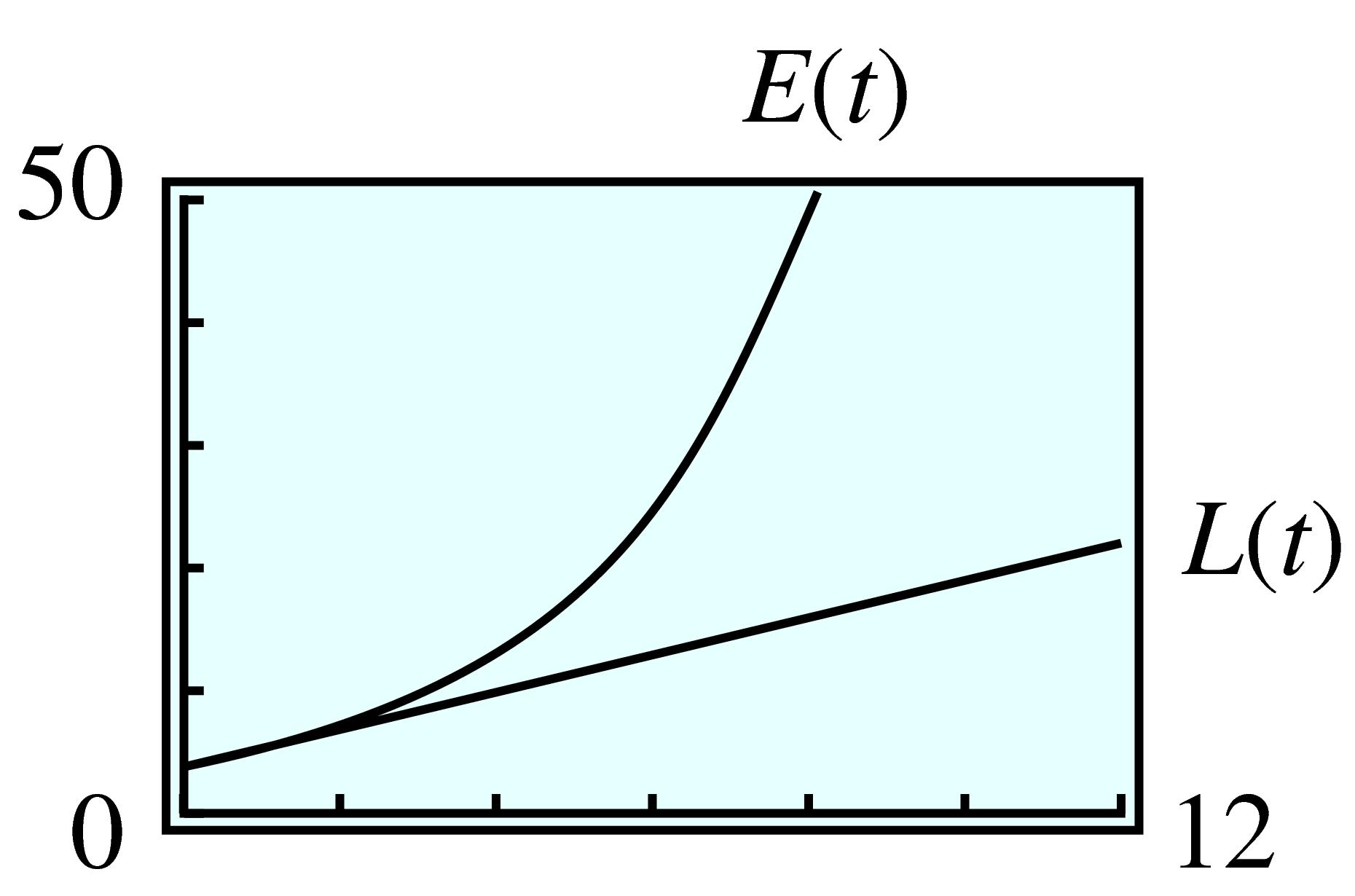
  1. \(t\) \(0\) \(2\) \(4\) \(6\) \(8\)
    \(L(t)\) \(3\) \(6\) \(9\) \(12\) \(15\)
    \(\displaystyle L(t) = 3 + 1.5t\)
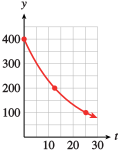
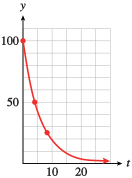
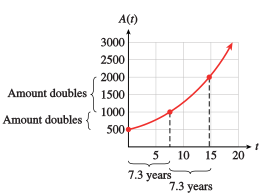
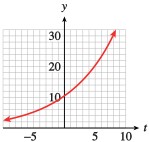
    linear and exponential
  2. \(t\) \(0\) \(2\) \(4\) \(6\) \(8\)
    \(E(t)\) \(3\) \(6\) \(12\) \(24\) \(48\)
    \(\displaystyle E(t) = 3\cdot 2^{t/2}\)

4.2 Exponential Functions
Homework 4.2

3.

Answer.
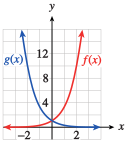
\(x\) \(-3\) \(-2\) \(-1\) \(0\) \(1\) \(2\) \(3\)
\(f(x)=3^x \) \(\frac{1}{27} \) \(\frac{1}{9} \) \(\frac{1}{3} \) \(1\) \(3\) \(9\) \(27\)
\(g(x)=\left(\frac{1}{3} \right)^x \) \(27\) \(9\) \(3\) \(1\) \(\frac{1}{3} \) \(\frac{1}{9} \) \(\frac{1}{27} \)
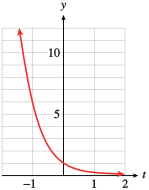
exponential growth and decay
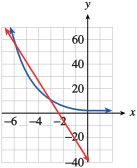
The two graphs are reflections of each other across the \(y\)-axis. \(f\) is increasing, \(g\) is decreasing. \(f\) has the negative \(x\)-axis as an asymptote, and \(g\) has the positive \(x\)-axis as its asymptote.

5.

Answer.
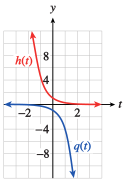
\(t\) \(-3\) \(-2\) \(-1\) \(0\) \(1\) \(2\) \(3\)
\(h(t)=4^{-t} \) \(64\) \(16\) \(4\) \(1\) \(\frac{1}{4} \) \(\frac{1}{16} \) \(\frac{1}{64} \)
\(q(t)=-4^t \) \(\frac{-1}{64} \) \(\frac{-1}{16} \) \(\frac{-1}{4} \) \(-1\) \(-4\) \(-16\) \(-64\)
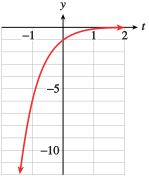
exponential decay and negative of growth
The graphs are reflections of each other across the origin. Both are decreasing, but \(h\) has the negative \(t\)-axis as an asymptote, and \(q\) has the positive t-axis as its asymptote.

13.

Answer.
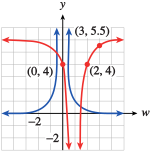
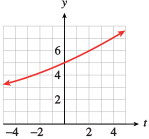
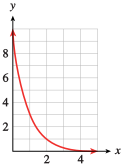
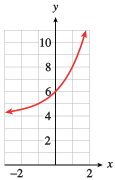
Because they are defined by equivalent expressions, (b), (c), and (d) have identical graphs

15.

Answer.
  1. To evaluate \(f\) we subtract \(1\) from the input before evaluating the exponential function; to evaluate \(g\) we subtract \(1\) from the output of the exponential function.
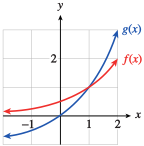
  2. \(x\) \(y=2^x\) \(f(x)\) \(g(x)\)
    \(-2\) \(\dfrac{1}{4} \) \(\dfrac{1}{8} \) \(\dfrac{-3}{4} \)
    \(-1\) \(\dfrac{1}{2} \) \(\dfrac{1}{4} \) \(\dfrac{-1}{2} \)
    \(0\) \(1 \) \(\dfrac{1}{2} \) \(0 \)
    \(1\) \(2 \) \(1 \) \(1 \)
    \(2\) \(4 \) \(2 \) \(3 \)
    two shifts of growth
  3. The graph of \(f\) is translated \(1\) unit to the right; the graph of \(g\) is shifted \(1\) unit down.

17.

Answer.
  1. To evaluate \(f\) we take the negative of the output of the exponential function; to evaluate \(g\) we take the negative of the input.
  2. \(x\) \(y=3^x\) \(f(x)\) \(g(x)\)
    \(-2\) \(\dfrac{1}{9} \) \(\dfrac{-1}{9} \) \(9 \)
    \(-1\) \(\dfrac{1}{3} \) \(\dfrac{-1}{3} \) \(3 \)
    \(0\) \(1 \) \(-1 \) \(1 \)
    \(1\) \(3 \) \(-3 \) \(\dfrac{1}{3} \)
    \(2\) \(9 \) \(-9 \) \(\dfrac{1}{9} \)
    two shifts of growth
  3. The graph of \(f\) is reflected about the \(x\)-axis; the graph of \(g\) is reflected about the \(y\)-axis.

51.

Answer.
\(x\) \(f(x)=x^2\) \(g(x)=2^x \)
\(-2\) \(4\) \(\frac{1}{4} \)
\(-1\) \(1\) \(\frac{1}{2} \)
\(0\) \(0\) 1
\(1\) \(1\) \(2\)
\(2\) \(4\) \(4\)
\(3\) \(9\) \(8\)
\(4\) \(16\) \(16\)
\(5\) \(25\) \(32\)
exponential growth and qudratic
  1. Range of \(f\text{:}\) \([0, \infty)\text{;}\) Range of \(g\text{:}\) \((0, \infty)\)
  2. \(\displaystyle 3\)
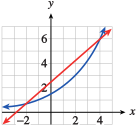
  3. \(-0.7667\text{,}\) \(2\text{,}\) \(4\)
  4. \((-0.7667, 2) \) and \((4,\infty)\)

53.

Answer.
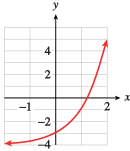
  1. \(y = 3^x - 4\)
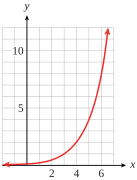
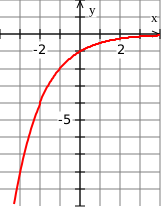
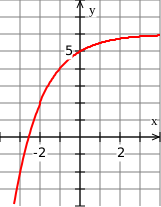
    shifted growth
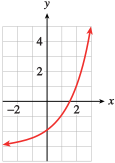
    Domain: \((-\infty, \infty)\text{;}\) range: \((-4, \infty)\text{,}\) \(x\)-intercept \((1.26, 0)\text{;}\) \(y\)-intercept \((0, -3)\text{;}\) horizontal asymptote \(y=-4\)
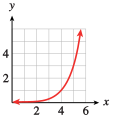
  2. \(y=3^{x-4}\text{,}\)
    growth
    Domain: \((-\infty, \infty)\text{;}\) range: \((0, \infty)\text{,}\) no \(x\)-intercept; \(y\)-intercept \(\left(0, \dfrac{1}{81}\right)\text{;}\) the \(x\)-axis is the horizontal asymptote.
  3. \(y=-4\cdot 3^{x}\text{,}\)
    growth reflected
    Domain: \((-\infty, \infty)\text{;}\) range: \((-\infty, 0)\text{,}\) no \(x\)-intercept; \(y\)-intercept \((0, -4)\text{;}\) the \(x\)-axis is the horizontal asymptote.

55.

Answer.
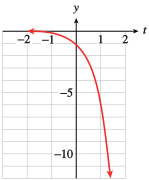
  1. \(y =-6^t\)
    reflected growth
    Domain: \((-\infty, \infty)\text{;}\) range: \((-\infty, 0)\text{,}\) no \(t\)-intercept; \(y\)-intercept \((0, -1)\text{;}\) the \(t\)-axis is the horizontal asymptote.
  2. \(y=6^{-t}\text{,}\)
    decay
    Domain: \((-\infty, \infty)\text{;}\) range: \((0, \infty)\text{,}\) no \(t\)-intercept; \(y\)-intercept \((0, 1)\text{;}\) the \(t\)-axis is the horizontal asymptote.
  3. \(y=-6^{-t}\text{,}\)
    decay reflected
    Domain: \((-\infty, \infty)\text{;}\) range: \((-\infty, 0)\text{,}\) no \(t\)-intercept; \(y\)-intercept \((0, -1)\text{;}\) the \(t\)-axis is the horizontal asymptote.

57.

Answer.
  1. \(y =2^{x-3}\)
    growth
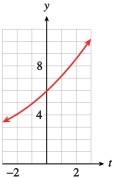
    Domain: \((-\infty, \infty)\text{;}\) range: \((0, \infty)\text{,}\) no \(x\)-intercept; \(y\)-intercept \(\left(0, \frac{1}{8}\right)\text{;}\) the \(x\)-axis is the horizontal asymptote.
  2. \(y=2^{x-3}+4 \text{,}\)
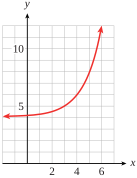
    shifted growth
    Domain: \((-\infty, \infty)\text{;}\) range: \((4, \infty)\text{,}\) no \(x\)-intercept; \(y\)-intercept \(\left(0, \frac{33}{8}\right)\text{;}\) horizontal asymptote \(y=4\)

59.

Answer.
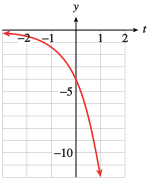
  1. \(y =-\left(\dfrac{1}{2}\right)^t\)
    reflected decay
    Domain: \((-\infty, \infty)\text{;}\) range: \((-\infty, 0)\text{,}\) no \(t\)-intercept; \(y\)-intercept \((0, -1)\text{;}\) the \(t\)-axis is the horizontal asymptote.
  2. \(y=6-\left(\dfrac{1}{2} \right)^t \text{,}\)
    shifted reflected decay
    Domain: \((-\infty, \infty)\text{;}\) range: \((-\infty,6)\text{,}\) \(t\)-intercept approximately \((-2.58,0)\text{;}\) \(y\)-intercept \((0, 5)\text{;}\) horizontal asymptote is \(y=6\)

67.

Answer.
  1. \(t\) \(3.5\) \(4\) \(8\) \(10\) \(15\)
    \(f(t)\) \(128\) \(154.75\) \(184.05\) \(150.93\) \(103.96\)
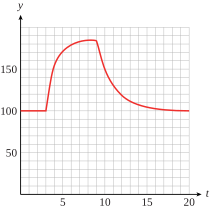
  2. piecewise
  3. From \(0\) to \(3\) minutes, the volunteer is walking with heart rate \(100\) beats per minute. The volunteer jogged at a steady pace from \(3\) to \(4\) minutes, and the heart rate increased to about \(155\) beats per minutes. From \(4\) to \(9\) minutes, the jogging pace increased, and the heart rate rose to about \(185\) beats per minute. The cooldown started at \(9\) minutes, and the heart rate decreased rapidly and leveled off to about \(100\) beats per minute.

4.3 Logarithms
Homework 4.3

45.

Answer.
\(2\cdot 5^x\ne 10^x\text{;}\) the first step should be to divide both sides of the equation by \(2\text{;}\) \(x = \log_5 (424)\text{.}\)

47.

Answer.
\(\frac{10^{4x}}{4} \ne 10^x\text{;}\) the first step should be to write \(4x = \log (20)\text{;}\) \(x = \frac{\log 20}{4}\text{.}\)

4.4 Properties of Logarithms
Homework 4.4

4.5 Exponential Models
Homework 4.5

37.

Answer.
  1. \(\displaystyle ab^R = \frac{1}{3} \cdot ab^0 = \frac{1}{3} a\)
  2. \(\displaystyle b^R=\frac{1}{3} \)
  3. \(\displaystyle g(t + R) = ab^{t+R} = a\cdot b^t\cdot b^R = ab^t\cdot \frac{1}{3} = \frac{1}{3} g(t)\)
  4. For any value of \(t\text{,}\) after \(R\) units of time, the new value of \(g\) is \(\frac{1}{3} \) times the old value.

47.

Answer.
  1. \(\displaystyle N(t) = 2200(2)^{t/1.5}\)
  2. The given model has a smaller growth factor, \(1.356\text{,}\) than \(2^{1/1.5}\approx 1.59\text{.}\)
  3. Name of chip Year Moore’s
    law
    \(N(t)\) Actual
    number
    Pentium IV \(2000\) \(2,306,867,200\) \(20,427,413\) \(42,000,000\)
    Pentium M (Banias) \(2003\) \(9,227,468,800\) \(50,932,200\) \(77,000,000\)
    Pentium M (Dothan) \(2004\) \(14,647,693,680\) \(69,064,063\) \(140,000,000\)
  4. About \(2.3\) years

4.6 Chapter Summary and Review
Chapter 4 Review Problems

37.

Answer.
\(M = M_0(2)^{t/10}\text{,}\) where \(M\) is the organic content, \(M_0\) is the organic content at \(0\degree\)C, and \(t\) is the temperature in \(\degree\) Celsius.

5 Logarithmic Functions
5.1 Inverse Functions
Homework 5.1

5.

Answer.
  1. \(f (60)\approx 38\text{.}\) The car that left the \(60\)-foot skid marks was traveling at \(38\) mph.
  2. \(f^{-1} (60) \approx 150\text{.}\) The car traveling at \(60\) mph left \(150\)-foot skid marks

7.

Answer.
  1. \(\displaystyle (60~ \text{hours}, 78~ \text{grams})\)
  2. \(f^{-1} (90) \approx 19\text{,}\) so that the vampire bat’s weight has dropped to \(90\) grams about \(19\) hours after its last meal.

5.2 Logarithmic Functions
Homework 5.2

1.

Answer.
  1. \(x\) \(-1\) \(0\) \(1\) \(2\)
    \(2^x\) \(\frac{1}{2} \) \(1\) \(2\) \(4\)
    \(x\) \(\frac{1}{2} \) \(1\) \(2\) \(4\)
    \(\log_2 x\) \(-1\) \(0\) \(1\) \(2\)
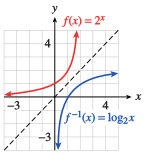
  2. exponential and log functions

3.

Answer.
  1. \(x\) \(-2\) \(-1\) \(0\) \(1\)
    \(\left(\frac{1}{3}\right)^x\) \(9\) \(3\) \(1\) \(\frac{1}{3} \)
    \(x\) \(9\) \(3\) \(1\) \(\frac{1}{3} \)
    \(\log_{1/3} x\) \(-2\) \(-1\) \(0\) \(1\)
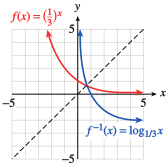
  2. exponential and log functions

27.

Answer.
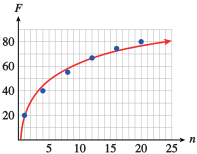
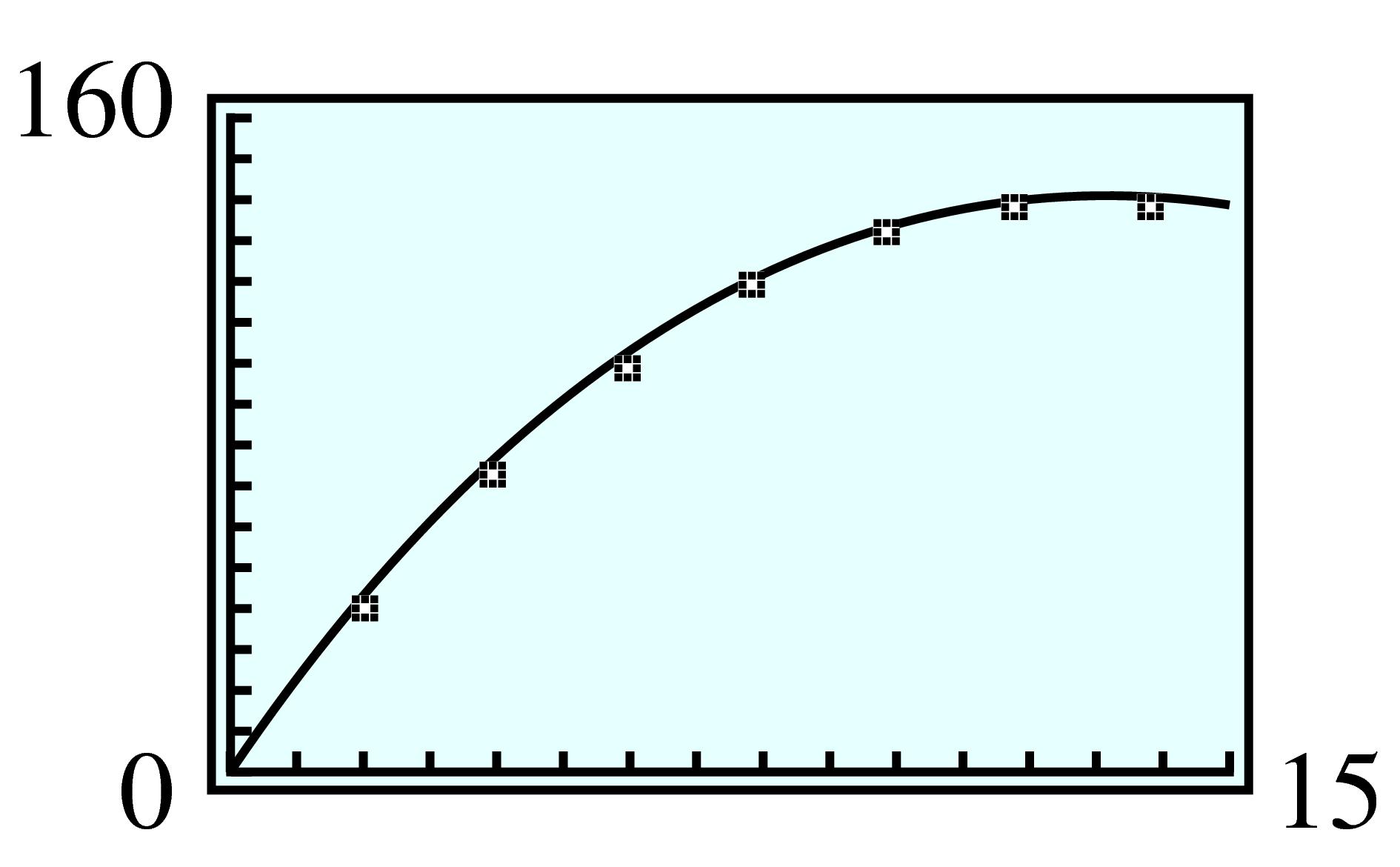
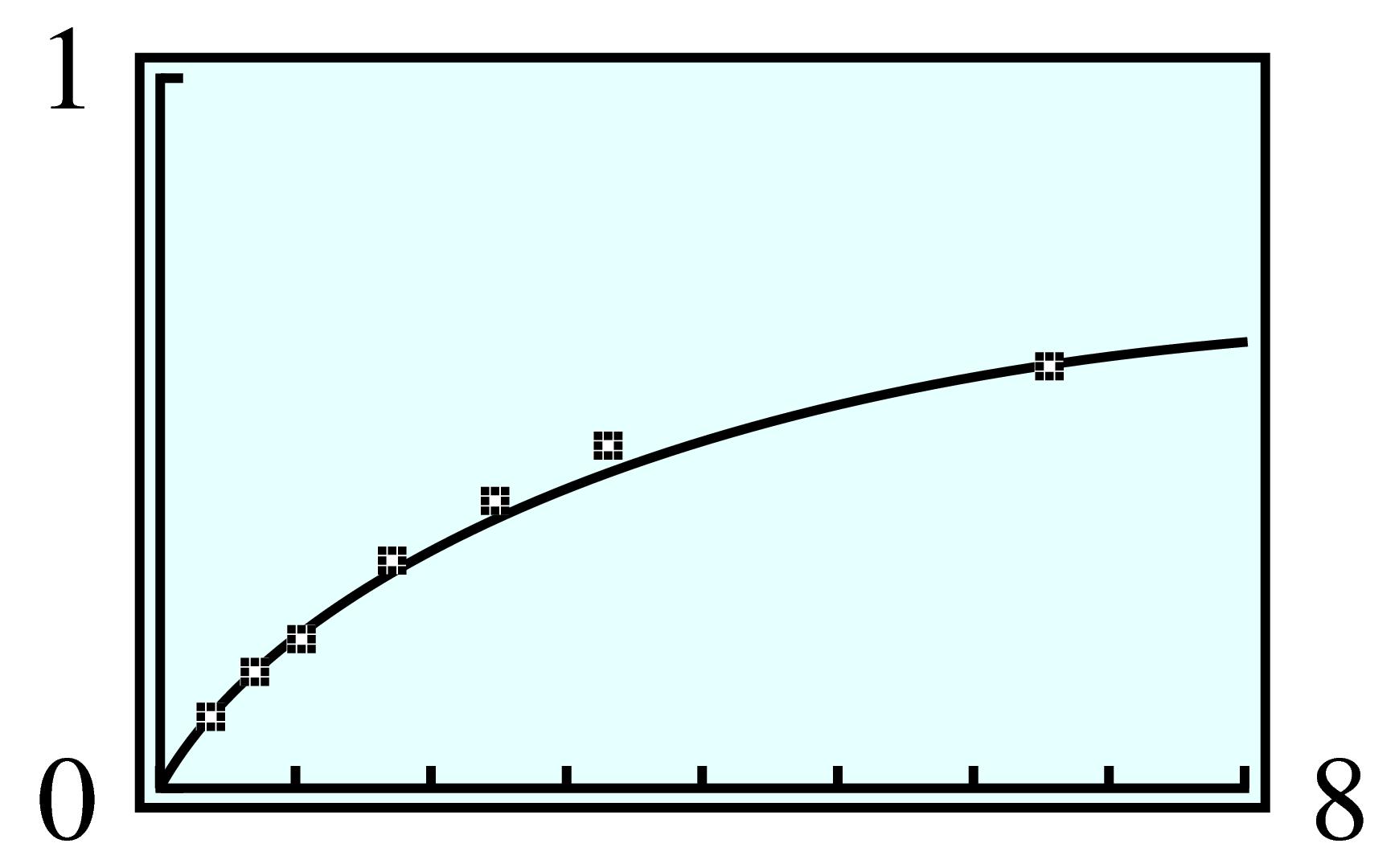
  1. data points and log curve
  2. The graph resembles a logarithmic function. The (translated) log function is close to the points but appears too steep at first and not steep enough after \(n = 15\text{.}\) Overall, it is a good fit.
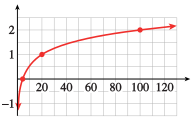
  3. \(f\) grows (more and more slowly) without bound. \(f\) will eventually exceed \(100\) per cent, but no one can forget more than \(100\%\) of what is learned.

69.

Answer.
  1. \(x\) \(x^2\) \(\log_{10}(x)\) \(\log_{10}(x^2) \)
    \(1\) \(1\) \(0\) \(0\)
    \(2\) \(4\) \(0.301\) \(0.602\)
    \(3\) \(9\) \(0.477\) \(0.954\)
    \(4\) \(16\) \(0.602\) \(1.204\)
    \(5\) \(25\) \(0.699\) \(1.398\)
    \(6\) \(36\) \(0.778\) \(1.556\)
  2. \(\displaystyle \log_{10}x^2=2\log_{10}(x) \)

71.

Answer.
\(x\) \(y=\log_e (x) \)
\(1\) \(0\)
\(2\) \(0.693\)
\(4\) \(1.386\)
\(16\) \(2.772\)
\(\frac{1}{2} \) \(-0.693\)
\(\frac{1}{4} \) \(-1.386\)
\(\frac{1}{16} \) \(-2.772\)
log base e

5.3 The Natural Base
Homework 5.3

1.

Answer.
\(x\) \(-10\) \(-5\) \(0\) \(5\) \(10\) \(15\) \(20\)
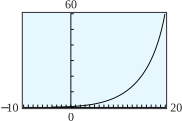
\(f(x)\) \(0.135\) \(0.368\) \(1\) \(2.718\) \(7.389\) \(20.086\) \(54.598\)
growth

3.

Answer.
\(x\) \(-10\) \(-5\) \(0\) \(5\) \(10\) \(15\) \(20\)
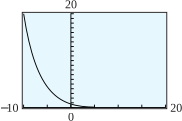
\(f(x)\) \(20.086\) \(4.482\) \(1\) \(0.223\) \(0.05\) \(0.011\) \(0.00248\)
decay

15.

Answer.
\(P (t) = 20\left(e^{0.4} \right)^t \approx 20\cdot 1.492^t\text{;}\) increasing; initial value \(20\)

17.

Answer.
\(P (t) = 6500\left(e^{-2.5} \right)^t \approx 6500\cdot 0.082^t\text{;}\) decreasing; initial value \(6500\)

19.

Answer.
  1. \(x\) \(0\) \(0.5\) \(1\) \(1.5\) \(2\) \(2.5\)
    \(e^x\) \(1 \) \(1.6487\) \(2.7183\) \(4.4817\) \(7.3891\) \(12.1825\)
  2. Each ratio is \(e^{0.5} \approx 1.6487\text{:}\) Increasing \(x\)-values by a constant \(\Delta x = 0.5\) corresponds to multiplying the \(y\)-values of the exponential function by a constant factor of \(e^{\Delta x}\text{.}\)

21.

Answer.
  1. \(x\) \(0\) \(0.6931\) \(1.3863\) \(2.0794\) \(2.7726\) \(3.4657\) \(4.1589\)
    \(e^x\) \(1 \) \(2\) \(4\) \(8\) \(16\) \(32\) \(64\)
  2. Each difference in \(x\)-values is approximately \(\ln (2)\approx 0.6931\text{:}\) Increasing \(x\)-values by a constant \(\Delta x = \ln (2)\) corresponds to multiplying the \(y\)-values of the exponential function by a constant factor of \(e^{\Delta x} = e^{\ln (2)} = 2\text{.}\) That is, each function value is approximately equal to double the previous one.

37.

Answer.
  1. \(n\) \(0.39\) \(3.9\) \(39\) \(390\)
    \(\ln n\) \(-0.942 \) \(1.361 \) \(3.664 \) \(5.966 \)
  2. Each difference in function values is approximately \(\ln (10)\approx 2.303\text{:}\) Multiplying \(x\)-values by a constant factor of \(10\) corresponds to adding a constant value of ln (10) to the \(y\)-values of the natural log function.

39.

Answer.
  1. \(n\) \(2\) \(4\) \(8\) \(16\)
    \(\ln (n)\) \(0.693 \) \(1.386 \) \(2.079 \) \(2.773 \)
  2. Each quotient equals \(k\text{,}\) where \(n = 2^k\text{.}\) Because \(\ln (n) = \ln \left(2^k\right) = k\cdot \ln (2)\text{,}\) \(k = \dfrac{\ln (n)}{\ln (2)}\text{.}\)

5.4 Logarithmic Scales
Homework 5.4

7.

Answer.
\(1\text{,}\) \(80\text{,}\) \(330\text{,}\) \(1600\text{,}\) \(7000\text{,}\) \(4\times 10^7\)

11.

Answer.
Proxima Centauri: \(15.5\text{;}\) Barnard: \(13.2\text{;}\) Sirius: \(1.4\text{;}\) Vega: \(0.6\text{;}\) Arcturus: \(-0.4\text{;}\) Antares: \(-4.7\text{;}\) Betelgeuse: \(-7.2\)

19.

Answer.
A: \(a\approx 45\text{,}\) \(p \approx 7.4\%\text{;}\) B: \(a \approx 400\text{,}\) \(p \approx 15\%\text{;}\) C: \(a\approx 6000\text{,}\) \(p\approx 50\%\text{;}\) D: \(a \approx 13000\text{,}\) \(p \approx 45\%\)

5.5 Chapter Summary and Review
Chapter 5 Review Problems

1.

Answer.
\(y\) \(-1\) \(1\) \(3\) \(11\)
\(x=f^{-1}(y)\) \(-1\) \(0\) \(1\) \(2\)

3.

Answer.
\(y\) \(0\) \(\frac{-1}{3} \) \(-1\) \(-3\)
\(w=g^{-1}(y)\) \(-1\) \(0\) \(1\) \(2\)

65.

Answer.
Order \(3\text{:}\) \(17,000\text{;}\) Order \(4\text{:}\) \(5000\text{;}\) Order \(8\text{:}\) \(40\text{;}\) Order \(9\text{:}\) \(11\)

6 Quadratic Functions
6.1 Factors and \(x\)-Intercepts
Homework 6.1

25.

Answer.
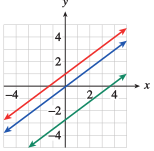
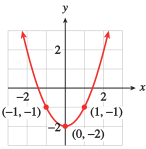
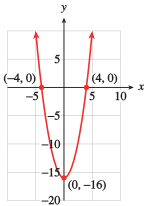
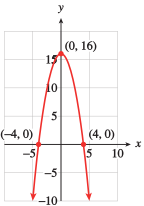
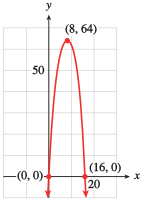
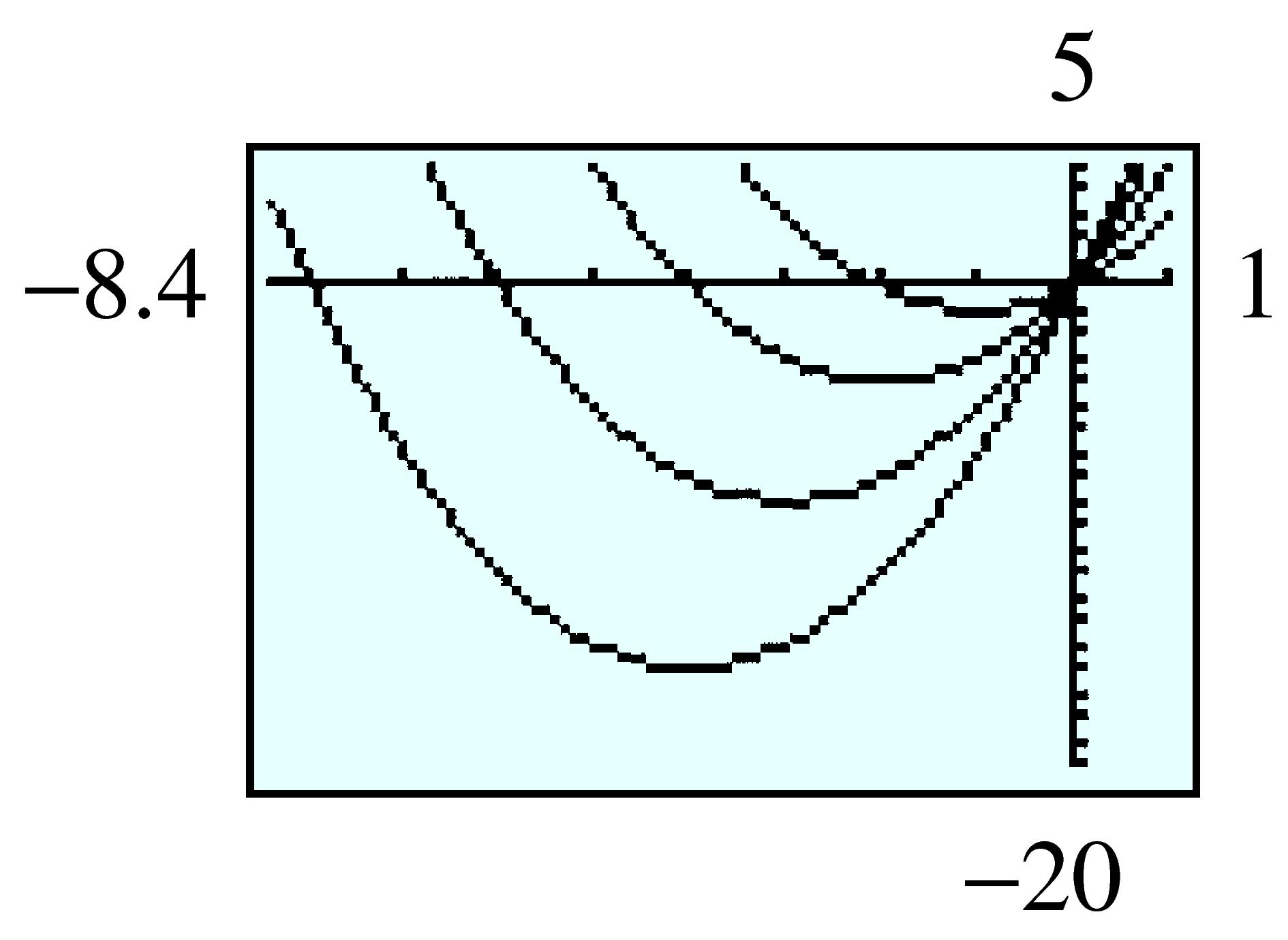
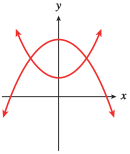
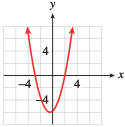
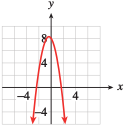
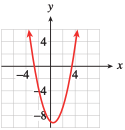
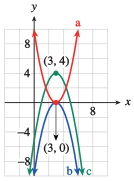
The 3 graphs have the same \(x\)-intercepts. In general, the graph of \(y = ax^2 + bx + c\) has the same \(x\)-intercepts as the graph of \(y = k(ax^2 + bx + c)\text{.}\)

27.

Answer.
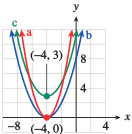
The 3 graphs have the same \(x\)-intercepts. In general, the graph of \(y = ax^2 + bx + c\) has the same \(x\)-intercepts as the graph of \(y = k(ax^2 + bx + c)\text{.}\)

45.

Answer.
  1. Width Length Area
    \(10\) \(170\) \(1700\)
    \(20\) \(160\) \(3200\)
    \(30\) \(150\) \(4500\)
    \(40\) \(140\) \(5600\)
    \(50\) \(130\) \(6500\)
    \(60\) \(120\) \(7200\)
    \(70\) \(110\) \(7700\)
    \(80\) \(100\) \(8000\)
  2. \(l= 180 - x\text{,}\) \(A = 180x - x^2\text{;}\) \(80\) yd by \(100\) yd
  3. \(180x-x^2=8000\text{,}\) \(80\) yd by \(100\) yd, or \(100\) yd by \(80\) yd. There are two solutions because the pasture can be oriented in two directions.

49.

Answer.
  1. \(x\) \(0\) \(500\) \(1000\) \(1500\) \(2000\) \(2500\) \(3000\) \(3500\)
    \(I\) \(0\) \(550\) \(1000\) \(1350\) \(1600\) \(1750\) \(1800\) \(1750\)
    \(x\) \(4000\) \(4500\) \(5000\) \(5500\) \(6000\) \(6500\) \(7000\)
    \(I\) \(1600\) \(1350\) \(1000\) \(550\) \(0\) \(-650\) \(-1400\)
  2. \(1600\text{,}\) \(1000\text{,}\) \(-1400\)
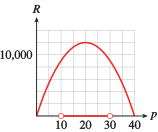
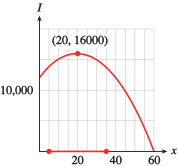
  3. parabola
  4. No increase
  5. \(3000\text{;}\) \(1800\)

6.2 Solving Quadratic Equations
Homework 6.2

7.

Answer.
\(\dfrac{3}{2} \pm \sqrt{\dfrac{21}{4}} = \dfrac{-3\pm\sqrt{21}}{2} \)

13.

Answer.
\(\dfrac{1}{4} \pm \sqrt{\dfrac{13}{16}} = \dfrac{1\pm\sqrt{13}}{4} \)

21.

Answer.
\(-\dfrac{b}{2} \pm \sqrt{\dfrac{b^2-4}{4}} = \dfrac{-b\pm\sqrt{b^2-4}}{2} \)

37.

Answer.
  1. \(s\) \(10\) \(20\) \(30\) \(40\) \(50\) \(60\) \(70\) \(80\) \(90\) \(100\)
    \(d\) \(9\) \(27\) \(53\) \(87\) \(129\) \(180\) \(239\) \(307\) \(383\) \(467\)
  2. parabola
  3. \(\dfrac{s^2}{24}+\dfrac{s}{2}=50\text{;}\) \(~29.16\) mph

45.

Answer.
\(w= \dfrac{-4l\pm \sqrt{16l^2+8A}}{4} = \dfrac{-2l\pm \sqrt{4l^2+2A}}{2} \)

47.

Answer.
\(t = \dfrac{4 \pm \sqrt{16+64h}}{32} = \dfrac{1 \pm \sqrt{1+4h}}{8} \)

6.3 Graphing Parabolas
Homework 6.3

9.

Answer.
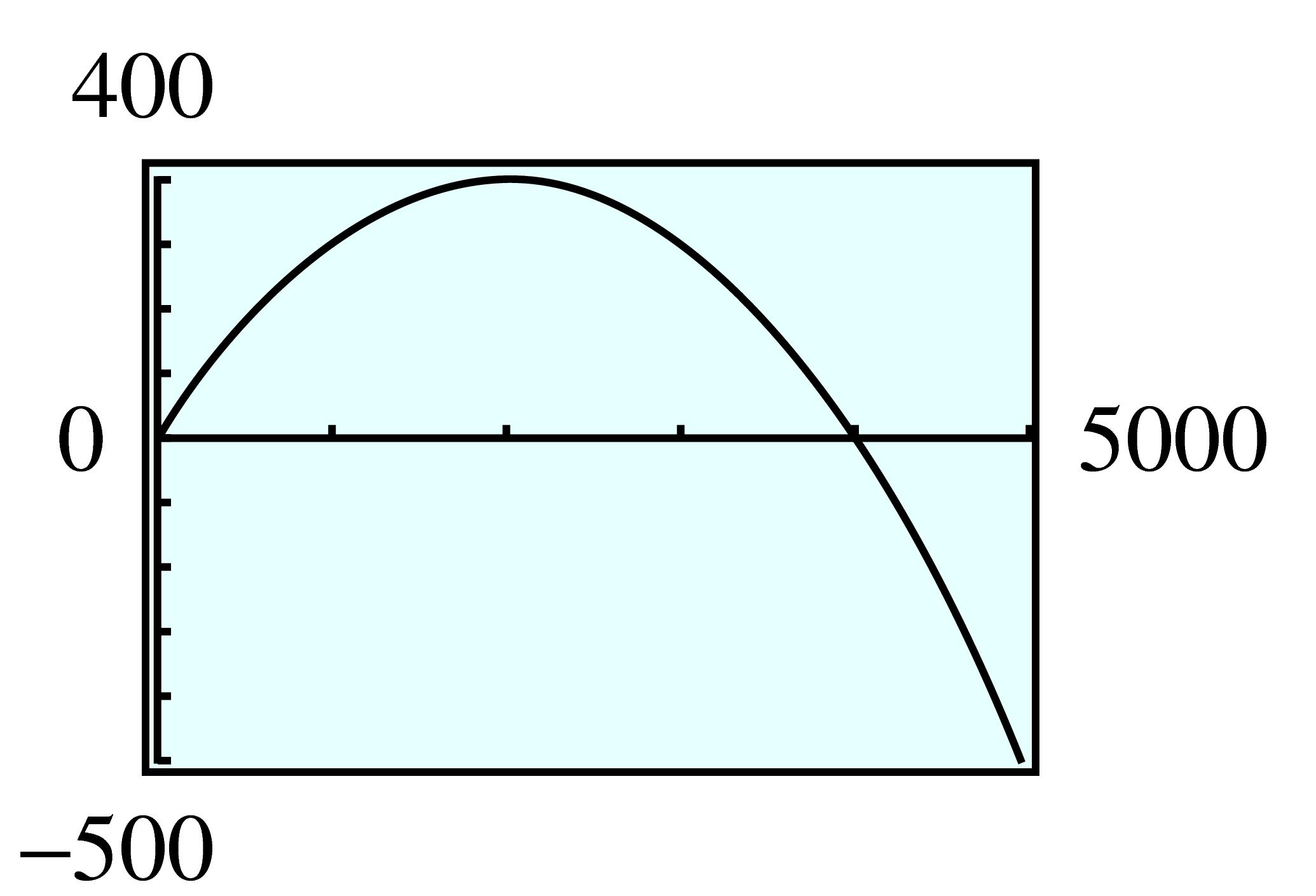
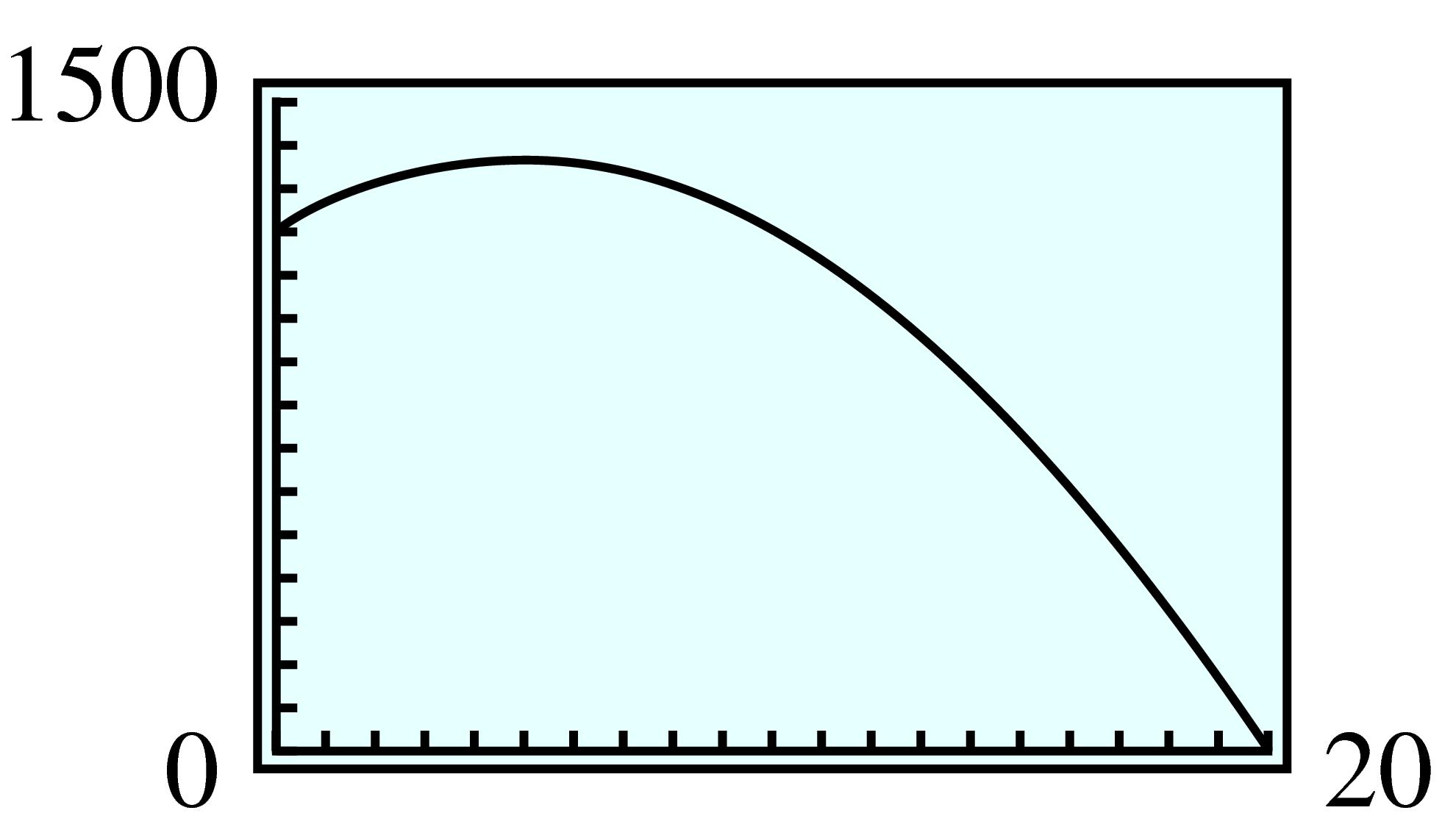
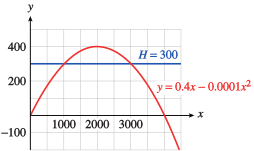
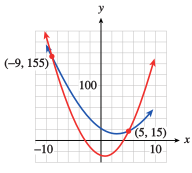
  1. \((2000, 400)\text{;}\) The largest annual increase in biomass, \(400\) tons, occurs when the biomass is \(2000\) tons.
  2. parabola
  3. \(4000 \lt x \le 5000\text{;}\) When there are too many fish, there will not be enough food to support all of them.

11.

Answer.
  1. \(x\) \(~~1~~\) \(~~2~~\) \(~~3~~\) \(~~4~~\) \(~~5~~\)
    \(y\) \(1.6\) \(1.2\) \(0.8\) \(0.4\) \(0\)
    \(A\) \(1.6\) \(2.4\) \(2.4\) \(1.6\) \(0\)
  2. \(A = x(2 - 0.4x)\) or \(A = 2x - 0.4x^2\)
  3. parabola
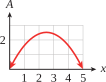
  4. The maximum number of young marmots, on average, is \(2.5\text{;}\) the optimal number of female marmots is \(2.5\text{.}\)

13.

Answer.
  1. parabola
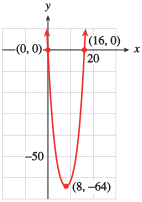
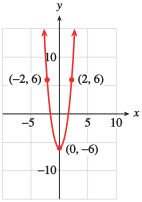
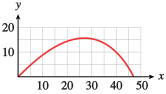
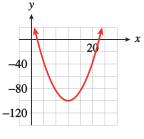
    Vertex: \((-6, -1.5)\text{;}\) Horizontal intercepts \((-12, 0)\) and \((0, 0)\text{.}\) The point \((0, 0)\) means that no distance is required to stop a plane that is not moving.
  2. \(594\) ft/sec

17.

Answer.
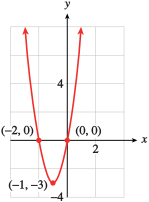
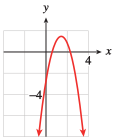
  1. \(x\)-intercepts: \(\left(\frac{-1}{2} , 0\right)\) and \((4, 0)\text{;}\) \(y\)-intercept: \((0, 4)\text{;}\) vertex: \(\left(\frac{7}{4},\frac{81}{8} \right)\)
  2. parabola

25.

Answer.
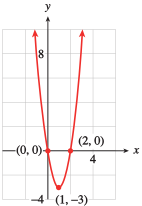
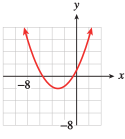
  1. \(x\)-intercepts: \(\left(\dfrac{3\pm\sqrt{3}}{2},0 \right) \text{;}\) \(y\)-intercept: \((0, -3)\text{;}\) vertex: \(\left(\dfrac{3}{2},\dfrac{3}{2} \right) \)
  2. parabola

27.

Answer.
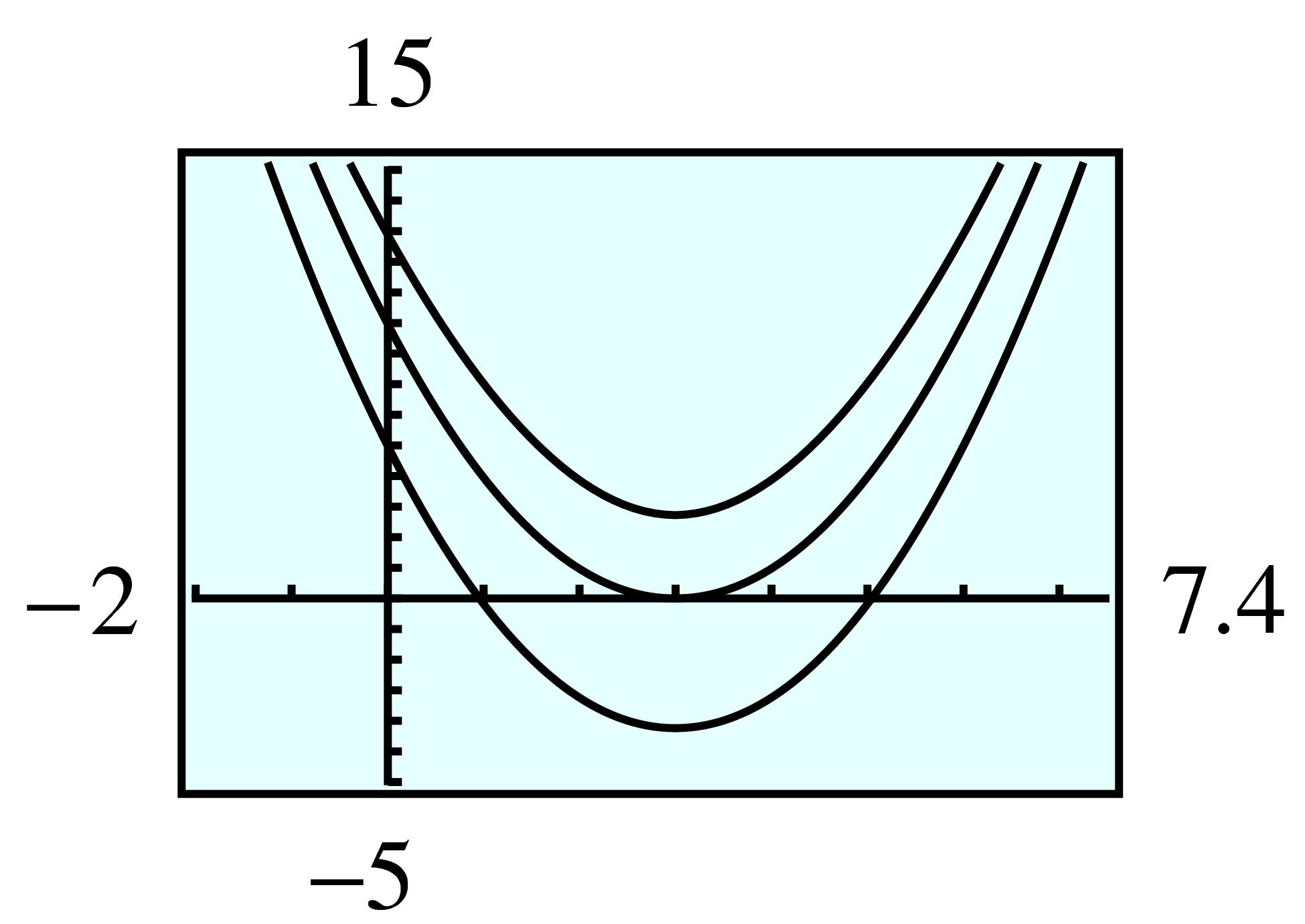
  1. three parabolas
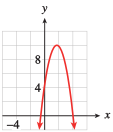
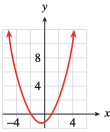
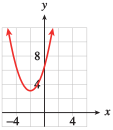
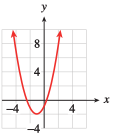
    \(f(x) = x^2 - 6x + 5\text{:}\) \(x\)-intercepts \((1, 0)\) and \((5, 0)\text{;}\) \(g(x) = x^2 - 6x + 9\text{:}\) \(x\)-intercept \((3, 0)\text{;}\) \(h(x) = x^2 - 6x + 12\text{:}\) No \(x\)-intercept.
  2. \(16, 0, -12\text{:}\) \(D = 16\) means that there are two rational \(x\)-intercepts, \(D = 0\) means that there is exactly one \(x\)-intercept, \(D=-12\) means that there is no \(x\)-intercept.

6.4 Problem Solving
Homework 6.4

1.

Answer.
  1. No. of price
    increases
    Price of
    room
    No. of rooms
    rented
    Total
    revenue
    \(0\) \(20\) \(60\) \(1200\)
    \(1\) \(22\) \(57\) \(1254\)
    \(2\) \(24\) \(54\) \(1296\)
    \(3\) \(26\) \(51\) \(1326\)
    \(4\) \(28\) \(48\) \(1344\)
    \(5\) \(30\) \(45\) \(1350\)
    \(6\) \(32\) \(42\) \(1344\)
    \(7\) \(34\) \(39\) \(1326\)
    \(8\) \(36\) \(36\) \(1296\)
    \(10\) \(40\) \(30\) \(1200\)
    \(12\) \(44\) \(24\) \(1056\)
    \(16\) \(52\) \(12\) \(624\)
    \(20\) \(60\) \(0\) \(0\)
  2. Price of a room: \(20 + 2x\text{;}\) Rooms rented: \(60 - 3x\text{;}\) Revenue: \(1200 + 60x - 6x^2\)
  3. \(\displaystyle 20\)
  4. parabola
  5. $\(24;~\) $\(36\)
  6. $\(1350;~\) $\(30;\) \(~45~\)rooms

6.5 Quadratic Inequalities
Homework 6.5

6.6 Curve Fitting
Homework 6.6

5.

Answer.
\(a = 3, b = 1, c = -2\text{.}\) The equation for the parabola is \(y = 3x^2 + x - 2\)

6.7 Chapter Summary and Review
Chapter 6 Review Problems

35.

Answer.
\(A_1\) is the area of a square minus the area of two triangles:
\begin{equation*} x^2-2\left(\dfrac{1}{2}y\cdot y \right)=x^2-y^2 \end{equation*}

7 Polynomial and Rational Functions
7.1 Polynomial Functions
Homework 7.1

19.

Answer.
\(\begin{aligned}[t] (x + y)^3 \amp = (x + y)(x + y)^2\\ \amp = (x + y)(x^2 + 2xy + y^2) \\ \amp = x^3 + 2x^2 y + xy^2 + x^2 y + 2xy^2 + y^3\\ \amp = x^3 + 3x^2 y + 3xy^2 + y^3 \end{aligned}\)

21.

Answer.
\(\begin{aligned}[t] (x + y)(x^2 - xy + y^2) \amp = x^3 -x^2 y + xy^2 + x^2 y -xy^2 + y^3\\ \amp = x^3 + y^3 \end{aligned}\)

23.

Answer.
  1. The formula begins with \(x^3\) and ends with \(y^3\text{.}\) As you proceed from term to term, the exponents on \(x\) decrease while the exponents on \(y\) increase, and on each term the sum of the exponents is \(3\text{.}\) The coefficients of the two middle terms are both \(3\text{.}\)
  2. The formula is the same as for \((x - y)^3\text{,}\) except that the terms alternate in sign.

7.2 Graphing Polynomial Functions
Homework 7.2

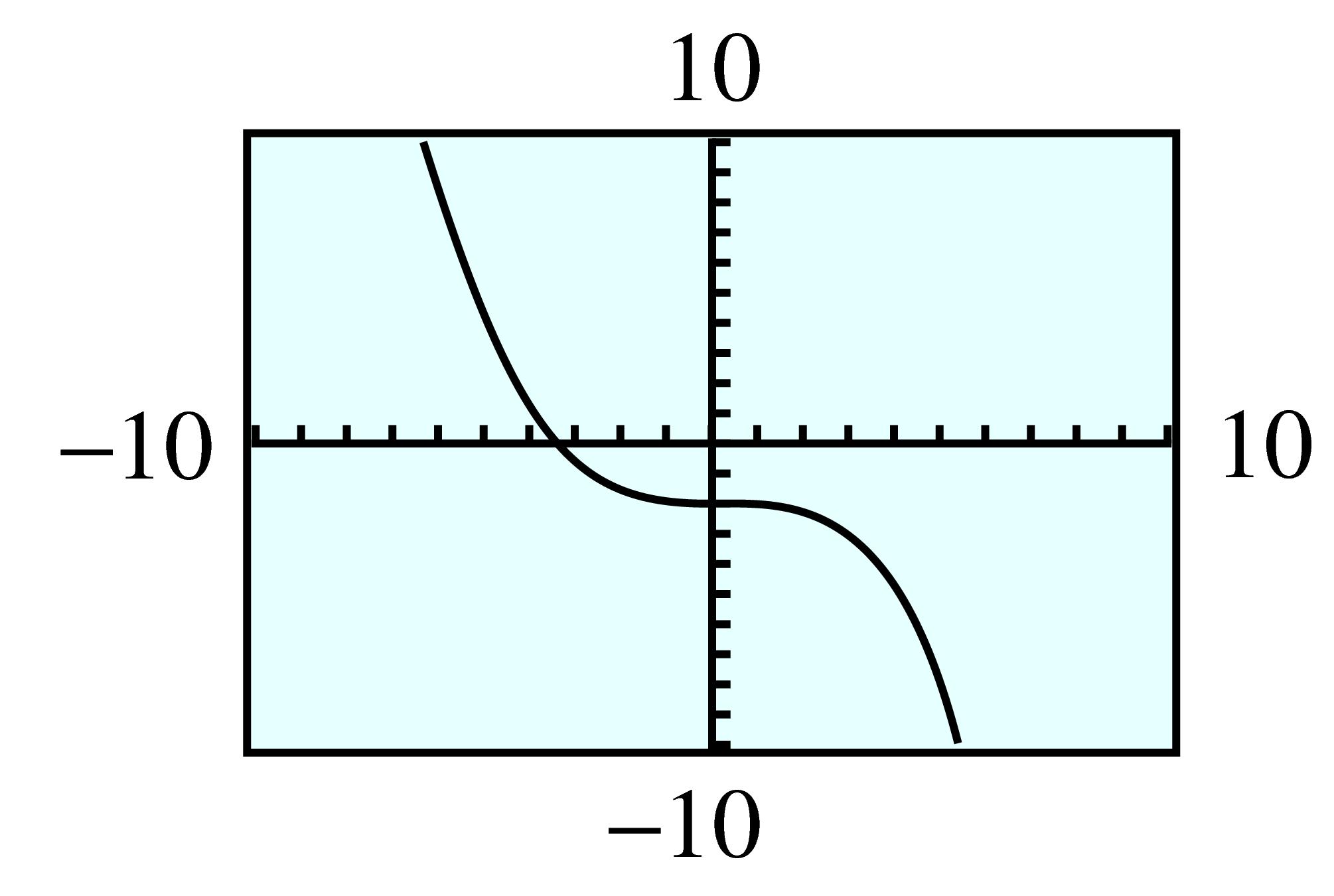
3.

Answer.
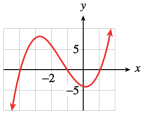
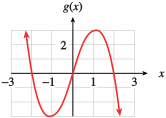
cubic
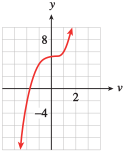
  1. The end behavior is the opposite to the basic cubic (the graph starts in the upper left and extends to the lower right) because the lead coefficient is negative.
  2. There is one \(x\)-intercept, no turning points, one inflection point.

13.

Answer.
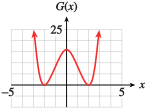
quartic
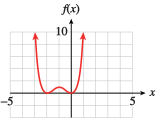
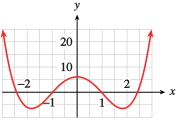
  1. The end behavior is the opposite of the basic quartic (the graph starts in the lower left and ends in the lower right) because the lead coefficient is negative.
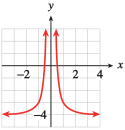
  2. There are no \(x\)-intercepts, three turning points, two inflection points.

17.

Answer.
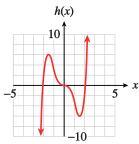
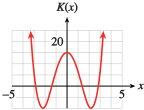
quartic
  1. The end behavior is the opposite of the basic quartic (the graph starts in the lower left and ends in the lower right) because the lead coefficient is negative.
  2. There are no \(x\)-intercepts, one turning point, two inflection points.

19.

Answer.
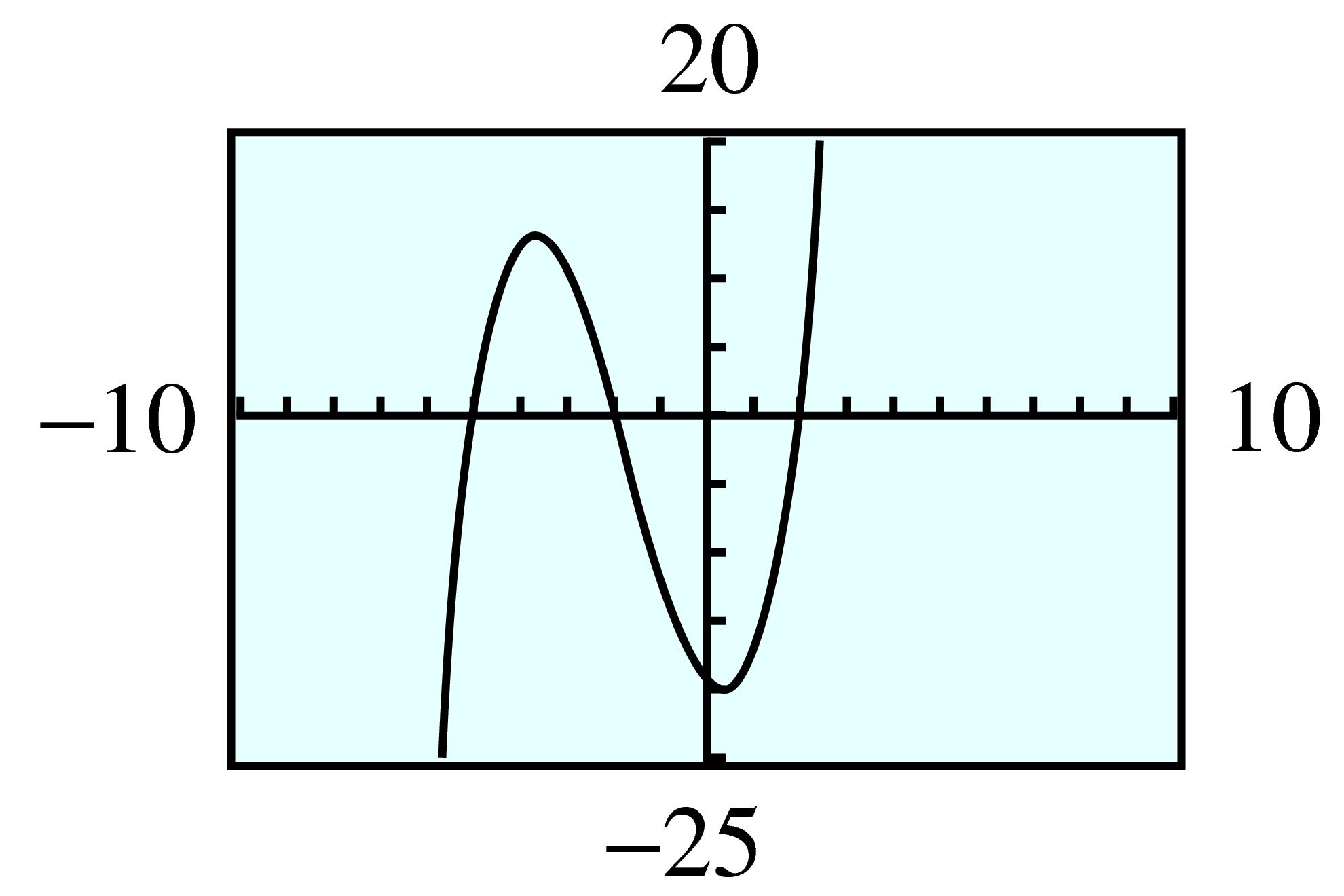
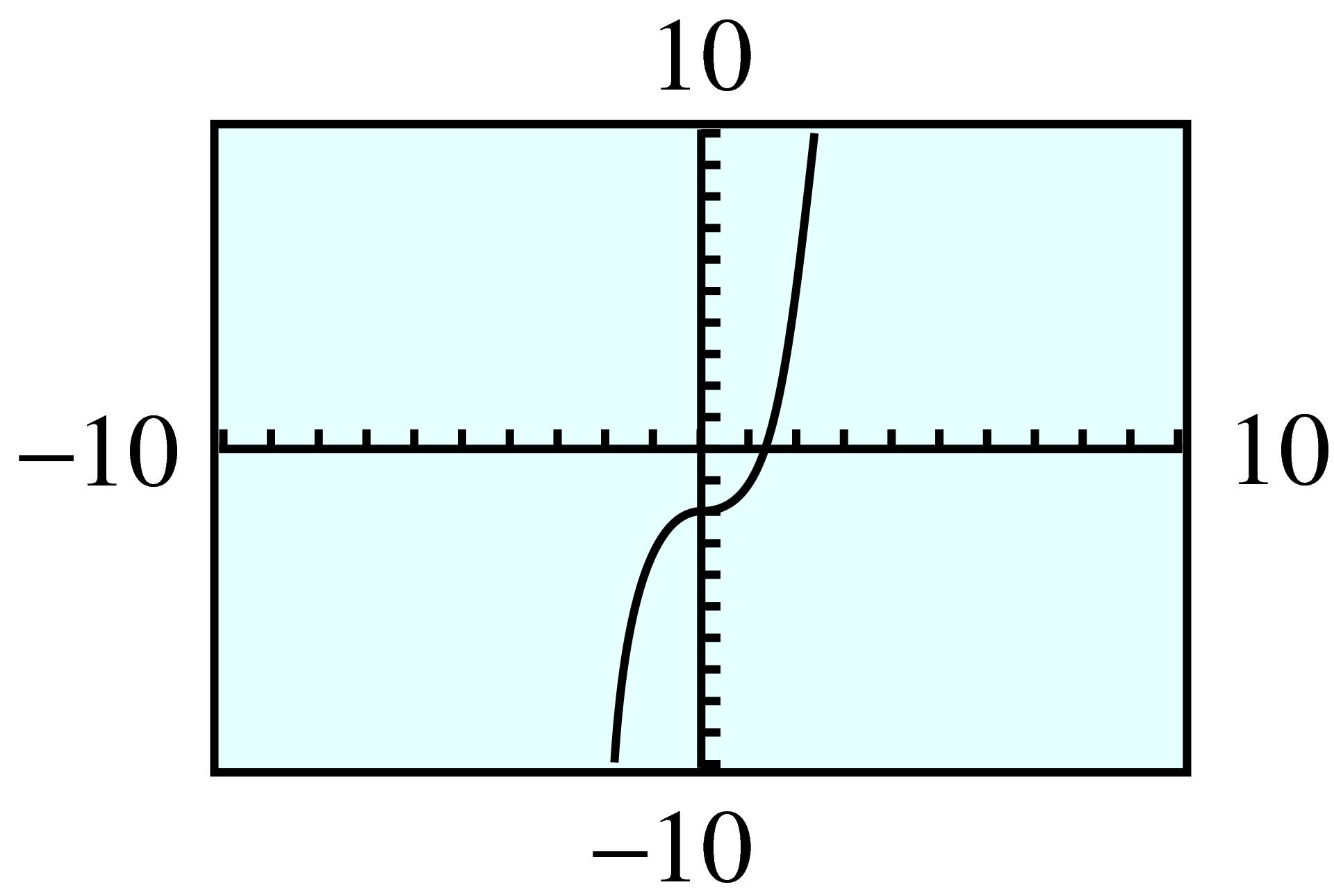
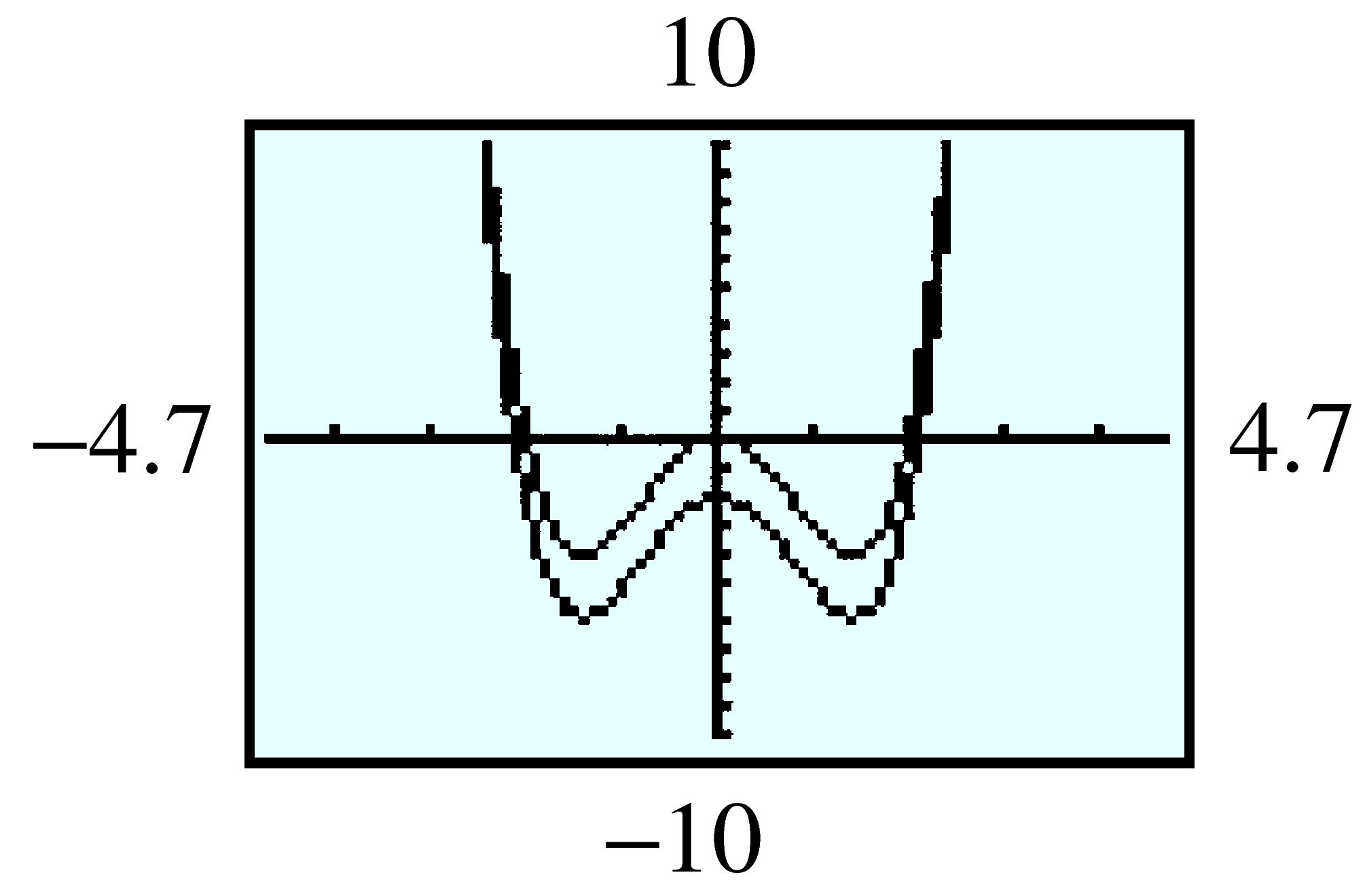
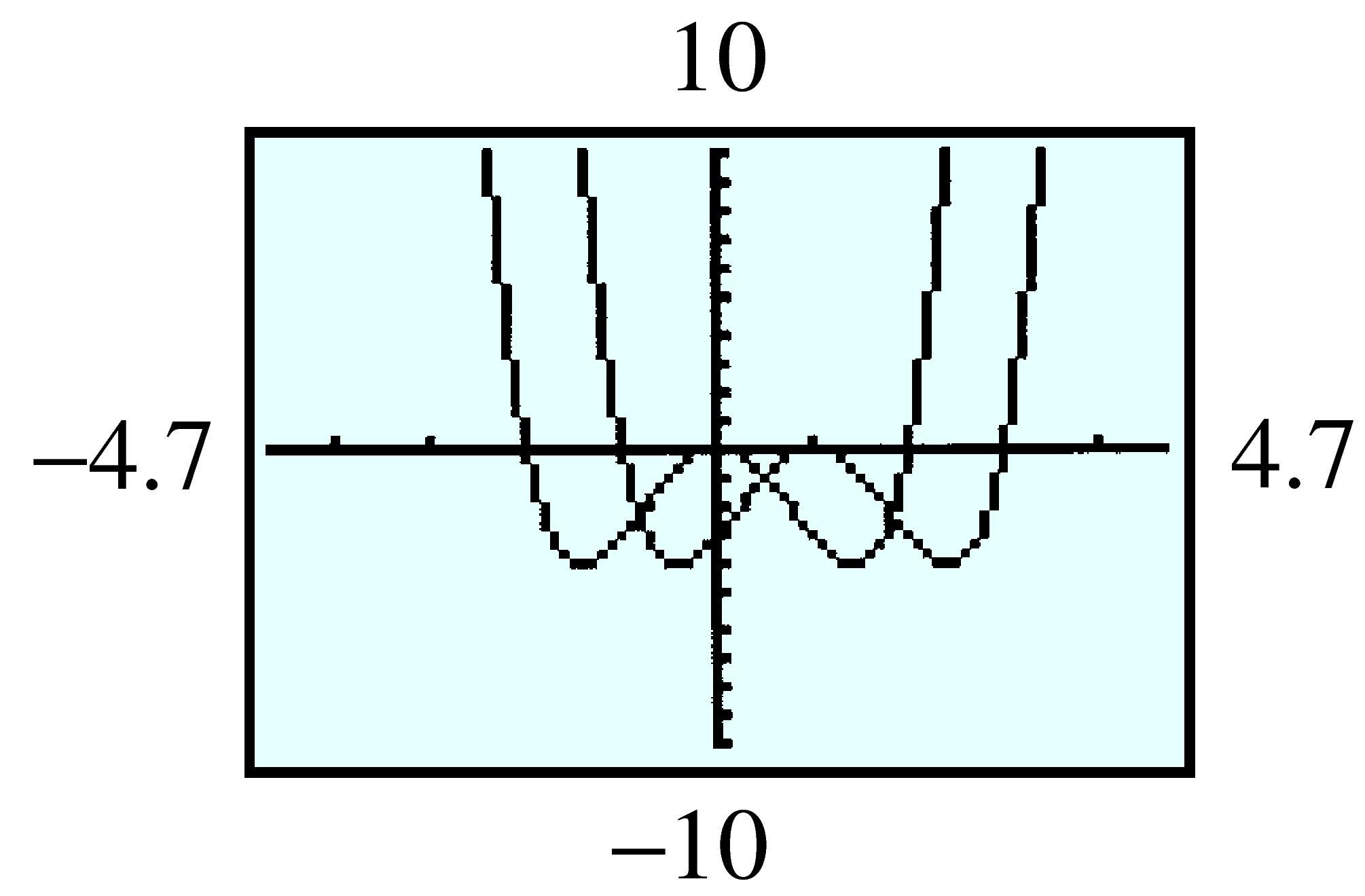
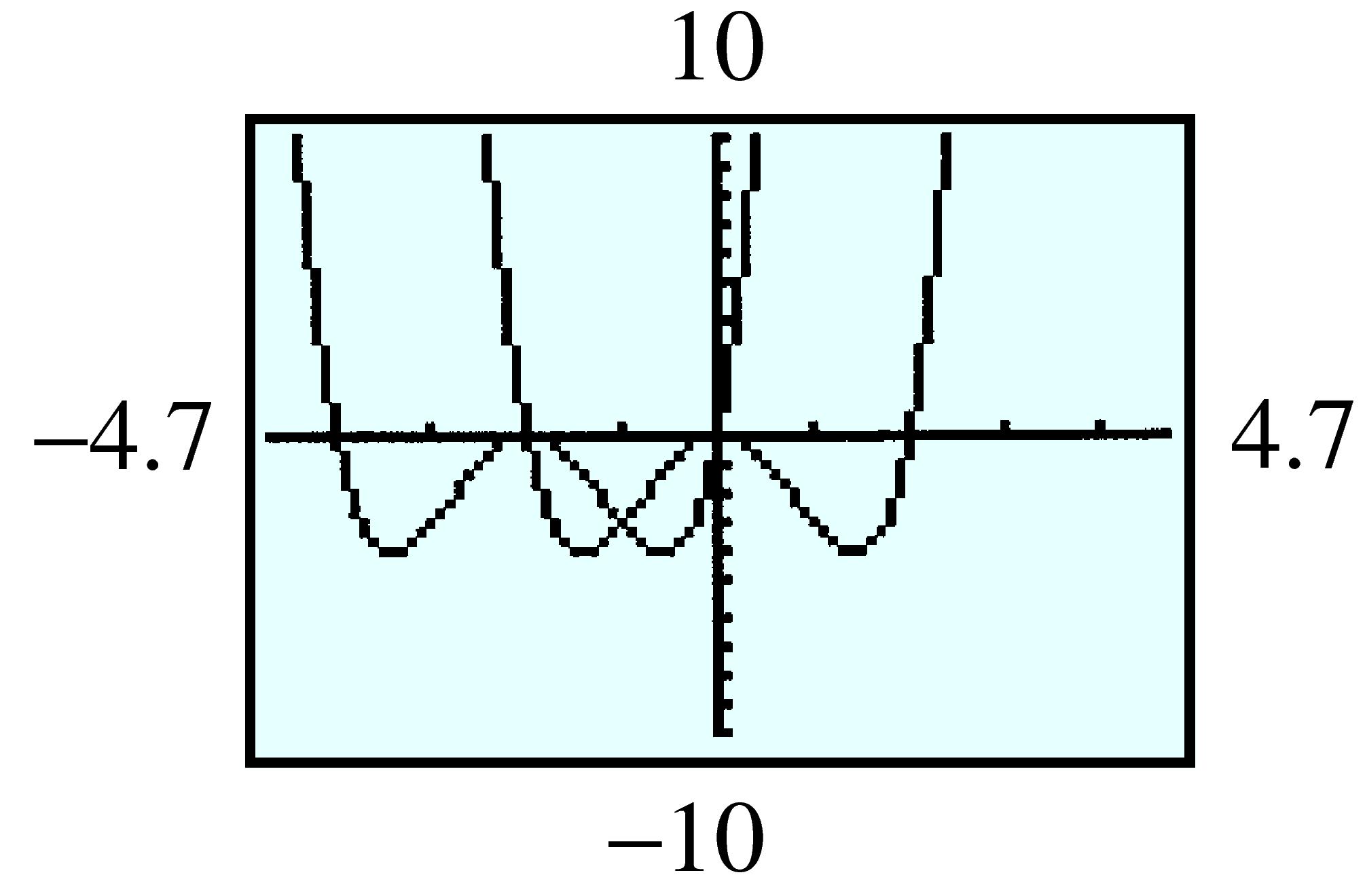
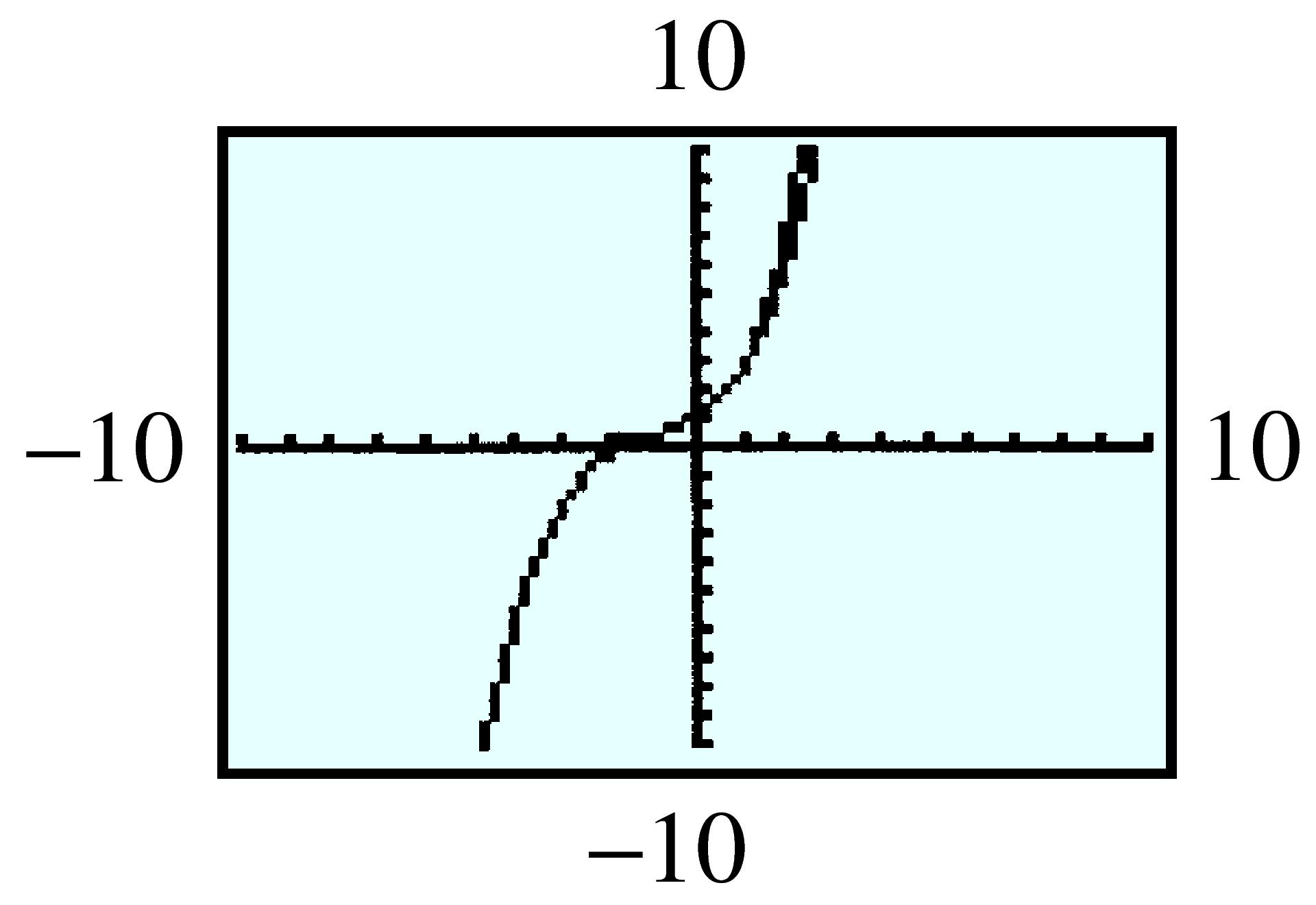
The graph of a cubic polynomial with a positive lead coefficient will have the same end behavior as the basic cubic, and a cubic with a negative lead coefficient will have the opposite end behavior. Each graph of a cubic polynomial has one, two, or three \(x\)-intercepts, it has two, one or no turning point, and it has exactly one inflection point.

53.

Answer.
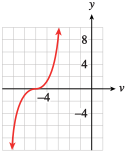
  1. \(y = x^3 - 4x + 3\text{;}\) The graph of \(y = f (x)\) shifted \(3\) units up.
    cubics
  2. \(y = x^3 - 4x -5\text{;}\) The graph of \(y = f (x)\) shifted \(5\) units down.
    cubics
  3. \(y = (x - 2)^3 - 4(x - 2)\text{;}\) The graph of \(y = f (x)\) shifted \(2\) units right.
    cubics
  4. \(y = (x +3)^3 - 4(x +3)\text{;}\) The graph of \(y = f (x)\) shifted \(3\) units left.
    cubics

55.

Answer.
  1. \(y = x^4 - 4x^2 + 6\text{;}\) The graph of \(y = f (x)\) shifted \(6\) units up.
    quartics
  2. \(y = x^4 - 4x^2 - 2\text{;}\) The graph of \(y = f (x)\) shifted \(2\) units down.
    quartics
  3. \(y = (x - 1)^4 - 4(x - 1)^2\text{;}\) The graph of \(y = f (x)\) shifted \(1\) unit right.
    quartics
  4. \(y = (x +2)^4 - 4(x +2)^2\text{;}\) The graph of \(y = f (x)\) shifted \(2\) units left.
    quartics

61.

Answer.
  1. If \(P(x)\) is a nonconstant polynomial with real coefficients and \(a\) is any real number, then there exist unique polynomials \(q(x)\) and \(r (x)\) such that
    \begin{equation*} P(x) = (x - a)q(x) + r (x) \end{equation*}
    where \(\text{deg }r (x)\lt \text{deg }(x - a)\text{.}\)
  2. \(P(a) = (a - a)q(a) + r (a) = r (a)\text{.}\) Because \(\text{deg }r(x) = 0 \text{,}\) \(r(x) \) is a constant. That constant value is \(P(a) \text{,}\) so \(P(x) = (x - a)q(x) + P(a)\text{.}\)

63.

Answer.
  1. From the remainder theorem, \(\begin{aligned}[t] P(x) \amp = (x - a)Q(x) + P(a)\\ \amp = (x - a)Q(x) + 0\\ \amp =(x - a)Q(x) \end{aligned}\)
  2. By definition of a factor, if \(x-a\) is a factor of \(P(x) \text{,}\) then \(P(x) = (x - a)q(x)\text{,}\) so \(P(x) =(x - a)q(x) + 0\text{.}\) The uniqueness guaranteed in the remainder theorem tells us that \(P(a) = 0\text{.}\)

69.

Answer.
  1. About \(-1\lt x \lt 2\)
    cubic on exponential
  2. \(x\) \(-1\) \(-0.5\) \(0\) \(0.5\) \(1\) \(1.5\) \(2\)
    \(f(x) \) \(0.368 \) \(0.607 \) \(1 \) \(1.649 \) \(2.718 \) \(4.482 \) \(7.389 \)
    \(p(x) \) \(0.333\) \(0.604\) \(1\) \(1.646\) \(2.667\) \(4.188\) \(6.333\)
  3. \(\displaystyle 0.122\)
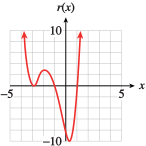
  4. quintic on exponential
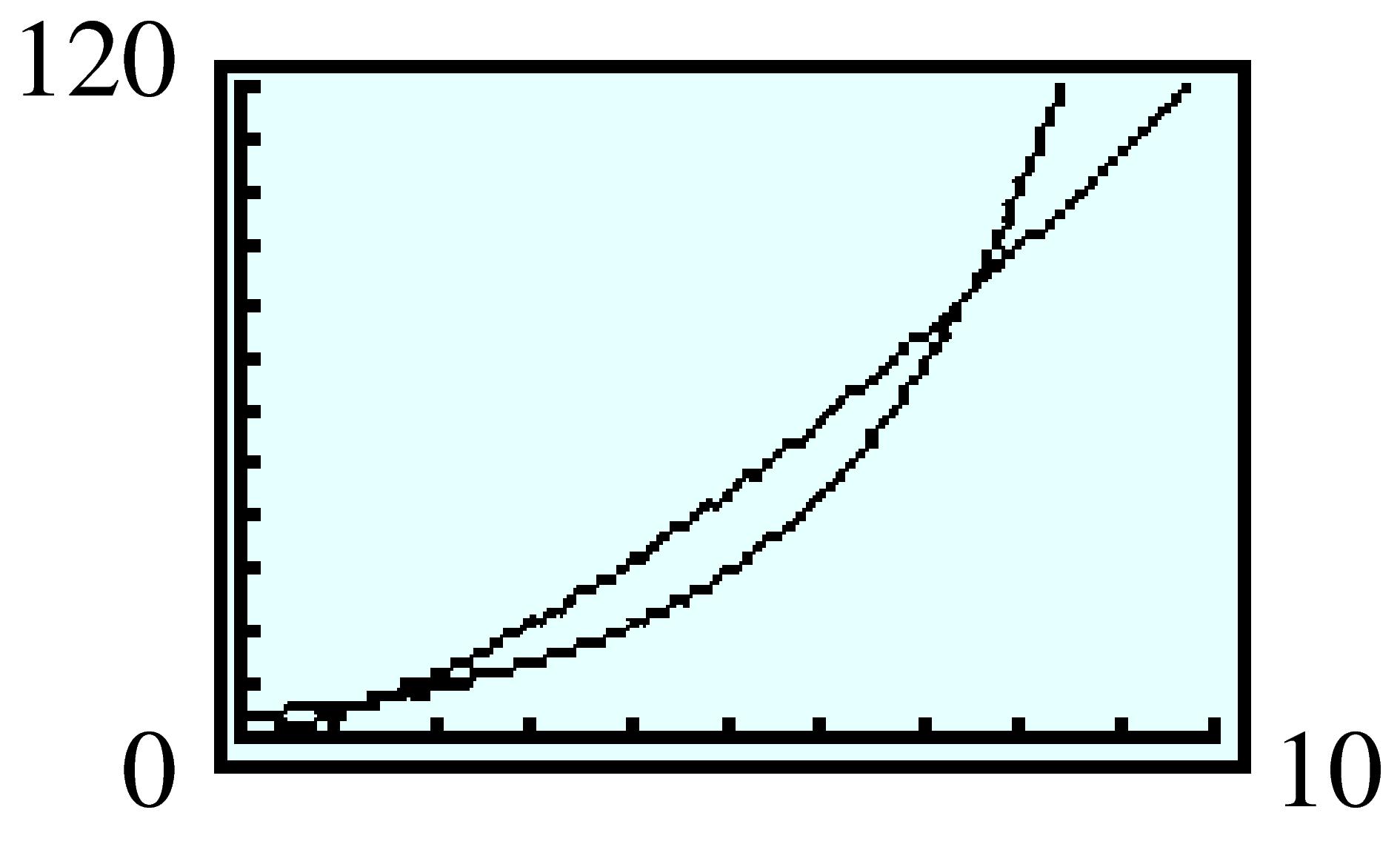
    The error is relatively small for values of \(x\) between \(-3\) and \(2.5\text{.}\)

7.3 Complex Numbers
Homework 7.3

63.

Answer.
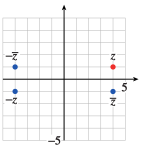
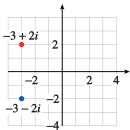
complex conjugates
The complex conjugates are reflections of each other across the real axis.

65.

Answer.
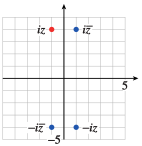
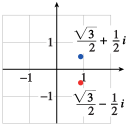
complex conjugates
The complex conjugates are reflections of each other across the real axis.

7.4 Graphing Rational Functions
Homework 7.4

1.

Answer.
  1. \(\displaystyle t=\dfrac{150}{50-v} \)
  2. \(v\) \(0\) \(5\) \(10\) \(15\) \(20\) \(25\) \(30\) \(35\) \(40\) \(45\) \(50\)
    \(t\) \(3\) \(3.33\) \(3.75 \) \(4.29 \) \(5 \) \(6 \) \(7.5 \) \(10 \) \(15 \) \(30 \) β€”
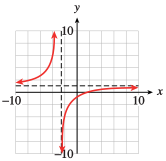
    The travel time increases as the headwind speed increases.
  3. rational function

9.

Answer.
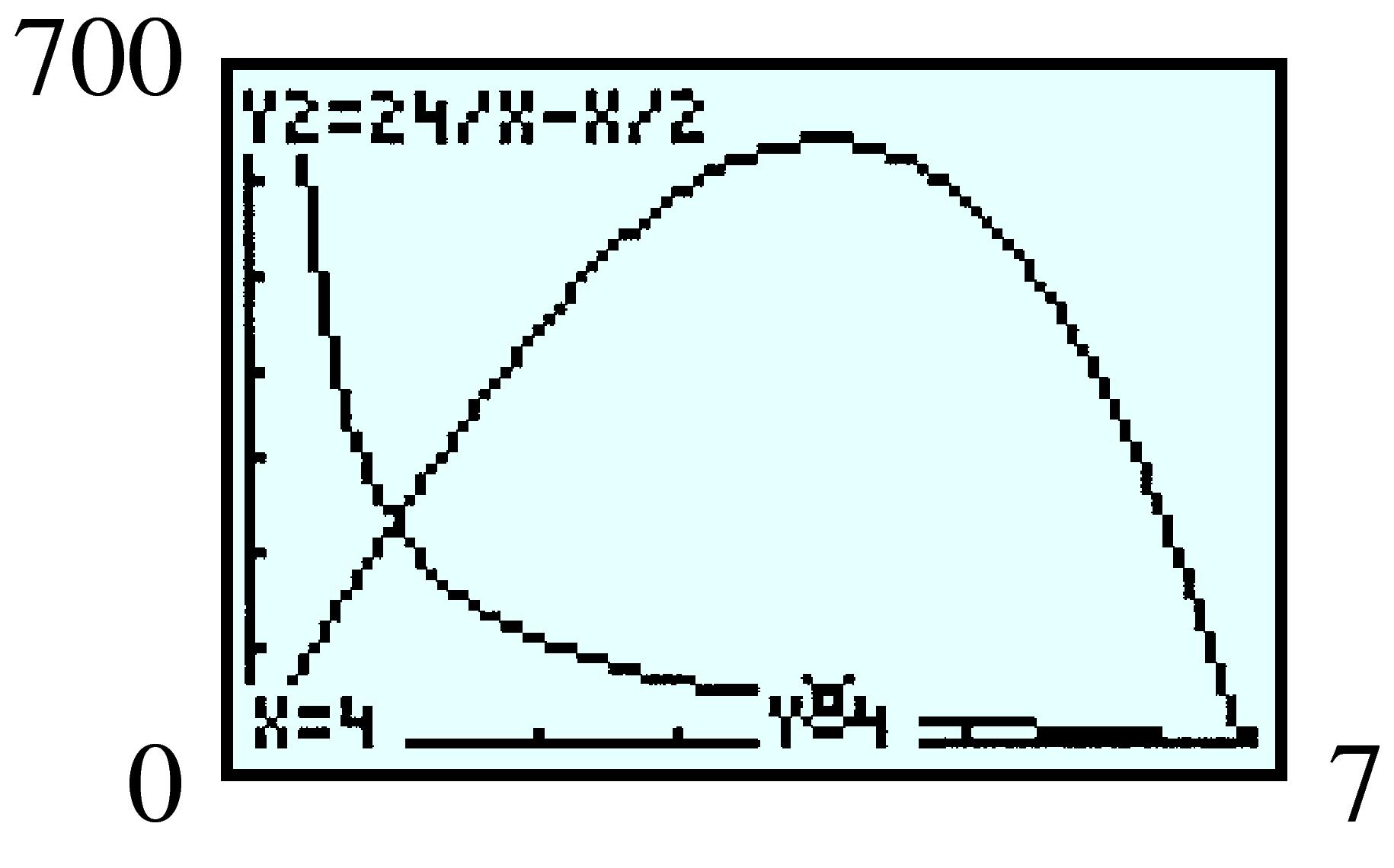
  1. The surface area is \(2x^2 + 4xh = 96\text{.}\) Solving for \(h\text{,}\) \(h=\dfrac{96-2x^2}{4x}=\dfrac{24}{x}-\dfrac{x}{2} \text{.}\)
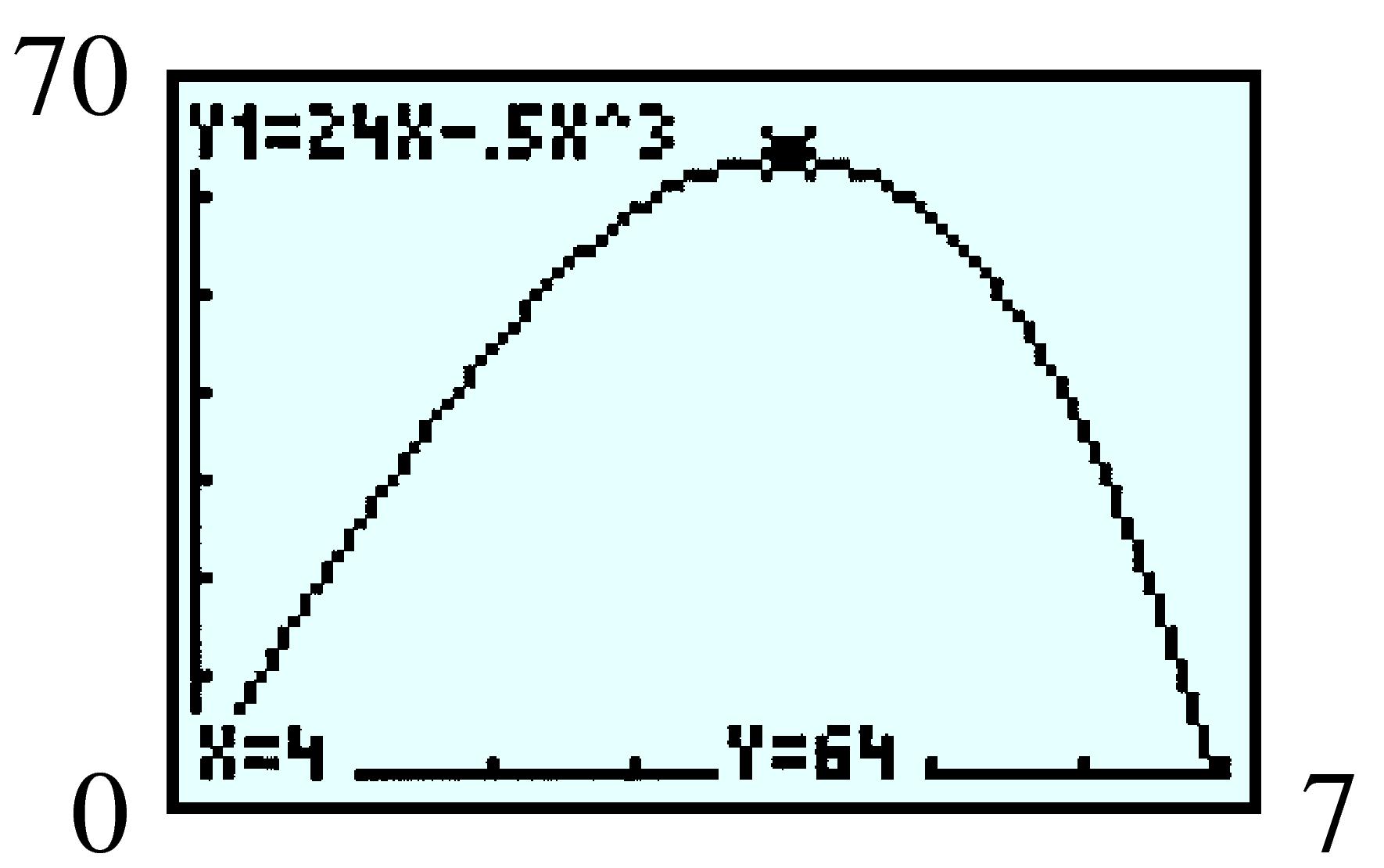
  2. \(\displaystyle V=24x-\dfrac{1}{2}x^3\)
  3. \(x\) \(1\) \(2\) \(3\) \(4\) \(5\) \(6\) \(7\)
    \(h\) \(23.5 \) \(11 \) \(6.5 \) \(4\) \(2.3 \) \(1 \) \(-0.07 \)
    \(V\) \(23.5 \) \(44 \) \(58.5 \) \(64 \) \(57.5 \) \(36\) \(-3.5 \)
    If the base is more than \(7\) cm, the top and bottom alone exceed the total area allowed.
  4. cubic function
    Maximum of \(64\) cu. cm
  5. \(4\) cm
  6. \(h=4\) cm
    cubic and rational

11.

Answer.
  1. \(v\) \(-100\) \(-75\) \(-50\) \(-25\) \(0\) \(25\) \(50\) \(75\) \(100\)
    \(P\) \(338.15 \) \(358.92 \) \(382.41 \) \(409.19 \) \(440 \) \(475.83 \) \(518.01 \) \(568.4 \) \(629.66 \)
  2. rational function
  3. \(-20\) m/sec; \(68\) m/sec
  4. \(v \gt 12\) m/sec
  5. \(v=332\text{;}\) As \(v\) approaches \(332\) m per sec, the pitch increases without bound.

45.

Answer.
  1. \(\dfrac{1}{y}=\dfrac{1}{x}+\dfrac{1}{k}=\dfrac{k+x}{xk}\text{,}\) so by taking reciprocals, \(y=\dfrac{kx}{x+k} \text{.}\)
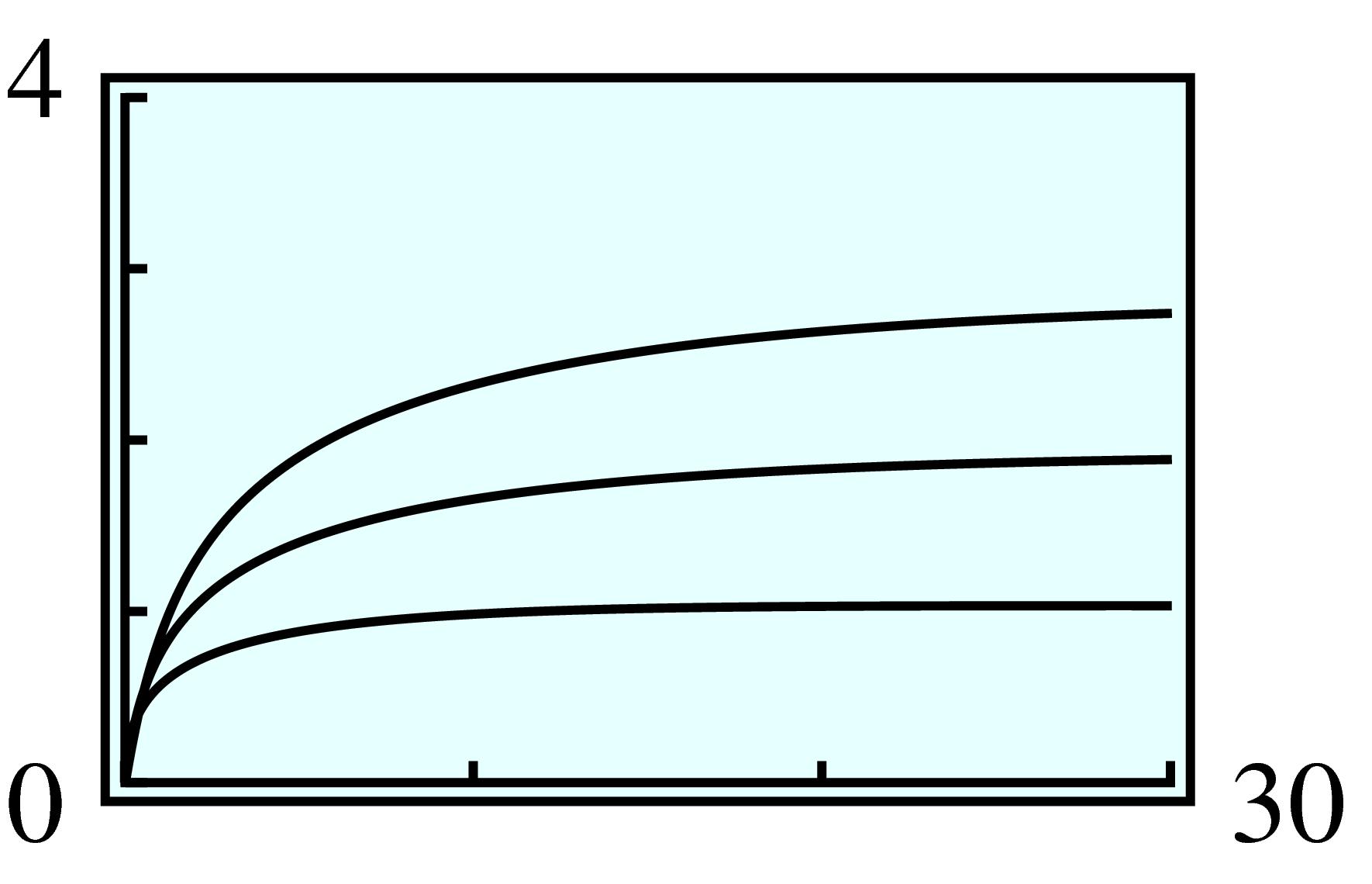
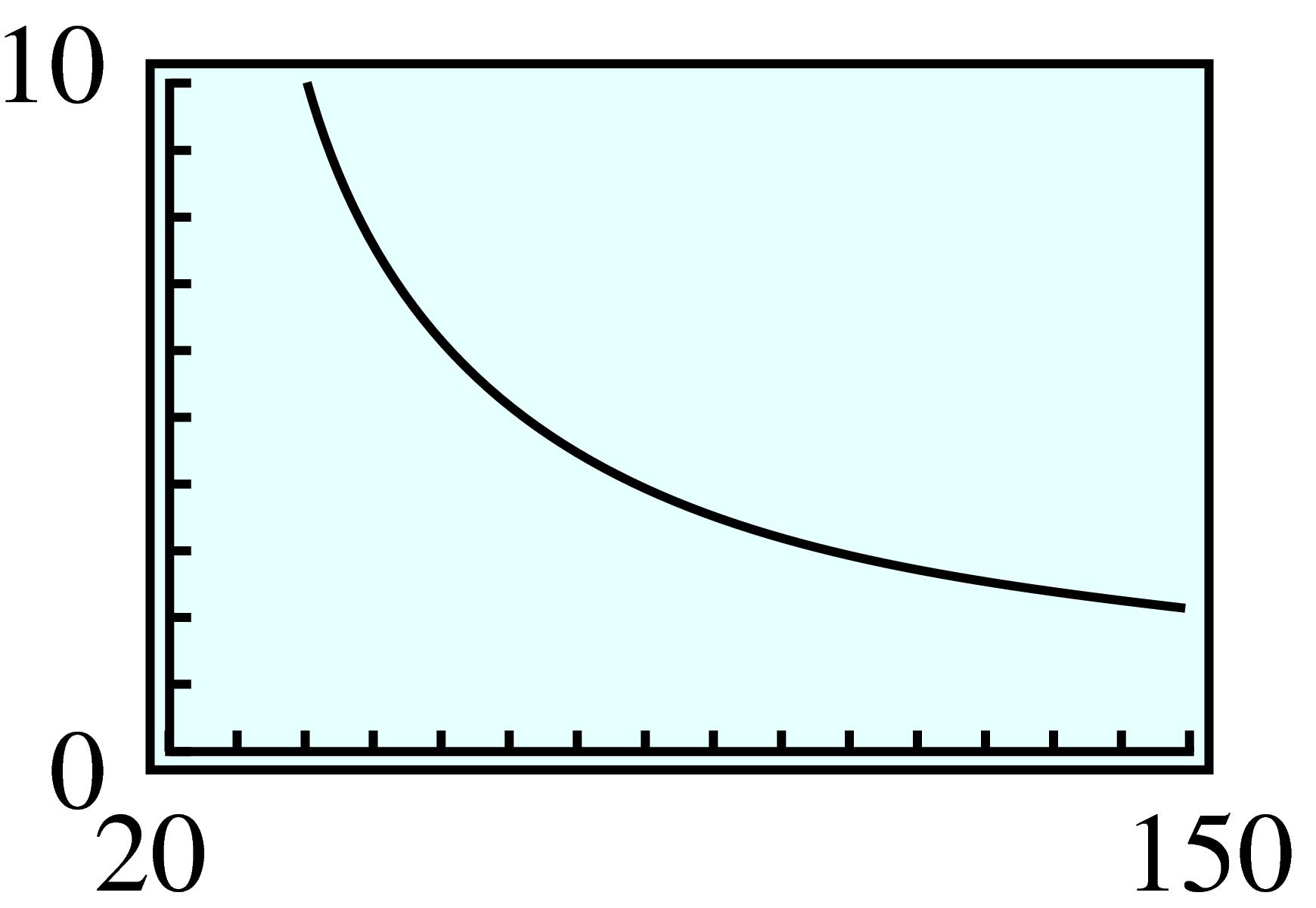
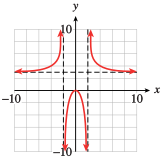
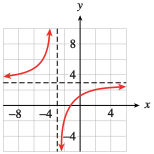
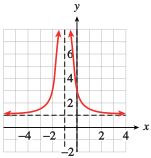
  2. three rational functions
    The graphs increase from the origin and approach a horizontal asymptote at \(y=k\text{.}\)

51.

Answer.
  1. \(\dfrac{1}{v}=\dfrac{K}{V}\cdot\dfrac{1}{s} +\dfrac{1}{V}\text{;}\) Therefore, \(a=\dfrac{K}{V} \) and \(b=\dfrac{1}{V} \)
  2. \(\frac{1}{s}\) \(3\) \(1.5\) \(1\) \(0.6\) \(0.4\) \(0.3\) \(0.15\)
    \(\frac{1}{v} \) \(12.5\) \(7.1\) \(5\) \(3.3\) \(2.6\) \(2.2\) \(1.7\)
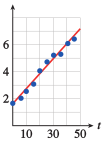
  3. linear fit on data points
    \(\displaystyle \dfrac{1}{v}=3.8\cdot \dfrac{1}{s}+1.1 \)
  4. \(\displaystyle V\approx 0.89, ~K\approx 3.37\)

7.5 Equations That Include Algebraic Fractions
Homework 7.5

23.

Answer.
Multiply both sides of the equation by \(bd\) and simplify.
\begin{equation*} \frac{a}{b}\cdot \frac{bc}{1} = \frac{c}{d} \cdot \frac{bc}{1}, \text{ so } ac=bd \end{equation*}

7.6 Chapter Summary and Review
Chapter 7 Review Problems

8 Linear Systems
8.1 Systems of Linear Equations in Two Variables
Homework 8.1

8.2 Systems of Linear Equations in Three Variables
Homework 8.2

35.

Answer.
\(0.3\) cup carrots, \(0.4\) cup green beans, \(0.3\) cup cauliflower

8.3 Solving Linear Systems Using Matrices
Homework 8.3

1.

Answer.
\(\left[ \begin{array}{@{}cc|c@{}} -2 \amp 1 \amp 0 \\ -9 \amp 3 \amp -6 \end{array}\right] \)

3.

Answer.
\(\left[ \begin{array}{@{}cc|c@{}} 1 \amp 3 \amp 6 \\ 0 \amp -2 \amp 11 \end{array}\right] \)

5.

Answer.
\(\left[ \begin{array}{@{}ccc|c@{}} 1 \amp 0 \amp -2 \amp 5 \\ 2 \amp 6 \amp -1 \amp 3 \\ 0 \amp -3 \amp 2 \amp -3 \end{array}\right] \)

7.

Answer.
\(\left[ \begin{array}{@{}ccc|c@{}} 1 \amp 2 \amp 1 \amp -5 \\ 0 \amp 4 \amp -2 \amp 3 \\ 0 \amp -9 \amp 2 \amp 12 \end{array}\right] \)

9.

Answer.
\(\left[ \begin{array}{@{}cc|c@{}} 1 \amp -3 \amp 2 \\ 0 \amp 7 \amp 0 \end{array}\right] \)

11.

Answer.
\(\left[ \begin{array}{@{}cc|c@{}} 2 \amp 6 \amp -4 \\ 4 \amp 0 \amp 3 \\ \end{array}\right] \)

13.

Answer.
\(\left[ \begin{array}{@{}ccc|c@{}} 1 \amp -2 \amp 2 \amp 1 \\ 0 \amp 7 \amp -5 \amp 4 \\ 0 \amp 9 \amp -11 \amp -1 \end{array}\right] \)

15.

Answer.
\(\left[ \begin{array}{@{}ccc|c@{}} -1 \amp 4 \amp 3 \amp 2 \\ 3 \amp 0 \amp -5 \amp 14 \\ -3 \amp 0 \amp -3 \amp 8 \end{array}\right] \)

17.

Answer.
\(\left[ \begin{array}{@{}ccc|c@{}} -2 \amp 1 \amp -3 \amp -2 \\ 0 \amp 4 \amp -6 \amp -2 \\ 0 \amp 0 \amp -4 \amp -5 \end{array}\right] \)

37.

Answer.
\(\left(\dfrac{5}{3},\dfrac{4}{3},\dfrac{-1}{2},\dfrac{-2}{3} \right) \)

8.4 Linear Inequalities
Homework 8.4

8.5 Linear Programming
Homework 8.5

1.

Answer.
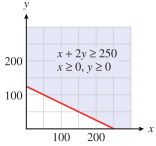
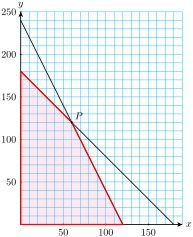
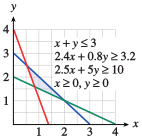
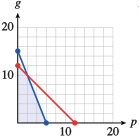
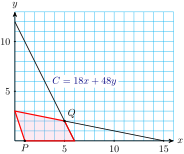
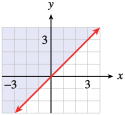
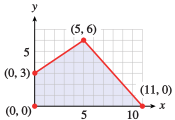
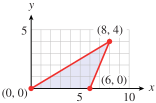
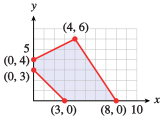
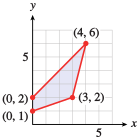
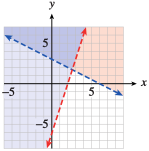
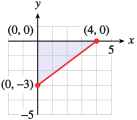
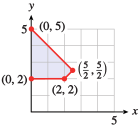
The graph of \(12 = 3x + 4y\) does not intersect the set of feasible solutions.

13.

Answer.
b. \((0,0) \text{;}\) \(0\hphantom{000}\)c. \((3,2) \text{;}\) \(13\)

15.

Answer.
b. \((0,14) \text{;}\) \(-14\hphantom{000}\)c. \((0,0) \text{;}\) \(30\)

17.

Answer.
b. \((0,8) \text{;}\) \(-160\hphantom{000}\)c. \((8,0) \text{;}\) \(1600\)

8.6 Chapter Summary and Review
Chapter 8 Review Problems

9 Sequences and Series
9.1 Sequences
Homework 9.1

45.

Answer.
  1. \(\displaystyle 1, 1, 2, 3, 5, 8, 13, 21, 34, 55, 89, 144, 233, 377, 610, 987\)
  2. \(1, 2, 1.5, 1.\overline{6}, 1.6, 1.625, 1.615, 1.619, 1.618, 1.618, 1.618, 1.618, 1.618,\)
    \(1.618, 1.618.\)
    The quotients approach a limit near \(1.618\text{.}\)
    \(\dfrac{1+\sqrt{5}}{2} \approx 1.618033989\text{,}\) the same as the limit above.

49.

Answer.
\(c_n\) approaches \(0.64039\text{,}\) or \(\dfrac{1+\sqrt{17}}{8}\)

9.2 Arithmetic and Geometric Sequences
Homework 9.2

29.

Answer.
\(\dfrac{16}{3}, \dfrac{32}{3}, \dfrac{64}{3}, \cdots, \dfrac{2}{3}(2)^{n-1}\)

31.

Answer.
\(\dfrac{-1}{2}, \dfrac{1}{4}, \dfrac{-1}{8}, \cdots, 4(\dfrac{-1}{2})^{n-1}\)

9.3 Series
Homework 9.3

9.4 Infinite Geometric Series
Homework 9.4

7.

Answer.
\(\dfrac{-1}{2}+\dfrac{1}{2^2}-\dfrac{1}{2^3}+\dfrac{1}{2^4}\)

9.5 The Binomial Expansion
Homework 9.5

5.

Answer.
11 rows
\(n=0\) \(\hphantom{0000}\) \(1\)
\(n=1\) \(1\hphantom{000}1\)
\(n=2\) \(1\hphantom{000}2\hphantom{000}1\)
\(n=3\) \(1\hphantom {000}3\hphantom{000} 3 \hphantom{000}1\)
\(n=4\) \(1\hphantom {000}4\hphantom{000} 6 \hphantom{000}4\hphantom{000}1\)
\(n=5\) \(1\hphantom {000} 5\hphantom{ii0} 10 \hphantom{00}10 \hphantom{0ii}5 \hphantom{000}1\)
\(n=6\) \(1\hphantom {000} 6\hphantom{ii0} 15 \hphantom{00}20 \hphantom{0ii}15 \hphantom{000} 6\hphantom{ii0}1\)
\(n=7\) \(1\hphantom {000} 7\hphantom{ii0} 21 \hphantom{00}35 \hphantom{0ii}35 \hphantom{000} 21 \hphantom{00} 7\hphantom{ii0}1\)
\(n=8\) \(1\hphantom {000} 8\hphantom{ii0} 28 \hphantom{00}56 \hphantom{0ii}70 \hphantom{ii0} 56 \hphantom{00}28 \hphantom{000} 8\hphantom{ii0}1\)
\(n=9\) \(1\hphantom {000} 9\hphantom{ii0} 36 \hphantom{00}84 \hphantom{0ii}126 \hphantom{000} 126 \hphantom{000} 84 \hphantom{00} 36 \hphantom{0ii} 9 \hphantom{ii0}1\)
\(n=10\) \(1\hphantom {000} 10\hphantom{ii0} 45 \hphantom{00} 120 \hphantom{0ii}210 \hphantom{000} 252 \hphantom{ii0} 210 \hphantom{ii0} 120\hphantom{ii0} 45 \hphantom{00} 10 \hphantom{0ii} 1\)

13.

Answer.
\(x^{14} - 21x^{12} + 189x^{10} - 945x^8 + 2835x^6 - 5103x^4 + 5103x^2 -2187\)

23.

Answer.
  1. \(\displaystyle 5\cdot 4\cdot 3\cdot 2\cdot 1 = 120\)
  2. \(\displaystyle \dfrac{9\cdot 8\cdot 7\cdot 6\cdot 5\cdot 4\cdot 3\cdot 2\cdot 1}{7\cdot 6\cdot 5\cdot 4\cdot 3\cdot 2\cdot 1} = 72\)
  3. \(\displaystyle \dfrac{(5\cdot 4\cdot 3\cdot 2\cdot 1)(7\cdot 6\cdot 5\cdot 4\cdot 3\cdot 2\cdot 1)}{12\cdot 11\cdot 10\cdot 9\cdot 8\cdot 7\cdot 6\cdot 5\cdot 4\cdot 3\cdot 2\cdot 1} = \dfrac{1}{792}\)
  4. \(\displaystyle \dfrac{8\cdot 7\cdot 6\cdot 5\cdot 4\cdot 3\cdot 2\cdot 1}{(2\cdot 1)(6\cdot 5\cdot 4\cdot 3\cdot 2\cdot 1)} = 28\)

43.

Answer.
\(1,~11,~121,~1331,~14641.~~\) The digits of the terms in the sequence correspond to the numbers in the first five rows of Pascal’s triangle. If \(11^n = (10+1)^n\) is expanded as a binomial, each term is the product of a number from Pascal’s triangle times a power of 10 times a power of 1.

9.6 Chapter Summary and Review
Chapter 9 Review Problems

19.

Answer.
Geometric; \(\dfrac{-1}{16}, \dfrac{1}{32}, \dfrac{-1}{64}, \dfrac{1}{128};~a_n = (-1)^n (\dfrac{1}{2})^{n-1}\)