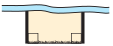
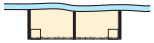
Many quadratic models arise as the product of two variables, one of which increases while the other decreases. For example, the area of a rectangle is the product of its length and its width, or \(A = lw\text{.}\) If we require that the rectangle have a certain perimeter, then as we increase its length, we must also decrease its width. (We analyzed this problem in Investigation 2.2 of Chapter 2.)
The local theater group sold tickets to its opening night performance for \(\$5\) and drew an audience of \(100\) people. The next night, the group reduced the ticket price by \(\$0.25\) and \(10\) more people attended; that is, \(110\) people bought tickets at \(\$4.75\) apiece. In fact, for each \(\$0.25\) reduction in ticket price, \(10\) additional tickets can be sold.
Let \(x\) represent the number of price reductions, as in the first column of the table. Write algebraic expressions in terms of \(x\) for each quantity.
Enter your expressions for the price of a ticket, the number of tickets sold, and the total revenue into the calculator as \(Y_1\text{,}\)\(Y_2\text{,}\) and \(Y_3\text{.}\) Use the Table feature to verify that your algebraic expressions agree with your table from part (1).
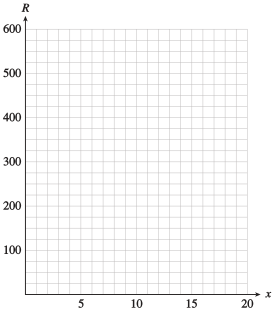
Use your calculator to graph your expression for total revenue in terms of \(x\text{.}\) Use your table to choose appropriate window settings that show the high point of the graph and both xintercepts.
What is the maximum revenue possible from ticket sales? What price should the theater group charge for a ticket to generate that revenue? How many tickets will the group sell at that price?
Finding the maximum or minimum value for a variable expression is a common problem in many applications. For example, if you own a company that manufactures blue jeans, you might like to know how much to charge for your jeans in order to maximize your revenue.
As you increase the price of the jeans, your revenue may increase for a while. But if you charge too much for the jeans, consumers will not buy as many pairs, and your revenue may actually start to decrease. Is there some optimum price you should charge for a pair of jeans in order to achieve the greatest revenue?
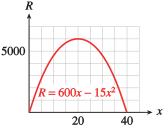
Late Nite Blues finds that it can sell \(600 - 15x\) pairs of jeans per week if it charges \(x\) dollars per pair. (Notice that as the price increases, the number of pairs of jeans sold decreases.)
Write an equation for the revenue as a function of the price of a pair of jeans.
Using the formula for revenue stated above, we find
\begin{equation*}
\begin{aligned}[t]
\text{Revenue} \amp= (\text{price of one item})(\text{number of items sold})\\
R \amp = x(600 - 15x)\\
R \amp = 600x - 15x^2
\end{aligned}
\end{equation*}
The revenue takes on its maximum value when \(x = 20\text{,}\) and the maximum value is \(R = 6000\text{.}\) This means that Late Nite Blues should charge $\(20\) for a pair of jeans in order to maximize revenue at $\(6000\) a week.
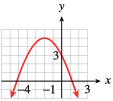
The maximum or minimum value of a quadratic function is easy to find: It is the value at the vertex. If the parabola opens downward, as in Example 6.73, there is a maximum value at the vertex. If the parabola opens upward, there is a minimum value at the vertex.
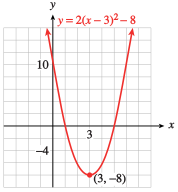
Notice that the coordinates of the vertex, \((3,-8)\text{,}\) are apparent in the original equation; we don’t need to do any computation to find the vertex.
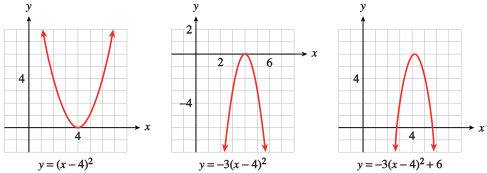
Compare the equation to the vertex form to see that the coordinates of the vertex are \((4, 6)\text{.}\) For this equation, \(a = -3 \lt 0\text{,}\) so the parabola opens downward. The vertex is the maximum point of the graph.
which confirms that when \(x = 4\text{,}\)\(y = 6\text{.}\) Next, notice that if \(x\) is any number except \(4\text{,}\) the expression \(-3(x - 4)^2\) is negative, so \(y \lt 6\text{.}\) Therefore, \(6\) is the maximum value for \(y\) on the graph, so \((4, 6)\) is the high point or vertex.
You can also rewrite \(y = -3(x - 4)^2 + 6\) in standard form and use the formula \(x_v = \dfrac{-b}{2a}\) to confirm that the vertex is the point \((4, 6)\text{.}\)
Any quadratic equation in vertex form can be written in standard form by expanding, and any quadratic equation in standard form can be put into vertex form by completing the square.
We must add \(1\) to complete the square. However, we are really adding \(3(1)\) to the right side of the equation, so we must also subtract \(3\) to compensate:
\begin{equation*}
y = 3(x^2 - 2x \alert{{}+{}1}) - 1\,\alert{-\,3}
\end{equation*}
The expression inside parentheses is now a perfect square, and the vertex form is
\begin{equation*}
y = 3(x - 1)^2 - 4
\end{equation*}
We can graph \(f(x)\) by applying transformations to the basic parabola, \(y = x^2\text{.}\) To identify the transformations, think of evaluating the function for a specific value of \(x\text{.}\) What operations would we perform on \(x\text{,}\) besides squaring?
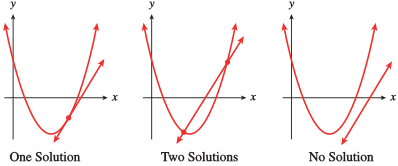
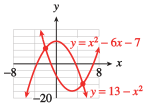
Recall that the solution to a \(2 \times 2\) system of linear equations is the intersection point of the graphs of the equations. (See Algebra Review Refresher Section A.5.) This is also true of systems in which one or both of the equations is quadratic. The figure below shows the three cases for systems of one quadratic and one linear equation.
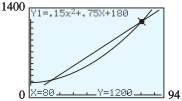
Thus, the Pizza Connection must sell either \(15\) or \(80\) pizzas in order to break even. On the graph we see that revenue is greater than cost for \(x\)-values between \(15\) and \(80\text{,}\) so the Pizza Connection will make a profit if it sells between \(15\) and \(80\) pizzas.
We can also solve algebraically for the break-even points. The intersection points of the two graphs correspond to the solutions of the system of equations
Technology6.90Solving Systems with the Graphing Calculator.
We can use the intersect feature of the graphing calculator to solve systems of quadratic equations. Consider the system
\begin{equation*}
\begin{aligned}[t]
y \amp= (x + 1.1)^2\\
y \amp = 7.825 - 2x - 2.5x^2
\end{aligned}
\end{equation*}
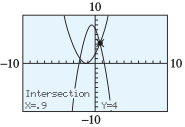
We will graph these two equations in the standard window. The two intersection points are visible in the window, but we do not find their exact coordinates when we trace the graphs.
We can use the intersect command to locate one of the solutions, as shown below. You can check that the point \((0.9, 4)\) is an exact solution to the system by substituting \(x = 0.9\) and \(y = 4\) into each equation of the system. (The calculator is not always able to find the exact coordinates, but it usually gives a very good approximation.)
You can find the other solution of the system by following the same steps and moving the bug close to the other intersection point. You should verify that the other solution is the point \((-2.1, 1)\text{.}\)
Francine attempts to write the equation \(g(x) = 2x^2 - 6x + 1\) in vertex form as follows: \(g(x) = (2x^2 - 6x +\alert{9}) + 1 - \alert{9}\text{.}\) What is wrong with her work?
The owner of a motel has \(60\) rooms to rent. She finds that if she charges $\(0\) per room per night, all the rooms will be rented. For every $\(2\) that she increases the price of a room, \(3\) rooms will stand vacant.
Complete the table. The first two rows are filled in for you.
Let \(x\) stand for the number of \(\$2\) price increases the owner makes. Write algebraic expressions for the price of a room, the number of rooms that will be rented, and the total revenue earned at that price.
Use your calculator to make a table of values for your algebraic expressions. Let \(Y_1\) stand for the price of a room, \(Y_2\) for the number of rooms rented, and \(Y_3\) for the total revenue. Verify the values you calculated in part (a).
What is the lowest price that the owner can charge for a room if she wants her revenue to exceed \(\$1296\) per night? What is the highest price she can charge to obtain this revenue?
What is the maximum revenue the owner can earn in one night? How much should she charge for a room to maximize her revenue? How many rooms will she rent at that price?
The owner of a taco stand sells \(96\) tacos per week if he charges \(\$6\) per taco. For every \(\$0.50\) he increases the price, he sells \(4\) fewer tacos per week.
Complete the table. The first two rows are filled in for you.
Let \(x\) stand for the number of \(\$0.50\) price increases the owner makes. Write algebraic expressions for the price of a taco, the number of tacos sold, and the total revenue.
Use your calculator to make a table of values for your algebraic expressions. Let \(Y_1\) stand for the price of a taco, \(Y_2\) for the number of tacos sold, and \(Y_3\) for the total revenue. Verify the values you calculated in part (a).
What is the maximum revenue the owner can earn from tacos in one week? How much should he charge for a taco to maximize his revenue? How many tacos will he sell at that price?
Obtain a good graph on your calculator and verify your answer. (Use the coordinates of the vertex and the vertical intercept to help you choose an appropriate window for the graph.)
As part of a collage for her art class, Sheila wants to enclose a rectangle with \(100\) inches of yarn.
Let \(w\) represent the width of the rectangle, and write an expression for its length. Then write an expression that gives the area, \(A\text{,}\) of the rectangle as a function of its width, \(w\text{.}\)
Gavin has rented space for a booth at the county fair. As part of his display, he wants to rope off a rectangular area with \(80\) yards of rope.
Let \(w\) represent the width of the roped-off rectangle, and write an expression for its length. Then write an expression that gives the area, \(A\text{,}\) of the roped-off space as a function of its width, \(w\text{.}\)
A travel agent offers a group rate of \(\$2400\) per person for a week in London if \(16\) people sign up for the tour. For each additional person who signs up, the price per person is reduced by \(\$100\text{.}\)
Let \(x\) represent the number of additional people who sign up. Write expressions for the total number of people signed up, the price per person, and the total revenue.
An entrepreneur buys an apartment building with \(40\) units. The previous owner charged \(\$240\) per month for a single apartment and on the average rented \(32\) apartments at that price. The entrepreneur discovers that for every \(\$20\) increase in the rent, another apartment stands vacant.
Let \(x\) represent the number of \(\$20\) price increases. Write expressions for the new price, the number of rented apartments, and the total revenue.
During a statistical survey, a public interest group obtains two estimates for the average monthly income of young adults aged 18 to 25. The first estimate is \(\$860\) and the second estimate is \(\$918\text{.}\) To refine its estimate, the group will take a weighted average of these two figures:
\begin{equation*}
I = 860a + 918(1 - a)\hphantom{00} \text{ where }\hphantom{00} 0\le a \le 1
\end{equation*}
To get the best estimate, the group must choose \(a\) to minimize the function
\begin{equation*}
V = 576a^2 + 5184(1 - a)^2
\end{equation*}
(The numbers that appear in this expression reflect the variance of the data, which measures how closely the data cluster around the mean, or average.) Find the value of \(a\) that minimizes \(V\text{,}\) and use this value to get a refined estimate for the average income.
The rate at which an antigen precipitates during an antigen-antibody reaction depends upon the amount of antigen present. For a fixed quantity of antibody, the time required for a particular antigen to precipitate is given in minutes by the function
\begin{equation*}
t = 2w^2 - 20w + 54
\end{equation*}
where \(w\) is the quantity of antigen present, in grams. For what quantity of antigen will the reaction proceed most rapidly, and how long will the precipitation take?
A system of two quadratic equations may have no solution, one solution, or two solutions. Sketch a system illustrating each case. In your sketches, one of the parabolas should open up, and the other down.
A system of two quadratic equations may have no solution, one solution, or two solutions. Sketch a system illustrating each case. In your sketches, both parabolas should open up.
If the biomass is currently \(2500\) tons and \(300\) tons are harvested, will the population be larger or smaller next year? By how much? What if the biomass is currently \(3500\) tons?
What is the largest annual harvest that still allows for a stable population? (This harvest is called the maximum sustainable yield.) What is the stable population?
The annual increase, \(N\text{,}\) in a bear population of size \(x\) is given by
\begin{equation*}
N = F(x) = 0.0002x(2000 - x)
\end{equation*}
if the bears are not hunted. The number of bears killed each year by hunters is related to the bear population by the equation \(K = 0.2x\text{.}\) (Notice that in this model, hunting is adjusted to the size of the bear population.)
Sketch the graphs of \(N\) and \(K\) on the same axes.
When the bear population is \(1200\text{,}\) which is greater, \(N\) or \(K\text{?}\) Will the population increase or decrease in the next year? By how many bears?
Each year hunters are allowed to harvest a biomass given by \(H = 0.6x\text{.}\) Sketch \(H\) on the same graph with \(w\text{.}\) What is the stable biomass with hunting?
For the value of \(k\) found in part (e), what size will the population approach over time? What biomass are hunters allowed to harvest for that size population?
Explain why the whaling industry should prefer hunting quotas of \(kx\) rather than \(0.6x\) for a long-term strategy, even though \(0.6x \gt kx\) for any positive value of \(x\text{.}\)
Problems 53 and 54 prove that the vertical line \(x =\dfrac{-b}{2a}\) is the axis of symmetry of the graph of \(f(x) = ax^2 + bx + c\text{.}\) A graph is symmetric about the line \(x = h\) if the point \((h + d, v)\) lies on the graph whenever the point \((h - d, v)\) lies on the graph.
Sketch a parabola \(f(x) = a(x - h)^2 + k\) and the line \(x = h\text{.}\) We will show that the parabola is symmetric about the line \(x = h\text{.}\)
To find the axis of symmetry for the graph of \(g(x) = ax^2 + bx + c\text{,}\) we will use the results of Problem 51 and the technique of completing the square.
Write the equation \(y = ax^2 + bx + c\) in vertex form by completing the square. (Follow the steps in Example 6.82.)