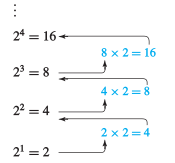
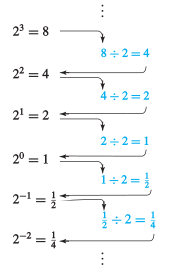
Study the list of powers of \(2\) shown in Table (a) and observe the pattern as we move up the list from bottom to top. Each time the exponent increases by 1 we multiply by another factor of \(2\text{.}\) We can continue up the list as far as we like.
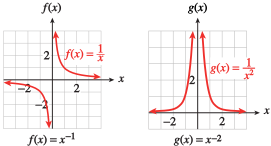
These definitions tell us that if the base \(a\) is not zero, then any number raised to the zero power is \(1\text{,}\) and that a negative exponent denotes a reciprocal.
The body mass index, or BMI, is one measure of a person’s physical fitness. Your body mass index is defined by
\begin{equation*}
BMI = wh^{-2}
\end{equation*}
where \(w\) is your weight in kilograms and \(h\) is your height in meters. The World Health Organization classifies a person as obese if his or her BMI is \(25\) or higher.
The world’s heaviest athlete is the amateur sumo wrestler Emanuel Yarbrough, who weighs \(319\) kg (\(704\) pounds). What height would Yarbrough have to be to have a BMI under \(25\text{?}\)
\(BMI = wh^{-2} = \dfrac{w}{h^2}\text{,}\) so BMI varies inversely with the square of height. That is, for a fixed weight, BMI decreases as height increases.
To find the height that gives a BMI of \(25\text{,}\) we solve the equation \(~25 = 319h^{-2}\text{.}\) Note that the variable \(h\) appears in the denominator of a fraction, so we begin by clearing the denominator—in this case we multiply both sides of the equation by \(h^2\text{.}\)
\begin{equation*}
\begin{aligned}[t]
25 \amp = \frac{319}{h^2} \amp\amp \blert{\text{Multiply both sides by }h^2.}\\
25h^2 \amp = 319 \amp\amp \blert{\text{Divide both sides by }25.}\\
h^2 \amp = 12.76 \amp\amp \blert{\text{Extract square roots.}}\\
h \amp\approx 3.57
\end{aligned}
\end{equation*}
To have a BMI under \(25\text{,}\) Yarbrough would have to be over \(3.57\) meters, or \(11\) feet \(8\) inches tall. (In fact, he is \(6\) feet \(8\) inches tall.)
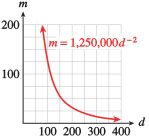
In the Middle Ages in Europe, castles were built as defensive strongholds. An attacking force would build a huge catapult called a trebuchet to hurl rocks and scrap metal inside the castle walls. The engineers could adjust its range by varying the mass of the projectiles. The mass, \(m\text{,}\) of the projectile should be inversely proportional to the square of the distance, \(d\text{,}\) to the target.
The engineers test the trebuchet with a \(20\)-kilogram projectile, which lands \(250\) meters away. Find the constant of proportionality; then rewrite your formula for \(m\text{.}\)
If we use \(k\) for the constant of proportionality, then \(m = \dfrac{k}{d^2}\text{.}\) Rewriting this equation with a negative exponent gives \(m = kd^{-2}\text{.}\)
The function \(~m = \dfrac{k}{d^2}~\) is an example of an inverse square law, because \(m\) varies inversely with the square of \(d\text{.}\) Such laws are fairly common in physics and its applications, because gravitational and other forces behave in this way. Here is a more modern example of an inverse square law.
Cell phone towers typically transmit signals at 10 watts of power. The signal strength varies inversely with the square of distance from the tower, and 1 kilometer away the signal strength is 0.8 picowatt. (A picowatt is \(10^{-12}\) watt.) Cell phones can receive a signal as small as 0.01 picowatt. How far can you be from the nearest tower and still hope to have cell phone reception?
A negative exponent denotes the reciprocal of a power. Thus, to simplify a fraction with a negative exponent, we compute the positive power of its reciprocal.
The laws of exponents apply to all integer exponents, positive, negative, and zero. When we allow negative exponents, we can simplify the rule for computing quotients of powers.
For reference, we restate the laws of exponents below. The laws are valid for all integer exponents \(m\) and \(n\text{,}\) and for \(a, b \ne 0\text{.}\)
You can check that each of the calculations in Example 3.46 is shorter when we use negative exponents instead of converting the expressions into algebraic fractions.
The laws of exponents do not apply to sums or differences of powers. We can add or subtract like terms, that is, powers with the same exponent. For example,
At the start of this section, we saw that \(2^0 = 1\text{,}\) and in fact \(a^0 = 1\) as long as \(a \ne 0\text{.}\) Now we can see that this definition is consistent with the laws of exponents. The quotient of any (nonzero) number divided by itself is \(1\text{.}\) But by applying the second law of exponents, we also have
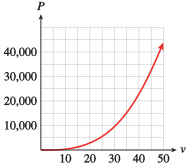
When an automobile accelerates, the power, \(P\text{,}\) needed to overcome air resistance varies directly with a power of the speed, \(v\text{.}\)
Use the data and the graph to find the scaling exponent and the constant of variation. Then write a formula for \(P\) as a power function of \(v\text{.}\)
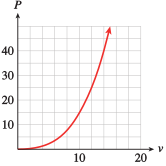
The power, \(P\text{,}\) generated by a windmill varies directly with a power of wind velocity, \(v\text{.}\)
Use the data and the graph to find the scaling exponent and the constant of variation. Then write a formula for \(P\) as a power function of \(v\text{.}\)
The “Rule of 70” is used to estimate how long it takes an investment to double in value when interest is compounded annually. The doubling time, \(D\text{,}\) is inversely proportional to the interest rate, \(i\text{.}\) (Note that \(i\) is expressed as a percent, not as a decimal fraction. For example, if the interest rate is \(8\%\text{,}\) then \(i = 8\text{.}\))
Use the data and the graph to find the constant of proportionality and write \(D\) as a power function of \(i\text{.}\)
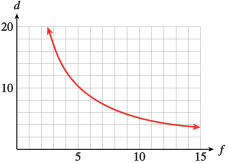
The f-stop setting on a camera regulates the size of the aperture and thus the amount of light entering the camera. The f-stop \(f\) is inversely proportional to the diameter, \(d\text{,}\) of the aperture.
Use the data and the graph to find the constant of proportionality and write \(d\) as a power function of \(f\text{.}\) Values of \(d\) have been rounded to one decimal place.
Why are the f-stop settings labeled with the values given in the table? Hint: As you stop down the aperture from one f-value to the next, by what factor does \(d\) increase?
The Stefan-Boltzmann law relates the total amount of radiation emitted by a star to its temperature, \(T\text{,}\) in kelvins, by the following formula:
where \(R\) is the radius of the star, \(L\) is its luminosity, and \(s = 5.7\times 10^{-8} \text{ watt/m}^2\) is a constant governing radiation. (See Algebra Skills Refresher Scientific Notation to review scientific notation.)
Write a formula for luminosity as a power function of temperature for a fixed radius.
Poiseuille’s law for the flow of liquid through a tube can be used to describe blood flow through an artery. The rate of flow, \(F\text{,}\) in liters per minute is proportional to the fourth power of the radius, \(r\text{,}\) divided by the length, \(L\text{,}\) of the artery.
Write a formula for the rate of flow as a power function of radius.
If the radius and length of the artery are measured in centimeters, then the constant of variation, \(k = 7.8\times 10^5\text{,}\) is determined by blood pressure and viscosity. If a certain artery is \(20\) centimeters long, what should its radius be in order to allow a blood flow of \(5\) liters per minute?
Airplanes use radar to detect the distances to other objects. A radar unit transmits a pulse of energy, which bounces off a distant object, and the echo of the pulse returns to the sender. The power, \(P\text{,}\) of the returning echo is inversely proportional to the fourth power of the distance, \(d\text{,}\) to the object. A radar operator receives an echo of \(5\times 10^{-10}\) watts from an aircraft \(2\) nautical miles away.
Express the power of the echo received in picowatts. (\(1\) picowatt \(= 10^{-12}\) watts.)
Radar units can typically detect signals as low as \(10^{-13}\) watts. How far away is an aircraft whose echo is \(10^{-13}\) watts? Hint: Convert \(10^{-13}\) watts to picowatts.
The lifetime of a star is roughly inversely proportional to the cube of its mass. Our Sun, which has a mass of one solar mass, will last for approximately \(10\) billion years.
Write a power function for the lifetime, \(L\text{,}\) of a star in terms of its mass, \(m\text{.}\)
The amount of force or thrust generated by the propeller of a ship is a function of two variables: the diameter of the propeller and its speed, in rotations per minute. The thrust, \(T\text{,}\) in pounds, is proportional to the square of the speed, \(r\text{,}\) and the fourth power of the diameter, \(d\text{,}\) in feet.
Write a formula for the thrust in terms of the speed if the diameter of the propeller is \(2\) feet.
A propeller of diameter \(2\) feet generates a thrust of \(1000\) pounds at \(100\) rotations per minute. Find the constant of variation in the formula for thrust.
Sketch a graph of the thrust as a function of the propeller speed for a propellor of diameter \(4\) feet. If the speed of the propeller is doubled, by what factor does the thrust increase?
A propeller of diameter \(4\) feet generates a thrust of \(32,000\) pounds at \(100\) rotations per minute. Find the constant of variation in the formula for thrust.
Sketch a graph of the thrust as a function of the diameter of the propeller at a speed of \(100\) rotations per minute. If the diameter of the propeller is doubled, by what factor does the thrust increase?
By rewriting the expressions in Problems 59–62 as fractions, verify that the laws of exponents hold for negative exponents. Show where you apply the corresponding law for positive exponents. Here is the fourth law as an example:
\begin{align*}
(ab)^{-3} \amp= \frac{1}{(ab)^3}= \frac{1}{a^3b^3} \amp\amp\text{By the fourth law of exponents.}\\
\amp= \frac{1}{a^3}\cdot\frac{1}{b^3}=a^{-3}b^{-3}
\end{align*}