A solution to an equation in three variables, such as
\begin{equation*}
x + 2y - 3z = -4
\end{equation*}
is an ordered triple of numbers that satisfies the equation. For example, \((0, -2, 0)\) and \((-1, 0, 1)\) are solutions to the equation above, but \((1, 1, 1)\) is not. You can verify this by substituting the coordinates into the equation to see if a true statement results.
\begin{alignat*}{5}
\amp\text{For }(0,-2, 0):{}\amp 0 {}+{}\amp 2(-2) \amp{}-{}\amp 3(0) \amp = -4{}\amp\hphantom{blank} \blert{\text{True}}\amp\\
\amp\text{For }(-1, 0, 1):{}\amp {-}1 {}+{}\amp 2(0) \amp{}-{}\amp 3(1) \amp = -4{}\amp\hphantom{blank} \blert{\text{True}}\amp\\
\amp\text{For }(1, 1, 1):{}\amp 1 {}+{}\amp 2(1) \amp{}-{}\amp 3(1) \amp = -4{}\amp\hphantom{blank} \blert{\text{Not true}}\amp
\end{alignat*}
As with the two-variable case, a single linear equation in three variables has infinitely many solutions.
An ordered triple
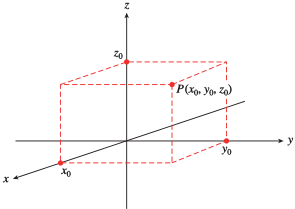
\((x, y, z)\) can be represented geometrically as a point in space using a three-dimensional Cartesian coordinate system, as shown below. In this coordinate system, the graph of a linear equation in three variables is a plane, and the fact that there are infinitely many solutions to the equation tells us that that there are infinitely many points in the corresponding plane.
It is impractical to solve
\(3\times 3\) systems by graphing. Even when technology for producing three-dimensional graphs is available, we cannot read coordinates on such graphs with any confidence. Thus, we will restrict our attention to algebraic methods of solving such systems.