Section 5.5 Application: Whispering Galleries

An ellipse has a reflection property of its own: a ray leaving one focus reflects off the ellipse and passes through the other focus. In a room whose ceiling is a half-ellipse—the dome of St. Paul’s Cathedral, or Statuary Hall in the U.S. Capitol—a whisper released at one focus is gathered up by the whole ceiling and delivered to a listener standing at the other focus, while people in between hear nothing.
The constant-sum definition explains why it works so well. Every path from one focus to the wall and on to the other focus has total length \(r_1 + r_2 = 2a\)—the same length, no matter where it strikes. So the reflected sound does not merely arrive at the far focus: it arrives from every direction at the same instant, in phase, and the pieces reinforce one another instead of smearing out. That is what makes a whisper audible across the room.
described in detail following the image
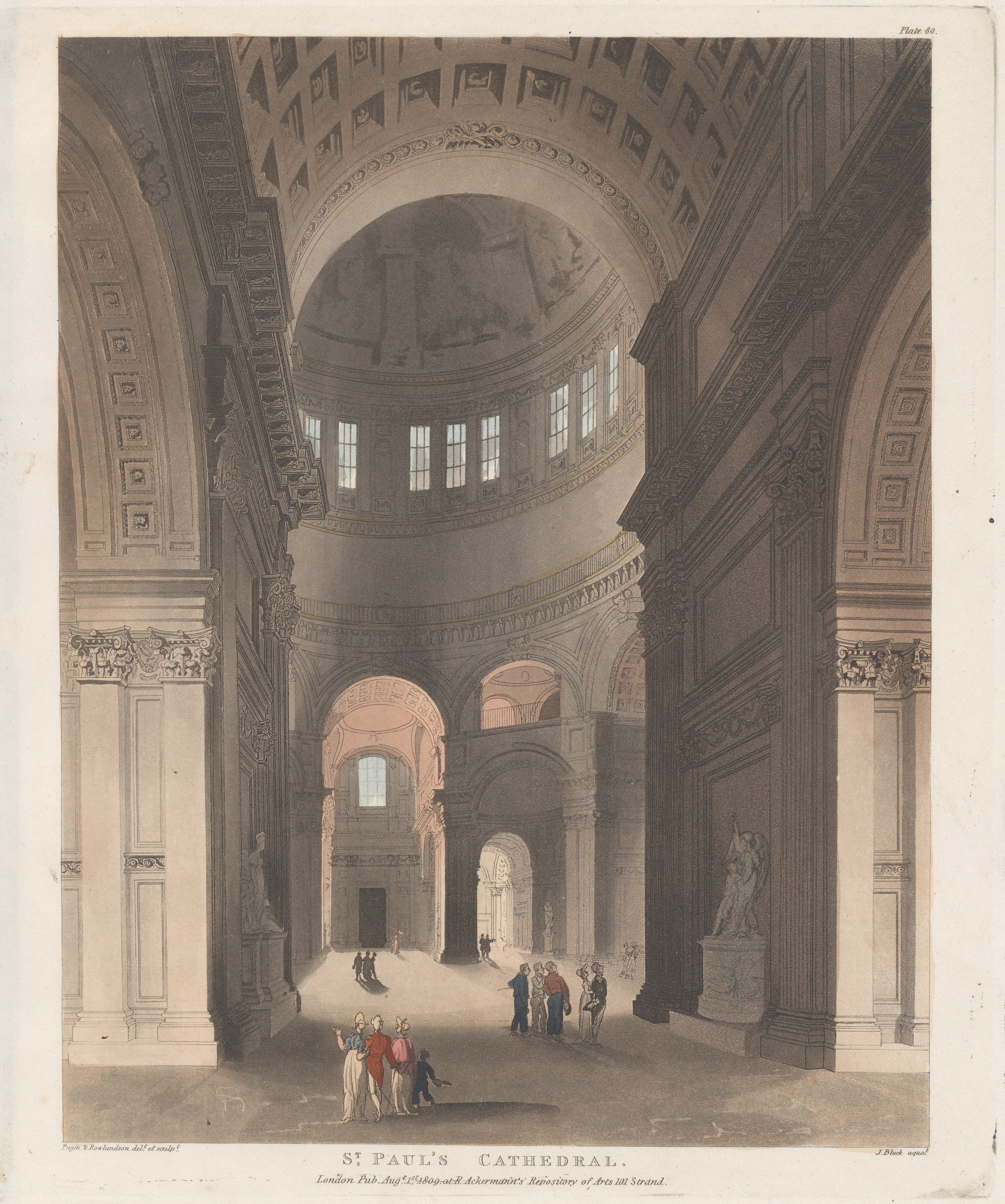
A hand-coloured aquatint from 1809 showing the interior of Saint Paul’s Cathedral, looking up toward the great dome above the crossing, with small figures of visitors walking the marble floor below.
Figure 5.26. The interior of St. Paul’s Cathedral beneath Wren’s dome. Hand-coloured aquatint by Thomas Rowlandson and Augustus Pugin, from Ackermann’s Microcosm of London (1809). Public domain, via The Metropolitan Museum of Art.
Diagram Exploration Keyboard Controls
Key Action
Enter, A Activate keyboard driven exploration
B Activate menu driven exploration
Escape Leave exploration mode
Cursor down Explore next lower level
Cursor up Explore next upper level
Cursor right Explore next element on level
Cursor left Explore previous element on level
X Toggle expert mode
W Extra details if available
Space Repeat speech
M Activate step magnification
Comma Activate direct magnification
N Deactivate magnification
Z Toggle subtitles
C Cycle contrast settings
T Monochrome colours
L Toggle language (if available)
K Kill current sound
Y Stop sound output
O Start and stop sonification
P Repeat sonification output
Figure 5.27. A whispering gallery seen from above. Five sound paths leave the speaker at one focus, bounce off the elliptical wall, and all arrive at the listener at the other focus. Each path has the same total length \(2a\text{.}\)

Example 5.29. Where should the listener stand?

A whispering gallery is \(100\) feet long and \(60\) feet wide. Where should the speaker and the listener stand, and how far does the whisper travel on its way across?
Solution.
Model the room as \(\dfrac{x^2}{a^2} + \dfrac{y^2}{b^2} = 1\) with center at the origin. The room is \(100\) feet long and \(60\) feet wide, so \(2a = 100\) and \(2b = 60\text{,}\) giving \(a = 50\) and \(b = 30\text{.}\) Then
\begin{equation*} c^2 = a^2 - b^2 = 2500 - 900 = 1600 \;\Longrightarrow\; c = 40. \end{equation*}
The two people should stand at the foci \((\pm 40, 0)\text{,}\) that is, \(40\) feet from the center along the long axis, or \(80\) feet apart. Whatever point of the wall the sound bounces off, it travels a total of \(r_1 + r_2 = 2a = 100\) feet—the same distance every way round, which is exactly why it arrives in phase.

You have attempted of activities on this page.
