Section4.1Definition and Properties of the Cross Product
Given two vectors \(\mathbf u\) and \(\mathbf v\) in \(\mathbb R^3\text{,}\) the cross product \(\mathbf u \times \mathbf v\) is a vector defined as follows.
Note that \(|\mathbf u||\mathbf v||\sin\theta|\) is the length of the cross product \(\mathbf u \times \mathbf v\text{.}\) Since \(\sin(\theta)\) can be negative, we need to include its absolute value.
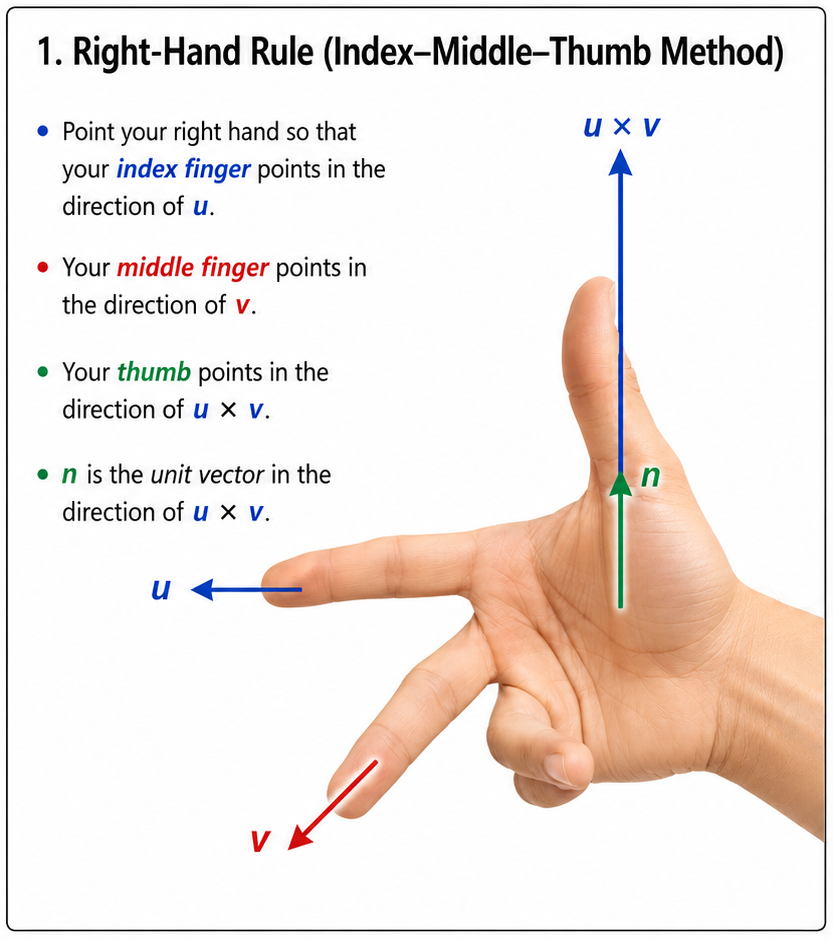
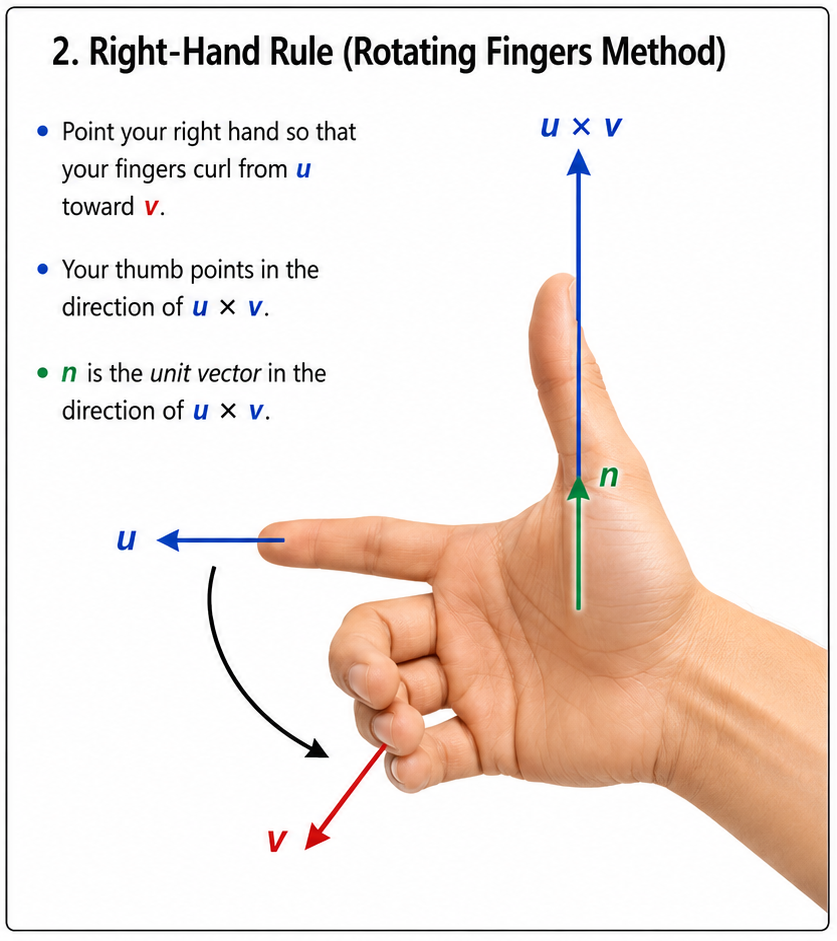
The vector \(\mathbf n\) is the unit vector that determines the direction of \(\mathbf u \times \mathbf v\) using the right-hand rule. Note that \(\mathbf u \times \mathbf v\) is orthogonal (perpendicular) to both vectors, as shown in Figure 4.2.
Figure4.2.The cross product \(\mathbf u \times \mathbf v\) points in the direction of the unit vector \(\mathbf n\text{,}\) given by the right-hand rule, and is orthogonal to both \(\mathbf u\) and \(\mathbf v\text{;}\) its length is \(|\mathbf u||\mathbf v||\sin\theta|\text{.}\)
Figure4.4.The right-hand rule: the fingers of the right hand curl from \(\mathbf u\) toward \(\mathbf v\text{,}\) and the thumb points in the direction of the unit vector \(\mathbf n\text{,}\) along \(\mathbf u \times \mathbf v\text{.}\) Drag to rotate the picture.
\begin{equation}
\mathbf u \parallel \mathbf v \iff \mathbf u \times \mathbf v = \mathbf 0,
\qquad \mathbf u, \mathbf v \neq \mathbf 0.\tag{4.2}
\end{equation}