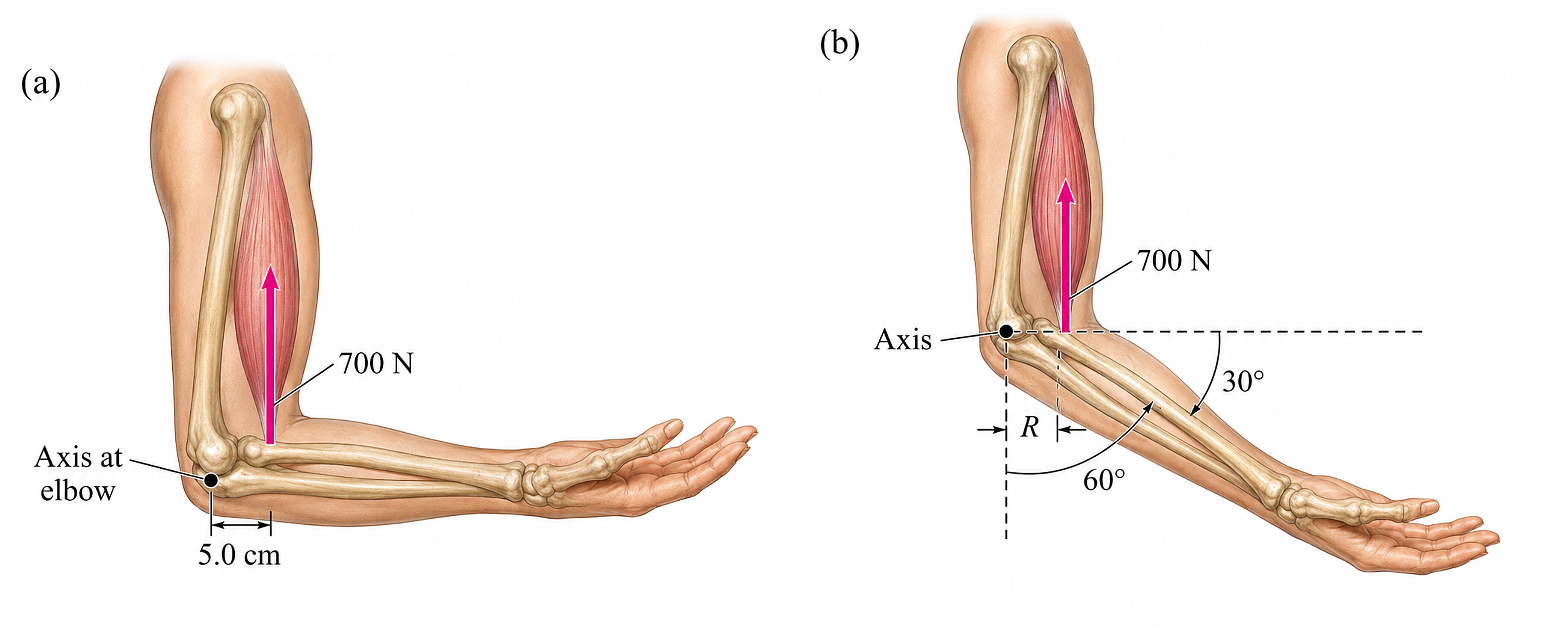
Place the elbow at the origin and let the force act in the plane
\(z = 0\text{,}\) with
\(\vec F = \langle 0, 700, 0\rangle\) pointing straight up.
Part 1. The forearm is horizontal, so \(\vec r = \langle 0.050, 0, 0\rangle\) and the angle between \(\vec r\) and \(\vec F\) is \(\theta = 90^\circ\text{.}\) Then
\begin{align*}
\vec\tau = \vec r \times \vec F \amp=
\begin{vmatrix}
\vec i \amp \vec j \amp \vec k \\
0.050 \amp 0 \amp 0 \\
0 \amp 700 \amp 0
\end{vmatrix}
= \langle 0, 0, (0.050)(700)\rangle
= \langle 0, 0, 35 \rangle,
\end{align*}
so \(|\vec\tau| = 35\ \text{m}\cdot\text{N}\text{.}\) Equivalently, \(|\vec\tau| = |\vec r||\vec F|\sin 90^\circ = (0.050)(700)(1) = 35\
\text{m}\cdot\text{N}\text{.}\) The torque points in the direction \(+\vec k\) (out of the page), which by the right-hand rule corresponds to a counterclockwise rotation of the forearm about the elbow.
Part 2. Now the forearm points \(30^\circ\) below the horizontal, so
\begin{equation}
\vec r = 0.050\,\langle \cos(-30^\circ), \sin(-30^\circ), 0\rangle
= \langle 0.0433, -0.025, 0\rangle,\tag{4.9}
\end{equation}
while \(\vec F = \langle 0, 700, 0\rangle\) is unchanged. The cross product gives
\begin{align*}
\vec\tau = \vec r \times \vec F \amp=
\begin{vmatrix}
\vec i \amp \vec j \amp \vec k \\
0.0433 \amp -0.025 \amp 0 \\
0 \amp 700 \amp 0
\end{vmatrix}
= \langle 0, 0, (0.0433)(700) - (-0.025)(0)\rangle\\
\amp= \langle 0, 0, 30.3 \rangle \approx \langle 0, 0, 30 \rangle.
\end{align*}
So
\(|\vec\tau| \approx 30\ \text{m}\cdot\text{N}\text{,}\) again counterclockwise. To check with
(4.8): the vector
\(\vec r\) sits at
\(-30^\circ\) and
\(\vec F\) at
\(90^\circ\text{,}\) so the angle between them is
\(\theta = 120^\circ\text{,}\) and
\begin{equation}
|\vec\tau| = |\vec r||\vec F|\sin 120^\circ
= (0.050)(700)\left(\tfrac{\sqrt 3}{2}\right)
\approx 30\ \text{m}\cdot\text{N}.\tag{4.10}
\end{equation}
Note that
\(\sin 120^\circ = \sin 60^\circ\text{,}\) so this agrees with the lever-arm point of view: the lever arm has shortened to
\(r_\perp = (0.050)\sin 60^\circ \approx 0.043\) m. The arm exerts less torque at this angle than when the forearm is horizontal — weight machines at gyms are often designed to account for exactly this variation.