Section 6.11 An Activity Introducing Posets

Discussion 6.41.

Alice was surfing the web and found a site listing top movies, grouped by categories (comedy, drama, family, etc) as well as by the decade in which they were released. Alice was intrigued by the criticโ€™s choices and rankings, especially for the top seven dramas from the 1990โ€™s. Alice agreed with the criticโ€™s choices as a group but not the specific rankings. She wrote the criticโ€™s rankings on the board and just to the right, she gave her own rankings, all the time insisting that she was certainly correct in her opinions.
Movie Criticโ€™s Ranking Aliceโ€™s Ranking
1 Saving Private Ryan Life is Beautiful
2 Life is Beautiful Saving Private Ryan
3 Forrest Gump Good Will Hunting
4 Braveheart Titanic
5 Good Will Hunting Braveheart
6 Titanic Forrest Gump
7 Jurassic Park Jurassic Park
Dave studied the two rankings and listened carefully to Aliceโ€™s rationale (which he felt was a bit over the top), but eventually, he held up the following diagram and offered it as a statement of those comparisons on which both Alice and the movie critic were in agreement.
described in detail following the image
A diagram depicting seven points labeled with movie titles as given in the table above. Jurassic Park is at the bottom of the diagram and has line segments going up to points labeled Forrest Gump, Braveheart, and Titanic. From Forrest Gump, there are two line segments going up to Saving Private Ryan and Life is Beautiful. From Braveheart, there are two line segments going up to Saving Private Ryan and Life is Beautiful. From Titanic, there is a line segment going up to Good Will Hunting. From Good Will Hunting there are two line segments going up to Saving Private Ryan and Life is Beautiful.
Figure 6.42. Top Movies from the 90โ€™s
Do you see how Dave made up this diagram? Add your own rankings of these seven films and then draw the diagram that Dave would produce as a statement about the comparisons on which you, Alice and the movie critic were in agreement.
More generally, when humans are asked to express preferences among a set of options, they often report that establishing a totally ranked list is difficult if not impossible. Instead, they prefer to report a partial order โ€” where comparisons are made between certain pairs of options but not between others. In this chapter, we make these observations more concrete by introducing the concept of a partially ordered set. Elementary examples include (1) a family of sets which is partially ordered by inclusion and (2) a set of positive integers which is partially ordered by divisibility. From an applications standpoint, a complex construction job typically involves a large number of projects for which there is a notion of precedence between some but not all pairs. Also, computer file systems are modeled by trees which become partially ordered sets whenever links are added.
A binary relation \(R\) on a set \(X\) is a subset of the cartesian product \(X\times X = \set{(x,y)\colon x,y\in X}\text{.}\) In discussions of binary relations, the notation \((x,y)\in R\) is sometimes written as \(xRy\text{.}\)
A binary relation \(R\) is:
  1. reflexive if \((x,x)\in R\) for all \(x\in X\text{.}\)
  2. antisymmetric if \(x=y\) whenever \((x,y)\in R\) and \((y,x)\in R\text{,}\) for all \(x,y\in X\text{.}\)
  3. transitive if \((x,y)\in R\) and \((y,z)\in R\) imply \((x,z)\in R\text{,}\) for all \(x,y,z\in X\text{.}\)
When using the ordered pair notation for binary relations, to indicate that a pair \((x,y)\) is not in the relation, we simply write \((x,y)\notin R\text{.}\) When using the alternate notation, this is usually denoted by using the negation symbol from logic and writing \(\lnot (xRy)\text{.}\)
A partially ordered set or poset \(\bfP\) is a pair \((X,P)\) where \(X\) is a set and \(P\) is a reflexive, antisymmetric, and transitive binary relation on \(X\text{.}\) We call \(X\) the ground set while \(P\) is a partial order on \(X\text{.}\) Elements of the ground set \(X\) are also called points, and the poset \(\bfP\) is finite if its ground set \(X\) is a finite set.

Example 6.43.

Let \(X=\{a,b,c,d,e,f\}\text{.}\) Consider the following binary relations on \(X\text{.}\)
\begin{align*} R_1=\{\amp (a,a),(b,b),(c,c),(d,d),(e,e),(f,f),(a,b),(a,c),(e,f)\}\\ R_2=\{\amp (a,a),(b,b),(c,c),(d,d),(e,e),(f,f),(d,b),(d,e),(b,a),(e,a),\\ \amp(d,a),(c,f)\}\\ R_3=\{\amp(a,a),(b,b),(c,c),(d,d),(e,e),(f,f),(a,c),(a,e),(a,f),(b,c),\\ \amp(b,d),(b,e),(b,f),(d,e),(d,f),(e,f)\}\\ R_4=\{\amp(a,a),(b,b),(c,c),(d,d),(e,e),(f,f),(d,b),(b,a),(e,a),(c,f)\}\\ R_5=\{\amp(a,a),(c,c),(d,d),(e,e),(a,e),(c,a),(c,e),(d,e)\}\\ R_6=\{\amp(a,a),(b,b),(c,c),(d,d),(e,e),(f,f),(d,f),(b,e),(c,a),(e,b)\} \end{align*}
Which of the binary relations are partial orders on \(X\text{?}\) For those that are not partial orders on \(X\text{,}\) which property or properties are violated?
Solution.
A bit of checking confirms that \(R_1\text{,}\) \(R_2\) and \(R_3\) are partial orders on \(X\text{,}\) so \(\bfP_1=(X,R_1)\text{,}\) \(\bfP_2=(X,R_2)\) and \(\bfP_3=(X,R_3)\) are posets. Several of the other examples we will discuss in this chapter will use the poset \(\bfP_3=(X,R_3)\text{.}\)
On the other hand, \(R_4\text{,}\) \(R_5\) and \(R_6\) are not partial orders on \(X\text{.}\) Note that \(R_4\) is not transitive, as it contains \((d,b)\) and \((b,a)\) but not \((d,a)\text{.}\) The relation \(R_5\) is not reflexive, since it doesnโ€™t contain \((b,b)\text{.}\) (Also, it also doesnโ€™t contain \((f,f)\text{,}\) but one shortcoming is enough.) Note that \(R_5\) is a partial order on \(\{a,c,d,e\}\text{.}\) The relation \(R_6\) is not antisymmetric, as it contains both \((b,e)\) and \((e,b)\text{.}\)
When \(\PXP\) is a poset, it is common to write \(x\le y\) in \(P\) or \(y\ge x\) in \(P\) as substitutes for \((x,y)\in P\text{.}\) Of course, the notations \(x\lt y\) in \(P\) and \(y>x\) in \(P\) mean \(x\le y\) in \(P\) and \(x\ne y\text{.}\) When the poset \(\bfP\) remains fixed throughout a discussion, we will sometimes abbreviate \(x\le y\) in \(P\) by just writing \(x\le y\text{,}\) etc. We say that \(x\) is comparable to \(y\) in \(P\) provided that \(x\leq y\) or \(y\leq x\) in \(P\text{.}\) Otherwise, we say that \(x\) and \(y\) are incomparable.
When \(x\) and \(y\) are distinct points from \(X\text{,}\) we say \(x\) is covered
โ€‰1โ€‰
Reflecting the vagaries of the English language, mathematicians use the phrases: (1) \(x\) is covered by \(y\) in \(P\text{;}\) (2)ย \(y\) covers \(x\) in \(P\text{;}\) and (3)ย \((x,y)\) is a cover in \(P\) interchangeably.
by \(y\) in \(P\) when \(x\lt y\) in \(P\text{,}\) and there is no point \(z\in X\) for which \(x\lt z\) and \(z\lt y\) in \(P\text{.}\) For example, in the poset \(\bfP_3=(X,R_3)\) from Exampleย 6.43, \(d\) is covered by \(e\) and \(c\) covers \(b\text{.}\) However, \(a\) is not covered by \(f\text{,}\) since \(a\lt e\lt f\) in \(R_3\text{.}\)
It is convenient to illustrate a poset with a suitably drawn diagram in the Euclidean plane. We choose a standard horizontal/vertical coordinate system in the plane and require that the vertical coordinate of the point corresponding to \(y\) be larger than the vertical coordinate of the point corresponding to \(x\) whenever \(y\) covers \(x\) in \(P\text{.}\) Each cover relation is represented by a straight line segment which contains no point corresponding to any element in the poset other than those associated with its two end points. Such diagrams are called Hasse diagrams
โ€‰2โ€‰
Named for German mathematician Helmut Hasse, who was born in 1898. Care is required with things named after mathematicians of that era, since many of them were Nazis. Hasseโ€™s background is a bit complicated, but his doctoral supervisor was Jewish and he collaborated with many prominent Jewish mathematicians, including Emmy Noether. So we shall let the name persist.
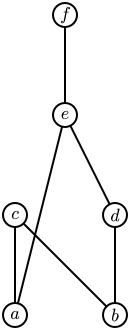
(also poset diagrams, order diagrams, or simply diagrams ). The drawing in Figureย 6.44 is a diagram of the poset \(\bfP_3\) from Exampleย 6.43.
A poset with points labeled a, b, c, d, e, f.
Figure 6.44. A diagram of a poset
For posets of moderate size, diagrams are frequently used to define a poset โ€” rather than the explicit binary relation notation illustrated in Exampleย 6.43. In Figureย 6.45, we illustrate a poset \(\PXP\) with ground set \(X=[17]=\{1,2,\dots,17\}\text{.}\) It would take several lines of text to write out the binary relation \(P\text{,}\) and somehow the diagram serves to give us a more tactile sense of the properties of the poset.
described in detail following the image
A Poset on 17 Points
Figure 6.45. A Poset on 17 Points

Activity 6.46.

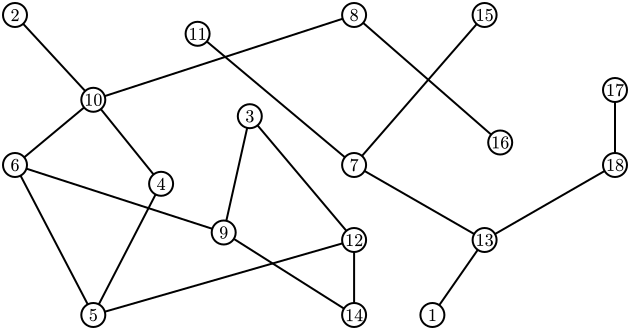
Below is the diagram of a poset. There are several questions about this poset on the tabs below. Answer each of them.
A poset with points labeled from 1 to 18

(a)

Select all of the elements below that cover the point 9.
  • 2
  • While \(2 \gt 9\) in the poset, this is not a cover relation because \(2\gt 10\gt 6\gt 9\text{.}\)
  • 3
  • 6
  • 10
  • While \(10\gt 9\) in the poset, this is not a cover relation because \(10\gt 6\gt 9\text{.}\)
  • 14
  • โ€œCoverโ€ is a directional term. Here 9 covers 14, but the question asked for elements that cover 9.

(b)

Select all of the elements below that are comparable to the point 7.
  • 1
  • 11
  • 13
  • 15
  • 18
  • Although \(7\gt 13\) and \(18\gt 13\) in the poset, these relations do not line up in a way that provides a relation by transitivity. Thus, 7 and 18 are incomparable.

(c)

Select all of the elements below that are greater than point 6.
  • 2
  • Correct! Since \(6\lt 10\lt 2\text{,}\) by transitivity we have that \(6\lt 2\) or \(2\gt 6\text{.}\)
  • 3
  • Although physically higher in the diagram, there is not a sequence of less than relations all in the same direction leading from 6 to 3, so 3 is incomparable to 6.
  • 8
  • Correct! Since \(6\lt 10\lt 8\text{,}\) by transitivity we have that \(6\lt 8\) or \(8\gt 6\text{.}\)
  • 10
  • Correct! We can see that \(10\) covers \(6\text{,}\) so \(10\gt 6\text{.}\)
  • 11
  • Although physically higher in the diagram, there is not a sequence of less than relations all in the same direction leading from 6 to 11, so 11 is incomparable to 6.

(d)

Select all of the elements below that are incomparable to point 10.
  • 1
  • 2
  • 3
  • 7
  • 10
  • Because the relation in a poset is reflexive, we have that each point is related to itself. Thus, \(10\leq 10\) so we say that 10 is comparable to itself, rather than being incomparable.

Definition 6.47 Maximal and Minimal Elements.

Let \(\bfP=(X,P)\) be a poset. An element \(x\in X\) is maximal if there is no \(y\in X\) with \(y\gt x\) in \(P\text{.}\)
Let \(\bfP=(X,P)\) be a poset. An element \(x\in X\) is minimal if there is no \(y\in X\) with \(y\lt x\) in \(P\text{.}\)

Activity 6.48.

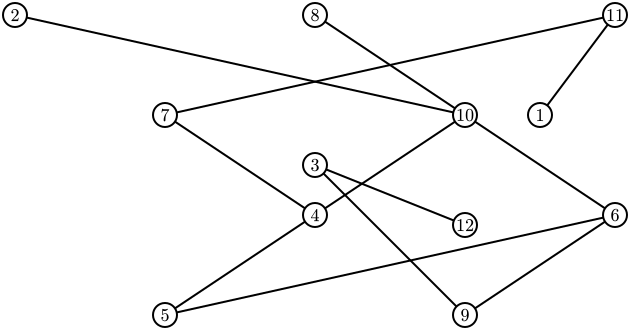
Below is the diagram of a poset \(\bfP\text{.}\) Answer the questions about it on the tabs.
A poset with points labeled from 1 to 12

(a)

Select all of the following that are maximal elements of \(\bfP\text{.}\)
  • 1
  • Since \(11\gt 1\text{,}\) we see that 1 is not maximal.
  • 2
  • 3
  • 7
  • Since \(11\gt 7\text{,}\) we see that 7 is not maximal.
  • 11

(b)

Select all of the following that are minimal elements of \(\bfP\text{.}\)
  • 1
  • Although 1 appears high in the diagram, 1 is not greater than any element of the poset and thus is minimal.
  • 3
  • Since \(3\gt 12\text{,}\) we see that 3 is not minimal.
  • 5
  • 10
  • Since \(10\gt 6\text{,}\) we see that 10 is not minimal.
  • 12
You have attempted of activities on this page.