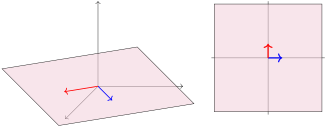
Verify that both \(\vec{v}=\left[\begin{array}{c}1\\-1\\1\end{array}\right]\) and \(\vec{w}=\left[\begin{array}{c}1\\0\\-1\end{array}\right]\) are solutions.
Recall that if \(S=\left\{\vec{v}_1,\dots, \vec{v}_n\right\}\) is subset of vectors in \(\IR^n\text{,}\) then \(\vspan(S)\) is the set of all linear combinations of vectors in \(S\text{.}\) In EV2 (Section 2.2), we learned how to decide whether \(\vspan(S)\) was equal to all of \(\IR^n\) or something strictly smaller.
Let \(S\) denote a set of vectors in \(\IR^n\) and suppose that \(\vec{u},\vec{v}\in\vspan(S)\text{,}\)\(c\in\IR\) and that \(\vec{w}\in\IR^n\text{.}\) Which of the following vectors might not belong to \(\vspan(S)\text{?}\)
Note that if \(\left[\begin{array}{c} a_1 \\ \vdots \\ a_n \end{array}\right] \) and \(\left[\begin{array}{c} b_1 \\ \vdots \\ b_n \end{array}\right] \) are both solutions, we know that
the set \(\vspan(S)\) is closed under addition: for any \(\vec{u},\vec{v}\in \vspan(S)\text{,}\) the sum \(\vec{u}+\vec{v}\) is also in \(\vspan(S)\text{.}\)
the set \(\vspan(S)\) is closed under scalar multiplication: for any \(\vec{u}\in\vspan(S)\) and scalar \(c\in\IR\text{,}\) the product \(c\vec{u}\) is also in \(\vspan(S)\text{.}\)
the set \(\vspan(S)\) is closed under scalar multiplication: for any \(\vec{u}\in W\) and scalar \(c\in\IR\text{,}\) the product \(c\vec{u}\) is also in \(W\text{.}\)
the subset is closed under scalar multiplication: for any \(\vec{u} \in W\) and scalar \(c \in \IR\text{,}\) the product \(c\vec{u}\) is also in \(W\text{.}\)
Note the similarities between a planar subspace spanned by two non-colinear vectors in \(\IR^3\text{,}\) and the Euclidean plane \(\IR^2\text{.}\) While they are not the same thing (and shouldn’t be referred to interchangably), algebraists call such similar spaces isomorphic; we’ll learn what this means more carefully in a later chapter.
Let’s assume that \(\vec{v}=\left[\begin{array}{c} x \\ y \\ z \end{array}\right]\) and \(\vec{w} = \left[\begin{array}{c} a \\ b \\ c \end{array}\right] \) are in \(W\text{.}\) What are we allowed to assume?
Which equation must be verified to show that \(\vec v+\vec w = \left[\begin{array}{c} x+a \\ y+b \\ z+c \end{array}\right]\) also belongs to \(W\text{?}\)
Show that \(k\vec v=\left[\begin{array}{c}kx\\ky\\kz\end{array}\right]\) also belongs to \(W\) for any \(k\in\IR\) by verifying \((kx)+2(ky)+(kz)=0\) under these assumptions.
Consider the following two sets of Euclidean vectors:
\begin{equation*}
U=\left\{ \left[\begin{array}{c} x \\ y \end{array}\right] \middle|\,7 \, x + 4 \, y = 0\right\} \hspace{2em} W=\left\{ \left[\begin{array}{c} x \\ y \end{array}\right] \middle|\,3 \, x y^{2} = 0\right\}
\end{equation*}
Let \(\left[\begin{array}{c} x \\ y \end{array}\right]\in U\text{,}\) so we know that \(x+y=xy\text{.}\) We want to show \(k\left[\begin{array}{c} x \\ y \end{array}\right]=\left[\begin{array}{c} kx \\ ky \end{array}\right]\in U\text{,}\) that is, \((kx)+(ky)=(kx)(ky)\text{.}\) This is verified by the following calculation:
Basically, you cannot prove something is true by assuming it’s true, and it’s not helpful to prove to someone that zero equals itself (they probably already know that).
Given the set of ingredients \(S=\{\textrm{flour}, \textrm{yeast}, \textrm{salt}, \textrm{water}, \textrm{sugar}, \textrm{milk}\}\text{,}\) how should we think of the subspace \(\vspan(S)\text{?}\)
The set \(W\) is a subspace. Below are two attempted proofs of the fact that \(W\) is closed under vector addition. Both of them are invalid; explain why.
Let \(\vec{u}=\left[\begin{array}{c}1\\4\\1\\1\end{array}\right],\vec{v}=\left[\begin{array}{c}2\\-1\\1\\-1\end{array}\right].\) Then both \(\vec{u},\vec{w}\) are elements of \(W\text{.}\) Their sum is
If \(\left[\begin{array}{c}x\\y\\z\\w\end{array}\right],\left[\begin{array}{c}a\\b\\c\\d\end{array}\right]\) are in \(W\text{,}\) we need to show that \(\left[\begin{array}{c}x+a\\y+b\\z+c\\w+d\end{array}\right]\) is also in W. To be in \(W\text{,}\) we need
by moving everything over to the left hand side. Since we are assumming that \(x+y-3z-2w=0\) and \(a+b-3c-2d=0\text{,}\) it follows that \(0=0\text{,}\) which is true, which proves that vector addition is closed.
A square matrix \(M\) is symmetric if, for each index \(i,j\text{,}\) the entries \(m_{ij} = m_{ji}\text{.}\) That is, the matrix is itself when reflected over the diagonal from upper left to lower right. Prove that the set of \(n \times n\) symmetric matrices is a subspace of \(M_{n \times n}\text{.}\)
The space of all real-valued function of one real variable is a vector space. First, define \(\oplus\) and \(\odot\) for this vector space. Check that you have closure (both kinds!) and show what the zero vector is under your chosen addition. Decide if each of the following is a subspace. If so, prove it. If not, provide the counterexample.
The set of even functions, \(\{f:\mathbb{R} \rightarrow \mathbb{R}: f(-x) = f(x) \mbox{ for all } x\}\text{.}\)
Let \(V\) be a vector space and \(S = \{\vec{v}_1,\vec{v}_2,\ldots,\vec{v}_n\}\) a subset of \(V\text{.}\) Show that the span of \(S\) is a subspace. Is it possible that there is a subset of \(V\) containing fewer vectors than \(S\text{,}\) but whose span contains all of the vectors in the span of \(S\text{?}\)