Section 3.4 The AI Toolbox (Core Subfields)

AI is not one single technique. It is a toolbox of methods for learning from data, recognizing patterns, and making predictions. This section introduces the core subfields you will encounter most often in modern AI systems.

Subsection 3.4.1 Machine Learning & Deep Learning

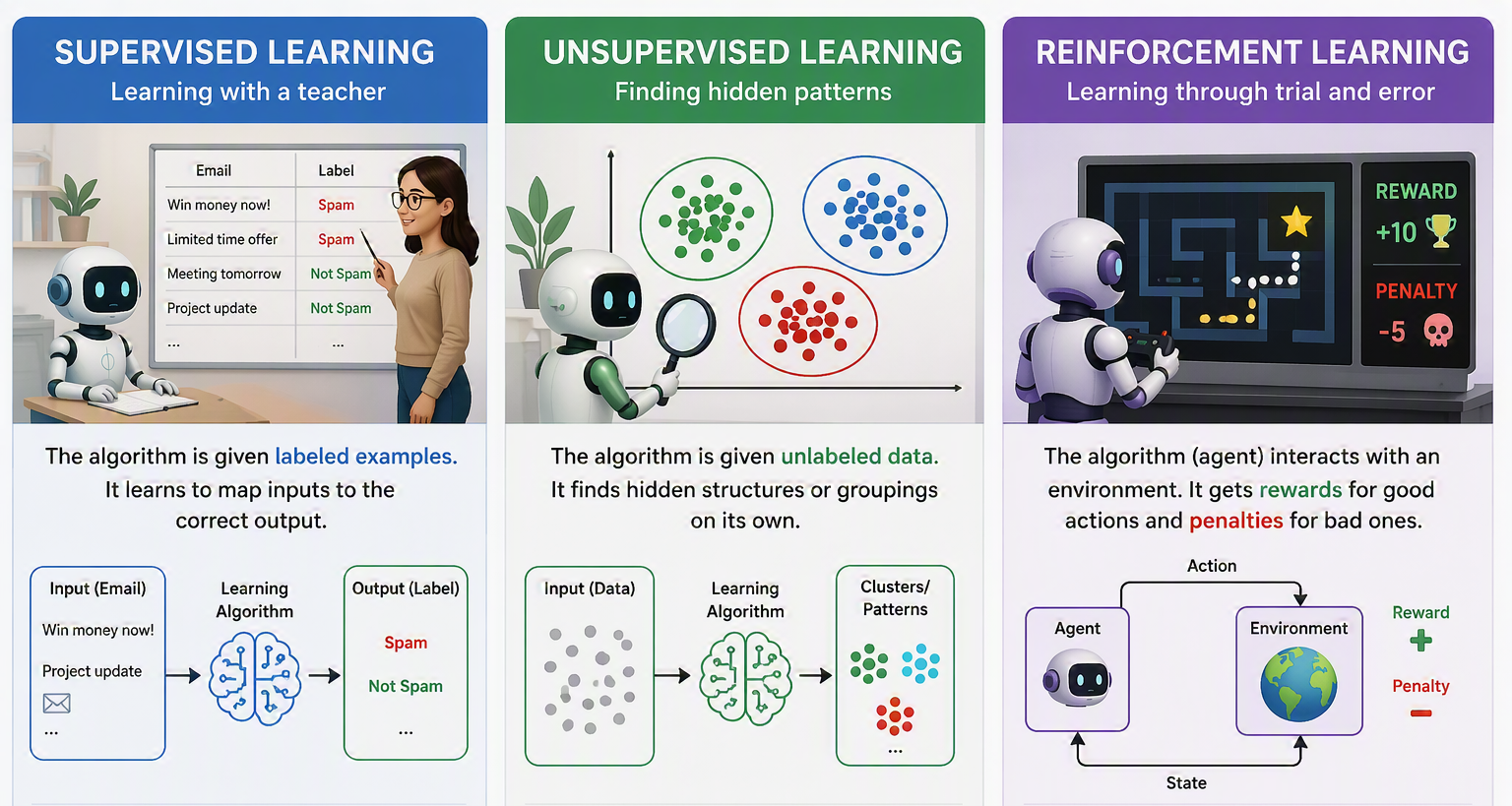
We will begin our investigation of the AI toolbox by breaking down the primary methodologies that programmers use to find patterns. Depending on the nature of our data and the problem we are trying to solve, machine learning tasks generally fall into three machine learning styles.
  • Supervised Learning: Learning with a teacher. In this setup, the algorithm is provided with a training dataset where every input is paired with its corresponding correct output answer, known as a label. For instance, an algorithm can analyze thousands of email examples explicitly marked as "spam" or "not spam" until it learns the distinct features of an unwanted message.
  • Unsupervised Learning: Finding hidden patterns. Here, the algorithm processes an unlabeled dataset completely on its own, without any historical answers or human guidance. Instead of predicting a specific label, it looks for underlying structures, similarities, or natural groupings within the data. This is often used for tasks like customer segmentation, where an algorithm groups online shoppers together based on shared buying habits.
  • Reinforcement Learning: Learning through trial and error. In this setup, the algorithm acts as an autonomous agent interacting with a dynamic environment. It is not given explicit answers or labeled data; instead, it receives feedback in the form of rewards for good decisions and penalties for mistakes. Over time, the agent learns a strategy (or policy) to maximize its total cumulative reward. For instance, a reinforcement learning algorithm can learn to play a complex video game or navigate a robotic arm entirely from scratch by trying millions of random actions, slowly figuring out which sequences of movements lead to a high score or a successful task completion.
Figure 3.4.1. Comparison of Machine Learning Types

Subsection 3.4.2 Deep Learning

Deep learning is a specialized branch of machine learning that uses multi-layer neural networks to learn complex patterns from large datasets. Instead of relying on humans to manually design every feature, deep models can learn useful internal representations directly from raw inputs such as text, audio, or images.
A neural network is organized into layers. Early layers often detect simple features, while deeper layers combine those features into higher-level concepts. During training, the model compares predictions to known answers, computes error, and updates internal weights through an optimization process called gradient descent with backpropagation.
Deep learning powers many modern applications:
  • Computer Vision: Convolutional and transformer-based models detect objects, segment medical scans, and interpret scenes for autonomous systems.
  • Language Systems: Transformer architectures power translation, summarization, question answering, and large language models.
  • Speech and Audio: Deep models convert speech to text, synthesize natural voices, and separate sounds in noisy environments.
Deep learning is powerful, but it typically requires substantial data, compute resources, and careful evaluation to avoid overfitting, bias amplification, and opaque decision-making.

Subsection 3.4.3 Understanding Training and Testing Sets

When developing any machine learning model, a critical question arises: How do we prove our algorithm has actually discovered real, generalized rules about the world instead of simply memorizing our data?
If a student memorizes the exact phrasing of a practice exam’s homework solutions, they might achieve a 100% score on those specific problems. However, if the teacher presents slightly altered questions on the actual test, a student who merely memorized the answers will fail. In machine learning, this dangerous trap of raw memorization is known as overfitting.
To prevent overfitting, we must systematically partition our data into two completely separate pools before training ever begins:
  • The Training Set: This represents the primary portion of our historical data (typically 75% to 80% of the dataset). The algorithm is granted full access to these samples, adjusting its internal weights and parameters as it uncovers relationships between the input features and target labels.
  • The Testing Set: This is a collection of sample instances completely withheld during the learning phase. It acts as an unbiased validation exam. Once the model is finalized, we ask it to make predictions on the testing set. Because the algorithm has never seen these exact instances before, its performance metrics give us an honest measurement of how well the AI generalizes to the real world.

Subsection 3.4.4 Natural Language Processing (NLP) & Computer Vision

While basic machine learning works incredibly well with organized data spreadsheets, the human world is full of unstructured information. Two of the most common and powerful subfields within the AI toolbox focus on teaching computers to process human communication and imagery.
  • Natural Language Processing (NLP): This subfield focuses on how machines read, decipher, synthesize, and understand human languages. Human text is notoriously complex, filled with context, slang, sarcasm, and ambiguous grammar rules. NLP enables applications like machine translation, automated sentiment analysis, and the complex foundational architectures behind modern Large Language Models (LLMs).
  • Computer Vision: This subfield gives machines the ability to "see" and interpret visual inputs. To a computer, an image is not a collection of shapes and colors; it is a giant, complex grid of numerical pixel values. Computer vision utilizes advanced deep learning networks to parse these pixel arrays, enabling systems to automatically identify objects, read traffic signs, track motion, and power applications like facial recognition and autonomous driving vehicles.
Python

Subsection 3.4.5 Section 2.3 Review Questions

Checkpoint 3.4.2.

Question 1 (Categorizing Machine Learning Styles):
A banking institution wants to implement an automated fraud prevention system. To do this, engineers compile a massive historical database containing 500,000 credit card transactions. Each transaction entry is explicitly marked with a binary tag: either 1 for "Confirmed Fraudulent" or 0 for "Legitimate User." The algorithm is tasked with analyzing this historical data to find hidden mathematical relationships between transaction amounts, geographical locations, and fraud occurrences.
Which machine learning style is this system utilizing?
  • Unsupervised Learning, because the system must hunt for hidden, grouped anomalies completely on its own without human intervention.
  • Incorrect. The data here is explicitly labeled as fraudulent or legitimate.
  • Supervised Learning, because the algorithm is provided with a training dataset where every input transaction is explicitly paired with a pre-determined correct output label.
  • Correct. This is supervised learning because each training example includes a known target label.
  • Reinforcement Learning, because the algorithm receives a positive financial reward whenever it stops a scammer and a penalty when it blocks a real customer.
  • Incorrect. The scenario describes learning from labeled historical data, not reward-based interaction.
  • Overfitting, because checking 500,000 real-world entries forces the model to memorize the exact names of the credit card holders.
  • Incorrect. Overfitting is a model failure mode, not a learning paradigm.

Checkpoint 3.4.3.

Question 2 (Identifying AI Toolbox Domains):
An automated warehouse facility deploys a fleet of mobile robotic sorting units. Each robot is equipped with a high-definition digital camera. As packages move down a conveyor belt, an onboard deep learning model scans the oncoming items. The algorithm translates the visual feed from a massive grid of numerical pixel values to instantly draw digital boundaries around each package, identifying its structural type (e.g., "Mailing Envelope," "Cardboard Box," or "Plastic Tube") so the mechanical arm can safely grasp it.
Which core AI subfields are being actively combined to execute this task?
  • Natural Language Processing (NLP) and Unsupervised Learning
  • Incorrect. The task is visual object identification, not language understanding.
  • Computer Vision and Deep Learning
  • Correct. The system interprets camera pixels using a deep neural model for recognition.
  • Supervised Learning and Spreadsheet Calculators
  • Incorrect. Spreadsheets are not the core AI subfield driving this perception task.
  • Sentiment Analysis and Gradient Descent
  • Incorrect. Sentiment analysis is an NLP task, not package detection from images.

Checkpoint 3.4.4.

Question 3 (Evaluating Data Partitioning & Model Generalization):
A team of medical researchers trains a deep learning model to spot early signs of pneumonia from lung X-ray scans. During the training phase, they give the algorithm full access to 10,000 historical scans from Hospital A. The model achieves a flawless 100% accuracy score on those 10,000 images. However, when the model is deployed at Hospital B and tested on a brand-new batch of X-ray scans it has never seen before, its accuracy drops to 52%.
What algorithmic error occurred, and how should the researchers have mathematically prevented it?
  • The model suffered from Context Drift; they should have used Socratic dialogues to remind the algorithm how a lung looks.
  • Incorrect. Context drift applies to generative conversation behavior, not this training/evaluation failure.
  • The model suffered from Reinforcement Decay; they should have rewarded the algorithm with more compute resources during the testing phase.
  • Incorrect. The issue is not reward tuning but poor generalization.
  • The model overfitted to the unique quirks of Hospital A’s data; they should have partitioned their data to hide a separate testing set from the model during training to evaluate its true real-world generalization.
  • Correct. The model memorized training-set specifics and failed on unseen data; a held-out test set is the standard guardrail.
  • The model suffered from Unsupervised Segmentation; they should have manually hand-coded thousands of rigid spreadsheet rules instead of using a deep neural network.
  • Incorrect. This does not describe the observed train/test performance gap.
You have attempted of activities on this page.