<section xmlns:pi="http://pretextbook.org/2020/pretext/internal">
<title>Cyclic groups</title>
<p>Often a subgroup will depend entirely on a single element of the group; that is, knowing that particular element will allow us to compute any other element in the subgroup.</p>
<!-- RAB 2014/08/18 Maybe this id should have 3z, not z3? -->
<example xml:id="example-cyclic-z3">
<title>An Infinite Cyclic Subgroup, Modular Addition</title>
<p>Suppose that we consider <m>3 \in {\mathbb Z}</m> and look at all multiples (both positive and negative) of 3. As a set, this is <md>3 {\mathbb Z} = \{ \ldots, -3, 0, 3, 6, \ldots \}</md>. It is easy to see that <m>3 {\mathbb Z}</m> is a subgroup of the integers. This subgroup is completely determined by the element 3 since we can obtain all of the other elements of the group by taking multiples of 3. Every element in the subgroup is <q>generated</q> by 3.</p>
</example>
<example xml:id="example-cyclic-2n">
<title>An Infinite Cyclic Subgroup, Multiplication of Rational Numbers</title>
<p>If <m>H = \{ 2^n : n \in {\mathbb Z} \}</m>, then <m>H</m> is a subgroup of the multiplicative group of nonzero rational numbers, <m>{\mathbb Q}^*</m>. If <m>a = 2^m</m> and <m>b = 2^n</m> are in <m>H</m>, then <m>ab^{-1} = 2^m 2^{-n} = 2^{m-n}</m> is also in <m>H</m>. By <xref ref="proposition-subgroup"/>, <m>H</m> is a subgroup of <m>{\mathbb Q}^*</m> determined by the element 2.</p>
</example>
<theorem xml:id="theorem-cyclic-subgroup">
<statement>
<p>Let <m>G</m> be a group and <m>a</m> be any element in <m>G</m>. Then the set <md>\langle a \rangle = \{ a^k : k \in {\mathbb Z} \}</md> is a subgroup of <m>G</m>. Furthermore, <m>\langle a \rangle</m> is the smallest subgroup of <m>G</m> that contains~<m>a</m>.<notation>
<usage><m>\langle a \rangle</m></usage>
<description>cyclic group generated by <m>a</m></description>
</notation></p>
</statement>
<proof>
<p>The identity is in <m>\langle a \rangle </m> since <m>a^0 = e</m>. If <m>g</m> and <m>h</m> are any two elements in <m>\langle a \rangle </m>, then by the definition of <m>\langle a \rangle</m> we can write <m>g = a^m</m> and <m>h = a^n</m> for some integers <m>m</m> and <m>n</m>. So <m>gh = a^m a^n = a^{m+n}</m> is again in <m>\langle a \rangle </m>. Finally, if <m>g = a^n</m> in <m>\langle a \rangle </m>, then the inverse <m>g^{-1} = a^{-n}</m> is also in <m>\langle a \rangle </m>. Clearly, any subgroup <m>H</m> of <m>G</m> containing <m>a</m> must contain all the powers of <m>a</m> by closure; hence, <m>H</m> contains <m>\langle a \rangle </m>. Therefore, <m>\langle a \rangle </m> is the smallest subgroup of <m>G</m> containing <m>a</m>.</p>
</proof>
</theorem>
<remark>
<p>If we are using the <q>+</q> notation, as in the case of the integers under addition, we write <m>\langle a \rangle = \{ na : n \in {\mathbb Z} \}</m>.</p>
</remark>
<p>For <m>a \in G</m>, we call <m>\langle a \rangle </m> the <term>cyclic subgroup</term><idx><h>Subgroup</h><h>cyclic</h></idx> generated by <m>a</m>. If <m>G</m> contains some element <m>a</m> such that <m>G = \langle a \rangle </m>, then <m>G</m> is a <term>cyclic group</term><idx><h>Group</h><h>cyclic</h></idx>. In this case <m>a</m> is a <term>generator</term><idx><h>Generator of a cyclic subgroup</h></idx> of <m>G</m>. If <m>a</m> is an element of a group <m>G</m>, we define the <term>order</term><idx><h>Element</h><h>order of</h></idx> of <m>a</m> to be the smallest positive integer <m>n</m> such that <m>a^n= e</m>, and we write <m>|a| = n</m>. <notation><usage><m>|a|</m></usage><description>the order of an element <m>a</m></description></notation> If there is no such integer <m>n</m>, we say that the order of <m>a</m> is infinite and write <m>|a| = \infty</m> to denote the order of <m>a</m>.</p>
<example xml:id="example-cyclic-z6">
<title>Generators of a Finite Cyclic Group</title>
<p>Notice that a cyclic group can have more than a single generator. Both 1 and 5 generate <m>{\mathbb Z}_6</m>; hence, <m>{\mathbb Z}_6</m> is a cyclic group. Not every element in a cyclic group is necessarily a generator of the group. The order of <m>2 \in {\mathbb Z}_6</m> is 3. The cyclic subgroup generated by 2 is <m>\langle 2 \rangle = \{ 0, 2, 4 \}</m>.</p>
</example>
<p>The groups <m>{\mathbb Z}</m> and <m>{\mathbb Z}_n</m> are cyclic groups. The elements 1 and <m>-1</m> are generators for <m>{\mathbb Z}</m>. We can certainly generate <m>{\mathbb Z}_n</m> with 1 although there may be other generators of <m>{\mathbb Z}_n</m>, as in the case of <m>{\mathbb Z}_6</m>.</p>
<example xml:id="example-cyclic-u9">
<title>A Cyclic Group of Units</title>
<p>The group of units, <m>U(9)</m>, in <m>{\mathbb Z}_9</m> is a cyclic group. As a set, <m>U(9)</m> is <m>\{ 1, 2, 4, 5, 7, 8 \}</m>. The element 2 is a generator for <m>U(9)</m> since<md>
<mrow>2^1 & = 2 \qquad 2^2 = 4</mrow>
<mrow>2^3 & = 8 \qquad 2^4 = 7</mrow>
<mrow>2^5 & = 5 \qquad 2^6 = 1</mrow>
</md>.</p>
</example>
<example xml:id="example-cyclic-s3-not-cyclic">
<title>A Group That is Not Cyclic</title>
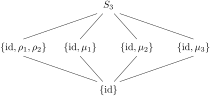
<p>Not every group is a cyclic group. Consider the symmetry group of an equilateral triangle <m>S_3</m>. The subgroups of <m>S_3</m> are shown in <xref ref="figure-subgrps-s3"/>. Notice that every subgroup is cyclic; however, no single element generates the entire group.</p>
</example>
<figure xml:id="figure-subgrps-s3">
<caption>Subgroups of <m>S_3</m></caption>
<!-- Replaced figure with tikz figure - TWJ 5/6/2010 -->
<image xml:id="cyclic-s3-subgroups">
<latex-image>
\begin{tikzpicture}[scale=1]
\draw (0,0.3) -- (2.6,1.2);
\draw (2,0.3) -- (2.8,1.2);
\draw (4,0.3) -- (3.2,1.2);
\draw (6,0.3) -- (3.4,1.2);
\draw (0,-0.3) -- (2.6,-1.2);
\draw (2,-0.3) -- (2.8,-1.2);
\draw (4,-0.3) -- (3.2,-1.2);
\draw (6,-0.3) -- (3.4,-1.2);
\node at (0, 0) {$\{ \identity, \rho_1, \rho_2\}$};
\node at (2, 0) {$\{ \identity, \mu_1\}$};
\node at (4, 0) {$\{ \identity, \mu_2 \}$};
\node at (6, 0) {$\{ \identity, \mu_3 \}$};
\node at (3, 1.5) {$S_3$};
\node at (3,-1.5) {$\{ \identity \}$};
\end{tikzpicture}
</latex-image>
</image>
</figure>
<theorem xml:id="theorem-cyclic-abelian">
<statement>
<p>Every cyclic group is abelian.</p>
</statement>
<proof>
<p>Let <m>G</m> be a cyclic group and <m>a \in G</m> be a generator for <m>G</m>. If <m>g</m> and <m>h</m> are in <m>G</m>, then they can be written as powers of <m>a</m>, say <m>g = a^r</m> and <m>h = a^s</m>. Since <md>g h = a^r a^s = a^{r+s} = a^{s+r} = a^s a^r = h g</md>, <m>G</m> is abelian.</p>
</proof>
</theorem>
</section>
Section 4.1 Cyclic groups
View Source for section
Often a subgroup will depend entirely on a single element of the group; that is, knowing that particular element will allow us to compute any other element in the subgroup.
Example 4.1.1 An Infinite Cyclic Subgroup, Modular Addition.
View Source for example
<example xml:id="example-cyclic-z3" xmlns:pi="http://pretextbook.org/2020/pretext/internal">
    <title>An Infinite Cyclic Subgroup, Modular Addition</title>
   <p>Suppose that we consider <m>3 \in {\mathbb Z}</m> and look at all multiples (both positive and negative) of 3.  As a set, this is <md>3 {\mathbb Z} = \{ \ldots, -3, 0, 3, 6, \ldots \}</md>. It is easy to see that <m>3 {\mathbb Z}</m> is a subgroup of the integers.  This subgroup is completely determined by the element 3 since we can obtain all of the other elements of the group by taking multiples of 3.  Every element in the subgroup is <q>generated</q> by 3.</p>
</example>
Suppose that we consider \(3 \in {\mathbb Z}\) and look at all multiples (both positive and negative) of 3. As a set, this is
\begin{equation*}
3 {\mathbb Z} = \{ \ldots, -3, 0, 3, 6, \ldots \}\text{.}
\end{equation*}
It is easy to see that \(3 {\mathbb Z}\) is a subgroup of the integers. This subgroup is completely determined by the element 3 since we can obtain all of the other elements of the group by taking multiples of 3. Every element in the subgroup is “generated” by 3.
Example 4.1.2 An Infinite Cyclic Subgroup, Multiplication of Rational Numbers.
View Source for example
<example xml:id="example-cyclic-2n" xmlns:pi="http://pretextbook.org/2020/pretext/internal">
    <title>An Infinite Cyclic Subgroup, Multiplication of Rational Numbers</title>
    <p>If <m>H = \{ 2^n : n \in {\mathbb Z} \}</m>, then <m>H</m> is a subgroup of the multiplicative group of nonzero rational numbers, <m>{\mathbb Q}^*</m>.  If <m>a = 2^m</m> and <m>b = 2^n</m> are in <m>H</m>, then <m>ab^{-1} = 2^m 2^{-n} = 2^{m-n}</m> is also in <m>H</m>.  By <xref ref="proposition-subgroup"/>, <m>H</m> is a subgroup of <m>{\mathbb Q}^*</m> determined by the element 2.</p>
</example>
If \(H = \{ 2^n : n \in {\mathbb Z} \}\text{,}\) then \(H\) is a subgroup of the multiplicative group of nonzero rational numbers, \({\mathbb Q}^*\text{.}\) If \(a = 2^m\) and \(b = 2^n\) are in \(H\text{,}\) then \(ab^{-1} = 2^m 2^{-n} = 2^{m-n}\) is also in \(H\text{.}\) By Proposition 3.3.8, \(H\) is a subgroup of \({\mathbb Q}^*\) determined by the element 2.
Theorem 4.1.3.
View Source for theorem
<theorem xml:id="theorem-cyclic-subgroup" xmlns:pi="http://pretextbook.org/2020/pretext/internal">
    <statement>
        <p>Let <m>G</m> be a group and <m>a</m> be any element in <m>G</m>.  Then the set <md>\langle a \rangle  = \{ a^k : k \in {\mathbb Z} \}</md> is a subgroup of <m>G</m>.  Furthermore, <m>\langle a \rangle</m> is the smallest subgroup of <m>G</m> that contains~<m>a</m>.<notation>
            <usage><m>\langle a \rangle</m></usage>
            <description>cyclic group generated by <m>a</m></description>
        </notation></p>
    </statement>
    <proof>
        <p>The identity is in <m>\langle a \rangle </m> since <m>a^0 = e</m>. If <m>g</m> and <m>h</m> are any two elements in <m>\langle a \rangle </m>, then by the definition of <m>\langle a \rangle</m> we can write <m>g = a^m</m> and <m>h = a^n</m> for some integers <m>m</m> and <m>n</m>. So <m>gh = a^m a^n = a^{m+n}</m> is again in <m>\langle a \rangle </m>. Finally, if <m>g = a^n</m> in <m>\langle a \rangle </m>, then the inverse <m>g^{-1} = a^{-n}</m> is also in <m>\langle a \rangle </m>. Clearly, any subgroup <m>H</m> of <m>G</m> containing <m>a</m> must contain all the powers of <m>a</m> by closure; hence, <m>H</m> contains <m>\langle a \rangle </m>. Therefore, <m>\langle a \rangle </m> is the smallest subgroup of <m>G</m> containing <m>a</m>.</p>
    </proof>
</theorem>
Let \(G\) be a group and \(a\) be any element in \(G\text{.}\) Then the set
\begin{equation*}
\langle a \rangle = \{ a^k : k \in {\mathbb Z} \}
\end{equation*}
is a subgroup of \(G\text{.}\) Furthermore, \(\langle a \rangle\) is the smallest subgroup of \(G\) that contains~\(a\text{.}\)
Proof.
View Source for proof
<proof xmlns:pi="http://pretextbook.org/2020/pretext/internal">
    <p>The identity is in <m>\langle a \rangle </m> since <m>a^0 = e</m>. If <m>g</m> and <m>h</m> are any two elements in <m>\langle a \rangle </m>, then by the definition of <m>\langle a \rangle</m> we can write <m>g = a^m</m> and <m>h = a^n</m> for some integers <m>m</m> and <m>n</m>. So <m>gh = a^m a^n = a^{m+n}</m> is again in <m>\langle a \rangle </m>. Finally, if <m>g = a^n</m> in <m>\langle a \rangle </m>, then the inverse <m>g^{-1} = a^{-n}</m> is also in <m>\langle a \rangle </m>. Clearly, any subgroup <m>H</m> of <m>G</m> containing <m>a</m> must contain all the powers of <m>a</m> by closure; hence, <m>H</m> contains <m>\langle a \rangle </m>. Therefore, <m>\langle a \rangle </m> is the smallest subgroup of <m>G</m> containing <m>a</m>.</p>
</proof>
The identity is in \(\langle a \rangle \) since \(a^0 = e\text{.}\) If \(g\) and \(h\) are any two elements in \(\langle a \rangle \text{,}\) then by the definition of \(\langle a \rangle\) we can write \(g = a^m\) and \(h = a^n\) for some integers \(m\) and \(n\text{.}\) So \(gh = a^m a^n = a^{m+n}\) is again in \(\langle a \rangle \text{.}\) Finally, if \(g = a^n\) in \(\langle a \rangle \text{,}\) then the inverse \(g^{-1} = a^{-n}\) is also in \(\langle a \rangle \text{.}\) Clearly, any subgroup \(H\) of \(G\) containing \(a\) must contain all the powers of \(a\) by closure; hence, \(H\) contains \(\langle a \rangle \text{.}\) Therefore, \(\langle a \rangle \) is the smallest subgroup of \(G\) containing \(a\text{.}\)
Remark 4.1.4.
View Source for remark
<remark xmlns:pi="http://pretextbook.org/2020/pretext/internal">
    <p>If we are using the <q>+</q> notation, as in the case of the integers under addition, we write <m>\langle a \rangle  = \{ na : n \in {\mathbb Z} \}</m>.</p>
</remark>
If we are using the “+” notation, as in the case of the integers under addition, we write \(\langle a \rangle = \{ na : n \in {\mathbb Z} \}\text{.}\)
For \(a \in G\text{,}\) we call \(\langle a \rangle \) the cyclic subgroup generated by \(a\text{.}\) If \(G\) contains some element \(a\) such that \(G = \langle a \rangle \text{,}\) then \(G\) is a cyclic group. In this case \(a\) is a generator of \(G\text{.}\) If \(a\) is an element of a group \(G\text{,}\) we define the order of \(a\) to be the smallest positive integer \(n\) such that \(a^n= e\text{,}\) and we write \(|a| = n\text{.}\) If there is no such integer \(n\text{,}\) we say that the order of \(a\) is infinite and write \(|a| = \infty\) to denote the order of \(a\text{.}\)
Example 4.1.5 Generators of a Finite Cyclic Group.
View Source for example
<example xml:id="example-cyclic-z6" xmlns:pi="http://pretextbook.org/2020/pretext/internal">
    <title>Generators of a Finite Cyclic Group</title>
    <p>Notice that a cyclic group can have more than a single generator. Both 1 and 5 generate <m>{\mathbb Z}_6</m>; hence, <m>{\mathbb Z}_6</m> is a cyclic group. Not every element in a cyclic group is necessarily a generator of the group. The order of <m>2 \in {\mathbb Z}_6</m> is 3. The cyclic subgroup generated by 2 is <m>\langle 2 \rangle  = \{ 0, 2, 4 \}</m>.</p>
</example>
Notice that a cyclic group can have more than a single generator. Both 1 and 5 generate \({\mathbb Z}_6\text{;}\) hence, \({\mathbb Z}_6\) is a cyclic group. Not every element in a cyclic group is necessarily a generator of the group. The order of \(2 \in {\mathbb Z}_6\) is 3. The cyclic subgroup generated by 2 is \(\langle 2 \rangle = \{ 0, 2, 4 \}\text{.}\)
The groups \({\mathbb Z}\) and \({\mathbb Z}_n\) are cyclic groups. The elements 1 and \(-1\) are generators for \({\mathbb Z}\text{.}\) We can certainly generate \({\mathbb Z}_n\) with 1 although there may be other generators of \({\mathbb Z}_n\text{,}\) as in the case of \({\mathbb Z}_6\text{.}\)
Example 4.1.6 A Cyclic Group of Units.
View Source for example
<example xml:id="example-cyclic-u9" xmlns:pi="http://pretextbook.org/2020/pretext/internal">
<title>A Cyclic Group of Units</title>
<p>The group of units, <m>U(9)</m>, in <m>{\mathbb Z}_9</m> is a cyclic group. As a set, <m>U(9)</m> is <m>\{ 1, 2, 4, 5, 7, 8 \}</m>. The element 2 is a generator for <m>U(9)</m> since<md>
<mrow>2^1 & = 2 \qquad 2^2 = 4</mrow>
<mrow>2^3 & = 8 \qquad 2^4 = 7</mrow>
<mrow>2^5 & = 5 \qquad 2^6 = 1</mrow>
</md>.</p>
</example>
The group of units, \(U(9)\text{,}\) in \({\mathbb Z}_9\) is a cyclic group. As a set, \(U(9)\) is \(\{ 1, 2, 4, 5, 7, 8 \}\text{.}\) The element 2 is a generator for \(U(9)\) since
\begin{align*}
2^1 & = 2 \qquad 2^2 = 4\\
2^3 & = 8 \qquad 2^4 = 7\\
2^5 & = 5 \qquad 2^6 = 1\text{.}
\end{align*}
Example 4.1.7 A Group That is Not Cyclic.
View Source for example
<example xml:id="example-cyclic-s3-not-cyclic" xmlns:pi="http://pretextbook.org/2020/pretext/internal">
    <title>A Group That is Not Cyclic</title>
    <p>Not every group is a cyclic group.  Consider the symmetry group of an equilateral triangle <m>S_3</m>.  The subgroups of <m>S_3</m> are shown in <xref ref="figure-subgrps-s3"/>.  Notice that every subgroup is cyclic; however, no single element generates the entire group.</p>
</example>
Not every group is a cyclic group. Consider the symmetry group of an equilateral triangle \(S_3\text{.}\) The subgroups of \(S_3\) are shown in Figure 4.1.8. Notice that every subgroup is cyclic; however, no single element generates the entire group.
View Source for figure
<figure xml:id="figure-subgrps-s3" xmlns:pi="http://pretextbook.org/2020/pretext/internal">
    <caption>Subgroups of <m>S_3</m></caption>
    <!-- Replaced figure with tikz figure - TWJ 5/6/2010 -->
    <image xml:id="cyclic-s3-subgroups">
        <latex-image>
            \begin{tikzpicture}[scale=1]

            \draw  (0,0.3) -- (2.6,1.2);
            \draw  (2,0.3) -- (2.8,1.2);
            \draw  (4,0.3) -- (3.2,1.2);
            \draw  (6,0.3) -- (3.4,1.2);

            \draw  (0,-0.3) -- (2.6,-1.2);
            \draw  (2,-0.3) -- (2.8,-1.2);
            \draw  (4,-0.3) -- (3.2,-1.2);
            \draw  (6,-0.3) -- (3.4,-1.2);

            \node at (0, 0) {$\{  \identity, \rho_1, \rho_2\}$};
            \node at (2, 0) {$\{  \identity, \mu_1\}$};
            \node at (4, 0) {$\{  \identity, \mu_2 \}$};
            \node at (6, 0) {$\{  \identity, \mu_3 \}$};
            \node at (3, 1.5) {$S_3$};
            \node at (3,-1.5) {$\{ \identity \}$};
            \end{tikzpicture}
        </latex-image>
    </image>
</figure>
Theorem 4.1.9.
View Source for theorem
<theorem xml:id="theorem-cyclic-abelian" xmlns:pi="http://pretextbook.org/2020/pretext/internal">
    <statement>
        <p>Every cyclic group is abelian.</p>
    </statement>
    <proof>
        <p>Let <m>G</m> be a cyclic group and <m>a \in G</m> be a generator for <m>G</m>. If <m>g</m> and <m>h</m> are in <m>G</m>, then they can be written as powers of <m>a</m>, say <m>g = a^r</m> and <m>h = a^s</m>. Since <md>g  h = a^r a^s = a^{r+s} = a^{s+r} = a^s a^r = h g</md>, <m>G</m> is abelian.</p>
    </proof>
</theorem>
Every cyclic group is abelian.
Proof.
View Source for proof
<proof xmlns:pi="http://pretextbook.org/2020/pretext/internal">
    <p>Let <m>G</m> be a cyclic group and <m>a \in G</m> be a generator for <m>G</m>. If <m>g</m> and <m>h</m> are in <m>G</m>, then they can be written as powers of <m>a</m>, say <m>g = a^r</m> and <m>h = a^s</m>. Since <md>g  h = a^r a^s = a^{r+s} = a^{s+r} = a^s a^r = h g</md>, <m>G</m> is abelian.</p>
</proof>
Let \(G\) be a cyclic group and \(a \in G\) be a generator for \(G\text{.}\) If \(g\) and \(h\) are in \(G\text{,}\) then they can be written as powers of \(a\text{,}\) say \(g = a^r\) and \(h = a^s\text{.}\) Since
\begin{equation*}
g h = a^r a^s = a^{r+s} = a^{s+r} = a^s a^r = h g\text{,}
\end{equation*}
\(G\) is abelian.
You have attempted of activities on this page.

